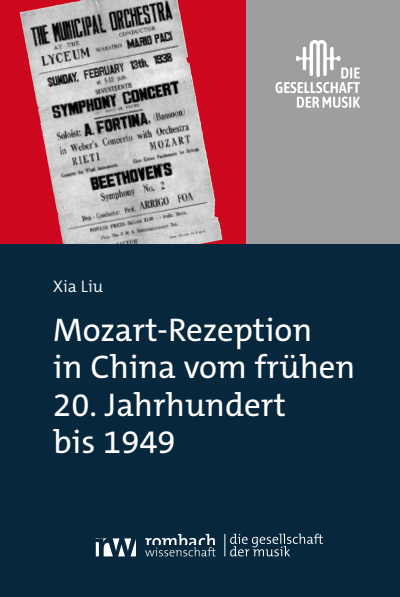
, to see if you have full access to this publication.
Monograph No access

Mozart-Rezeption in China vom frühen 20. Jahrhundert bis 1949

Authors:
Series:
Die Gesellschaft der Musik, Volume 5
Publisher:
 2026

Summary

What new perspectives can be gained from examining Mozart in China? This study provides the first systematic analysis of the reception of Mozart’s music up to 1949 and shows how it was reinterpreted within the interplay of media, institutions, and social change. Based on concert and publication data as well as a wide range of contemporary sources, it reconstructs key processes of reception and their cultural conditions. Methodologically, the book combines quantitative analysis with historically contextualized approaches. Xia Liu is a musicologist and freelance soprano specializing in historical musicology and intercultural German studies.
Keywords


Bibliographic data

Edition
1/2026
Copyright Year
2026
ISBN-Print
978-3-98858-175-4
ISBN-Online
978-3-98858-176-1
Publisher
Rombach Wissenschaft, Baden-Baden
Series
Die Gesellschaft der Musik
Volume
5
Language
German
Pages
265
Product Type
Monograph

Table of contents

ChapterPages
    1. Vorwort No access
    1. 1.1 Übersicht über den Forschungsstand No access
      1. 1.2.1 Quellenkorpus und Datenerhebung No access
      2. 1.2.2 Kategorisierung und Aufbereitung des Materials No access
      3. 1.2.3 Quantitative und qualitative Analyse No access
      4. 1.2.4 Kontrollierter Vergleich mit anderen Komponisten No access
    2. 1.3 Aufbau der Arbeit No access
  1. 2 Überblick der Mozart-Rezeption in China bis 1949 No access Pages 25 - 30
      1. 3.1.1 Die Öffnung der SMO-Konzerte für das chinesische Publikum No access
      2. 3.1.2 Das potenzielle chinesische Publikum bei Konzerten des SMO No access
    1. 3.2 Mozarts Musik im Lehrplan christlicher Schulen und Hochschulen No access
      1. 3.3.1 Das Musikinstitut der Universität Peking No access
      2. 3.3.2 Die Nationale Musikhochschule Shanghai No access
    2. 3.4 Die Verbreitung von Mozarts Musik durch Schallplatten und Rundfunk No access
      1. 3.5.1 Erster Eindruck: das Bild des „Genies“ No access
      2. 3.5.2 Mozarts nationale Identität in Die Zauberflöte No access
    3. 3.6 Zwischenfazit zu Kapitel 3 No access
        1. 4.1.1.1 Das Requiem No access
        2. 4.1.1.2 Mozart, ein „Revolutionär im Geiste“ No access
      1. 4.1.2 Mozart im Repertoire des Zhonghua-Sinfonieorchesters in Chongqing No access
      2. 4.1.3 Mozart in den Zwischenräumen der großen Chorbewegung in Guilin No access
        1. Staatliche finanzielle Unterstützung für SchülerInnen und Studierende No access
        1. 4.2.1.1 Konzerte in jüdischen und russischen Gemeinden während der Inselzeit No access
        2. 4.2.1.2 Zunahme der französischen und italienischen Musik im SMO-Konzert No access
        1. 4.2.2.1 SMO zu Shanghai Philharmoniker No access
        2. 4.2.2.2 Musik jüdischer Flüchtlinge im Ghetto und die Abwesenheit von Mozarts Musik No access
    1. 4.3 Zwischenfazit zu Kapitel 4 No access
  2. 5 Mozart-Rezeption in China zwischen 1946 und 1949 No access Pages 167 - 182
  3. 6 Schluss No access Pages 183 - 186
  4. 7 Literaturverzeichnis No access Pages 187 - 210
  5. 8 Anhänge No access Pages 211 - 264

Similar publications

from the series "Die Gesellschaft der Musik"
Cover of book: Klassische Musik bei YouTube
Monograph No access
Corinna Herr
Klassische Musik bei YouTube
Cover of book: John Williams und das Leitmotiv der Romantik
Monograph No access
Mirco Oswald
John Williams und das Leitmotiv der Romantik
Cover of book: Rollen und Funktionen von Musik in der digitalen Ära
Edited Book No access
Corinna Herr, Veronika Keller, Wolfgang Fuhrmann
Rollen und Funktionen von Musik in der digitalen Ära
Cover of book: Atemlos zum Erfolg
Monograph No access
Marina Forell
Atemlos zum Erfolg