Monograph Open Access Full access
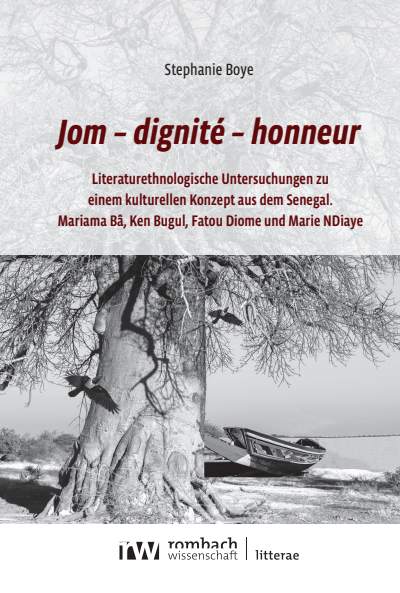
Jom – dignité – honneur
Literaturethnologische Untersuchungen zu einem kulturellen Konzept aus dem Senegal.- Authors:
- Series:
- Litterae, Volume 262
- Publisher:
- 2024
Summary
This volume enables a change of perspective on the perceptions of the narrative voices and characters of the four novels it examines, but also of the authors Mariama Bâ, Fatou Diome, Ken Bugul and Marie NDiaye of Senegaelese origins. The literary ethnological method of ‘ethnocritique’ and a perspective that is as Afrocentric as possible reveal misinterpretations of the novels. These are due to common Eurocentric methods of textual analysis because culturally influenced concepts such as ‘jom’, which originates from Senegalese society, are difficult to fathom using conventional literary methods. This book is intended as a prime example of ‘close reading’ in terms of the decolonisation of the sciences.
Keywords
Search publication
Bibliographic data
- Edition
- 1/2024
- Copyright Year
- 2024
- ISBN-Print
- 978-3-98858-083-2
- ISBN-Online
- 978-3-98858-084-9
- Publisher
- Rombach Wissenschaft, Baden-Baden
- Series
- Litterae
- Volume
- 262
- Language
- German
- Pages
- 299
- Product Type
- Monograph
Table of contents
ChapterPages
- Titelei/InhaltsverzeichnisPages 1 - 6 Download chapter (PDF)
- 1.1.1 Annäherung an das Thema
- 1.1.2 Formulierung und Eingrenzung des Themas
- 1.2.1 Die Beobachter-Perspektive
- 1.2.2 Literaturethnologie aus literaturwissenschaftlicher Perspektive
- 1.2.3 Literaturethnologie aus ethnologischer Perspektive
- 1.2.4 Die literaturethnologische Methode der ethnocritique
- 1.2.5 Die frankophonen Literaturen
- 1.2.6 Frankophonie und die französische Schriftsprache
- 1.3.1 Jom aus linguistischer Perspektive
- 1.3.2 Senghor: Négritude, die Literatur und jom
- 1.3.3 Senghors Definition von jom
- 2.1.1 Die Funktionen von Gorgui in Un chant écarlate
- 2.1.2 Die histoire und der discours von Un chant écarlate
- 2.1.3 Gorguis Tod
- 2.1.4 Wer ist Gorgui [góor gi]?
- 2.1.5 Gorgui in Bezug zu jom, dignité und honneur
- 2.1.5 Systematisierung der Begriffe jom, dignité, honneur
- 2.2.1 Die Eroberung von jom in Le ventre de l’Atlantique
- 2.2.2 Chaque miette de vie doit servir pour conquérir la dignité !
- 2.2.3 Immigration ohne Emigration
- 2.2.4 Der Homme de Barbès. Migration und die Frage nach wërsëk und teranga
- 2.2.5 Die schöne Sankèle – Frauen im Konflikt mit kersa und muñ
- 2.2.6 Der Lehrer Ndétare, die Bildung und das Konzept tegin
- 2.2.7 Jom, der Atlantik und der Selbstmord
- 2.3.1 Der Forschungsstand zu Ken Bugul und zum Roman Le Baobab fou
- 2.3.2 Die Romanhandlung und der Diskurs
- 2.3.3 Der Baobab als embrayeur culturel
- 2.3.4 Die Griots und ihre besondere Beziehung zum Baobab
- 2.3.5 Die Fesseln des Baobabs
- 2.3.6 Sprechen, Schweigen und jom
- 2.3.7 Die hoffnungslose Unerreichbarkeit von jom
- 2.4.1 Histoire und discours des Romans Trois femmes puissantes (2009)
- 2.4.2 Bäume und Vögel als embrayeurs culturels
- 2.4.3 Namen und ihre Verweisfunktion auf dignité
- 2.4.4 Die Schuld und das Schweigen
- 2.4.5 Die Fremdheit Afrikas und kultureller Konzepte wie jom
- 3.1 Ergebnisse der literaturethnologischen Untersuchung
- 3.2.1 Paratext zu Mariama Bâs Werk
- 3.2.2 Filmdialoge auf Wolof in Atlantique von Mati Diop (2019)
- 3.2.3 Gespräch mit Fatou Diome am 20. März 2019
- 3.3 Beantwortung einiger Fragen aus der Einleitung
- 3.4 Schlussbemerkung
- 4.1.1 Primärliteratur
- 4.1.2.1 Monografien und Sammelbände
- 4.1.2.2 Zeitschriften- und Zeitungsartikel
- 4.1.2.3 Online-Ressourcen
- 4.1.2.5 Nachschlagewerke
- 4.1.2.6 Filme
- 4.2.1 Szenen aus dem Film Atlantique von Mati Diop (2019)
Bibliography (271 entries)
No match found. Try another term.
- Bâ, Mariama, Un chant écarlate, Dakar: Les Nouvelles Éditions Africaines, 1981. Open Google Scholar DOI: 10.5771/9783988580849
- Bâ, Mariama, Der scharlachrote Gesang, Unterägi (CH-Zug): Europabuch AG, 1982, übersetzt von Irmgard Rathke. Open Google Scholar DOI: 10.5771/9783988580849
- Bugul, Ken, Le baobab fou, Paris: Présence Africaine, 2009 [1984]. Open Google Scholar DOI: 10.5771/9783988580849
- Diome, Fatou, Le Ventre de l’Atlantique, Paris: Anne Carrière, 2003. Open Google Scholar DOI: 10.5771/9783988580849
- Diome, Fatou, Der Bauch des Ozeans, Zürich: Diogenes, 2004, übersetzt von Brigitte Große. Open Google Scholar DOI: 10.5771/9783988580849
- NDiaye, Marie, Trois femmes puissantes, Paris: Gallimard, 2009. Open Google Scholar DOI: 10.5771/9783988580849
- Chaulet-Achour, Christiane, Dictionnaire des écrivains francophones classiques. Afrique subsaharienne, Caraïbe, Maghreb, Machrek, Océan Indien, Paris: Honoré Champion Éditeur, 2010. Open Google Scholar DOI: 10.5771/9783988580849
- Achilles, Jochen et al. (Hrsg.), Liminale Anthropologien. Zwischenzeiten, Schwellenphänomene, Zwischenräume in Literatur und Philosophie, Würzburg: Verlag Königshausen & Neumann, 2012. Open Google Scholar DOI: 10.5771/9783988580849
- Adam, Jean-Michel et al., Le Discours Anthropologique. Description, narration, savoir, Paris: Méridiens Klincksieck, 1990. Open Google Scholar DOI: 10.5771/9783988580849
- Asibong, Andrew, Marie NDiaye. Blankness and Recognition, Liverpool: Liverpool University Press, 2013. Open Google Scholar DOI: 10.5771/9783988580849
- Avias, André, Francophonie: identités multiples et complexes, Saint-Denis: Edilivre, 2020. Open Google Scholar DOI: 10.5771/9783988580849
- Azodo, Ada Uzoamaka, Emerging Perspectives on Ken Bugul. From Alternative Choices to Oppositional Practices, Trenton: Africa World Press, 2009. Open Google Scholar DOI: 10.5771/9783988580849
- Azodo, Ada Uzoamaka, Emerging perspectives on Mariama Bâ: postcolonialism, feminism, and postmodernism, Trenton, NJ: Africa World Press, 2003. Open Google Scholar DOI: 10.5771/9783988580849
- Bâ, Mariama, Bataaxal bu gudde nii, ci tekkim Maam Yunus Jeŋ, Aram Faal, Dakar: Les Nouvelles Éditions Africaines, 2007. Diese Wolof-Version ist als Hörbuch auf Youtube zu finden unter: www.youtube.com/watch?v=i0eoxiDd2e4&list=PLHG9hgcZCwsze4RJzGCkBbWLntH4uy-wg (05.06.2024). Open Google Scholar DOI: 10.5771/9783988580849
- Bâ, Mariama, »La fonction politique des littératures africaines écrites«, Vortrag beim Symposium in Frankfurt, 4.–6.10.1980 mit dem Titel »La fonction des littératures modernes d’Afrique noire«, in: Ada Uzoamaka Azodo, Emerging Perspectives On Mariama Bâ. Postcolonialism, Feminism, and Postmodernim, Trenton, Asmara: Africa World Press, 2003, S. 403–409. Open Google Scholar DOI: 10.5771/9783988580849
- Bâ, Mariama, Une si longue lettre, Neuauflage, Paris: Le Serpent à plumes, Coll. »Motif« Nr. 137, 2001. Open Google Scholar DOI: 10.5771/9783988580849
- Babka, Anna et al. (Hrsg.), Homi K. Bhabhas Kulturtheorie. Kritik. Anwendung. Reflexion, Wien, Berlin: Turia + Kant, 2012. Open Google Scholar DOI: 10.5771/9783988580849
- Bachtin, Michail M., Chronotopos, übers. Michael Dewey, Nachwort Michael C. Frank und Kirsten Mahlke, Berlin: Suhrkamp 2008 [1975]. Open Google Scholar DOI: 10.5771/9783988580849
- Bachtin, Michail M., Die Ästhetik des Wortes, hrsg. v. Rainer Grübel, Frankfurt a.M.: Suhrkamp, 1979. Open Google Scholar DOI: 10.5771/9783988580849
- Bachtin, Michail M., Esthétique de la création verbale, Paris: Gallimard, 1984. Open Google Scholar DOI: 10.5771/9783988580849
- Bachtin, Michail M., La Poétique de Dostoievski, Paris: Le Seuil, 1970. Open Google Scholar DOI: 10.5771/9783988580849
- Baggioni, Daniel/Calvet, Louis-Jean/Chaudenson, Robert/Manessy,Gabriel/De Robillard, Didier, Multilinguisme et développement dans l’espace francophone, Paris: Didier Érudition, 1992. Open Google Scholar DOI: 10.5771/9783988580849
- Barthes, Roland, Leçon inaugurale de la chaire de sémiologie littéraire du collège de France, Paris: Éditions du Seuil, 1978. Open Google Scholar DOI: 10.5771/9783988580849
- Bationo, Jean-Claude, »Zur Darstellung des Fußballs in der schwarzafrikanischen Literatur«, in: Robert Dion et al., Interkulturelle Kommunikation in der frankophonen Welt. Literatur, Medien, Kulturtransfer. Festschrift zum 60. Geburtstag von Hans-Jürgen Lüsebrink, St. Ingbert: Röhrig Universitätsverlag, 2012, 171–187. Open Google Scholar DOI: 10.5771/9783988580849
- Baumann, Christine/Kunzmann, Peter (Hrsg.), Würde – dignté – godność – dignity. Die Menschenwürde im internationalen Vergleich, München: Herbert Utz Verlag, 2010. Open Google Scholar DOI: 10.5771/9783988580849
- Bengsch, Daniel/Ruhe, Cornelia (Hrsg.), Une femme puissante. L’œuvre de Marie NDiaye, Amsterdam/New York: Rodopi B.V., 2013. Open Google Scholar DOI: 10.5771/9783988580849
- Bhabha, Homi K., Die Verortung der Kultur, deutsche Übersetzung von Michael Schiffmann und Jürgen Freudl, Tübingen: Stauffenburg Verlag, 2011 [2000]. Open Google Scholar DOI: 10.5771/9783988580849
- Bierschenk, Thomas/Krings, Matthias/Lenz, Carola (Hrsg.), Ethnologie im 21. Jahrhundert, Berlin: Dietrich Reimer, 2013. Open Google Scholar DOI: 10.5771/9783988580849
- Borgards, Roland, »Liminale Anthropologien. Skizze eines Forschungsfeldes«, in: Jochen Achilles et al. (Hrsg.), Liminale Anthropologien. Zwischenzeiten, Schwellenphänomene, Zwischenräume in Literatur und Philosophie, Würzburg: Verlag Königshausen & Neumann, 2012, S. 9–13. Open Google Scholar DOI: 10.5771/9783988580849
- Borgomano, Madeleine, Voix et visages de femmes dans les livres écrits par des femmes en Afrique francophone, Abidjan: CEDA, 1989. Open Google Scholar DOI: 10.5771/9783988580849
- Bourdieu, Pierre, »Préface. Un analyseur de l’inconscient«, in: Abdelmalek Sayad (Hrsg.), L’immigration, ou les paradoxes de l’altérité, Brüssel: De Boeck-Wesmael, 1991, S. 7ff. Open Google Scholar DOI: 10.5771/9783988580849
- Bugul, Ken, Cendres et Braises, Paris: L’Harmattan, 1994. Open Google Scholar DOI: 10.5771/9783988580849
- Bugul, Ken, Riwan ou le Chemin de Sable, Paris: Présence Africaine, 1999. Open Google Scholar DOI: 10.5771/9783988580849
- Bugul, Ken, Le Trio Bleu, Paris: Présence Africaine, 2022. Open Google Scholar DOI: 10.5771/9783988580849
- Bugul, Ken, The Abandoned Baobab: The autobiography of a Senegalese woman, New York: Lawrence Hill Books, 1991. Open Google Scholar DOI: 10.5771/9783988580849
- Bugul, Ken, Die Nacht des Baobab. Eine Afrikanerin in Europa. Autobiographischer Bericht, 2016. Open Google Scholar DOI: 10.5771/9783988580849
- Bulman, Stephen, »The Buffalo-Woman Tale«, in: Discourse and its Disguises, Birmingham University African Studies Series, 1, 1989, S. 171–188. Open Google Scholar DOI: 10.5771/9783988580849
- Cerquiglini, Bernard, »Préface«, in: Christiane Chaulet Achour, Dictionnaire des écrivains francophones classiques. Afrique subsaharienne, Caraïbe, Maghreb, Machrek, Océan Indien, Paris: Éditions Honoré Champion, 2010. Open Google Scholar DOI: 10.5771/9783988580849
- Césaire, Aimé, Discours sur le colonialisme suivi de Discours sur la Négritude, Paris: Présence Africaine, 1955. Open Google Scholar DOI: 10.5771/9783988580849
- Chossat, Michèle, Ernaux, Redonnet, Bâ und Ben Jelloun. Le personnage féminin à l’aube du XXIsiècleème, New York: Lang, 2002. Open Google Scholar DOI: 10.5771/9783988580849
- Cissé, Blondin, »Reinventer la modernité africaine !«, in: Achille Mbembe und Felwine Sarr (Hrsg.), Écrire l’Afrique-Monde, Dakar: Jimsaan, 2017, S. 139–156. Open Google Scholar DOI: 10.5771/9783988580849
- Clifford, James/Marcus, George E., Writing Culture. The Poetics and Politics of Ethnography, London: University of California Press, 1986. Open Google Scholar DOI: 10.5771/9783988580849
- Dadié, Bernard B., Un nègre à Paris, Paris: Présence Africaine, 1976 [Manuskript eingereicht 1959]. Open Google Scholar DOI: 10.5771/9783988580849
- De Saint-Exupéry, Antoine, Le Petit Prince, Paris: Editions Gallimard, 1946. Open Google Scholar DOI: 10.5771/9783988580849
- Diagne, Anna M./ Kesseler, Sascha/Meyer, Christian, Communication Wolof et société sénégalaise, Paris: L’Harmattan, 2011. Open Google Scholar DOI: 10.5771/9783988580849
- Diome, Fatou Les veilleurs de Sangomar, Paris: Éditions Albin Michel, 2019. Open Google Scholar DOI: 10.5771/9783988580849
- Diop, Abdoulaye-Bara, La société wolof. Tradition et changement. Les systèmes d’inégalité et de domination, Paris: Karthala, 1981. Open Google Scholar DOI: 10.5771/9783988580849
- Diop, Cheikh Anta, Civilisation ou barbarie. Anthropologie sans complaisance, Paris: Présence Africaine, 1981. Open Google Scholar DOI: 10.5771/9783988580849
- Diop, Papa Samba, Archéologie littéraire du roman sénégalais, Frankfurt a.M.: IKO – Verl. für Interkulturelle Kommunikation, 1993. Open Google Scholar DOI: 10.5771/9783988580849
- Diop, Samba, The oral history and literature of the Wolof people of Waalo, northern Senegal. The Master of the Word (Griot) in the Wolof Tradition, New York/Ontario/Wales: The Edwin Mellen Press, 1995. Open Google Scholar DOI: 10.5771/9783988580849
- Diouf, Jean-Léopold/Yaguello, Marina (Hrsg.), J’apprends le wolof, Paris: Karthala, 1991. Open Google Scholar DOI: 10.5771/9783988580849
- Domokos, Johanna, »Towards a Polycultural Narratology: Some Suggestions for Further Analysis«, in: Alexandra Strohmaier (Hrsg.), Kultur – Wissen – Narration. Perspektiven trandisziplinärer Erzählforschung für die Kulturwissenschaften, Bielefeld: transcript, 2013, S. 307–319. Open Google Scholar DOI: 10.5771/9783988580849
- Donovan, Frédérique, La lettre, le théâtral et les femmes dans la fiction d’aujourd’hui. Ken Bugul, Marie Ndiaye et Pascale Roze. Paris: L’Harmattan, 2013. Open Google Scholar DOI: 10.5771/9783988580849
- Eco, Umberto, Lector in fabula. Die Mitarbeit der Interpretation in erzählenden Texten, München/Wien: Carl Hanser Verlag, 1987. Open Google Scholar DOI: 10.5771/9783988580849
- Faret, Nicolas, L’Honnete Homme. Ou l’Art De Plaire A La Cour, Strasbourg: Welper, 1664. Open Google Scholar DOI: 10.5771/9783988580849
- Flaubert, Gustave, Œuvres/Flaubert, texte établi et annoté par A. Thibaudet et R. Dumesnil, Bibliothèque de la Pléiade, 36, Paris: Gallimard, 1951. Open Google Scholar DOI: 10.5771/9783988580849
- Foucault, Michel, »Andere Räume«, in: Karlheinz Barck et al. (Hrsg.), Aisthesis. Wahrnehmung heute oder Perspektiven einer anderen Ästhetik, Leipzig: Reclam, 1992, S. 34–46. Open Google Scholar DOI: 10.5771/9783988580849
- Frank, Michael C./Mahlke, Kirsten, »Nachwort«, in: Michail M. Bachtin, Chronotopos, Berlin: Suhrkamp 2008 [1975], S. 201–230. Open Google Scholar DOI: 10.5771/9783988580849
- Frank, Susi K./Ruhe, Cornelia/Schmitz, Alexander, »Nachwort. Jurij Lotmans Semiotik der Übersetzung«, in: Jurij M. Lotman, Die Innenwelt des Denkens: eine semiotische Theorie der Kultur, Berlin: Suhrkamp, 2010, S. 381–416. Open Google Scholar DOI: 10.5771/9783988580849
- Freland, François-Xavier, L’Africaine blanche, 1891–1986, Germaine Le Goff, Paris: Autrement, 2004. Open Google Scholar DOI: 10.5771/9783988580849
- Geertz, Clifford, The Interpretation of Cultures, New York: Basic Books, 1973. Open Google Scholar DOI: 10.5771/9783988580849
- Göttsche, Dirk/Dunker, Axel/Dürbeck, Gabiele (Hrsg.), Handbuch Postkolonialismus und Literatur, Stuttgart: J.B. Metzler, 2017. Open Google Scholar DOI: 10.5771/9783988580849
- Graneß, Anke, Philosophie in Afrika. Herausforderungen einer globalen Philosophiegeschichte, Berlin: Suhrkamp, 2023. Open Google Scholar DOI: 10.5771/9783988580849
- Hannerz, Ulf, Writing Future Worlds. An Anthropologist Explores Global Scenarios, London: Palgrave Macmillan, 2016. Open Google Scholar DOI: 10.5771/9783988580849
- Hemer, Oscar et al. (Hrsg.), Voice & Matter. Communication, Development And The Cultural Return, Göteborg: Nordicom, 2016. Open Google Scholar DOI: 10.5771/9783988580849
- Hennigfeld, Ursula, »Humain, trop humain, rien d’humain: le théâtre de Marie NDiaye«, in: Daniel Bengsch und Cornelia Ruhe (Hrsg.), Une femme puissante. L’œuvre de Marie NDiaye, Amsterdam/New York: Rodopi B.V., 2013, S. 177–199. Open Google Scholar DOI: 10.5771/9783988580849
- Hitchcott, Nicki, Women Writers in Francophone Africa, Oxford: Berg, 2000. Open Google Scholar DOI: 10.5771/9783988580849
- Hugo, Victor, Les misérables, édition établie par Henri Scepi, avec la collaboration de Dominque Moncond’huy, Bibliothèque de la Pléiade, 85, 2018. Open Google Scholar DOI: 10.5771/9783988580849
- Ippolito, Christophe, »Trois contes, Trois femmes puissantes: le puzzle et l’oiseau migrateur«, in: Daniel Bengsch und Cornelia Ruhe (Hrsg.), Une femme puissante. L’œuvre de Marie NDiaye, Amsterdam/New York: Rodopi B.V., 2013, S. 305–318. Open Google Scholar DOI: 10.5771/9783988580849
- Iser, Wolfgang, Das Fiktive und das Imaginäre. Perspektiven literarischer Anthropologie, Frankfurt a.M.: Suhrkamp, 1991. Open Google Scholar DOI: 10.5771/9783988580849
- Iser, Wolfgang, Der Akt des Lesens. Theorie ästhetischer Wirkung, München: Fink Verlag, 1994 [1976]. Open Google Scholar DOI: 10.5771/9783988580849
- Iser, Wolfgang, Die Appellstruktur der Texte. Unbestimmtheit als Wirkungsbedingung literarischer Prosa, Konstanz: Universitätsverlag, 1970. Open Google Scholar DOI: 10.5771/9783988580849
- Shirley Jordan, »La puissance de Khady Demba«, in: Daniel Bengsch und Cornelia Ruhe (Hrsg.), Une femme puissante. L’œuvre de Marie NDiaye, Amsterdam/New York: Rodopi B.V., 2013, S. 263–283. Open Google Scholar DOI: 10.5771/9783988580849
- Kastner, Kristin, »Schreiben über Schweigen«, in: Markus Verne et al. (Hrsg.), Körper Technik Wissen. Kreativität und Aneignungsprozesse in Afrika. In den Spuren Kurt Becks, Berlin: LIT verlag Dr. W. Hopf, S. 153–163. Open Google Scholar DOI: 10.5771/9783988580849
- Kéita, Aoua, Femme d’Afrique, Paris: Présence Africaine, 1975. Open Google Scholar DOI: 10.5771/9783988580849
- Keßler, Eckhard, »Philologische Methode und Naturwissenschaft«, in: Denis Thouard et al. (Hrsg.) Philologie als Wissensmodell/La philologie comme modèle de savoir, Berlin/New York: De Gruyter, 2010, S. 165–180. Open Google Scholar DOI: 10.5771/9783988580849
- Kilani, Mondher, »Les anthropologues et leur savoir: du terrain au texte«, in: Jean-Michel Adam et al. (Hrsg.), Le Discours anthropologique. Description, narration, savoir, Paris: Méridiens Klincksieck, 1990, S. 71–110. Open Google Scholar DOI: 10.5771/9783988580849
- Klinkert, Thmas, Einführung in die französische Literaturwissenschaft, Berlin: Erich Schmidt Verlag, 2008. Open Google Scholar DOI: 10.5771/9783988580849
- Klinkert, Thomas, Migration et identité, Freiburg i.Br.: Rombach Verlag, 2014. Open Google Scholar DOI: 10.5771/9783988580849
- Klinkert, Thomas, Muße und Erzählen: ein poetologischer Zusammenhang, Tübingen: Mohr Siebeck, 2016. Open Google Scholar DOI: 10.5771/9783988580849
- Koschorke, Albrecht, »Ein neues Paradigma der Kulturwissenschaften«, in: Eva Eßlinger et al. (Hrsg.) Die Figur des Dritten: ein kulturwissenschaftliches Paradigma, Berlin: Suhrkamp, S. 9–31. Open Google Scholar DOI: 10.5771/9783988580849
- Kumoll, Karsten, »From the Native’s Point of View«? Kulturelle Globalisierung nach Clifford Geertz und Pierre Bourdieu, Bielefeld: transcript Verlag, 2005. Open Google Scholar DOI: 10.5771/9783988580849
- Langer, Antje et al., Weiblichkeit – Ansätze zur Theoretisierung, Berlin: Verlag Barbara Budrich, 2018. Open Google Scholar DOI: 10.5771/9783988580849
- Laye, Camara, Le Maître de la parole, 1978, Paris: Plon. Open Google Scholar DOI: 10.5771/9783988580849
- Lebdai, Benaouda, »Les écrivains migrants: constructeurs d’une globalisation équilibrée Afrique/Europe«, in: Écrire l’Afrique-Monde. Les Ateliers de la pensée, sous la direction de Achille Mbembe et Felwine Sarr, Dakar: Jimsaan, 2017, S. 79–95. Open Google Scholar DOI: 10.5771/9783988580849
- Le Bris, Michel et al. (Hrsg.), Pour une littérature-monde, Paris: Gallimard, 2007. Open Google Scholar DOI: 10.5771/9783988580849
- Lemaignen, Robert/Senghor, Léopold Sédar/Prince Youtevong, Sisowath, La communauté impériale française, Paris: Éditions Alsatia, 1945. Open Google Scholar DOI: 10.5771/9783988580849
- Ursula Link-Heer, »Noms et toponymes dans l’œuvre de Marie Ndiaye«, in: Daniel Bengsch und Cornelia Ruhe (Hrsg.), Une femme puissante. L’œuvre de Marie NDiaye, Amsterdam/New York: Rodopi B.V., 2013, S. 233–242. Open Google Scholar DOI: 10.5771/9783988580849
- Loimeier, Manfred, Africando, Frankfurt a.M.: Brandes & Apsel, 2010. Open Google Scholar DOI: 10.5771/9783988580849
- Loimeier, Manfred, Wortschätze. Interviews mit afrikanischen Schriftstellerinnen und Schriftstellern, Berlin: Horlemann, 2012. Open Google Scholar DOI: 10.5771/9783988580849
- Lotman, Jurij M., Die Innenwelt des Denkens: eine semiotische Theorie der Kultur, Berlin: Suhrkamp, 2010. Open Google Scholar DOI: 10.5771/9783988580849
- Lüsebrink, Hans-Jürgen, Schrift, Buch und Lektüre in der französischsprachigen Literatur Afrikas, Tübingen: Max Niemeyer, 1990. Open Google Scholar DOI: 10.5771/9783988580849
- Man, Michel, La folie, le mal de l’Afrique postcoloniale dans le Baobab fou et la folie et la mort de Ken Bugul, Columbia: University of Missouri, 2007: core.ac.uk/reader/62761597 (27.01.2023). Open Google Scholar DOI: 10.5771/9783988580849
- Mbembe, Achille/Sarr, Felwine (Hrsg.), Écrire l’Afrique-Monde, Dakar: Jimsaan, 2017. Open Google Scholar DOI: 10.5771/9783988580849
- Mbiga, Sylvie, Selbstfindungsprozesse im interkulturellen Roman. Eine Analyse zur Identitätssuche im postkolonialen Afrika, Berlin: LIT, 2010. Open Google Scholar DOI: 10.5771/9783988580849
- Meyer, Christian, Culture, Practice, and the Body. Conversational Organization and Embodied Culture in Northwestern Senegal, Stuttgart: J.B. Metzler, 2018. Open Google Scholar DOI: 10.5771/9783988580849
- Meyer, Wolfgang J., Modalität und Modalverb: kompetenztheoretische Erkundungen zum Problem der Bedeutungbeschreibung modaler Ausdrücke am Beispiel von »devoir« und »pouvoir« im heutigen Französisch, Stuttgart: Steiner, 1991. Open Google Scholar DOI: 10.5771/9783988580849
- Miller, Christopher L., Theories of Africans. Francophone Literature and Anthropology in Africa, Chicago: The University of Chicago Press, 1990. Open Google Scholar DOI: 10.5771/9783988580849
- Mills, David, Difficult Folk? A Political History of Social Anthropology, New York/Oxford: Berghahn Books, 2010. Open Google Scholar DOI: 10.5771/9783988580849
- Mollien, Gaspard Théodore, Voyage dans l’intérieur de l’Afrique, aux sources du Sénégal et de la Gambie, fait en 1818, par ordre du gouvernement français, Paris: Veuve Courcier, 1820: gallica.bnf.fr/ark:/12148/bpt6k75667j/f188.item (07.06.2024). Open Google Scholar DOI: 10.5771/9783988580849
- Moudileno, Lydie, »L’Excellent Français de Marie Ndiaye«, in: Andrew Asibong, Shirley Jordan, Marie NDiaye: L’Étrangeté à l’œuvre, 2009, S. 25–38. Open Google Scholar DOI: 10.5771/9783988580849
- Moudileno, Lydie, »Marie NDiaye: entre visibilité et réserve«, in: Daniel Bengsch und Cornelia Ruhe (Hrsg.), Une femme puissante. L’œuvre de Marie NDiaye, Amsterdam/New York: Rodopi B.V., 2013, S. 159–175. Open Google Scholar DOI: 10.5771/9783988580849
- Moudileno, Lydie, »Une bibliothèque qui déborde«, in: Achille Mbembe, Felwine Sarr (Hrsg.), Écrire l’Afrique-Monde. Ateliers de la pensée Dakar et Saint-Louis-du-Sénégal 2016, Dakar: Jimsaan, 2017, S. 157–173. Open Google Scholar DOI: 10.5771/9783988580849
- Moura, Jean-Marc, Littératures francophones et théorie postcoloniale, Paris: Presses Universitaires de France, 1999. Open Google Scholar DOI: 10.5771/9783988580849
- Ndiaye, Christiane, Introduction aux littératures francophones: Afrique – Caraïbe – Maghreb, Montréal: Presses de l’Université de Montréal, 2004. Open Google Scholar DOI: 10.5771/9783988580849
- Ndiaye, Mama Coumba, Mariama Bâ ou les allées d’un destin, Dakar: Les Nouvelles Éditions Africaines, 2007. Open Google Scholar DOI: 10.5771/9783988580849
- NDiaye, Marie, Brief an Jean-Marie Volet am 02.01.1992: aflit.arts.uwa.edu.au/LettreNdiayeM.html (08.04.2023). Open Google Scholar DOI: 10.5771/9783988580849
- Njoya, Wandia, In Search of El Dorado? Immigration, French Ideals, and the African Experience in Contemporary African Novels, Saarbrücken: VDM, 2008. Open Google Scholar DOI: 10.5771/9783988580849
- Poyatos, Fernando, Literary Anthropology. A new interdisciplinary Approach to People, Signs And Literature, Amsterdam/Philadelphia: John Benjamins Publishing Company, 1988. Open Google Scholar DOI: 10.5771/9783988580849
- Privat, Jean-Marie, Bovary charivari. Essai d’ethno-critique, Paris: CNRS Éditions, 1994. Open Google Scholar DOI: 10.5771/9783988580849
- Rabaté, Dominique, »Marie NDiaye et l’Art des dérapages contrôlés«, in: Daniel Bengsch und Cornelia Ruhe (Hrsg.), Une femme puissante. L’œuvre de Marie NDiaye, Amsterdam/New York: Rodopi B.V., 2013, S. 71–82. Open Google Scholar DOI: 10.5771/9783988580849
- Raffenel, Anne, Voyage dans l’intérieur de l’Afrique, Paris: A. Bertrand, 1846. Open Google Scholar DOI: 10.5771/9783988580849
- Riesz, János, Léopold Sédar Senghor und der afrikanische Aufbruch im 20. Jahrhundert, Wuppertal: Peter Hammer Verlag, 2006. Open Google Scholar DOI: 10.5771/9783988580849
- Riesz, János, Südlich der Sahara. Afrikanische Literatur in französischer Sprache, Tübingen: Stauffenburg Verlag, 2013. Open Google Scholar DOI: 10.5771/9783988580849
- Rohrbacher, Peter, Die Geschichte des Hamiten-Mythos, Wien: Veröffentlichungen der Institute für Afrikanistik und Ägyptologie der Universität Wien, Band 71, 2002. Open Google Scholar DOI: 10.5771/9783988580849
- Ruhe, Cornelia, »Semiosphäre und Sujet«, in: Jörg Dünne et al. (Hrsg.), Handbuch Literatur & Raum, Berlin/München/Boston: De Gruyter, 2015, S. 170–177. Open Google Scholar DOI: 10.5771/9783988580849
- Ruzza, Sara, Une Odysée moderne: L’expérience de la migration à travers l’œuvre de Fatou Diome, Dissertation Universität Padova, 2019: thesis.unipd.it/handle/20.500.12608/22601 (09.02.2021). Open Google Scholar DOI: 10.5771/9783988580849
- Sarr, Felwine, Afrotopia, Paris: Editions Philippe Rey, 2016. Open Google Scholar DOI: 10.5771/9783988580849
- Sayad, Abdelmalek, La double absence. Des illusions de l’émigré aux souffrances de l’imigré, Préface de Pierre Bourdieu, Paris: Éditions du Seuil, 1999. Open Google Scholar DOI: 10.5771/9783988580849
- Sayad, Abdelmalek, L’immigration, ou les paradoxes de l’altérité, Brüssel: De Boeck-Wesmael, 1991. Open Google Scholar DOI: 10.5771/9783988580849
- Scarpa, Marie, Le Carnaval des Halles. Une ethnocritique du Ventre de Paris de Zola, Paris: CNRS Éditions, 2000. Open Google Scholar DOI: 10.5771/9783988580849
- Schüttpelz, Erhard, »Drei Schritte zur Weltliteratur«, in: Schamma Schahadat, Annette Weinberger (Hrsg.), Weltliteratur in der longue durée, Leiden: Wilhelm Fink Verlag, 2021. Open Google Scholar DOI: 10.5771/9783988580849
- Semujanga, Josias, »Qu’est-ce que la francophonie?«, in: Christiane Ndiaye, Introduction aux littératures francophones: Afrique – Caraïbe – Maghreb, Montréal: Presses de l’Université de Montréal, 2004, S. 9–61. Open Google Scholar DOI: 10.5771/9783988580849
- Senghor, Léopold Sédar, Ce que je crois: Négritude, Francité et civilisation de l’universel, Paris: Grasset, 1988. Open Google Scholar DOI: 10.5771/9783988580849
- Senghor, Léopold Sédar, Chants d’ombre: poèmes, Paris: Seuil, 1956. Open Google Scholar DOI: 10.5771/9783988580849
- Senghor, Léopold Sédar et al., Les plus beaux écrits de l’Union française et du Maghreb, Paris: La Colombe, 1947. Open Google Scholar DOI: 10.5771/9783988580849
- Senghor, Léopold Sédar, Négritude et humanisme, Vol. 1, Liberté, Paris: Seuil, 1964. Open Google Scholar DOI: 10.5771/9783988580849
- Sommer, Roy, »Funktionsgeschichten: Überlegungen zur Verwendung des Funktionsbegriffs in der Literaturwissenschaft und Anregungen zu seiner terminologischen Differenzierung«, in: Literaturwissenschaftliches Jahrbuch im Auftrage der Görres-Gesellschaft, 41, 2000, S. 319–342. Open Google Scholar DOI: 10.5771/9783988580849
- Sow Fall, Aminata, L’empire du mensonge, Dakar: Khoudia Editions, 2017. Open Google Scholar DOI: 10.5771/9783988580849
- Sow, Pape Samba, Les anges blesses, Dakar: Fama Éditions, 2009. Open Google Scholar DOI: 10.5771/9783988580849
- Spivak, Gayatri Chakravorty, »Can the Subaltern Speak?«, in: Patrick Williams et al. (Hrsg.), Colonial Discourse and Post–colonial Theory, New York: Columbia University Press, 1993, S. 66–111. Open Google Scholar DOI: 10.5771/9783988580849
- Spivak, Gayatri Chakravorty, Death of a Discipline, New York: Columbia University Press, 2003. Open Google Scholar DOI: 10.5771/9783988580849
- Struve, Karen, Zur Aktualität von Homi K. Bhabha, Wiesbaden: Springer, 2013, S. 172. Open Google Scholar DOI: 10.5771/9783988580849
- Tang, Elodie Carine, Le roman féminin francophone de la migration : émergence et identité, Paris: L’Harmattan, 2015. Open Google Scholar DOI: 10.5771/9783988580849
- Thompson, Chantal P., »The Myth of the Garden of Eden and the Symbolism of the Baobab Tree in West African Literature«, in: Kamal Salhi (Hrsg.), Francophone Post-Colonial Cultures, Maryland: Lexington Books, 2003, S. 90–101. Open Google Scholar DOI: 10.5771/9783988580849
- Turner, Victor, The Ritual Process. Structure and Anti-Structure, London: Routledge & Kegan Paul, 1969. Open Google Scholar DOI: 10.5771/9783988580849
- Van Mol, Christof et al., »Conducting Qualitative Research: Dancing a Tango between Insider – and Outsiderness«, in: Lejla Voloder, Liudmila Kirpitchenko (Hrsg.), Insider Research on Migration and Mobility, Surrey: Ashgate, 2014, S. 69ff. Open Google Scholar DOI: 10.5771/9783988580849
- Waldenfels, Bernhard, »Fremdheitsschwellen«, in Jochen Achilles et al. (Hrsg.), Liminale Anthropologien. Zwischenzeiten, Schwellenphänomene, Zwischenräume in Literatur und Philosophie, Würzburg: Verlag Königshausen & Neumann, 2012, S. 15–27. Open Google Scholar DOI: 10.5771/9783988580849
- Walker, Keith L., Countermodernism and Francophone Literary Culture. The Game of Klipknot, Durham: Duke University Press, 1999. Open Google Scholar DOI: 10.5771/9783988580849
- Warning, Rainer, »Der Chronotopos Paris bei den ›Realisten‹«, in: ders. (Hrsg.), Die Phantasie der Realisten, München: Wilhelm Fink Verlag, 1999, S. 269–310. Open Google Scholar DOI: 10.5771/9783988580849
- Watson, Julia, »Exile in the Promised Land. Self-Decolonization and Bodily Re-Membering in Ken Bugul’s The Abandones Baobab«, in: Gisela Brinker-Gabler, Writing New Identities. Gender, Nation, and Immigration in Contemporary Europe, London: University of Minnesota Press, 1997, S. 143–167. Open Google Scholar DOI: 10.5771/9783988580849
- Wiles, Ellen, Saffron Shadows and Salvaged Scripts: Literary Life in Myanmar under Censorship and in Transition, New York: Columbia University Press, 2015. Open Google Scholar DOI: 10.5771/9783988580849
- Winner, Thomas G., »Literature as a source for anthropological research. The case of Jaroslav Hašek’s Good Soldier Švejk«, in: Fernando Poyatos, Literary Anthropology. A new interdisciplinary Approach to People, Signs And Literature, Amsterdam/Philadelphia: John Benjamins Publishing Company, 1988. Open Google Scholar DOI: 10.5771/9783988580849
- Zimmermann, Margarete, »Le jeu des intertextualités dans Trois femmes puissantes«, in: Daniel Bengsch und Cornelia Ruhe (Hrsg.), Une femme puissante. L’œuvre de Marie NDiaye, Amsterdam/New York: Rodopi B.V., 2013, S. 285–304. Open Google Scholar DOI: 10.5771/9783988580849
- Zizek, Boris, Formen der Aneignung des Fremden, Heidelberg: Winter, 2020. Open Google Scholar DOI: 10.5771/9783988580849
- Alkemeyer, Thomas, »Literatur als Ethnographie. Repräsentation und Präsenz der stummen Macht symbolischer Gewalt«, in: Zeitschrift für Qualitative Forschung, 8, 1, 2007, 11–31. Open Google Scholar DOI: 10.5771/9783988580849
- Amaize, Ohimai, »The ›Social Distance‹ between Africa and African-Americans«, in: JSTOR Daily, 14.07.2021: daily.jstor.org/the-social-distance-between-africa-and-african-americans/ (09.04.2023). Open Google Scholar DOI: 10.5771/9783988580849
- Asaah, Augustine H., »Primacy, polemic, and paradox in Ken Bugul’s The abandoned baobab«, in: Legon Journal of the Humanities, 31.1, 2020, S. 36–62. Open Google Scholar DOI: 10.5771/9783988580849
- Babou, Cheikh Anta/Loporcaro, Michele, »Noun classes and grammatical gender in Wolof«, in: Journal of African Languages and Linguistics, 37, 1, 2016, S. 1–57. Open Google Scholar DOI: 10.5771/9783988580849
- Barthélémy, Pascale, »La formation des institutrices africaines en A.O.F.: pour une lecture historique du roman de Mariama Bâ, Une si longue lettre«, in: Clio. Histoire, femmes et sociétés, 6, 1997, Abschn. 10: journals.openedition.org/clio/381?lang=en (17.07.2023). Open Google Scholar DOI: 10.5771/9783988580849
- Beck, Rose Marie, »Urban Languages in Africa«, in: Africa Spectrum, 2010, 45, 3, S. 11–41. Open Google Scholar DOI: 10.5771/9783988580849
- Blum, Françoise, »Années 68 postcoloniales ? ›Mai‹ de France et d’Afrique«, in: French Historical Studies, 41, 2, 2018, S. 193–218. Open Google Scholar DOI: 10.5771/9783988580849
- Bonoli, Lorenzo, »La lecture du texte ethnographique: entre fiction et connaissance«, in: Revue de théologie et de philosophie, 135, 2003, S. 99–114. Open Google Scholar DOI: 10.5771/9783988580849
- Bryson, Devin, »The Afrotopic Economies of Felwine Sarr«, in: Journal of the African Literature Association, 16, 1, 2022, S. 134–150. Open Google Scholar DOI: 10.5771/9783988580849
- Cissé, Mamadou, »Écrits et écriture en Afrique de l’ouest«, in: Sudlangues, 6, 2006, S. 63–88. Open Google Scholar DOI: 10.5771/9783988580849
- Cissoko, Sékéné Mody, »Civilisation wolofo-sérère«, in: Présence Africaine, 1967, 2, 62, S. 121–145. Open Google Scholar DOI: 10.5771/9783988580849
- Craith, Máiréad Nic/Fournier, Laurent Sebastian, »Literary Anthropology. The Sub-disciplinary Context«, in: Anthropological Journal of European Cultures, 25, 2, 2016, S. 1–8. Open Google Scholar DOI: 10.5771/9783988580849
- Craith, Máiréad Nic/Kockel, Ullrich, »Blurring the Boundaries between Literature and Anthropology. A British Perspective«, in: Cairn.info, Ethnologie française, 4, 44, 2014, S. 689–697. Open Google Scholar DOI: 10.5771/9783988580849
- Crom, Nathalie, »Marie Ndiaye: ›Je ne veux plus que la magie soit une ficelle‹«, in: Télérama, 21.08.2009: www.telerama.fr/livre/marie-ndiaye-je-ne-veux-plus-que-la-magie-soit-une-ficelle-litte raire,46107.php (06.04.2023). Open Google Scholar DOI: 10.5771/9783988580849
- De Larquier, Jeanne-Sarah, »Pour un humanisme du compromis dans ›Un Chant écarlate‹ de Mariama Bâ«, in: The French Review, 77, 6, 2004, S. 1092–1102. Open Google Scholar DOI: 10.5771/9783988580849
- Desfourneaux, Emmanuel, »Et si nous décolonisions nos esprits, nous aussi les Blancs !«, SENEPLUS, 01.09.2019: www.seneplus.com/opinions/et-si-nous-decolonisions-nos-esprits-nous-aussi-les-blancs (19.08.2022). Open Google Scholar DOI: 10.5771/9783988580849
- Diaw, Alioune, »De la célébration à la profanation: le corps féminin dans la littérature africaine francophone«, in: Afrique et développement, Vol. XLIII, No. 1, 2018, S. 21–42. Open Google Scholar DOI: 10.5771/9783988580849
- Diéry Diagne, Ndeye Fatou, »Baobab sacré de Fadial – l’ancien cimetière des griots résiste au temps«, in: AllAfrica.com, Gale General OneFile, 2020: link.gale.com/apps/doc/A635395900/ITOF?u=Freiburg&sid=ebsco&xid=fc1fbae9 (21.11.2022). Open Google Scholar DOI: 10.5771/9783988580849
- Diop, El Hadji Moustapha, »Qui est donc ›l’homme de Barbès‹? Le problème du ›nègre‹ de l’écriture migrante dans Le ventre de l’Atlantique de Fatou Diome«, in: Présence Africaine, 92, 2019, S. 98–120. Open Google Scholar DOI: 10.5771/9783988580849
- Diop, Momar Coumba et al., »Le baobab a été déraciné. L’alternance au Sénégal«, in: Politique africaine, 2, 78, S. 157–179. Open Google Scholar DOI: 10.5771/9783988580849
- Diouf, Mbaye, »J’écris pour apprendre à vivre. Entretien avec Fatou Diome. Québec, 18 avril 2008«, in: Stichproben. Wiener Zeitschrift für kritische Afrikastudien, 17, 2009, S. 137–151. Open Google Scholar DOI: 10.5771/9783988580849
- Dominic, Thomas, »African Youth in the Global Economy: Fatou Diome’s Le ventre de l’Atlantique«, in: Comparative Studies of South Asia, Africa and the Middle East, 26, 2, 2006, S. 243–259. Open Google Scholar DOI: 10.5771/9783988580849
- Drouet, Guillaume, »Les voi(e)x de l’ethnocritique«, in: Romantisme, 145, 3, 2009, S. 11–23. Open Google Scholar DOI: 10.5771/9783988580849
- Faye, Mactar, »La ›Teranga‹ sénégalaise facteur de développement du tourisme urbain«, in: Norois. Ville et tourisme, 178, 1998, S. 337–341: www.persee.fr/doc/noroi_0029-182x_1998_num_178_1_6875 (11.11.2019). Open Google Scholar DOI: 10.5771/9783988580849
- Fillon, Alexandre, »Les généalogies de Marie NDiaye«, in: Express, 02.03.2013: www.lexpress.fr/culture/livre/les-genealogies-de-marie-ndiaye_1221965.html (05.05.2023). Open Google Scholar DOI: 10.5771/9783988580849
- Flood, Alison »Black woman wins Prix Goncourt for the first time«, in: The Guardian, 02.11.2009: www.theguardian.com/books/2009/nov/02/black-woman-prix-goncourt (08.04.2023). Open Google Scholar DOI: 10.5771/9783988580849
- Ford, Rebecca, »Mumbai: Mati Diop on Becoming the First Black Female Director in Competition at Cannes«, in: The Hollywood Reporter, 09.05.2019: www.hollywoodreporter.com/news/general-news/mati-diop-being-first-black-female-director-cannes-lineup-1208189/ (09.06.2023). Open Google Scholar DOI: 10.5771/9783988580849
- Gasparetti, Fedora, »Relying on Teranga: Senegalese Migrants to Italy and Their Children left Behind«, in: Autrepart, 57–58, 2011, S. 215–232. Open Google Scholar DOI: 10.5771/9783988580849
- Gehrmann, Susanne, »Ken Bugul: Le baobab fou«, in: Kindlers Literatur Lexikon (KLL), Heidelberg: Springer-Verlag: doi.org/10.1007/978-3-476-05728-0_9159-1 (21.11.2022). Open Google Scholar DOI: 10.5771/9783988580849
- Geiger, Marion, »Trois femmes puissantes by Marie Ndiaye«, in: The French Review, 84, 2, 2010, S. 425f.: www.jstor.org/stable/25758459 (24.03.2023). Open Google Scholar DOI: 10.5771/9783988580849
- Giraud, Frédérique, »Marc Bernardot, Loger les immigrés. La Sonacotra 1956–2006, Vulaines: Éditions du Croquant, 2008«, in: Lectures. Les comptes rendus, 2008: journals.openedition.org/lectures/682 (07.09.2022). Open Google Scholar DOI: 10.5771/9783988580849
- Guèye, Médoune, »La Question du féminisme chez Mariama Bâ et Aminata Sow Fall«, in: The French Review, 72, 2, 1998, S. 308–319. Open Google Scholar DOI: 10.5771/9783988580849
- Guèye Diédhiou, Maguette et al. »Sénégal: [Feuilles d’hivernage] ›Jom‹, ›kersa‹, ›soutoura‹, ›ngor‹ ...- Des valeurs cardinales à l’épreuve de la désuétude«, in: lesoleil – Allafrica, 16.08.2021: fr.allafrica.com/stories/202108170139.html (14.06.2022). Open Google Scholar DOI: 10.5771/9783988580849
- Hödl, Gerald, »Afrika in der globalen Fußballökonomie«, in: Peripherie, 117, 2010, S. 9–21. Open Google Scholar DOI: 10.5771/9783988580849
- Hébert, Claudia, »Atlantique de Mati Diop : Ceux qui partent, celles qui restent«, in: Radio Canada, 14.09.2019: ici.radio-canada.ca/nouvelle/1300976/atlantique-film-mati-diop-tiff?depuisRecherche=true (08.06.2024). Open Google Scholar DOI: 10.5771/9783988580849
- Immoune, Youcef, »Mobilité et éthique de la dignité dans Trois femmes puissantes de Marie Ndiaye«, in: Multilinguales, 14, 2020, S. 8: journals.openedition.org/multilinguales/5915 (28.03.2023). Open Google Scholar DOI: 10.5771/9783988580849
- Jurt, Joseph, »Le long chemin vers l’autonomie littéraire en France et la lutte pour l’indépendance littéraire dans la périphérie francophone«, in: Revell, 1, 21, 2019, S. 57–86. Open Google Scholar DOI: 10.5771/9783988580849
- Kellogg, Carolyn, »Author Marie Ndiaye is the first black woman to win the Prix Goncourt«, in: Los Angeles Times, 02.11.2009: www.latimes.com/archives/blogs/jacket-copy/story/2009-11-02/author-marie-ndiaye-is-the-first-black-woman-to-win-the-prix-goncourt (06.04.2023). Open Google Scholar DOI: 10.5771/9783988580849
- Khaldi, Tarik, »Interview with Mati Diop, member of the Feature Film Jury«, in: Festival de Cannes, 13.07.2021: www.festival-cannes.com/en/2021/interview-with-mati-diop-member-of-the-feature-film-jury/ (27.06.2023). Open Google Scholar DOI: 10.5771/9783988580849
- King, Adele, »The Personal and the Political in the Work of Mariama Bâ«, in: Studies in 20th Century Literature, 18, 1994, S. 177–188. Open Google Scholar DOI: 10.5771/9783988580849
- Lambert, Fernando, »La Figure de la femme dans la poésie de Léopold Sédar Senghor«, in: Nouvelles Études Francophones, 22, 1, 2007, S. 75–85. Open Google Scholar DOI: 10.5771/9783988580849
- Łebkowska, Anna, »Between the Anthropology of Literature and Literary Anthropology«, in: Teksty Drugie, 2, 2012, S. 29–43. Open Google Scholar DOI: 10.5771/9783988580849
- Lee-Ferrand, Déborah, »Enracinement et déracinement gustatifs dans Le Baobab fou«, in: Nouvelles Études Francophones, 32, 2, 2017, S. 170–183, S. 176. Open Google Scholar DOI: 10.5771/9783988580849
- Le Goff, Germaine, »Les Noirs se suicident-ils en A. O. F. ?«, in: Bulletin du Comité d’études historiques et scientifiques de l’Afrique occidentale française, 1938: gallica.bnf.fr/ark:/12148/bpt6k9736209m (06.06.2024). Open Google Scholar DOI: 10.5771/9783988580849
- Lenz, Carola, »Der Kampf um die Kultur: Zur Ent- und Re-Soziologisierung eines ethnologischen Konzepts«, in: Soziale Welt, 60, 3, 2009, S. 305–324: www.jstor.org/stable/40878654 (20.07.2018). Open Google Scholar DOI: 10.5771/9783988580849
- Lo, Ndèye Khady, »Pourquoi des activistes veulent réviser le code de la famille au Sénégal ?«, in: BBC-News, 15.09.2020: www.bbc.com/afrique/region-54056140 (20.09.2022). Open Google Scholar DOI: 10.5771/9783988580849
- Mabana, Kahiudi Claver, »Léopold Sédar Senghor und die Zivilisation des Universellen«, in: Diogenes, 3, 235–236, 2011, S. 3–13. Open Google Scholar DOI: 10.5771/9783988580849
- Mabanckou, Alain, »La francophonie, oui, le ghetto: non !«, in: Le Monde, 18.03.2006: www.lemonde.fr/idees/article/2006/03/18/la-francophonie-oui-le-ghetto-non_752169_3232.html (15.11.2022). Open Google Scholar DOI: 10.5771/9783988580849
- Malonga, Alpha Noël, »Migritude, amour et identité. L’exemple de Calixthe Beyala et Ken Bugul«, in: Cahiers d’Études Africaines, 46, 181, 2006, S. 169–178. Open Google Scholar DOI: 10.5771/9783988580849
- Marcus, George E., »The Legacies of Writing Culture and the Near Future of the Ethnographic Form: A Sketch«, in: Cultural Anthropology, 27, 3, 2012, S. 427–445. Open Google Scholar DOI: 10.5771/9783988580849
- Martins, Catarina, »Polyphonic Disconcert around Polygyny. Riwan ou le Chemin de Sable by Ken Bugul (Senegal) and Niketche. A Story of Polygamy by Paulina Chiziane (Mozambique)«, in: Cahier d’Études africaines, LV, 4, 220, 2015, S. 787–810. Open Google Scholar DOI: 10.5771/9783988580849
- Maurin, Aurélie, »Interview with Marie Ndiaye«, in: The White Review, März 2021: www.thewhitereview.org/feature/interview-with-marie-ndiaye/ (06.04.2023). Open Google Scholar DOI: 10.5771/9783988580849
- Mauss, Marcel, »Die Techniken des Körpers«, vorgetragen vor der Société de Psychologie am 17.05.1934, in: Journal de Psychologie Normale et Pahtologique, 23, 3–4, 1935, S. 271–293. Open Google Scholar DOI: 10.5771/9783988580849
- Mey, Günter, »Erzählungen in qualitativen Interviews: Konzepte, Probleme, soziale Konstruktionen«, in: Sozialer Sinn, 1, 2000, S. 135–151: nbn-resolving.de/urn:nbn:de:0168-ssoar-4471 (12.10.2021). Open Google Scholar DOI: 10.5771/9783988580849
- Mbaye, Saliou, »Cinquantenaire du 1er Festival Mondial des Arts Nègres«, in: Présence Africaine, 2015, 1, 191, S. 279–282. Open Google Scholar DOI: 10.5771/9783988580849
- Nathan, Robert, »Moorings and mythology: Le Ventre de l’Atlantique and the immigrant experience«, in: Journal of African Cultural Studies, 24, 1, 2012, S. 73–87. Open Google Scholar DOI: 10.5771/9783988580849
- Ndiaye, Amadou Falilou/Sagna, Moussa, »Le Baobab fou, Riwan ou le chemin de sable et De l’autre côté du regard: Les Autobiographies feministes de Ken Bugul«, in: Nouvelles Études Francophones, 32, 1, 2017, S. 57–69. Open Google Scholar DOI: 10.5771/9783988580849
- Ngom, Fallou, »Ajami Scripts in the Senegalese Speech Community«, in: Journal of Arabic and Islamic Studies, 10, 2010, S. 1–23. Open Google Scholar DOI: 10.5771/9783988580849
- Ormerod, Beverley/Volet, Jean-Marie, »Francophone Women-Writers from Sub-Saharan Africa: An Annotated Bibliography«, in: ALA Bulletin, 1992, S. 15–22. Open Google Scholar DOI: 10.5771/9783988580849
- Praud, Frederic, »SENEGAL, Au CM2, en 1951, j’ai lu Le Petit Prince et j’ai dit: ›Plus tard, je serai pilote comme Saint-Exupéry.‹ Mr Racabab Sall«, in: Ecrivain public biographe – paroles d’hommes et de femmes: parolesdhommesetdefemmes.fr/senegal-au-cm2-en-1951-j-ai-lu-le-petit-prince-et-j-ai-dit-plus-tard-je-serai (07.06.2024). Open Google Scholar DOI: 10.5771/9783988580849
- Privat, Jean-Marie, »À la recherche du temps (calendaire) perdu. Pour une lecture ethnocritique«, in: Poétique, 123, 2000, S. 301–319. Open Google Scholar DOI: 10.5771/9783988580849
- Privat, Jean-Marie, »Pour une approche ethnocritique des soties«, in: Fifteenth Review Quarterly, 1988, S. 42–66. Open Google Scholar DOI: 10.5771/9783988580849
- Privat, Jean-Marie, »Essai d’ethnologie du texte littéraire : les charivaris dans Madame Bovary«, in: Ethnologie française, XVIII, 3, S. 291–295. Open Google Scholar DOI: 10.5771/9783988580849
- Probst, Peter, »Die Macht der Schrift«, in: Anthropos, 87, 1992, S. 167–182. Open Google Scholar DOI: 10.5771/9783988580849
- Rangira, Béatrice Gallimore, »Écriture féministe ? écriture féminine ? les écrivaines francophones de l’Afrique subsaharienne face au regard du lecteur/critique«, in: Études françaises, 37, 2, 2001, S. 79–98. Open Google Scholar DOI: 10.5771/9783988580849
- Rangira, Béatrice Gallimore, »Pour une lecture mythique du Baobab fou de Ken Bugul«, in: Présence Africaine, 161/162, 2000, S. 240–252. Open Google Scholar DOI: 10.5771/9783988580849
- Rossi, Laura Lucia, »Wolfgang Iser. Towards Literary Anthropology. Introduction«, in: Enthymema, XVIII, 2017, S. 1–5. Open Google Scholar DOI: 10.5771/9783988580849
- Rueff, Martin, »La conférence de Genève de Carlo Ginzburg: ›Ethnophilologie: deux études de cas‹: note analytique«, in: Methodos, 19, 2019, journals.openedition.org/methodos/5778 (20.01.2022). Open Google Scholar DOI: 10.5771/9783988580849
- Scarpa, Marie, »Littérature, anthropologie, ethnocritique«, in: L’Atelier du Centre de recherches historiques, 16 Bis, 2017, journals.openedition.org/acrh/7519 (03.10.2019). Open Google Scholar DOI: 10.5771/9783988580849
- Schaffhauser, Agnes, »Le ›père toxique‹ et la ›fille remède‹ dans le premier récit de Trois femmes puissantes de Marie NDiaye«, in: The French Review, 90, 4, 2017. Open Google Scholar DOI: 10.5771/9783988580849
- Seebass, Gottfried, »Approaching Literary Anthropology. Comments on Aleida Assmann’s Paper«, in: Being humans: anthropological universality and particularity in transdisciplinary perspectives, Berlin/New York: De Gruyter, 2000, S. 216–220. Open Google Scholar DOI: 10.5771/9783988580849
- Sidibé, Mamby, »Les gens de caste ou nyamakala au Soudan français«, in: Notes africaines, 81, 1959, S. 13–17. Open Google Scholar DOI: 10.5771/9783988580849
- Signer, David, »Der Vorwurf der ›kulturellen Aneignung‹ ist gefährlich – er fördert rassistisches Denken durch die Hintertür«, in: Neue Zürcher Zeitung, 04.08.2022: www.nzz.ch/meinung/kulturelle-aneignung-der-vorwurf-torpediert-die-kultur-selbst-ld.1693341 (15.06.2023). Open Google Scholar DOI: 10.5771/9783988580849
- Small, Audrey, »Sociétés d’accueil et de teranga. Emigration and immigration in three textes by Fatou Diome«, in: Francosphères, 8, 1, 2019, S. 41–55. Open Google Scholar DOI: 10.5771/9783988580849
- Stodulka, Thomas, »Feldforschung als Begegnung – Zur pragmatischen Dimension ethnographischer Daten«, in: Sociologus, 64, 2, 2014, S. 179–206. Open Google Scholar DOI: 10.5771/9783988580849
- Sy Seye, Babacar »Pape Samba Sow ›Zoumba‹ (écrivain, musicien, humoriste ...). ›Mon art est total‹«, in: Enquête, Nr. 3504. Open Google Scholar DOI: 10.5771/9783988580849
- Paul Stoller, »What is Literary Anthropology?«, in: Current Anthropology, 56, 1, 2015, S. 144f. Open Google Scholar DOI: 10.5771/9783988580849
- Toivanen, Anna-Leena, »Not at Home in the World: Abject Mobilities in Marie NDiaye’s Trois femmes puissantes and No Violet Bulawayo’s We Need New Names«, in: Postcolonial Text, 10, 1, 2015, S. 1–18. Open Google Scholar DOI: 10.5771/9783988580849
- Toivanen, Anna-Leena, »Retour Au Local : Celles qui attendent et l’engagement diasporique de Fatou Diome«, in: Relief , 5, 1, 2011, S. 62–77. Open Google Scholar DOI: 10.5771/9783988580849
- Touré, Paul N., »Jeunesse africaine et paradigme transnational dans ›Le ventre de l’Atlantique de Fatou Diome‹«, in: Journal of the African Literature Association, 7, 1, 2012, S. 107–124. Open Google Scholar DOI: 10.5771/9783988580849
- Trabant, Jürgen, »Französische Sprachpolitik – ein Modell für Deutschland?«, in: Akademie-Journal, 2, 2001, S. 10–14. Open Google Scholar DOI: 10.5771/9783988580849
- Van Oort, Richard, »The Use of Fiction in Literary and Generative Anthropology: An Interview with Wolfgang Iser«, in: Anthropoetics III, 2, 1997, anthropoetics.ucla. edu/ap0302/iser_int/ (23.07.2021). Open Google Scholar DOI: 10.5771/9783988580849
- Warner, Tobias, »How Mariama Bâ Became World Literature: Translation and the Legibility of Feminist Critique.« PMLA, vol. 131, no. 5, 2016, S. 1239–55: www.jstor.org/ stable/26158922 (26.04.2022). Open Google Scholar DOI: 10.5771/9783988580849
- Wiles, Ellen, »Three branches of literary anthropology: Sources, styles, subject matter«, in: Ethnography, 0, 2018, S. 1–16. Open Google Scholar DOI: 10.5771/9783988580849
- Africulture: africultures.com/personnes/?no=4015 (21.11.2019). Open Google Scholar DOI: 10.5771/9783988580849
- Afrikanische Literaturpreise: www.afrikaroman.de/literaturpreise/afrikanische-literaturpreise/noma-award-for-publishing-in-africa/ (22.02.2020). Open Google Scholar DOI: 10.5771/9783988580849
- allAfrica.com, Artikel: »Tollé après le refus d’enterrer une griotte dans le cimetière d’un village«, allAfrica.com, 29.12.2021: link.gale.com/apps/doc/A688193606/AONE?u=freiburg&sid=ebsco &xid=ca5ea6be (15.03.2023). Open Google Scholar DOI: 10.5771/9783988580849
- Association française du féminisme: associationfrancaisedufeminisme.fr/2020/10/20/une-si-longue-lettre-mariama-ba/ (05.06.2024). Open Google Scholar DOI: 10.5771/9783988580849
- Bundeszentrale für politische Bildung, Ansgar Nünning, »Vielfalt der Kulturbegriffe«, 2009: www.bpb.de/gesellschaft/bildung/kulturelle-bildung/59917/kulturbegriffe (28.12.2021). Open Google Scholar DOI: 10.5771/9783988580849
- Bundeszentrale für politische Bildung, Islam-Lexikon: www.bpb.de/kurz-knapp/lexika/islam-lexikon/21477/juengstes-gericht/ (22.06.2023). Open Google Scholar DOI: 10.5771/9783988580849
- Chartsurfer: www.chartsurfer.de/artist/youssou-n-dour/biography-upgp. html (09.09.2023). Open Google Scholar DOI: 10.5771/9783988580849
- Cheikh Anta Diop, Biographie und Bibliograhie: www.cheikhantadiop.net/cheikh_anta_diop_biograph.htm (28.04.2022). Open Google Scholar DOI: 10.5771/9783988580849
- CLAD: clad.ucad.sn/fr/presentation (04.06.2024). Open Google Scholar DOI: 10.5771/9783988580849
- Diversity Arts Culture: diversity-arts-culture.berlin/woerterbuch/schwarz (05.06.2024). Open Google Scholar DOI: 10.5771/9783988580849
- Ethnologue: www.ethnologue.com/country/GM (19.05.2022). Open Google Scholar DOI: 10.5771/9783988580849
- Ethnocritique: www.ethnocritique.com (05.06.2024). Open Google Scholar DOI: 10.5771/9783988580849
- Europäischer Rat: www.consilium.europa.eu/de/policies/eu-migration-policy/western-routes/ (12.08.2022). Open Google Scholar DOI: 10.5771/9783988580849
- Fembio. Frauen. Biographieforschung: www.fembio.org/biographie.php/frau/biographie/fatou-diome/ (10.08.2022). Open Google Scholar DOI: 10.5771/9783988580849
- Flora of China: www.efloras.org/florataxon.aspx?flora_id=2&taxon_id=200012087 (13.04.2023). Open Google Scholar DOI: 10.5771/9783988580849
- Francophonie: www.francophonie.org/88-etats-et-gouverne ments-125 (19.05.2022). Open Google Scholar DOI: 10.5771/9783988580849
- Newcastle University, Profilseite von Shirley Jordan: www.ncl.ac.uk/sml/our-people/profile/shirleyjordan.html (06.04.2023). Open Google Scholar DOI: 10.5771/9783988580849
- Journal officiel de la République du Sénégal: www.sec.gouv.sn/publications/lois-et-reglements/loi-ndeg-2001-03-du-22-janvier-2001-portant-constitution-modifiee (05.06.2024). Open Google Scholar DOI: 10.5771/9783988580849
- L’Afro (Blog), Adiaratou Diarrassouba und Dolores Bakèla, »Interview – Mati Diop, réalisatrice d’›Atlantique‹ : ›les femmes de mon film sont des survivantes‹, in : L’Afro, 02.10.2019: lafrolesite.wordpress.com/2019/10/02/interview-mati-diop (09.06.2023). Open Google Scholar DOI: 10.5771/9783988580849
- Larousse: www.larousse.fr/encyclopedie/personnage/Marie_NDiaye/180436 (09.10.2020). Open Google Scholar DOI: 10.5771/9783988580849
- Présidence du Sénégal: www.presidence.sn/presidence/le-sceau (06.02.2023). Open Google Scholar DOI: 10.5771/9783988580849
- République Française, Vie publique, Artikel: »Déclaration de M. Laurent Fabius, ministre des affaires étrangères, en hommage à trois intellectuels sénégalais, à Dakar le 27 juillet 2012«: www.vie-publique.fr/discours/185636-declaration-de-m-laurent-fabius-ministre-des-affaires-etrangeres-en-h (20.01.2023). Open Google Scholar DOI: 10.5771/9783988580849
- S. Fischer Verlage: www. fischerverlage.de/autor/felwine-sarr-1017934 (31.05.2023). Open Google Scholar DOI: 10.5771/9783988580849
- Senegal Online: www.senegal-online.com/flore-du-senegal/le-baobab/ (08.02.2023). Open Google Scholar DOI: 10.5771/9783988580849
- Interview mit Jérôme Meizoz, geführt von Jean-Marie Privat und Marie Scarpa an der Universität Lausanne, »Sociocritique, ethnologie et sociologie de la littérature«, Fußnote: »Descriptif du plan d’études de littérature française, domaine ‘Littérature et culture’«, 2008, S. 98: www2.unil.ch/fra/Francais_Moderne/DomaineC.html (nicht mehr verfügbar, letzter versuchter Aufruf 11.01.2021). Open Google Scholar DOI: 10.5771/9783988580849
- Blasche, Siegfried (Hrsg.), Enzyklopädie Philosophie und Wissenschaftstheorie, Stuttgart/Weimar: Metzler, 1995. Open Google Scholar DOI: 10.5771/9783988580849
- Butzer, Günter/Jacob, Joachim (Hrsg.), Metzler Lexikon literarischer Symbole, Stuttgart/Weimar: J.B. Metzler, 2012. Open Google Scholar DOI: 10.5771/9783988580849
- Centre National de Ressources Textuelles et Lexicales: www.cnrtl.fr/definition/écarlate (21.04.2022). Open Google Scholar DOI: 10.5771/9783988580849
- Code de la famille sénégalais, »Chapitre premier, La puissance paternelle, Paragraphe premier – L’attribution de la puissance paternelle, Article 277 Enfants légitimes.« 1972, von UNICEF zur Verfügung gestellt, 2017: data.unicef.org/wp-content/uploads/2017/12/extraits_code_de_la_familles_senegal.pdf (20.09.2022). Open Google Scholar DOI: 10.5771/9783988580849
- Diouf, Jean-Léopold, Dictionnaire wolof-français et français-wolof, Paris: Éditions Karthala, 2003. Open Google Scholar DOI: 10.5771/9783988580849
- Encyclopædia Universalis: www.universalis.fr/encyclopedie/peuls-fulbe-fulanis/ (02.12.2019). Open Google Scholar DOI: 10.5771/9783988580849
- Gallica: gallica.bnf.fr/ (06.06.2024). Open Google Scholar DOI: 10.5771/9783988580849
- Kluge, Friedrich (Hrsg.), Etymologisches Wörterbuch der deutschen Sprache, Berlin/New/York: De Gruyter, 2002. Open Google Scholar DOI: 10.5771/9783988580849
- N’Diaye-Correard, Geneviève, Les mots du patrimoine: le Sénégal, Paris: Éditions des Archives Contemporaines, 2006. Open Google Scholar DOI: 10.5771/9783988580849
- Nünning, Ansgar (Hrsg.), Metzler-Lexikon Literatur- und Kulturtheorie, 2001. Open Google Scholar DOI: 10.5771/9783988580849
- Ritter, Joachim (Hrsg.), Historisches Wörterbuch der Philosophie, Basel: Schwabe & Co., 1972. Open Google Scholar DOI: 10.5771/9783988580849
- Schnell, Ralf (Hrsg.), Metzler-Lexikon Kultur der Gegenwart, Stuttgart/Weimar: Metzler, 2000. Open Google Scholar DOI: 10.5771/9783988580849
- Seiler-Dietrich, Almut, »Die französischsprachige Literatur Westafrikas Literaturen Afrikas – Essay«, in: Munzinger Online/KLfG – Kritisches Lexikon zur fremdsprachigen Gegenwartsliteratur, www.munzinger.de/document/18000009031 (heruntergeladen von der Zentralbibliothek Zürich am 28.08.2019). Open Google Scholar DOI: 10.5771/9783988580849
- Serle, William/J. Morel, Gérard, Les oiseaux de l’Ouest africain, Lausanne: Delachaux et Niestlé, 1993. Open Google Scholar DOI: 10.5771/9783988580849
- Von Maydell, Hans-Jürgen, Arbres et arbustes du Sahel. Leurs caractéristiques et leurs utilisations. Weikersheim: Margraf, 1992. Open Google Scholar DOI: 10.5771/9783988580849
- Diop, Mati, Atlantique, Frankreich, Senegal, Belgien: Arte France Cinéma [fr], Les Film du Bal, Cinekap [sn], Frakas Productiions S.P.R.L. [be], 2019, 104 min. Open Google Scholar DOI: 10.5771/9783988580849
- Hitchcock, Alfred, The Birds, USA: Alfred J. Hitchcock Productions, 1963, 119 min. Open Google Scholar DOI: 10.5771/9783988580849