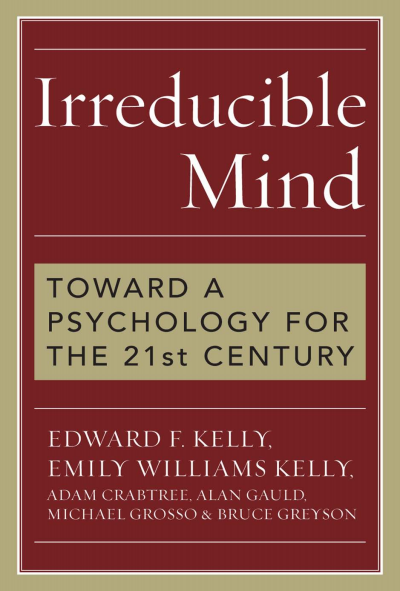
Irreducible Mind
Toward a Psychology for the 21st Century- Authors:
- | | | |
- Publisher:
- 2006
Summary
Current mainstream opinion in psychology, neuroscience, and philosophy of mind holds that all aspects of human mind and consciousness are generated by physical processes occurring in brains. Views of this sort have dominated recent scholarly publication. The present volume, however, demonstrates empirically that this reductive materialism is not only incomplete but false. The authors systematically marshal evidence for a variety of psychological phenomena that are extremely difficult, and in some cases clearly impossible, to account for in conventional physicalist terms. Topics addressed include phenomena of extreme psychophysical influence, memory, psychological automatisms and secondary personality, near-death experiences and allied phenomena, genius-level creativity, and 'mystical' states of consciousness both spontaneous and drug-induced. The authors further show that these rogue phenomena are more readily accommodated by an alternative 'transmission' or 'filter' theory of mind/brain relations advanced over a century ago by a largely forgotten genius, F. W. H. Myers, and developed further by his friend and colleague William James. This theory, moreover, ratifies the commonsense conception of human beings as causally effective conscious agents, and is fully compatible with leading-edge physics and neuroscience. The book should command the attention of all open-minded persons concerned with the still-unsolved mysteries of the mind.
Search publication
Bibliographic data
- Edition
- 1/2006
- Copyright Year
- 2006
- ISBN-Print
- 978-0-7657-0502-0
- ISBN-Online
- 978-1-4422-0207-8
- Publisher
- Rowman & Littlefield, Lanham
- Language
- English
- Pages
- 800
- Product Type
- Monograph
Table of contents
- Contents No access
- Preface and Acknowledgments No access
- Introduction No access
- From James B. Watson to the Cognitive Revolution No access
- Problems in Classic Cognitivism No access
- The Second Cognitive Revolution: Connectionism and Dynamic Systems No access
- John Searle's Critique of Computational Theories of the Mind No access
- Biological Naturalism: The Final Frontier No access
- Psi Phenomena No access
- Extreme Psychophysical Influence No access
- Informational Capacity, Precision, and Depth No access
- Memory No access
- Psychological Automatisms and Secondary Centers of Consciousness No access
- The Unity of Conscious Experience No access
- Genius-Level Creativity No access
- Mystical Experience No access
- The Heart of the Mind No access
- Conclusion No access
- The Roots of Scientific Psychology: Dualism, Mechanistic Determinism, and the Continuity of Nature No access
- Psychology as Science: A Fundamental Conflict No access
- The Naturalization of Mind: Limiting Psychology No access
- The Unresolved Dilemmas of Psychology No access
- An Attempted Solution: Methodological Parallelism No access
- Tertium Quid No access
- Continuity No access
- Empiricism No access
- Expanding Psychology No access
- Psychophysiological Concomitance No access
- The Study of Subliminal Phenomena No access
- The New Physics No access
- Mind and Matter No access
- An Expanded Naturalism No access
- The Unity-Multiplicity Problem: "Unitary" versus "Colonial" Views of Mind No access
- An Expanded View of Consciousness No access
- A Jacksonian Model of Mind No access
- An Evolutionary View of Mind No access
- The Subliminal Self: A "Tertium Quid" Theory of Consciousness No access
- The Permeable Boundary: A Psychological Mechanism No access
- Evolutive and Dissolutive Phenomena No access
- Automatisms and the Expression of Subliminal Functioning No access
- A Law of Mental Causality No access
- Methods for Psychology No access
- Chapters 2 and 3: Hysteria and Genius No access
- Chapter 4: Sleep No access
- Chapter 5: Hypnotism No access
- Chapters 6 and 7: Hallucinations—Sensory Automatisms and Phantasms of the Dead No access
- Chapters 8, 9, and the Epilogue: Motor Automatisms, Trance, Possession, and Ecstasy No access
- Conclusion No access
- Psychosomatic Medicine No access
- Psychoneuroimmunology No access
- Bereavement and Mortality No access
- Sudden and "Voodoo" Death No access
- Possible Mechanisms Behind Psychological Factors in Mortality No access
- Postponement of Death No access
- Religion and Health No access
- Meditation and Healing No access
- Faith Healing No access
- Placebo and Nocebo No access
- Sudden Whitening of Hair or Skin No access
- False Pregnancy No access
- Phenomena Related to Stigmata No access
- Specificity of the Wounds No access
- Predisposing Characteristics No access
- Hysteria No access
- Multiple Personality and Dissociative Disorders No access
- Yogis No access
- Autonomic Effects No access
- Sensory Effects No access
- Hypnotic Analgesia No access
- Allergies No access
- Bleeding No access
- Burns No access
- Warts No access
- Other Skin Diseases No access
- Skin Conditions: Induction of Bleeding, Blisters, and Markings No access
- Attempted Explanations of Hypnotic Skin Marking and Related Phenomena No access
- Sympathetic Symptoms No access
- Maternal Impressions No access
- Community of Sensation No access
- Suggestion at a Distance No access
- Distant Intentionality Studies: Clinical No access
- Distant Intentionality Studies: Clinical 227Distant Intentionality Studies: Experimental No access
- Birthmarks and Birth Defects in Cases of the Reincarnation Type No access
- Conclusion No access
- Trace Theories: General Issues No access
- Modern Approaches: Cognitive No access
- Modern Approaches: Neuroscientific No access
- Myers's Approach to the Problem of Survival No access
- Problems of Personal Identity No access
- Myers's "Broad Canvas" Revisitied No access
- Myers, Memory, and the Evidence for Survival No access
- Conclusion No access
- Historical Background No access
- The Views of F. W. H. Myers No access
- Pierre Janet No access
- William James No access
- Morton Prince No access
- T. W. Mitchell No access
- William McDougall No access
- Sigmund Freud No access
- Carl Jung No access
- Ernest Hilgard No access
- Stephen Braude No access
- Sociocognitive Theorists No access
- The Cognitive Unconscious No access
- Neurobiological Research No access
- Automatism and Creativity No access
- Sensory and Motor Automatisms and Mediumship No access
- Automatism and Experimental Psi Research No access
- Conclusion No access
- Near-Death Experiences: An Introduction No access
- Expectation No access
- Birth Models No access
- Depersonalization No access
- Personality Factors No access
- Blood Gases No access
- Neurochemical Theories No access
- Neuroanatomical Models No access
- Enhanced Mentation No access
- Veridical Out-of-Body Perceptions No access
- Visions of Deceased Acquaintances No access
- Converging Lines of Evidence No access
- Autoscopy No access
- Lucid Dreams No access
- Veridical Apparitions No access
- Collective Apparitions No access
- Deathbed Visions No access
- Mystical and Conversion Experiences No access
- A Psychological Theory? No access
- General Anesthesia No access
- Cardiac Arrest No access
- Conclusion No access
- Myers's Theory of Genius: General Features and Scope No access
- The Creative Process: A Descriptive Model No access
- Continuity No access
- Calculating Prodigies No access
- "Organic" Senses No access
- Hallucinatory Syndromes No access
- Automatisms in Genius No access
- Genius in Automatists No access
- Non-Linguistic Symbolisms No access
- Associationism and Its Limits No access
- Coleridge and the Theory of Imagination No access
- Psychoanalytic Theory: Primary and Secondary Process No access
- The Crucial Role of Analogy and Metaphor No access
- The Failure of Computational Theories of Analogy No access
- Implications for Cognitive Theory No access
- Summary No access
- Genius and Mental Illness No access
- Genius as Personality in Transformation No access
- The Creative Nisus: A Drive Towrd Wholeness No access
- Art as Transformative No access
- Creativity and Psi No access
- Genius and Mysticism No access
- Conclusion No access
- Phenomenology of Mystical Experience: An Introduction No access
- The Problem of the Universal Core No access
- Steven Katz and the Constructivist Backlash No access
- Stace's Philosophical Argument for Objective Significance No access
- Mysticism and Genius No access
- Mysticism and Supernormal Phenomena No access
- Mysticism and Temporal Lobe Epilepsy No access
- Gellhorn and Ergotropic/Trophotropic Systems No access
- The Model of d'Aquili and Newberg No access
- James Austin's Zen and the Brain (1999) No access
- Mysticism and Psychedelies No access
- Freud and Jung No access
- Myers and James No access
- General Considerations No access
- Sources of Relevant Phenomena No access
- Further Guidelines for Future Research and Theory No access
- Conclusion No access
- Contemporary Review of Human Personality No access
- Myers's Methodological Principles No access
- Myers's Natural History of the Mind No access
- Myers's General Theory of the Psyche: The Subliminal Self No access
- Post-Mortem Survival No access
- Myers's Generalized Concept of Evolution No access
- Non-Cartesian Dualist-Interactionist Models No access
- Neutral-Monist Models No access
- Summary and Prospectus No access
- Introductory and General Scientific Literature No access
- Sppontaneous Case Studies No access
- Philosophical Literature No access
- Survival and Mediumship No access
- Reincarnation No access
- History of Psychical Research No access
- DMILS {Distant Mental Influence on Living Systems} No access
- Ganzfeld No access
- Hypnosis and Psi No access
- Statisties and Meta-analyses No access
- The Psi Controversy No access
- References No access Pages 657 - 758
- Index No access Pages 759 - 798
- About the Authors No access Pages 799 - 800