, to see if you have full access to this publication.
Monograph No access
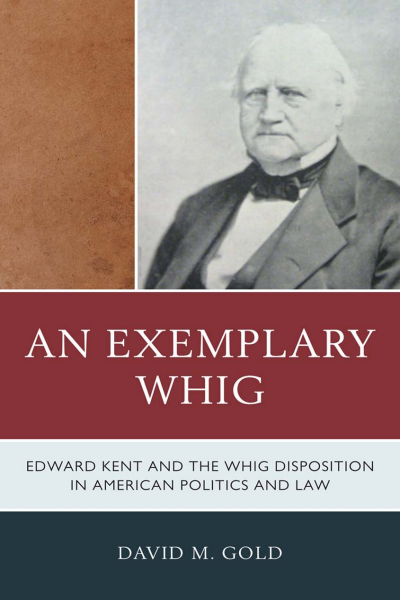
An Exemplary Whig
Edward Kent and the Whig Disposition in American Politics and Law
Authors:
Publisher:
2012
Summary
Historians have paid surprisingly little attention to state-level political leaders and judges. Edward Kent (1802–77) was both. He served three terms as a state legislator, two as mayor of Bangor, two as governor, and two as a judge of the state supreme court. He represented Maine in the negotiations that resolved the long-running northeastern border dispute between the United States and Great Britain and served for four years as the American consul in Rio de Janeiro. The foremost Whig in Maine state politics and later a Republican judge, Kent articulated classic Whig political views and carried them forward into his Whig-Republican jurisprudence.
In examining Kent's career as Maine's quintessential Whig, An Exemplary Whig reveals his characteristically conservative Whig outlook, including an aversion toward disorder and a deep respect for law, for existing institutions, and for the wisdom of experience. Kent brought his conservative disposition into the Republican Party. He had no use for radical abolitionism, preferring moderation and compromise to measures that endangered social order or the integrity of the Union. Kent saw the "slave power," not abolitionism, as the disrupter of the Union, and he urged the “fusion” of all antislavery elements into a new Republican party.
In 1859, Maine's Republican governor appointed Kent to the state supreme court. During his fourteen-year tenure, Kent adopted a Whiggish jurisprudence, pragmatic and commonsensical, and displayed a reverence for the common law and a distrust of “theoretic speculation.” After his retirement, he chaired a constitutional revision commission, admonishing his fellow commissioners to bear in mind the “practical wisdom” that kept dangerous innovation in check.
As a politician during the Jacksonian era, Kent exemplified Whig leadership at the local and state levels. In his jurisprudence, he carried the Whig persuasion into the Republican ascendancy and the beginnings of the Gilded Age.
Keywords
Search publication
Bibliographic data
Edition
1/2012
Copyright Year
2012
ISBN-Print
978-0-7391-7272-8
ISBN-Online
978-0-7391-7273-5
Publisher
Lexington, Lanham
Language
English
Pages
256
Product Type
Monograph
Table of contents
ChapterPages
Contents No access
Acknowledgments No access
Note on Citations No access
Introduction No access
1 Education in Federalism No access Pages 1 - 14
2 National Republican Legislator No access Pages 15 - 34
3 Mayor of Bangor No access Pages 35 - 48
4 Hell-Bent for Kent No access Pages 49 - 62
5 "The True End of Government" No access Pages 63 - 76
6 Running the Line No access Pages 77 - 94
7 Negotiating the Northeastern Boundary No access Pages 95 - 108
8 For Taylor and the Union No access Pages 109 - 128
9 Consul in Rio No access Pages 129 - 146
10 The Unholy Traffic No access Pages 147 - 156
11 The Demise of the Whigs No access Pages 157 - 168
12 The Rise of the Republicans No access Pages 169 - 182
13 A Republican on the Bench No access Pages 183 - 198
14 The Jurisprudence of Common Sense No access Pages 199 - 216