, to see if you have full access to this publication.
Monograph No access
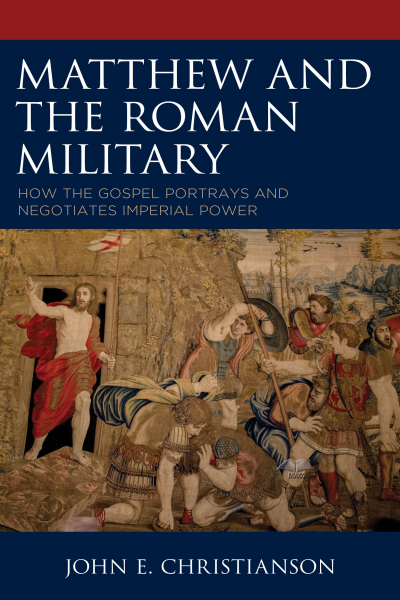
Matthew and the Roman Military
How the Gospel Portrays and Negotiates Imperial Power
Authors:
Publisher:
2022
Summary
This book addresses the ways in which the Gospel of Matthew portrays and negotiates Roman military power. John E. Christianson argues that Matthew, writing in the years following the Jewish War, offers strategies such as avoidance, accommodation, non-violent resistance, mimicry, and dreams of divine retribution and eschatological fulfillment to help his audience cope with life in Roman Syria. With an eye toward the ways that military structures and networks of social power functioned to increase imperial control over people and territory, Christianson shows how Matthew's strategies include ways to help his audience negotiate potentially dangerous encounters with Roman military personnel. This includes texts that address the possibility of state sanctioned violence by Roman aligned rulers Herod and Antipas; the abuse of requisitioned labor in Roman angaria; Jesus' response to the direct request of a centurion with opaque motivations; a vision of retribution on Roman eagles by the eschatological Son of Man, and soldiers' response to Jesus' death and resurrection as a prelude to divine overthrow of Roman military power. In all cases, this book demonstrates how interpretation of Matthew's narrative must account for the pervasive presence of the Roman military in the ancient world.
Keywords
Search publication
Bibliographic data
Edition
1/2022
Copyright Year
2022
ISBN-Print
978-1-9787-1221-8
ISBN-Online
978-1-9787-1222-5
Publisher
Lexington, Lanham
Language
English
Pages
244
Product Type
Monograph
Table of contents
ChapterPages
Contents No access
Figures No access
Table No access
Acknowledgments No access
Matthew’s Negotiation with Roman Military Power No access
Approaches to Matthew’s Gospel No access
A Military-focused Empire-critical Approach to Matthew No access
Notes No access
Introduction No access
Deployment and Pacification: The Threat and Use of Violence No access
Food Supply No access
Requisitioned Transport (Ἀγγαρήιον/Angaria) No access
Road Construction No access
Social Relationships: Local Women and Soldiers No access
Ideology of Empire No access
Conclusion No access
Notes No access
Introduction No access
Directing, Avoiding, and Suffering Roman Power No access
Approaches to Matthew’s Representation of Herod No access
Joseph and Mary No access
The Children of Bethlehem No access
Ways to Survive Roman Imperial Power No access
The Risk of Challenging Imperial Agents No access
Antipas’s Retainers and Patrons No access
John and Jesus No access
John’s Disciples No access
The Crowds Who Support John and Jesus No access
Conclusion No access
Notes No access
Introduction No access
Jesus’ Response to Everyday Violence (Matt 5:41) No access
Ἀγγαρήιον as a Means of Imperial Control No access
Jesus’ Ἀγγαρήιον as a Means of Non-Violent Social Change No access
The “Second Mile” as a Strategy of Imperial Negotiation No access
Conclusion No access
Notes No access
Introduction No access
When the Empire Approaches (Matt 8:5–13) No access
The Centurion’s Role No access
The Centurion’s Motivation No access
The Centurion’s Faith No access
Jesus’s Condemnation of Those Who Do Not Acknowledge Him No access
Conclusion No access
Notes No access
Introduction No access
Anti-Imperial Eschatological Discourse No access
Identifying Imperial Eagles No access
The Eschatological Son of Man No access
The Power of Lightning and Eagles No access
Interpreting Heavenly Portents No access
The Signum of the Son of Man No access
Anticipating Angels with Trumpets No access
Conclusion No access
Notes No access
Introduction No access
Armed Retainers Arrest Jesus (Matt 26:47–56) No access
Pilate No access
Pilate’s Soldiers No access
The Defeat of Roman Military Power (Matt 27:62–28:20) No access
Conclusion No access
Notes No access
Note No access
Bibliography No access Pages 219 - 234
Index No access Pages 235 - 238
Biblical References No access Pages 239 - 242
About the Author No access Pages 243 - 244
Similar publications
from the topics "Religion und Theologie allgemein"