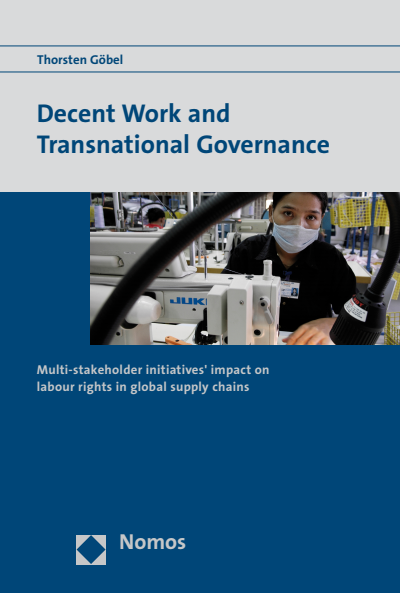
Decent Work and Transnational Governance
Multi-stakeholder initiatives' impact on labour rights in global supply chains- Authors:
- Publisher:
- 2010
Summary
This book provides guidance for policy and research on how the enforcement of core labour standards in supplier factories of transnational corporations can be improved. The book not only performs a comparative impact assessment of three multi-stakeholder initiatives (MSIs), but also develops an analytical model about the influence of "inclusiveness" on MSIs’ effectiveness.
MSIs are institutions of transnational governance. Several of them have been founded in the international textile, garment, footwear and sporting goods industry to address problems with labour rights violations in global supply chains that neither states nor transnational corporations have been able or willing to solve.
The author asks to what extent different MSIs were successful in improving working conditions in supplier factories in developing countries. It performs an analysis of the ILO Better Factories Cambodia Programme, the Fair Labor Association, and the AVE-GTZ project, using nearly 50 qualitative interviews. The book argues that the variation of degrees of effectiveness depends on the different approaches that underlie the work of each MSI – social dialogue, responsible competitiveness, or risk management.
Search publication
Bibliographic data
- Edition
- 1/2010
- Copyright Year
- 2010
- ISBN-Print
- 978-3-8329-5932-6
- ISBN-Online
- 978-3-8452-2585-2
- Publisher
- Nomos, Baden-Baden
- Language
- English
- Pages
- 241
- Product Type
- Monograph
Table of contents
- Titelei/Inhaltsverzeichnis No access Pages 2 - 4Authors:
- Preface No access Pages 5 - 12Authors:
- List of Tables No accessAuthors:
- List of Figures No access Pages 14 - 14Authors:
- Abbreviations No access Pages 15 - 16Authors:
- Introduction: Globalisation with a Human Face No access Pages 17 - 20Authors:
- The formtation of transnational governance institutions No access Pages 21 - 27Authors:
- MSIs as part of transnational governance No access Pages 27 - 29Authors:
- MSIs, authority, regulation, and the role of the state No access Pages 29 - 32Authors:
- Research question No access Pages 32 - 34Authors:
- Research design for analysing MSI effectiveness No access Pages 34 - 36Authors:
- Outline: Limits of the study and content No access Pages 36 - 38Authors:
- Object of evaluation: Three dimensions of effectiveness No access Pages 39 - 45Authors:
- Standard of reference No access Pages 45 - 50Authors:
- No forced labour No access Pages 50 - 52Authors:
- No child labour and regulations for underage workers No access Pages 52 - 53Authors:
- Non-discrimination No access Pages 53 - 54Authors:
- Freedom of association and right to collective bargaining No access Pages 54 - 56Authors:
- Occupational safety and health No access Pages 56 - 56Authors:
- Conditions of employment No access Pages 56 - 58Authors:
- Summary and outlook No access Pages 58 - 58Authors:
- Explaining effectiveness: mapping explanatory factors No access Pages 59 - 61Authors:
- Defining inclusiveness No access Pages 61 - 63Authors:
- Multi-stakeholder membership and decision-making rights No access Pages 63 - 64Authors:
- Hypothesis about inclusiveness and effectiveness No access Pages 64 - 68Authors:
- Authors:
- - Group size and number of stakeholders No accessAuthors:
- - Membership, decision-making rights, and effectiveness No accessAuthors:
- - Inclusiveness and effectiveness: The role of power No accessAuthors:
- Refining the hypothesis No access Pages 77 - 78Authors:
- The ILO Better Factories Cambodia Programme No access Pages 79 - 81Authors:
- The inclusiveness of ILO BFC No access Pages 81 - 83Authors:
- Output and outcome No access Pages 83 - 85Authors:
- Authors:
- - Impact in general No accessAuthors:
- - Impact on forced labour No accessAuthors:
- - Impact on child labour and underage workers No accessAuthors:
- - Impact on discrimination No accessAuthors:
- - Impact on freedom of association and the right to collective bargaining No accessAuthors:
- - Impact on occupational safety and health No accessAuthors:
- - Impact on conditions of employment No accessAuthors:
- Inclusiveness and effectiveness No access Pages 98 - 101Authors:
- Direct economic benefits and commitment No access Pages 101 - 104Authors:
- Membership, communication, transparency and commitment No access Pages 104 - 108Authors:
- The social dialogue approach No access Pages 108 - 117Authors:
- Summary No access Pages 117 - 118Authors:
- The Fair Labor Association No access Pages 119 - 121Authors:
- The FLA’s inclusiveness No access Pages 121 - 122Authors:
- Output and outcome No access Pages 122 - 124Authors:
- Authors:
- - Impact in general No accessAuthors:
- - Impact on forced labour No accessAuthors:
- - Impact on child labour and underage workers No accessAuthors:
- - Impact on discrimination No accessAuthors:
- - Impact on freedom of association and the right to collective bargaining No accessAuthors:
- - Impact on occupational safety and health No accessAuthors:
- - Impact on conditions of employment No accessAuthors:
- Inclusiveness and effectiveness No access Pages 139 - 141Authors:
- Attribution and causal mechanisms No access Pages 141 - 146Authors:
- The responsible competitiveness approach No access Pages 146 - 150Authors:
- Summary No access Pages 150 - 152Authors:
- The AVE-GTZ Project No access Pages 153 - 155Authors:
- The inclusiveness of AVE-GTZ No access Pages 155 - 156Authors:
- Output and outcome No access Pages 156 - 157Authors:
- Authors:
- - Impact in general No accessAuthors:
- - Impact on forced labour No accessAuthors:
- - Impact on child labour and underage workers No accessAuthors:
- - Impact on discrimination No accessAuthors:
- - Impact on freedom of association and the right to collective bargaining No accessAuthors:
- - Impact on occupational safety and health No accessAuthors:
- - Impact on conditions of employment No accessAuthors:
- Inclusiveness and effectiveness No access Pages 170 - 174Authors:
- Attribution and causal mechanisms No access Pages 174 - 175Authors:
- The risk management approach No access Pages 175 - 182Authors:
- Summary No access Pages 182 - 184Authors:
- Output and outcome No access Pages 185 - 187Authors:
- Authors:
- - Dimensions of the collective optimum compared across cases No accessAuthors:
- - Conditions for effectiveness, and unmitigated problems No accessAuthors:
- Mindsets and approaches No access Pages 194 - 197Authors:
- The power problem No access Pages 197 - 201Authors:
- Authors:
- - Recommendation 1: Upgrade your approach! No accessAuthors:
- - Recommendation 2: Include governments! No accessAuthors:
- - Recommendation 3: Review your purchasing practices! No accessAuthors:
- Authors:
- - Recommendation 1: Analyse effects of incentives! No accessAuthors:
- - Recommendation 2: Study effects of stakeholder numbers more in-depth! No accessAuthors:
- - Recommendation 3: Analyse effects of institutional fields! No accessAuthors:
- - Recommendation 4: Broaden research scope! No accessAuthors:
- Conclusion: The Curtain Closes No access Pages 209 - 212Authors:
- Bibliography No access Pages 213 - 234Authors:
- Index No access Pages 235 - 241Authors: