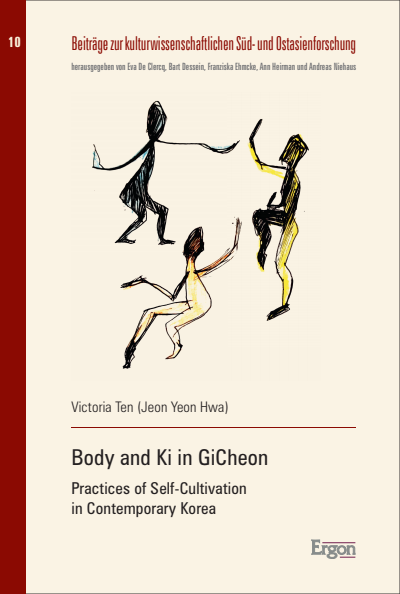
Body and Ki in GiCheon
Practices of Self-Cultivation in Contemporary Korea- Authors:
- Series:
- Beiträge zur kulturwissenschaftlichen Süd- und Ostasienforschung, Volume 10
- Publisher:
- 2020
Summary
Industrial growth and the development of the new middle class in South Korea of the 1980s went together with increased consumption and leisure culture, causing growing concerns with health and personal self-cultivation. Accordingly, sŏngin undong (sports for adults), mountain hiking and ki suryŏn were on the rise.
People of older generations have lived through Korea’s dramatic transformation from a mostly rural society to an industrial one. Their yearning for the past, in which the “past” is idealized and imagined anew, is directly connected to old Korean mountain culture of immortality, a touchstone of cultural authenticity.
Together with an image of rural “old Korea” in the minds of contemporary people, it becomes a source of inspiration in re-inventing tradition in the spirit of nationalism. This tendency is expressed in new religious and spiritual movements that matured toward the 1980s. Ki suryŏn is an important part of these spiritual-social phenomena. The author Victoria Ten (Jeon Yeon Hwa) is a teacher of GiCheon, one ki suryŏn disciplines, which she researches at academia, combining this with a profession of a lawyer.
Search publication
Bibliographic data
- Edition
- 1/2020
- Copyright Year
- 2020
- ISBN-Print
- 978-3-95650-733-5
- ISBN-Online
- 978-3-95650-734-2
- Publisher
- Ergon, Baden-Baden
- Series
- Beiträge zur kulturwissenschaftlichen Süd- und Ostasienforschung
- Volume
- 10
- Language
- English
- Pages
- 201
- Product Type
- Monograph
Table of contents
- Titelei/Inhaltsverzeichnis No access Pages 1 - 10
- Acknowledgements No access Pages 11 - 12
- Preface No access Pages 13 - 14
- Striving for upward mobility and self-improvement No access
- Reactions to Westernization and modernization No access
- Social pressure and ki suryŏn as a mechanism of survival and method of self-improvement No access
- Ki suryŏn as a contemporary phenomenon No access
- Immortality and nationalism in contemporary Korea No access
- Existing studies on ki suryŏn in general and on GiCheon in particular No access
- Approaches to practices similar to ki suryon No access
- Yangsheng practices in contemporary Beijing No access
- Ki suryŏn as “technologies of the self” No access
- Two vectors model No access
- The body and the self as the crossroads of the vectors No access
- Experiential modalities as a framework to analyze GiCheon experience No access
- A short history of GiCheon No access
- The setting for practice: what, where, how No access
- The practitioners No access
- Introduction to the concept of ki No access
- Ki as waves coming from the vibrations in the body No access
- Ki as help No access
- GiCheon as suryŏn No access
- Suryŏn as self-knowledge passed on to others No access
- Suryŏn as a voluntarily chosen, special path No access
- Suryŏn as endurance of hardship No access
- Suryŏn as purification No access
- Suryŏn as cultivating the social body No access
- Applying the two vectors model No access
- Applying Foucault’s technologies of self No access
- Attitudes toward suryŏn as personally colored experiential modalities No access
- Supporters of suryŏn: their personally colored experiential modalities No access
- Kim Pohŭi: experiential modality of “hardship and boredom” No access
- Sin Hyŏnju: the modalities of experiencing “softness and warmth”, “smooth and effortless passage” No access
- Kim Wŏn’gyu: the experiential modality of “lack and disappointment” No access
- Pain as a common denominator of different experiential modalities No access
- Pain as experience No access
- Pain as transforming No access
- Pain as a characteristic of ascetic practice No access
- Body as text No access
- Pain is akin to death No access
- Benefits of pain No access
- Greater pain brings higher efficiency No access
- Pain as restoring ki flow and as healing No access
- Pain in the narration of Ms. Sin No access
- Conclusion: is GiCheon an ascetic experience? No access
- Mountains in East Asian and Korean culture No access
- Mountain routes as ki channels in the human body No access
- Mountain routes as paths of religious or spiritual progress leading to the summit No access
- Mountains as innŭn kŏt (있는 것) No access
- Mountains as a hiking space No access
- Mountains as a space of immortality No access
- Epilogue No access Pages 183 - 184
- Bibliography No access Pages 185 - 198
- Index No access Pages 199 - 200
- About the author No access Pages 201 - 201
Bibliography (151 entries)
No match found. Try another term.
- Abayev, N. V. Chan-buddhism yi kultura psihicheskoi deyatelnosti v srednevekovom Kitae (Чань-буддизм и культура психической деятельности в средневековом Китае) (Zen-Buddhism and psychic culture in mediaeval China). Novosibirsk: Nauka (Наука), 1983. Open Google Scholar DOI: 10.5771/9783956507342
- Abayev, N. V. “Daosskie istoki kitaiskih Wu-shu” (Даосские истоки китайских у-шу) (Daoist sources of Chinese Wu-shu). In Dao yi daosism v Kitae (Дао и даосизм в Китае) (Dao and Daoism in China), 244-257. Moscow: Nauka (Наука), 1982. Open Google Scholar DOI: 10.5771/9783956507342
- Abelmann, Nancy. The Melodrama of Mobility: Women, Talk and Class in Contemporary South Korea. Honolulu: University of Hawaii Press, 2003. Open Google Scholar DOI: 10.5771/9783956507342
- Alter, Joseph. “Sex, Askesis and the Athletic Perfection of the Soul: Physical Philosophy in the Ancient Mediterranean and South Asia.” In Religion and the Subtle Body in Asia and the West: Between Mind and Body, edited by Geoffrey Samuel and Jay Johnston, 33-47. New York: Routledge, 2013. Open Google Scholar DOI: 10.5771/9783956507342
- Ames, R. T., and Hall, D. L. Focusing the Familiar: A Translation and Philosophical Interpretation of the Zhongyong. Honolulu: University of Hawaii Press, 2001. Open Google Scholar DOI: 10.5771/9783956507342
- Asakura, Toshio. “Aspects of Yangbanization.” In The Anthropology of Kore: East Asian Perspectives, edited by Mutsuhiko Shima and Roger L. Janelli, 191-212. Osaka: National Museum of Ethnology, 1998. Open Google Scholar DOI: 10.5771/9783956507342
- Baker, Don. Korean Spirituality. Honolulu: University of Hawaii Press, 2008. Open Google Scholar DOI: 10.5771/9783956507342
- Baker, Don. “Internal Alchemy in the Dahn World School.” In Religions of Korea in Practice, edited by Robert E. Buswell Jr., 508-513. Princeton and Oxford: Princeton University Press, 2007. Open Google Scholar DOI: 10.5771/9783956507342
- Bernbaum, Edwin. Sacred Mountains of the World. San Francisco: Sierra Club Books, 1990. Open Google Scholar DOI: 10.5771/9783956507342
- Bourdieu, Pierre. Le sens pratique. Paris: Les Editions de Minuit, 1980. Open Google Scholar DOI: 10.5771/9783956507342
- Boltz, Judith M. “Daozang and subsidiary compilations.” In The Encyclopedia of Taoism, edited by Fabrizio Pregadio, 28-33. New York: Routledge, 2008. Open Google Scholar DOI: 10.5771/9783956507342
- Brakke, David; Satlow, Michael, and Weitzman, Steven ed. Religion and the Self in Antiquity. Bloomington-Indianapolis: Indiana University Press, 2005. Open Google Scholar DOI: 10.5771/9783956507342
- Chakrabarty, Dipesh. “Afterword: Revisiting the Tradition/Modernity Binary.” In Mirror of Modernity: Invented Traditions of Modern Japan, edited by Stephen Vlastos, 285-296. Berkley, Los Angeles, London: University of California Press, 1998. Open Google Scholar DOI: 10.5771/9783956507342
- Chau, Adam Yuet. Religion in Contemporary China. New York: Routledge, 2011. Open Google Scholar DOI: 10.5771/9783956507342
- Chŏng, Chesŭng (정재승). “Minjok chŏngsin suryŏnpŏp e nat’anan ŭisik kaebal kwa simsin ŭihak: yonghokyŏl kwa wŏnsangpŏp ŭl chungsim ŭro” (민족정신 수련법에 나타난 의식개발과 심신의학: 《용호결(龍虎訣)》과 《원상법(原象法)》을 중심으로) (The development of consciousness and mind-body healing in national suryŏn method: focusing on yonghokyŏl and wŏnsang methods). Han’guk chŏngsin kwahak hoe haksultaehoe nonmunjip (한국정신과학회 학술대회 논문집) (The proceedings of the conference on Korean mind science) 15 (2001): 23-30. Open Google Scholar DOI: 10.5771/9783956507342
- Chŏng, Kyŏnghŭi (정경희). 2015. “Hyŏndae ‘Tan’gun undong ŭi saeroun chŏn’gae wa ‘Tanhak” (현대 ‘단군운동’의 새로운 전개와 ‘丹學’) (The new development of ‘Tan’gun movement’ and ‘Tanhak’ in contemporary Korea). Sŏndo munhwa (선도문화) (Journal of Korean sŏndo culture) 8 (2015): 143-194. Open Google Scholar DOI: 10.5771/9783956507342
- Choi, Jai-Sok. “A Socio-religious Study of Sindonae.” Transactions of the Royal Asiatic Society Korea Branch XLIII (1967): 67-91. Open Google Scholar DOI: 10.5771/9783956507342
- Choi, Wonsik and others. Beyond Korean Style: Shaping a New Growth Formula. London: McKinsey Global Institute, 2013. Open Google Scholar DOI: 10.5771/9783956507342
- Ch’oe, Chin’gu (최진구). “Silla Oak kwa Pulgyŏ ŭi sansin sinang yŏn’gu” (신라 五岳과 불교의 산신신앙 연구) (The study on five mountains and Buddhist beliefs in mountain spirits). Silla munhwa (新羅文化) (The journal of the center of research for Silla culture) 42 (2013): 243-268. Open Google Scholar DOI: 10.5771/9783956507342
- Ch’oe, Chŏnghyŏn (최정현); Yu Mi (유미); Pang, Kyŏngsuk (방경숙). “Tosi, nongch‘on chiyŏk kodŭnghaksaeng ŭi chasal saenggak e kwanhan yŏn’gu – sŏngjŏng paldal chasan kwa p’ongnyŏk kyŏnghŏm ŭl chungsim ŭro” (도시, 농촌지역 고등학생의 자살생각에 관한 연구 – 성정발달자산과 폭력경험을 중심으로) (A study on suicidal ideation of high school students in urban and rural area – focused on developmental assets and violence). Kibon kanhohak hoeji (기본간호학외지) (Journal of the Korean academy of fundamentals of nursing) 20, no. 1 (2013): 37-45. Open Google Scholar DOI: 10.5771/9783956507342
- Ch’oe, Miyŏn (최미연). “Kuksŏndo wa Han’guk ch’um ŭi sinmyŏng” (국선도와 한국춤의 신명 (神明)) (Kuksŏndo and exhilaration in Korean dance). Taehan muyong hakhoeji (大韓舞踊學會) (The Korean journal of dance) 54 (2008): 155-173. Open Google Scholar DOI: 10.5771/9783956507342
- Csordas, Thomas J. Body / Meaning / Healing. New York: Palgrave Macmillan, 2002. Open Google Scholar DOI: 10.5771/9783956507342
- Csordas, Thomas J. “The Body's Career in Anthropology.” In Anthropological Theory Today, edited by Henrietta Moore, 172-205. Cornwell: Polity Press, 1999. Open Google Scholar DOI: 10.5771/9783956507342
- Dax, Frank. “Recreational Hiking in South Korea: Transforming the Body, Transforming the Land.” Korea Journal 55, no. 3 (autumn 2015): 80-102. Open Google Scholar DOI: 10.5771/9783956507342
- DelVecchio Good, Mary-Jo; Good Byron J.; Kleinman, Arthur; Brodwin, Paul E. “Epilogue.” In Pain as Human Experience: An Anthropological Perspective, edited by Mary-Jo DelVecchio Good and others, 198-208. Berkley, Los Angeles, Oxford: University of California Press, 1992. Open Google Scholar DOI: 10.5771/9783956507342
- Despeux, Catherine. “Yangshen 養生 Nourishing Life.” In The Encyclopedia of Taoism, edited by Fabrizio Pregadio, 1148-1150. New York: Routledge, 2008a. Open Google Scholar DOI: 10.5771/9783956507342
- Despeux, Catherine. “Daoyin 導引 ‘guiding and pulling’; gymnastics.” In The Encyclopedia of Taoism, edited by Fabrizio Pregadio, 334-337. New York: Routledge, 2008b. Open Google Scholar DOI: 10.5771/9783956507342
- Despeux, Catherine. “Le qigong, une expression de la modernité Chinoise.” In En suivant la Voie Royale. Mélanges en homage à Léon Vandermeersch, edited by J. Gernet and M. Kalinowski, 267–281. Paris: École Française d'Extrême-Orient, 1997. Open Google Scholar DOI: 10.5771/9783956507342
- Despeux, Catherine. Taiji Quan: Art martial - Technique de longue vie. Paris: Guy Tredaniel, 1981. Open Google Scholar DOI: 10.5771/9783956507342
- Farquhar, Judith, and Zhang, Qicheng. Ten Thousand Things: Nurturing Life in Contemporary Beijing. New York: Zone, 2012. Open Google Scholar DOI: 10.5771/9783956507342
- Farquhar, Judith. “Biopolitical Beijing: Pleasure, Sovereignty, and Self-Cultivation in China‘s Capital.” Cultural Anthropology 20, no. 3 (2005): 303-327. Open Google Scholar DOI: 10.5771/9783956507342
- Faubion, James. “Constantine Cavafy: A Parrhesiast for the Cynic of the Future.” In Foucault Now: Current Perspectives in Foucault Studies, edited by James Faubion, 225-242. Cambridge: Polity Press, 2014. Open Google Scholar DOI: 10.5771/9783956507342
- Flood, Gavin. The Ascetic Self : Subjectivity, Memory and Tradition. Cambridge: Cambridge University Press, 2004. Open Google Scholar DOI: 10.5771/9783956507342
- Foucault, Michel. Le Gouvernement de soi et des autres I : Cours au Collège de France (1982-1983). Paris: Gallimard, 2008. Open Google Scholar DOI: 10.5771/9783956507342
- Foucault, Michel. L'Hermeneutique du sujet : Cours au Collège de France (1981-1982). Paris: Gallimard, 2001. Open Google Scholar DOI: 10.5771/9783956507342
- Foucault, Michel. “Le sujet et le pouvoir.” In Dits et écrits 1954-1988. IV: 1980-1988, 222-243. Paris: Gallimard, 1994a. Open Google Scholar DOI: 10.5771/9783956507342
- Foucault, Michel. “ Les techniques de soi.” In Dits et écrits 1954-1988. IV: 1980-1988, 783-813. Paris: Gallimard, 1994b. Open Google Scholar DOI: 10.5771/9783956507342
- Foucault, Michel. “Technologies of the Self.” In Technologies of the Self: A Seminar with Michel Foucault, edited by Luther H. Martin, Huck Gutman and Patrick H. Hutton, 16-49. London: Tavistock Publications, 1988. Open Google Scholar DOI: 10.5771/9783956507342
- Foucault, Michel. Histoire de la sexualité. 3: Le souci de soi. Paris: Gallimard, 1984. Open Google Scholar DOI: 10.5771/9783956507342
- Foucault, Michel. Surveiller et punir: Naissance de la Prison. Paris: Gallimard, 1975. Open Google Scholar DOI: 10.5771/9783956507342
- Foucault, Michel. Naissance de la clinique: une archéologie du regard médical. Paris: Gallimard, 1963. Open Google Scholar DOI: 10.5771/9783956507342
- Foucault, Michel. Folie et déraison. Histoire de la folie à l'âge classique. Paris: Librairie Plon, 1961. Open Google Scholar DOI: 10.5771/9783956507342
- Garro, Linda C. “Chapter Five: Chronic Illness and the Construction of Narratives.” In Pain as Human Experience: An Anthropological Perspective, edited by Mary-Jo DelVecchio and others, 100-137. Berkley, Los Angeles, Oxford: University of California Press, 1992. Open Google Scholar DOI: 10.5771/9783956507342
- Gerke, Barbara. “On the ‘subtle body’ and ‘circulation’ in Tibetan medicine.” In Religion and the Subtle Body in Asia and the West: Between Mind and Body, edited by Geoffrey Samuel and Jay Johnston, 83-99. New York: Routledge, 2013. Open Google Scholar DOI: 10.5771/9783956507342
- GiCheon.org. 2008. “What is GiCheon?” www.gicheon.org/. Accessed August 6th, 2019. Open Google Scholar DOI: 10.5771/9783956507342
- Gill, Christopher. The Structured Self in Hellenistic and Roman Thought. Oxford: Oxford University Press, 2006. Open Google Scholar DOI: 10.5771/9783956507342
- Good, Byron J. “Chapter Two: A Body in Pain – The Making of a World of Chronic Pain”. In Pain as Human Experience: An Anthropological Perspective, edited by Mary-Jo DelVecchio and others, 29-48. Berkley, Los Angeles, Oxford: University of California Press, 1992. Open Google Scholar DOI: 10.5771/9783956507342
- Grayson, James Huntley. “Ch’udo yebae: A Case Study in the Early Emplantation of Protestant Christianity in Korea.” The Journal of Asian Studies 68, no. 2 (2009): 413-434. Open Google Scholar DOI: 10.5771/9783956507342
- Hadot, Pierre. What is ancient philosophy? Cambridge, Massachusetts: Harvard University Press, 2002. Open Google Scholar DOI: 10.5771/9783956507342
- Hahm, Chaibong. “Confucian Rituals and the Technology of the Self: A Foucauldian Interpretation.” Philosophy East and West 51, no. 3 (2001): 315-324. Open Google Scholar DOI: 10.5771/9783956507342
- Han’guk chŏngsin munhwa yŏn’guwŏn (한국정신문화연구원) (Research institute of Korean culture) ed. Han’guk minjok munhwa taebaekkwa sajon (한국민족문화대백과사전) (Korean encyclopedia of folk culture). Kyŏngi-do, Sŏngnam-si: Han’guk chŏngsin munhwa yŏn’guwŏn (한국정신문화연구원) (Research institute of Korean culture), 1988. Open Google Scholar DOI: 10.5771/9783956507342
- Harkness, Nicholas. Songs of Seoul. An Ethnography of Voice and Voicing in Christian South Korea. Berkley, Los Angeles, London: University of California Press, 2014. Open Google Scholar DOI: 10.5771/9783956507342
- Harpham, Geoffrey Galt. The Ascetic Imperative in Culture and Criticism. Chicago and London: The University of Chicago Press, 1987. Open Google Scholar DOI: 10.5771/9783956507342
- Hobsbawm, Eric, and Ranger, Terence ed. The Invention of Tradition. Cambridge: Cambridge University Press, 1992 [1983]. Open Google Scholar DOI: 10.5771/9783956507342
- Hwang, Kyung Moon. Rationalizing Korea: The Rise of the Modern State, 1894-1945. Okland, California: University of California Press, 2016. Open Google Scholar DOI: 10.5771/9783956507342
- Kang, Sŏngbok (강성복). “Kongju Tonghaeri sanhyangkye ŭi sŏngnip kwa sansinje ŭi pyŏnhwa” (공주 동해리 산향계의 성립과 산신제의 변화) (Establishment of sanhyangkye in Kongju Tonghaeri and the changes in sansinje). Han’guk minsokhak (韓國民俗學) (Journal of Korean folklore) 54 (2011): 7-36. Open Google Scholar DOI: 10.5771/9783956507342
- Kang, Sŏngbok (강성복), and Pak, Chongik (박종익). “Kongju T’aehwasan sanhyangkye ŭi sŏnggyŏk kwa sansinje” (공주 태화산 산향계 (山饗稧)의 성격과 산신제) (The character of sanhyangkye at Kongju T’aehwa mountain and sansinje). Han’guk minsokhak (韓國民俗學) (Journal of Korean folklore) 51 (2010): 215-245. Open Google Scholar DOI: 10.5771/9783956507342
- Kang, Tongu (강동구). “Saeroun sinhwa mandŭlgi – chaeya sahak e taehan tto tarŭn ihae” (새로운 신화 만들기 – 재야사학에 대한 또 드른 이해 (Making a new myth: another view on the chaya sahak). Chŏngsin munhwa yŏn’gu (정신문화연구) (Korean studies quarterly) 23, no. 1 (2000): 3-16. Open Google Scholar DOI: 10.5771/9783956507342
- Kendall, Laurel. Shamans Nostalgias and the IMF: South Korean Popular Religion in Motion. Honolulu: University of Hawaii Press, 2009. Open Google Scholar DOI: 10.5771/9783956507342
- Kerr, Catherine. “Translating ‘Mind-In-Body’: Two Models of Patient Experience Underlying a Randomized Controlled Trial of Qigong.” Culture, Medicine and Psychiatry 26 (2002): 419-447. Open Google Scholar DOI: 10.5771/9783956507342
- Keum, Jang-tae. “Mountains in Korean Thought”. In Korean Cultural Heritage Vol. II: Thought and Religion, edited by Joungwon Kim, 36-41. Seoul: Samsun Moonhwa Printing Co., 1996. Open Google Scholar DOI: 10.5771/9783956507342
- Kim, Chŏngbin (김정빈). Tan (丹). Seoul: Chŏngsinsegyesa (정신세계사), 1996 [1984]. Open Google Scholar DOI: 10.5771/9783956507342
- Kim, Chŏngha (김정하). 2007. “Injegun sansinje ŭi sigi mit kusŏng wŏlli koch’al” (인제군 산신제(山神祭)의 시기 및 구성 원리 고찰) (A study on the structure of sansinje in Inje County). Kangwŏn minsokhak (강원민속학) (The Kangwŏn province folklore) 21 (2007): 145-166. Open Google Scholar DOI: 10.5771/9783956507342
- Kim, Sŏnp’ung (김선풍). “Tan’gun sinhwa wa T’aebaeksan, Mokmyŏksan, Samgaksan sinhwa ŭi taebi punsŏk” (단군신화와 태백산ㆍ목멱산ㆍ삼각산신화의 대비분석) (A comparative study on Tan’gun legend and the legends of T’aebaek, Mokmyŏk and Samgak Mountains). Kangwŏn minsokhak (강원민속학) (The Kangwŏn province folklore) 17 (2003): 73-102. Open Google Scholar DOI: 10.5771/9783956507342
- Kim, Yŏngja (김영자). 2005. “Sansindo e p’yohyŏntoen sansin ŭi yuhyŏng” (산신도(山神圖)에 표현된 산신(山神)의 유형) (Various types of mountain gods depicted in paintings). Han’guk minsokhak (韓國民俗學) (Journal of Korean folklore) 41 (2005): 187-223. Open Google Scholar DOI: 10.5771/9783956507342
- Kim, Daeyeol. “Symbolisme de la force vitale en Chine ancienne : Modèles et significations dans l’alchimie taoïste opératoire (études des pratiques alchimiques du Baopuzi neipian 抱朴子内篇 (4e siècle après J.-C. en Chine) ”. Thèse de doctorat, Ecole doctorale d’Histoire des religions et anthropologie religieuse, Université de Paris-Sorbonne (Paris 4), 2000. Open Google Scholar DOI: 10.5771/9783956507342
- Kim, Hŭisang, and Kich‘ŏnmun Ponmun (기천문 본문). Kich‘ŏnmun immun (기천문 입문) (Kich‘ŏnmun Introduction). Seoul: Yŏn’gusa (연구사), 1998. Open Google Scholar DOI: 10.5771/9783956507342
- Kim, Hŭisang, and Kich‘ŏnmun Ponmun (氣天門 本門) ed. Kich‘ŏn (氣天). Seoul: Ch‘orokpaemaejiksŭ (초록배매직스), 2000. Open Google Scholar DOI: 10.5771/9783956507342
- Kim, Moon-Kyum. “The 1997 Financial Crisis and Changing Patterns of Consumption and Leisure in Korea.” Korea Journal 45, no. 3 (2005): 58-85. Open Google Scholar DOI: 10.5771/9783956507342
- Kim, Taewoo. “Medicine without the Medical Gaze: Theory, Practice, and Phenomenology in Korean medicine.” Doctoral Dissertation, Department of Anthropology, University at Buffalo, State University of New York, 2010. Open Google Scholar DOI: 10.5771/9783956507342
- Kirkland, Russell. “Transcendence and immortality.” In The Encyclopedia of Taoism, edited by Fabrizio Pregadio, 91-93. New York: Routledge, 2008. Open Google Scholar DOI: 10.5771/9783956507342
- Kleinman, Arthur; Brodwin. Paul E.; Good Byron J.; DelVecchio Good, Mary-Jo. “Chapter One: Pain as Human Experience.” In Pain as Human Experience: An Anthropological Perspective, edited by Mary-Jo DelVecchio and others, 1-29. Berkley, Los Angeles, Oxford: University of California Press, 1992. Open Google Scholar DOI: 10.5771/9783956507342
- Knight, John. “Hunters and hikers: rival recreations in the Japanese forest”. In Japan at Play: The Ludic and the Logic of Power, edited by Joy Hendry and Massimo Raveri, 268-284. London, New York: Routledge, 2005. Open Google Scholar DOI: 10.5771/9783956507342
- Kohn, Livia, and Wang, Robin, ed. Internal Alchemy: Self, Society, and the Quest for Immortality. Dunedin: Three Pines Press, 2009. Open Google Scholar DOI: 10.5771/9783956507342
- Korea Newsreview. Seoul. Weekly since 1974. Open Google Scholar DOI: 10.5771/9783956507342
- Laidlaw, James. “The Undefined Work of Freedom: Foucualt’s Genealogy and the Anthropology of Ethics.” In Foucault Now: Current Perspectives in Foucault Studies, edited by James Faubion, 23-37. Cambridge: Polity Press, 2014a. Open Google Scholar DOI: 10.5771/9783956507342
- Laidlaw, James. The Subject of Virtue: an Anthropology of Ethics and Freedom. New York: Cambridge University Press, 2014b. Open Google Scholar DOI: 10.5771/9783956507342
- Lee, Kit’ae. 2002. GiCheon Instructional DVD Volume One. Seoul: Kich’ŏn Sangmuwŏn (기천상무원). Open Google Scholar DOI: 10.5771/9783956507342
- Lee, Kyung Yup. “The Current State and Changes of Popular Beliefs.” In Korean Popular Beliefs, Yong Bhum Yi, Kyung Yup Lee, Jong Seong Choi, Boudewijn Walraven, 183-200. Kyŏngi-do P’aju-si: JImoondang Publishing Company, 2015. Open Google Scholar DOI: 10.5771/9783956507342
- Lee, Namhee. The Making of Minjung: Democracy and the Politics of Representation in South Korea. New York: Cornell University Press, 2007. Open Google Scholar DOI: 10.5771/9783956507342
- Lee, Sangwŏn, and Kim, Sanghwan. Ki - the Science of Internal Energy. DVD. Wethersfield, CT: Turtle Press, 2004. Open Google Scholar DOI: 10.5771/9783956507342
- Lett, Denise. In Pursuit of Status: The Making of South Korea's "New" Urban Middle Class. Cambridge: Harvard University Asia Center, 1998. Open Google Scholar DOI: 10.5771/9783956507342
- Lobetti, Tullio Federico. Ascetic Practices in Japanese Religion. London, New York: Routledge, 2014. Open Google Scholar DOI: 10.5771/9783956507342
- Lock, Margaret. “Introduction.” In Beyond the Body Proper. Reading in Anthropology of Material Life, edited by Margaret Lock and Judith Farquhar, 1-16. Durham: Duke University Press, 2007. Open Google Scholar DOI: 10.5771/9783956507342
- Long Le, Phuoc Cuu; Kim, Jong Ik; and Kim, Kunbae. “The Growth of Korean Companies and Their Contributions to the Miracle of the Han River.” International Journal of Multimedia and Ubiquitous Engineering 11, no. 5 (2016): 253-266. Open Google Scholar DOI: 10.5771/9783956507342
- Mason, David. Spirit of the Mountains. Seoul: Hollym International Cor., 1999. Open Google Scholar DOI: 10.5771/9783956507342
- Mauss, Marcel. “Les technique du corps.” In Sociologie et Anthropologie, 365-386. Paris : Presses Universitaires de France, 1966 [1934]. Open Google Scholar DOI: 10.5771/9783956507342
- Merleau-Ponty, Maurice. Phénoménologie de la perception. Paris: Gallimard, 1945. Open Google Scholar DOI: 10.5771/9783956507342
- Miura, Kunio. “Shenren 神人 divine man; spirit man.” In The Encyclopedia of Taoism, edited by Fabrizio Pregadio, 885-886. New York: Routledge, 2008a. Open Google Scholar DOI: 10.5771/9783956507342
- Miura, Kunio. “Xianren 仙人 immortal; transcendent.” In The Encyclopedia of Taoism, edited by Fabrizio Pregadio, 1092-1094. New York: Routledge, 2008b. Open Google Scholar DOI: 10.5771/9783956507342
- Na, Kwŏnsu (나권수). “Han’guk sinjonggyo ŭi sŏndo sasang yŏn’gu” (한국 신종교의 선도사상 연구) (A study on sŏndo thought in Korean New Religions). Sŏndo munhwa (선도문화) (Journal of Korean sŏndo culture) 12 (2012): 409-443. Open Google Scholar DOI: 10.5771/9783956507342
- Ots, Thomas. “The Silenced Body - The Expressive Leib: On the Dialectic of Mind and Life in Chinese Cathartic Healing.” In Embodiment and Experience: The Existential Ground of Culture and Self, edited by Thomas Csordas, 116-136. Cambridge: Cambridge University Press, 1994. Open Google Scholar DOI: 10.5771/9783956507342
- Ots, Thomas. “Phenomenology of the Body: The Subject-Object Problem in Psychosomatic Medicine and the Role of Traditional Medical Systems herein.” In Anthropologies of Medicine: A Colloquium on West European and North American Perspectives, edited by Beatrix Pfeiderer and Giles Bibeau, 43-58. Wiesbaden: Friedrich Vieweg & Sohn Verlag, 1991. Open Google Scholar DOI: 10.5771/9783956507342
- Ots Thomas. “The Angry Liver, the Anxious Heart and the Melancholy Spleen. The Phenomenology of Perceptions in Chinese Culture.” Culture Medicine and Psychiatry 14, no. 1 (1990): 21-58. Open Google Scholar DOI: 10.5771/9783956507342
- Pak, Chŏngwŏn (박정원). “Ogi ro mannan sansillyŏng ŭi hanŭl – Tobongsan e tanyŏwaso” (오기(傲氣)로 만난 산신령의 하늘 - 도봉산에 다녀와서) (Discovering the heaven of sansin through endurance – ascending Tobong Mountain). Chiban hwankyŏng (지반환경) (Korean Geoenvironment) 12, no. 3 (2011): 30-34. Open Google Scholar DOI: 10.5771/9783956507342
- Pak, Chongik (박종익). “Musŏngsan sansinje ŭi hyŏngsŏng kwa pyŏnch’ŏn” (무성산 산신제의 형성과 변천) (The establishment and transformation of Musŏng Mountain sansinje). Han’guk minsokhak (韓國民俗學) (Journal of Korean folklore) 49 (2009): 247-274. Open Google Scholar DOI: 10.5771/9783956507342
- Pak, Chunhyŏng (박준형). “Sinhwa ka tŭllyŏjunŭn Tan’gun iyagi” (신화가 들려주는 단군 이야기) (The story of Tan’gun told by the legend). In Kojosŏn, Tan’gun, Puyŏ (고조선, 단군, 부여), edited by Koguryo Research Foundation, 88-95. Seoul: Koguryo Research Foundation, 2004. Open Google Scholar DOI: 10.5771/9783956507342
- Pak, Misuk (박미숙) and others. “Ki suryŏn i sŭt’ŭresŭ panŭng e mich’i nŭn yŏnghyang” (기(氣)수련이 스트레스 반응에 미치는 영향) (Effects of ki suryŏn on stress management). Han’guk sŭp’och’ŭ simni hakhoeji (한국스포츠심리학회지) (Korean journal of sport psychology) 14, no. 3 (2003): 101-109. Open Google Scholar DOI: 10.5771/9783956507342
- Pak, Taeyang (박대양), and Ch’oe, Hyŏn’gyu (최현규). Sosŏl Kich‘ŏnmun. Unpublished manuscript. Open Google Scholar DOI: 10.5771/9783956507342
- Palmer, David A. Qigong Fever: Body, Science, and Utopia in China. New-York: Columbia University Press, 2007. Open Google Scholar DOI: 10.5771/9783956507342
- Park, Sŏngdae (朴成大). Kich‘ŏn muhak (기천무학) (Kich‘ŏn Martial Art). Seoul: Hongbŏm (洪範 홍범), 2000. Open Google Scholar DOI: 10.5771/9783956507342
- Pregadio, Fabrizio. “Dantian 丹田 Cinnabar field(s); Fields of the Elixir.” In The Encyclopedia of Taoism, edited by Fabrizio Pregadio, 302-303. New York: Routledge, 2008. Open Google Scholar DOI: 10.5771/9783956507342
- Pregadio, Fabrizio, ed. The Encyclopedia of Taoism. New York: Routledge, 2008. Open Google Scholar DOI: 10.5771/9783956507342
- Rabinow, Paul. “Assembling Untimeliness: Permanently and Restively.” In Foucault Now: Current Perspectives in Foucault Studies, edited by James Faubion, 203-224. Cambridge: Polity Press, 2014. Open Google Scholar DOI: 10.5771/9783956507342
- Robinet, Isabelle. “Jindan dayao 金丹大要 Great Essentials of the Golden Elixir.” In The Encyclopedia of Taoism, edited by Fabrizio Pregadio, 557-558. New York: Routledge, 2008a. Open Google Scholar DOI: 10.5771/9783956507342
- Robinet, Isabelle. “Shengren 聖人 saint; saintly man; sage.” In The Encyclopedia of Taoism, edited by Fabrizio Pregadio, 879-881. New York: Routledge, 2008b. Open Google Scholar DOI: 10.5771/9783956507342
- Robinet, Isabelle. “Ziran 自然 so of its own; spontaneous, spontaneity.” In The Encyclopedia of Taoism, edited by Fabrizio Pregadio, 1302-1303. New York: Routledge, 2008c. Open Google Scholar DOI: 10.5771/9783956507342
- Ryang, Sonia. “Technologies of the Self: Reading from North Korean Novels in the 1980s.” Acta Koreana 5, no. 1 (2002): 21-32. Open Google Scholar DOI: 10.5771/9783956507342
- Scheid, Volker. Chinese Medicine in Contemporary China: Plurality and Synthesis. Durham and London: Duke University Press, 2002. Open Google Scholar DOI: 10.5771/9783956507342
- Schipper, Kristofer. The Taoist Body. Berkeley: University of California Press, 1993. Open Google Scholar DOI: 10.5771/9783956507342
- Seth, Michael J. Education Fever: Society, Politics and the Pursuit of Schooling in South Korea. Honolulu: University of Hawaii Press, 2002. Open Google Scholar DOI: 10.5771/9783956507342
- Shulman, David, and Stroumsa, Guy ed. Self and Self-transformation in the History of Religions. New York: Oxford University Press, 2002. Open Google Scholar DOI: 10.5771/9783956507342
- Sin, Hyesuk (신혜숙), and Kwŏn, Hyosuk (권효숙). “Sŏngin suryŏnja ŭi naerŏt’ibŭ e nat’anan noekyoyuk” (성인수련자의 내러티브에 나타난 뇌교육) (Brain education as manifested in the narratives of adult practitioners). Noekyoyuk yŏn’gu (뇌교육연구) (Journal of brain education) 2 (2008): 77-116. Open Google Scholar DOI: 10.5771/9783956507342
- Sŏndo munhwa yŏn’guwŏn (선도문화연구원) (Research institute of sŏndo culture) ed. Han’guk sŏndo ŭi yŏksa wa munhwa (한국선도의 역사와 문화) (History and culture of Korean sŏndo). Ch’ŏnan: International Graduate University for Peace Press, 2006. Open Google Scholar DOI: 10.5771/9783956507342
- Song, Mano (송만오). “Sŏnggong ŭl wihan Sŏ Ch’an’gyu ŭ chimnyŏm kwa noryŏk” (성공을 위한 서찬규의 집념과 노력) (Devotion and efforts of Sŏ Ch’an’gyu for achieving success). Chŏngsin munhwa yŏn’gu (정신문화연구) (Korean studies quarterly) 35, no. 4 (2012): 115-144. Open Google Scholar DOI: 10.5771/9783956507342
- StateUniversity.com. “South Korea - Educational System - overview” StateUniversity.com, http://education.stateuniversity.com/pages/1400/South-Korea-EDUCATIONAL-SYSTEM-OVERVIEW.html. Open Google Scholar DOI: 10.5771/9783956507342
- Statistics Korea. “Population Trends and Projections of the World and Korea” Statistics Korea, http://kostat.go.kr/portal/eng/pressReleases/8/8/index.board?bmode=read&bSeq=&aSeq=347597&pageNo=1&rowNum=10&navCount=10&currPg=&sTarget=title&sTxt=. Open Google Scholar DOI: 10.5771/9783956507342
- Statistics Korea. “Characteristics of the Employed Persons by Industry and Occupation according to the Local Area Labour Force Survey in the Second Half of 2015” Statistics Korea, http://kostat.go.kr/portal/eng/pressReleases/5/4/index.board?bmode=read&bSeq=&aSeq=354718&pageNo=1&rowNum=10&navCount=10&currPg=&sTarget=title&sTxt=. Open Google Scholar DOI: 10.5771/9783956507342
- Taylor, Charles. Sources of the Self: The Making of the Modern Identity. Cambridge: Cambridge University, 1989. Open Google Scholar DOI: 10.5771/9783956507342
- Teiser, Stephen F. "Introduction." In Religions of China in Practice, edited by Donald S. Lopez Jr., 3-40. Princeton, New Jersey: Princeton University Press, 1996. Open Google Scholar DOI: 10.5771/9783956507342
- Ten, Victoria. 2020. “Transforming the Self in Contemporary Korean Ki Suryŏn (氣修練): Water, Wood, and Stone in Two GiCheon (氣天) DVDs”. In Contemporary Practices of Citizenship in Asia and the West: Care of the Self, edited by Gregory Bracken, 67-88. Amsterdam: Amsterdam University Press. Open Google Scholar DOI: 10.5771/9783956507342
- Ten, Victoria. 2017a. Body and Ki in GiCheon: Practices of Self-Cultivation in Contemporary Korea, Doctoral Dissertation, Leiden University. Open Google Scholar DOI: 10.5771/9783956507342
- Ten, Victoria. 2017b. “Mt. Paektu and Sŏndo (仙道) in Contemporary South Korea: The Case of GiCheon (氣天).” Situations: Cultural Studies in the Asian Context 10 (2): 145-170. Open Google Scholar DOI: 10.5771/9783956507342
- Ten, Victoria, and Winstanley-Chesters, Robert. 2016. “New Goddesses at Paektu Mountain: Two Contemporary Korean Myths.“ S/N Korean Humanities 2 (1): 151-179. Open Google Scholar DOI: 10.5771/9783956507342
- Ten, Victoria. 2015. “Technologies of Self in Contemporary Korea: The Notion of Suryŏn (修練) in GiCheon (氣天).“ Papers of the British Association for Korean Studies (BAKS papers) 16: 76-96. Open Google Scholar DOI: 10.5771/9783956507342
- Ten, Victoria. 2014. “Encoding Visual Imagery of Ki Suryŏn Exported to the West.“ International Institute for Asian Studies (IIAS) Newsletter 70 (winter): 8-9. Open Google Scholar DOI: 10.5771/9783956507342
- Ten, Victoria. “The Notions of Ki 氣 and Great Void 太虛 in the Philosophy of Chinese Scholar Zhang Zai (張載, 1020-1077) and Korean Scholar Hwadam Sŏ Kyŏng Tŏk (花潭 徐敬德, 1489-1546). Explorations in Neo-Confucian Thought.” Russian Academy of Sciences, the Institute of Oriental Manuscripts, Written Monuments of the Orient (Письменные памятники Востока) 2, no. 15 (2011): 151-169. Open Google Scholar DOI: 10.5771/9783956507342
- Torchinov, E. A. Puti filosofiyi vostoka i zapada: poznanie zapredelnogo (Пути философии востока и запада: познание запредельного) (Philosophical ways of East and West: the knowledge of the beyond). Saint Petersburg: Peterburgskoye vostokovedenie (Петербургское востоковедение), 2007. Open Google Scholar DOI: 10.5771/9783956507342
- Torchinov, E. A. Religii mira. Opit zapredelnogo. Psihotehnika yi transpersonalnye sostoyaniya (Религии мира. Опыт запредельного. Психотехника и трансперсональные состояния) (World Religions. Experience of the “beyond”. Psycho-techniques and transpersonal states). Saint Petersburg: Peterburgskoye vostokovedenie (Петербургское востоковедение), 1998. Open Google Scholar DOI: 10.5771/9783956507342
- U, Hyeran (우혜란). “Ki suryŏn tanch’e ŭi minjokjuŭi chŏk sŏnghyang kwa segyehwa kihoek: tanwŏldŭ rŭl chungsim ŭro” (기수련 단체의 민족주의적 성향과 세계화 기획 : 단월드를 중심으로) (Nationalistic orientation and globalization plan of ki suryŏn groups: focusing on Dahn World). Inmun kwahak yŏn’gu (人文科學硏究) (Korean journal of humanities) 11 (2006a): 37-63. Open Google Scholar DOI: 10.5771/9783956507342
- U, Hyeran (우혜란). “Tong side Han’guk ŭi ki suryŏn munhwa wa musok” (동시대 한국의 기수련 문화와 무속) (Contemporary Korean ki suryŏn culture and shamanism). Chongkyo yŏn’gu (종교연구) (Korean study of religion) 9 (2006b): 71-113. Open Google Scholar DOI: 10.5771/9783956507342
- Utiraruto, Otehode. "The Creation and Reemergence of Qigong in China." In Making Religion, Making the State: The Politics of Religion in Modern China, edited by Yoshiko Ashiwa and David L. Wank, 241-265. Palo Alto: Stanford University Press, 2009. Open Google Scholar DOI: 10.5771/9783956507342
- Valantasis, Richard. “A Theory of the Social Function of Asceticism.” In Asceticism, edited by Vincent L. Wimbush and Richard Valantis, 544-552. New York, Oxford: Oxford University Press, 1995. Open Google Scholar DOI: 10.5771/9783956507342
- Van der Veer, Peter. “Global Breathing: Religious Utopias in India and China.” Anthropological Theory 7, no. 3 (2007): 315-329. Open Google Scholar DOI: 10.5771/9783956507342
- Walraven, Boudewijn. “The Parliament of Histories: New Religions, Collective Historiography, and the Nation.” Korean Studies 25, no. 2 (2001): 157-178. Open Google Scholar DOI: 10.5771/9783956507342
- Walraven, Boudewijn. “Reader’s Etiquette, and Other Aspects of Book Culture in Chosŏn Korea.” In Books in Numbers, edited by Wilt L. Idema, 237-266. Cambridge, Massachusetts: Harvard University, Harvard-Yenching Library, 2007. Open Google Scholar DOI: 10.5771/9783956507342
- WENR: World Education News and Reviews. “Asia Pacific: Education in South Korea” WENR, http://wenr.wes.org/2013/06/wenr-june-2013-an-overview-of-education-in-south-korea. Open Google Scholar DOI: 10.5771/9783956507342
- Weber, Max. The Protestant Ethic and the Spirit of Capitalism. London and New York: Routledge Classics, 2001 [1904]. Open Google Scholar DOI: 10.5771/9783956507342
- Wells, Kenneth M. Korea: Outline of a Civilization. Leiden, Boston: Brill, 2015. Open Google Scholar DOI: 10.5771/9783956507342
- Wenyuange Siku Quanshu (文淵閣四庫全書) (Wenyuan Chamber, Complete Collection in Four Branches of Literature). Hong Kong: Dizhi wenhua chuban 迪志文化出版 (Digital Heritage Publishing Limited), abbreviation: SKQS, 1999. Open Google Scholar DOI: 10.5771/9783956507342
- Electronic edition of Wenyuange Siku Quanshu 文淵閣四庫全書 (Wenyuan Chamber, Complete Collection in Four Branches of Literature). Hong Kong: Dizhi wenhua chuban 迪志文化出版 (Digital Heritage Publishing Limited), abbreviation: E-SKQS, 1999. Open Google Scholar DOI: 10.5771/9783956507342
- Xenophon. Memorables, IV, II, 24. Translated by Chambry, P. Paris: Garnier-Flammarion, 1966 [371 BC]. Open Google Scholar DOI: 10.5771/9783956507342
- Yang, Ch’unho (양춘호) and others. “Kuksŏndo suryŏn kwa salm ŭi chil e kwanhan yŏn’gu” (국선도 수련과 삶의 질에 관한 연구) (The Study on Kuksŏndo practice and quality of life). Han’guk sahoe ch’eyuk hakhoeji (한국사회체육학회지) (Korean journal of sports and leisure studies) 13 (2000): 27-38. Open Google Scholar DOI: 10.5771/9783956507342
- Yi, Hyŏnsu (이현수). “Yonghopigyŏl ŭi suryŏn pangpŏpron koch’al” (용호비결의 수련방법론 고찰) (A study on the methodology of Yonghopigyŏl suryŏn). Han’guk chŏngsin kwahak hakhoeji (한국정신과학학회지) (The Journal of Korean mind science) 10, no. 1 (2006): 1-20. Open Google Scholar DOI: 10.5771/9783956507342
- Yi, Kwangho (이광호). “Hyŏndae saenghwal ch’eyuk ŭrosŏ Kuksŏndo ŭi chŏngch’ak kwajŏng yŏn’gu” (현대 생활체육으로서 국선도의 정착과정 연구) (The Study on the formation of Kuksŏndo as contemporary sport). Han’guk ch’eyuk hakhoeji (한국체육학회지) (The Korean journal of physical education) 52, no. 1 (2013): 239-253. Open Google Scholar DOI: 10.5771/9783956507342
- Yi, Kyŏngyŏp (이경엽). “Sunch’ŏn ŭi Sŏnghwang sinang, sansin sinang kwa yŏksa chŏk inmul ŭi singyŏkhwa” (순천의 성황신앙ㆍ산신신앙과 역사적 인물의 신격화) (The cult of Sŏnghwang in Sunch‘ŏn, sansin sinang and the divinization of historical figures). Namdo minsok yŏn’gu (남도민속연구) (Namdo folklore research) 6 (2000): 165-193. Open Google Scholar DOI: 10.5771/9783956507342
- Yi, Myŏngbok (이명복). Tanhak haksŭppŏp (단학 학습법) (The Study of Tanhak). Seoul: Taeyang (대양), 1988. Open Google Scholar DOI: 10.5771/9783956507342
- Yi, Sŭngho (이승호). Han’guk sŏndo wa hyŏndae Tanhak (한국 선도와 현대 단학) (Korean sŏndo and contemporary Tanhak). Seoul: Kukhak charyowŏn (국학 자료원), 2015. Open Google Scholar DOI: 10.5771/9783956507342
- Yi, Yohan (이요한). “Han’gukin ŭi san sinang e taehan ihae” (한국인의 산 신앙에 대한 이해) (Understanding Korean mountain cults). Kidokkyo sasang (기독교사상) (Korean Christian thought) 343 (1987): 146-155. Open Google Scholar DOI: 10.5771/9783956507342
- Yim, Sŭngt’aek (임승택). “Ije nŭn kukchehwa e noryŏk ŭl” (이제는 국제화에 노력을) (Now let us strive for internationalization). Sikp’um kwahak kwa sanŏp (식품과학과 산업) (Korean food science and industry) 43, no. 4 (2010): 1-1. Open Google Scholar DOI: 10.5771/9783956507342
- Yoo, Gyesook. “Changing Views on Family Diversity in Urban Korea.” Journal of Comparative Family Studies 37, no. 1 (2006): 59-74. Open Google Scholar DOI: 10.5771/9783956507342