, to see if you have full access to this publication.
Monograph No access
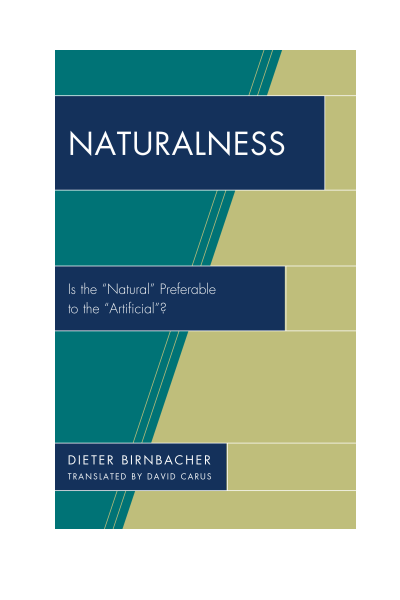
Naturalness
Is the “Natural” Preferable to the “Artificial”?
Authors:
Publisher:
2014
Summary
In Naturalness, Dieter Birnbacher delves into an argument common in everyday thinking and ethics—the argument of naturalness. This argument suggests that what is natural is in some ways superior to what is artificial, due to repeated positive connotations associated with the natural. This book presents both a phenomenology and a critique. For the former, Naturalness reviews the role of naturalistic arguments in various domains of everyday language and reasoning as well as in political and ethical debates, especially regarding controversial issues in preservation. For the latter, it critically discusses the persuasiveness of naturalness, both intellectually and morally, and how it is currently no more than an expression of conservatism and resistance to change in basic orientations.
Keywords
Search publication
Bibliographic data
Edition
1/2014
Copyright Year
2014
ISBN-Print
978-0-7618-6349-6
ISBN-Online
978-0-7618-6350-2
Publisher
Hamilton Books, Lanham
Language
English
Pages
180
Product Type
Monograph
Table of contents
ChapterPages
Contents No access
Preface No access
1.1 Naturalness and Artificiality as Points of Orientation No access
1.2 Genetic and Qualitative Naturalness No access
1.3 Dimensions of Naturalness in the Genetic Sense No access
1.4 Dimensions of Naturalness in the Qualitative Sense No access
2.1 Has Naturalness become Discredited as a Normative Principle? No access
2.2 The Naturalness Bonus in Everyday Morality No access
2.3 Naturalness Arguments in Applied Ethics No access
2.4 “Natural”: Positive Connotations and Their Background No access
2.5 The Structure of Naturalness Arguments No access
2.6 The Task of the Following Chapters No access
3.1 Nature as a Basis for Moral Norms? No access
3.2 Is the Argument of “Naturalistic Fallacy” Valid? No access
3.3 Different Approaches to Criticizing Ethical Naturalism No access
3.4 The Projective Character of Normative Images of Nature No access
3.5 Learning from Nature No access
3.6 Conclusions No access
4.1 Naturalness and Other Values of Nature No access
4.2 Can the Value of Protection Be Applied to Its Necessary Conditions? No access
4.3 Nature as an Anti-World No access
4.4 The Conservation of Naturalness in the Genetic Sense: Originality No access
4.5 Faking Nature No access
4.6 Naturalness in a Qualitative Sense—An Aesthetic or Also an Ethical Principle? No access
4.7 Does the Recognition of the Value of Naturalness Demand a Non-Anthropocentric Ethic? No access
4.8 Conclusions No access
5.1 The Religious and Other Reasons for the Sacrosanctity of Given Nature No access
5.2 Natural and Artificial: Boundary Issues No access
5.3 Which Alterations Resulting from Intervention Are Ethically Problematic? No access
5.4 Naturalness in Dealing with Ourselves—An Independent Value? No access
5.5 The “Naturalization” of Human Dignity No access
5.6 Conclusions No access
6.1 Gradations of Artificiality No access
6.2 What Role Do Naturalness Arguments Play in Reproductive Medicine? No access
6.3 Naturalness Preferences Versus Naturalness Principles No access
6.4 Sex Selection as a Test Case of Biopolitics No access
6.5 Principles of Naturalness in the Debate on Reproductive Cloning No access
6.6 The Dignity of the Species and Naturalness No access
6.7 Conclusions No access
7.1 The Idea of a Species Ethics No access
7.2 What Does “Human Nature” Mean? No access
7.3 “Posthumanism”? No access
7.4 The Openness of Human Nature No access
7.5 Images of Humanity as Intrinsic Values? No access