, to see if you have full access to this publication.
Edited Book No access
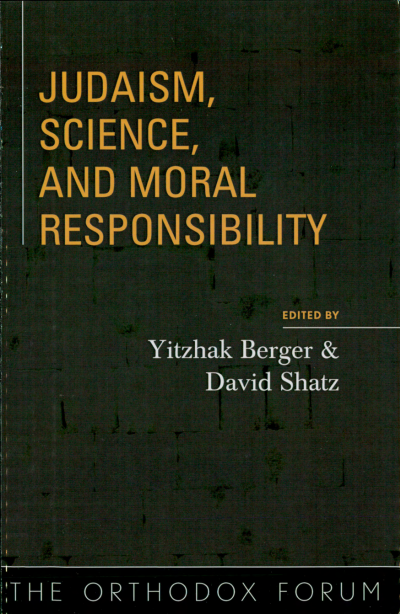
Judaism, Science, and Moral Responsibility
Editors:
|
Publisher:
2005
Summary
Do human beings have free will? Are they genuinely responsible for their actions? These questions have persisted all through the history of philosophy, but in the 21st century they have become defined more sharply and clearly than ever. Indeed, a vivid and mighty tension underlies today's intellectual struggles over free will. On the one hand, the rapid advances of several empirical disciplines, notably neuropsychology and genetics, threaten our instinctive affirmation that free will and moral responsibility exist. On the other hand, the depth and force of our instincts-our powerful intuition that there is free will, that there is moral responsibility-present, for most people, an almost impenetrable barrier against the sweeping denial of free will suggested by empirical research. The papers in this volume address this tension from a dual vantage point. While drawing heavily upon traditional Jewish texts and teachings, they also offer a blend of scientific, philosophical, psychological, and social insights into this most mystifying of topics. In addition, they illuminate the concept of repentance, a transformation of character that ranks in much of Jewish literature as the highest expression of free will.
Search publication
Bibliographic data
Edition
1/2005
Copyright Year
2005
ISBN-Print
978-0-7425-4596-0
ISBN-Online
978-1-4616-3834-6
Publisher
Rowman & Littlefield, Lanham
Language
English
Pages
306
Product Type
Edited Book
Table of contents
ChapterPages
Contents No access
Orthodox Forum: Fourteenth Conference No access
Series Editor's Introduction No access
Introduction Yitzhak Berger and David Shatz No access Pages 1 - 10
1 A Scientific Perspective on Human Choice Haim Sompolinsky No access
2 Genetics and Morality Robert Pollack No access
3 Is Matter All that Matters? Judaism, Free Will, and the Genetic and Neuroscientific Revolutions David Shatz No access
4 Use It or Lose It: On the Moral Imagination of Free Will Shalom Carmy No access
5 Choice-Diminished Behavior and Religious-Communal Policy Basil Herring No access
6 If an Abuser Cannot Control His Impulses, What Is the Responsibility of Other Adults in the Community? A Response to Basil Herring Rivkah Teitz Blau No access
7 Psychotherapy and Teshuvah: Parallel and Overlapping Systems for Change Michelle Friedman and Rachel Yehuda No access
8 To Whom, to Where, and to When Does One "Return" in Teshuvah? Moshe Halevi Spero No access
Index No access Pages 293 - 298
About the Series Editor No access Pages 299 - 300
About the Contributors No access Pages 301 - 306
Similar publications
from the topics "Religion und Theologie allgemein"