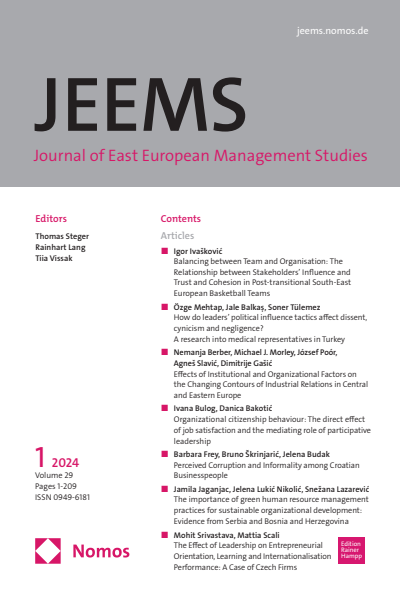
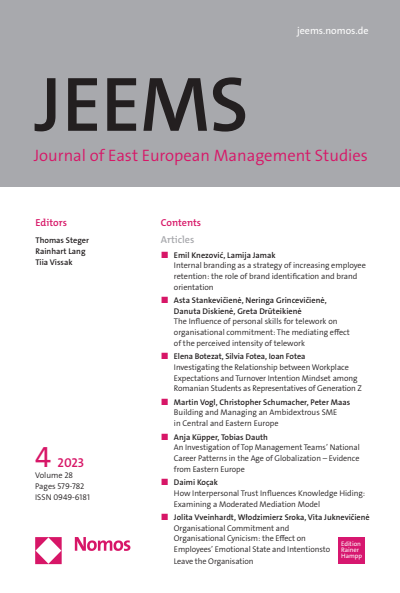
The Journal of East European Management Studies aims to promote dialogue and cooperation among scholars seeking to examine,explore and explain the behaviour and practices of management within the transforming societies of Central and Eastern Europe.The theoretical interests of the journal areorganisational and management change,Central and East European societies (including those on the fringes of Europe) undergoing processes of transition or transformation, andscientific issues of business, management and organisation that arise in such contexts.The JEEMS aims to attract social scientific contributions from scholars of any nation and region, but particularly wishes to encourageauthors from those countries directly experiencing transformational change. Its potential readership is international, comprising academicsand practitioners with an involvement or interest in the management of change in transforming societies in Central and Eastern Europe.
The paper studies earnings management in developing European countries. We investigated if membership in the European Union and the recent global financial crisis affected the decisions of managers in Eastern European countries to engage in earnings...
Based on an analysis of CSR/sustainability reports published by Russian companies, we analyse the determinants of socially responsible human resource management (SRHRM) disclosure in Russia. By considering the historical development and contextual...
Based on the results from four samples of academics from four different European countries, this study reveals why some universities are more successful than others in terms of creating and keeping their links with industry. It suggests that it is...
The paper presents the results of research on the mechanisms of corporate governance functioning on the Polish capital market. The purpose of this article is to identify the impact of selected internal mechanisms of corporate governance on the scope...
More and more companies are trying to optimize their corporate goals through digitalization. These include large corporations, medium-sized companies, but also small businesses. Starting with a central information system, companies are networking to...
The paper presents the results of the study of the influence of the dimensions of organizational culture on individual entrepreneurial orientation dimensions, the achievement dimension and the theory of planned behaviour dimensions. The respondents...
The Visegrad Four countries (the Czech Republic, Slovakia, Poland, and Hungary) share common traits in economics (Capik/Drahokoupil 2011), common history (Fawn 2013) and some political and social challenges (Förster/György Tòth 1997). In this...