, to see if you have full access to this publication.
Edited Book No access
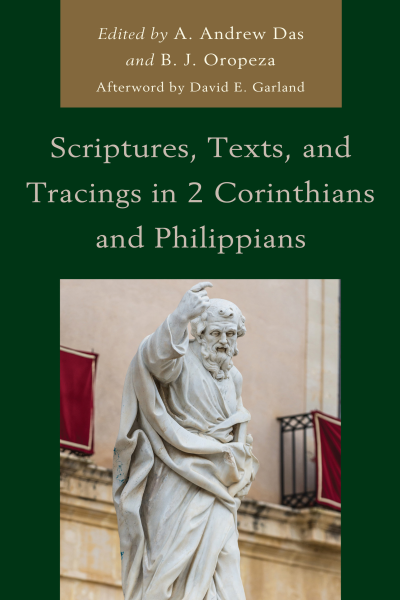
Scriptures, Texts, and Tracings in 2 Corinthians and Philippians
- Editors:
- |
- Publisher:
- 2022
Summary
Scripture, Texts, and Tracings in 2 Corinthians and Philippians advances the interpretation of 2 Corinthians and Philippians by exploring how the Apostle Paul quotes, alludes to, or "echoes" the Jewish Scriptures. Identification of allusions is at the forefront, as are questions about the Torah, God's righteousness, reconciliation, new creation, new covenant, Christology, lament language, cultic metaphors, canon, rhetoric, and more.
Keywords
Search publication
Bibliographic data
- Edition
- 1/2022
- Copyright Year
- 2022
- ISBN-Print
- 978-1-9787-1353-6
- ISBN-Online
- 978-1-9787-1354-3
- Publisher
- Lexington, Lanham
- Language
- English
- Pages
- 272
- Product Type
- Edited Book
Table of contents
ChapterPages
- Contents No access
- List of Tables No access
- List of Tables No access
- Abbreviations No access
- Preface No access
- Scripture, Texts, and Tracings in 2 Corinthians and Philippians No access Pages 1 - 12
- Paul’s Physical State No access
- Paul’s Credibility as a διάκονος of a New Covenant No access
- Paul’s Open and Honest Behavior No access
- Paul and the γνῶσις of God’s Glory No access
- Conclusion No access
- Notes No access
- Bibliography No access
- Ezekiel 36:26 (and 11:19) No access
- Jeremiah 38 (MT 31): 33 No access
- Exodus 31:18 (LXX): Inscribing on Tablets and Tablets of Stone No access
- 2 Corinthians 3:6: The Letter versus the Spirit No access
- 2 Corinthians 3:6–11: The Law and Gentile Sin No access
- The “Glory” Motif No access
- Conclusion: Hints of Confirmation from 2 Corinthians 3:12–18 No access
- Notes No access
- Bibliography No access
- “Inscribed” No access
- Structural Analysis No access
- “Letter of Christ” No access
- “Administrated by Us” No access
- Restoration of the Status Quo Ante No access
- “Christ, Who Is the Image of God” (2 Cor 4:4) No access
- The Use of Genesis 1:3 in 2 Corinthians 4:6 No access
- Conclusion No access
- Notes No access
- Bibliography No access
- Isaiah’s Figural Presentation of Servant and Servants No access
- Isaiah’s Figural Patterns in 2 Corinthians 5:14–6:10 No access
- Conclusion No access
- Notes No access
- Bibliography No access
- Reconciliation and Exchange No access
- First Isaiah and 2 Corinthians 4:6, 8 No access
- Isaiah 8:23b–9:7 and Later Isaiah No access
- Καταλλαγή and Messianic Peace (Isaiah 9:4[5]) No access
- Reconciliation in 2 Corinthians 5:17–21 No access
- Conclusion No access
- Notes No access
- Bibliography No access
- The Covenant-Faithfulness Interpretation No access
- Paul’s Use of Isaiah in 2 Corinthians 5–6 No access
- Isaiah’s Theology of Righteousness No access
- The Righteousness of God, Not of the Messiah No access
- The Verb “Become” No access
- Second Corinthians 5:21 at the Climax of Paul’s Defense of His Ministry No access
- Conclusion No access
- Notes No access
- Bibliography No access
- Leviticus 26:11–12 and/or Ezekiel 37:27 in 2 Corinthians 6:16 No access
- Isaiah 52:11 in 2 Corinthians 6:17 No access
- Ezekiel 20:34 in 2 Corinthians 6:17 No access
- 2 Kingdoms 7:8, 14 (and parallels) in 2 Corinthians 6:18 No access
- Putting the Pieces Together No access
- Conclusion No access
- Notes No access
- Bibliography No access
- LXX Isaiah 55:10 and LXX Hosea 10:12 in 2 Corinthians 9:10 No access
- Exodus 16:18 in 2 Corinthians 8:15 No access
- Conclusion No access
- Notes No access
- Bibliography No access
- An Overview of OT Lament and Its Intertextual Analysis in 2 Corinthians No access
- Paul’s Use and Reconfiguration of Lament in 2 Corinthians No access
- Lament in Paul’s Juxtaposition of Pain and Comfort No access
- Lament in Paul’s Catalogues of Suffering No access
- Lament in Seminal Moments of Paul’s Life No access
- Exegetical Results of Echoes of Lament No access
- Paul’s Theology as Sapientia Experimentalis No access
- Notes No access
- Bibliography No access
- Explicit Quotation and Use of Scripture across 2 Corinthians No access
- The Rhetorical Disposition and Scripture Use in 2 Corinthians No access
- Conclusion: Paul Argumentation Embodies God’s Word No access
- Notes No access
- Bibliography No access
- Image of God and Like God: An Analogy with Adam? No access
- Servant Song Repeated: “Took the Slave’s Image, Became Like Men” No access
- Lifted Above Any Creature to the Position of Lord No access
- Is “the Name Above Every Name” Equal to “the Name of the Lord”? No access
- Reference to the Tetragrammaton by the Phrase “the Name” Is Rooted in the Pentateuch No access
- Over, Under, and On the Earth No access
- The Eschatological Day of the Lord Re-Applied to Christ No access
- Recontextualization of Daniel 12:3 and Its Eschatological Context in Philippians 2:15–16 No access
- Conclusion No access
- Notes No access
- Bibliography No access
- Metaphor, Cultic Actions, and the Body No access
- Philippians and the Body No access
- Scripture in an Oral Culture No access
- The Body Brought Low: Christ, Paul, and the Philippians No access
- The Body Rising: The Philippians’ Fragrant Offering No access
- Gathering Up the Fragments No access
- Notes No access
- Bibliography No access
- Notes No access
- Bibliography No access
- Index No access Pages 241 - 246
- Index of Ancient Sources No access Pages 247 - 268
- About the Contributors No access Pages 269 - 272