, to see if you have full access to this publication.
Monograph No access
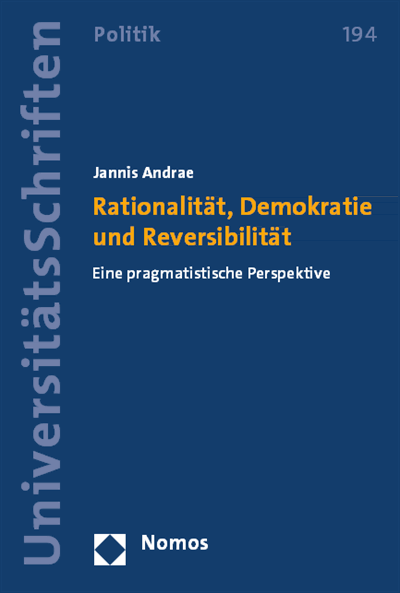
Rationalität, Demokratie und Reversibilität
Eine pragmatistische Perspektive- Authors:
- Series:
- Nomos Universitätsschriften - Politik, Volume 194
- Publisher:
- 2017
Search publication
Bibliographic data
- Edition
- 1/2017
- Copyright Year
- 2017
- ISBN-Print
- 978-3-8487-4265-3
- ISBN-Online
- 978-3-8452-8528-3
- Publisher
- Nomos, Baden-Baden
- Series
- Nomos Universitätsschriften - Politik
- Volume
- 194
- Language
- German
- Pages
- 412
- Product Type
- Monograph
Table of contents
ChapterPages
- Titelei/Inhaltsverzeichnis No access Pages 1 - 10
- a. Nichtdefinitivität als Merkmal der Demokratie? No access
- b. Einbezug künftiger Generationen No access
- B Themenstellung No access
- I. Revisibilität No access
- 1. Reversibilität und strikte Irreversibilität der Konsequenzen von Entscheidungen No access
- 2. Reversibilität und faktische Irreversibilität No access
- III. Demokratieprinzip No access
- 1. Rationalität als Optimierungsstrategie No access
- 2. Rationalität als prozedurales Konzept No access
- 3. Verhältnis beider Rationalitätsaspekte No access
- 1. Irreversibilität von Entscheidungskonsequenzen in der Praxis No access
- a. Anreizstrukturen als akteurszentrierte Triebfeder No access
- b. Komplexität als strukturelle Triebfeder No access
- aa) ARISTOTELES, THUKYDIDES, und DEMOSTHENES No access
- bb) LOCKE No access
- cc) HUME No access
- dd) Verfassungsdokumente des 18. Jahrhunderts No access
- ee) PAINE No access
- ff) JEFFERSON No access
- d. Ergebnisse No access
- a. Juristische Kritikstränge No access
- b. Philosophische Kritikstränge No access
- c. Politikwissenschaftliche Kritikstränge No access
- d. Denkfiguren und institutionelle Mechanismen mit Bezug zur Reversibilitätsproblematik No access
- e. Ergebnisse No access
- 5. Zusammenfassung und Fazit zur Relevanz des Themas No access
- 1. Weshalb der Klassische Pragmatismus? No access
- 2. Grundelemente des Klassischen Pragmatismus No access
- 3. Kernelemente zur Beleuchtung der Thesen No access
- 4. Biographischer und wissenschaftsgeschichtlicher Kontext No access
- 5. Abstrahleffekte auf andere Disziplinen No access
- 6. Ergebnisse No access
- 1. Deliberative Demokratietheorie No access
- 2. Epistemische Unterströmungen der Deliberativen Demokratietheorie No access
- a. Prozedural-epistemische Kombinationen No access
- b. Epistemischer Prozeduralismus: Die Jury als Analogie No access
- 4. ESTLUNDS Jury und das pragmatistische Kollektiv No access
- 5. Absoluter und relativer epistemischer Prozeduralismus No access
- 6. Liberalismus und Republikanismus No access
- A Theoretische Leitbilder und ihr Geltungsanspruch No access
- I. Einführung No access
- a. Firstness, Secondness, Thirdness No access
- b. Erfahrung bei PEIRCE No access
- 2. Überzeugung und Zweifel No access
- 3. Wahrheit und Realität No access
- 1. Zähigkeit No access
- 2. Autorität No access
- 3. A Priori-Methode No access
- IV. Die wissenschaftliche Methode No access
- 1. Von der Überzeugung zum Zweifel No access
- aa) Bedeutung der Abduktion für den Pragmatismus von PEIRCE No access
- bb) Kriterien der Hypothesenadäquanz No access
- cc) Logik der Abduktion No access
- b. Deduktion No access
- c. Induktion No access
- 3. Problemlösung No access
- 1. Wissenswachstum als Denkparadigma No access
- 2. Wissenschaftliches Kollektiv als Gemeinschaft No access
- a. Die Eigenschaft der Konvergenz No access
- b. Die Eigenschaft der Selbstkorrektur No access
- c. Theoretische Unmöglichkeit unwahrer Konsensmeinungen No access
- 4. Verwobenheit von Theorie und Praxis No access
- 5. Wirtschaftlichkeit No access
- 1. Zuverlässigkeit und Fruchtbarkeit bei der Wahrheitssuche No access
- 2. Prinzipielle Niedrigschwelligkeit No access
- 3. Normative Enthaltsamkeit No access
- 1. Menschenbild No access
- 2. Philosophie der Demokratie? No access
- a. Epistemisch unbegrenzte Deliberation No access
- b. Vorläufigkeit No access
- 2. Zusammenfassung No access
- I. Einführung: Inquiry als Logik No access
- a. Begriffsdefinition No access
- b. Das Element der Wechselbeziehung No access
- c. Das Element des Kontext No access
- 2. Rationalität und Wahrheit No access
- 3. Erfahrung und Wissen No access
- 1. Von der Überzeugung zum Zweifel No access
- 2. Problemstellung No access
- 3. Problemlösung No access
- 4. Urteil No access
- 1. Wissenschaft als Denkparadigma No access
- 2. Wissenschaftliches Kollektiv als Gemeinschaft No access
- 1. Epistemologischer Begründungszugang No access
- 2. Wachstum No access
- 3. Übertragbarkeit No access
- 1. Menschenbild No access
- 2. Philosophie der Demokratie No access
- a. Vorläufigkeit No access
- b. Allumfassende Deliberation No access
- 2. Zusammenfassung No access
- I. Gegenstandsbereich No access
- 1. Intention No access
- 2. Ziele des Prozesses No access
- 3. Ablauf No access
- III. Normative Begründung No access
- IV. Auftrag und Adressatenkreis No access
- 1. Kohärenz der epistemischen Bestandteile No access
- a. Problematische Variante des Erblühungsideals No access
- b. Unproblematische Variante des Erblühungsideals No access
- c. Fazit No access
- 1. Inquiry und Demokratie No access
- 2. Reversibilität und Rationalität No access
- 3. Reversibilität und Demokratieprinzip No access
- 1. Grad an Konkretheit No access
- 2. Grad an Realitätsnähe No access
- 3. Fazit No access
- IV. Grad der Bewährung No access
- 1. Ergebnisse der Geeignetheitsbetrachtung No access
- 2. Fazit No access
- I. Einführung und Rekapitulation No access
- II. Eine normative Metatheorie der Theoriebildung? No access
- A Einleitung in den angewandten Teil No access
- B Anwendbarkeit des Leitbilds No access
- C Theoretische und institutionelle Lehren No access
- I. Ein fiktiver Verfassungsartikel No access
- II. Wechselwirkungsfreiheit als Analyseinstrument No access
- 1. Entflechtung und Reversibilität No access
- 2. Entflechtung in der neueren politischen Theorie No access
- a. Verknüpfung zwischen Argumentation und Theoriegeschichte No access
- aa) POPPER No access
- bb) LINDBLOM No access
- cc) HAYEK No access
- dd) OFFE No access
- ee) LUHMANN No access
- 4. Fazit: Entflechtung und Reversibilität No access
- IV. Zur Angemessenheit von Entscheidungen mit irreversiblen Konsequenzen No access
- I. Zusammenfassung des angewandten Teils No access
- 1. Realitätsnähe des Arrangements No access
- 2. Vereinbarkeit mit dem Werk PEIRCES und DEWEYS No access
- 3. Fazit No access
- III. Abschließende Bemerkungen No access
- I. Einführung No access
- II. Reversibilität und strikte Irreversibilität No access
- III. Reversibilität und faktische Irreversibilität No access
- B Operationalisierung der Korrektheit bei ESTLUND No access
- C PEIRCES Zeichentheorie No access
- I. Deduktion No access
- II. Induktion No access
- E Klassische “roadblocks to inquiry” bei PEIRCE No access
- Literaturverzeichnis No access Pages 389 - 412
Bibliography (384 entries)
No match found. Try another term.
- Literaturverzeichnis Open Google Scholar DOI: 10.5771/9783845285283
- ADLOFF, F., & JÖRKE, D. (2013). Gewohnheiten, Affekte und Reflexivität. Ein pragmatistisches Modell sozialer Kooperation im Anschluss an Dewey und Mead. Österreichische Zeitschrift für Soziologie, 38 (Sonderheft 12), 21-41. Open Google Scholar DOI: 10.5771/9783845285283
- ALESINA, A., & PEROTTI, R. (1996). Fiscal Discipline and the Budget Process. American Economic Review, 86 (2), 401-407. Open Google Scholar DOI: 10.5771/9783845285283
- ALEXANDER, T. (2004). Dewey's denotative-empirical method. The Journal of Speculative Philosophy, 18 (3), 248-256. Open Google Scholar DOI: 10.5771/9783845285283
- ALEXY, R. (1978). Eine Theorie des praktischen Diskurses. In W. Oelmüller (Hrsg.), Transzendentalphilosophische Normbegründung (S. 122-158). Paderborn: Schöningh. Open Google Scholar DOI: 10.5771/9783845285283
- ALEXY, R. (1991). Idee und Struktur eines vernünftigen Rechtssystems. In R. Alexy, R. Dreier & U. Neumann (Hrsg.), Rechts- und Sozialphilosophie in Deutschland heute: Beiträge zur Standortbestimmung (S. 30-44). Stuttgart: Steiner. Open Google Scholar DOI: 10.5771/9783845285283
- ALLY, R. (1991). War and Gold - the Bank of England, the London Gold Market and South Africa's Gold, 1914-1919. Journal of Southern African Studies, 17 (2), 221-238. Open Google Scholar DOI: 10.5771/9783845285283
- ALMEDER, R. (1987). A Definition of Pragmatism. In H. Stachowiak (Hrsg.), Pragmatik. Handbuch pragmatischen Denkens (Bd. 2, S. 99-107). Hamburg: Felix Meiner Verlag. Open Google Scholar DOI: 10.5771/9783845285283
- ANDERSON, E. (2013). Die Epistemologie der Demokratie. In M. Hartmann, J. Liptow & M. Willaschek (Hrsg.), Die Gegenwart des Pragmatismus (S. 255-279). Frankfurt am Main: Suhrkamp. Open Google Scholar DOI: 10.5771/9783845285283
- ANDRAE, J. (2016). Treuhänder künftiger Generationen - Unabhängige Fachinstitutionen als Korrektiv im demokratischen Rechtsstaat. Baden-Baden: Nomos. Open Google Scholar DOI: 10.5771/9783845285283
- APEL, K.-O. (1981). Charles S. Peirce: From Pragmatism to Pragmaticism. Amherst: University of Massachusetts Press. Open Google Scholar DOI: 10.5771/9783845285283
- ARISTOTELES. (2012). Politik. In E. Schütrumpf (Hrsg.), Politik. Hamburg: Verlag Felix Meiner. Open Google Scholar DOI: 10.5771/9783845285283
- ASBACH, O. (2009). Die Revolution des Nutzens im Staatsdenken der Neuzeit. In O. Asbach (Hrsg.), Vom Nutzen des Staates (S. 13-30). Baden-Baden: Nomos. Open Google Scholar DOI: 10.5771/9783845285283
- ASHCRAFT, R. (1987). Locke's Two Treatises of Government. London: Unwin Hymen. Open Google Scholar DOI: 10.5771/9783845285283
- AUTORENKOLLEKTIV. (1990a). Nomos. In C. Andresen & K. Bartels (Hrsg.), Lexikon der Alten Welt (2. Aufl., Bd. 2, S. 2097-2098 (Spaltenangabe)). München und Zürich: Artemis Verlag. Open Google Scholar DOI: 10.5771/9783845285283
- AUTORENKOLLEKTIV. (1990b). Psephisma. In C. Andresen & K. Bartels (Hrsg.), Lexikon der Alten Welt (2. Aufl., Bd. 2, S. 2466 (Spaltenangabe)). München und Zürich: Artemis Verlag. Open Google Scholar DOI: 10.5771/9783845285283
- AUTORENKOLLEKTIV. (2004). Peirce, C. S.: Truth, Meaning, Inquiry. In J. Lachs & R. B. Talisse (Hrsg.), American Philosophy (S. 574-576). New York: Taylor & Francis. Open Google Scholar DOI: 10.5771/9783845285283
- BARRO, R. J. (1973). The Control of Politicians: An Economic Model. Public Choice, 14 (1), 19-42. Open Google Scholar DOI: 10.5771/9783845285283
- BARRO, R. J., & GORDON, D. B. (1983). A Positive Theory of Monetary Policy in a Natural Rate Model. Journal of Political Economy, 91 (4), 589-610. Open Google Scholar DOI: 10.5771/9783845285283
- BAUMGARTEN, E. (1938). Die geistigen Grundlagen des amerikanischen Gemeinwesens (Bd. 2). Frankfurt am Main: Vittorio Klostermann. Open Google Scholar DOI: 10.5771/9783845285283
- BECKMAN, L. (2013). Democracy and Future Generations. Should the Unborn Have a Voice? In J.-C. Merle (Hrsg.), Spheres of Global Justice (S. 775-788). Dordrecht: Springer. Open Google Scholar DOI: 10.5771/9783845285283
- BERGER, P. L., & LUCKMANN, T. (2010). Die gesellschaftliche Konstruktion der Wirklichkeit (23. Aufl.). Frankfurt am Main: S. Fischer. Open Google Scholar DOI: 10.5771/9783845285283
- BERGMAN, M. (2010). Serving Two Masters: Peirce on Pure Science, Useless Things, and Practical Applications. In M. Bergman, S. Paavola, A.-V. Pietarinen & H. Rydenfelt (Hrsg.), Ideas in Action: Proceedings of the Applying Peirce Conference (S. 1–16). Helsinki: Nordic Pragmatism Network. Open Google Scholar DOI: 10.5771/9783845285283
- BERLIN, I. (1969 (1958)). Two Concepts of Liberty. In I. Berlin (Hrsg.), Four Essays on Liberty (S. 118-172). Oxford: Oxford University Press. Open Google Scholar DOI: 10.5771/9783845285283
- BERNSTEIN, R. J. (1998). Community in the Pragmatic Tradition. In M. Dickstein (Hrsg.), The Revival of Pragmatism: New Essays on Social Thought, Law, and Culture (S. 141-156). Durham: Duke University Press. Open Google Scholar DOI: 10.5771/9783845285283
- BERNSTEIN, R. J. (1999). Praxis and Action. Contemporary Philosophies of Human Activity (2. Aufl.). Philadelphia: University of Pennsylvania Press. Open Google Scholar DOI: 10.5771/9783845285283
- BERNSTEIN, R. J. (2010). The Pragmatic Turn. Cambridge: Cambridge University Press. Open Google Scholar DOI: 10.5771/9783845285283
- BLACKWELL, C. W. (2003). Nomothesia (Legislation). In A. Mahoney & R. Scaife (Hrsg.), Dēmos: Classical Athenian Democracy. Abgerufen auf www.stoa.org: The Stoa: a consortium for electronic publication in the humanities. Open Google Scholar DOI: 10.5771/9783845285283
- BÖCKENFÖRDE, E.-W. (1987). Demokratie als Verfassungsprinzip. In J. Isensee & P. Kirchhof (Hrsg.), Handbuch des Staatsrechts (Bd. I, § 22, S. 887-893). Heidelberg: C. F. Müller. Open Google Scholar DOI: 10.5771/9783845285283
- BOHMAN, J. (1996). Public Deliberation: Pluralism, Complexity, and Democracy. Cambridge: MIT Press. Open Google Scholar DOI: 10.5771/9783845285283
- BOHMAN, J. (1999). Democracy as Inquiry, Inquiry as Democratic: Pragmatism, Social Science, and the Cognitive Division of Labor. American Journal of Political Science, 43 (2), 590-607. Open Google Scholar DOI: 10.5771/9783845285283
- BOHMAN, J. (2003). Deliberative Toleration. Political Theory, 31 (6), 757-779. Open Google Scholar DOI: 10.5771/9783845285283
- BORDO, M., & ROCKOFF, H. (1996). The Gold Standard as a “Good Housekeeping Seal of Approval”. Journal of Economic History, 56 (2), 389-428. Open Google Scholar DOI: 10.5771/9783845285283
- BRODOCZ, A. (2002). Die politische Theorie autopoietischer Systeme: Niklas Luhmann. In A. Brodocz & G. S. Schaal (Hrsg.), Politische Theorien der Gegenwart (Bd. 2, S. 499-528). Opladen: Leske und Budrich. Open Google Scholar DOI: 10.5771/9783845285283
- BRODOCZ, A. (2007). Niklas Luhmann: „Politische Theorie im Wohlfahrtsstaat“. In S. Kailitz (Hrsg.), Schlüsselwerke der Politikwissenschaft (S. 266-270). Wiesbaden: VS Verlag. Open Google Scholar DOI: 10.5771/9783845285283
- BRODOCZ, A. (2009). Wie binden wir uns selbst, Jon Elster? In G. S. Schaal (Hrsg.), Techniken rationaler Selbstbindung (S. XX). Münster: LIT Verlag. Open Google Scholar DOI: 10.5771/9783845285283
- BROWN, M. B. (2009). Science in Democracy: Expertise, Institutions, and Representation. Boston: MIT Press. Open Google Scholar DOI: 10.5771/9783845285283
- BROWNE, R. B. (1963). Billy Budd: Gospel of Democracy. Nineteenth-Century Fiction, 17 (4), 321-337. Open Google Scholar DOI: 10.5771/9783845285283
- BUCHSTEIN, H., & JÖRKE, D. (2003). Das Unbehagen an der Demokratietheorie. Leviathan, 31 (4), 470-495. Open Google Scholar DOI: 10.5771/9783845285283
- BUCHSTEIN, H., & JÖRKE, D. (2007). Deliberative Demokratie. In D. Fuchs & E. Roller (Hrsg.), Lexikon Politik: hundert Grundbegriffe (S. 35-38). Stuttgart: Reclam. Open Google Scholar DOI: 10.5771/9783845285283
- BURKE, E. (1951 (1790)). Reflections on the Revolution in France. New York: E.P. Dutton. Open Google Scholar DOI: 10.5771/9783845285283
- BURKE, T. (1994). Dewey's New Logic: A Reply to Russell. Chicago: University of Chicago Press. Open Google Scholar DOI: 10.5771/9783845285283
- BURKE, T. (2001). Introduction. In R. W. Sleeper (Hrsg.), The Necessity of Pragmatism: John Dewey's Conception of Philosophy (S. ix-xxiv). Urbana und Chicago: University of Illinois Press. Open Google Scholar DOI: 10.5771/9783845285283
- BURTT, E. A. (1954). The Metaphysical Foundations of Modern Science. Garden City: Doubleday Anchor. Open Google Scholar DOI: 10.5771/9783845285283
- BYBEE, M. D. (1996). Abductive Inferences and the Structure of Scientific Knowledge. Argumentation, 10 (1), 25-46. Open Google Scholar DOI: 10.5771/9783845285283
- CAMERER, C. F. (1998). Behavioral economics and nonrational organizational decision making. In H. J. & S. R. (Hrsg.), Debating Rationality (S. 53–77). Ithaca: Cornell University Press. Open Google Scholar DOI: 10.5771/9783845285283
- CANTENS, B. J. (2006). Ultimate Reality in the Philosophy of Charles Sanders Peirce: To Want to Learn the Truth. Ultimate Reality and Meaning, 29 (4), 229-243. Open Google Scholar DOI: 10.5771/9783845285283
- CARDEN, S. (2006). Virtue Ethics: Dewey and MacIntyre. London und New York: Bloomsbury Publishing. Open Google Scholar DOI: 10.5771/9783845285283
- CARNAP, R. (1945). On Inductive Logic. Philosophy of Science, 12 (2), 72-97. Open Google Scholar DOI: 10.5771/9783845285283
- CHWASZCZA, C. (2009). Staat und politische Philosophie in David Humes Essays. In O. Asbach (Hrsg.), Vom Nutzen des Staates (S. 63-86). Baden-Baden: Nomos. Open Google Scholar DOI: 10.5771/9783845285283
- CLANTON, J. C., & FORCEHIMES, A. T. (2009). Can Peircean Epistemic Perfectionists Bid Farewell to Deweyan Democracy? Contemporary Pragmatism, 6 (2), 165-183. Open Google Scholar DOI: 10.5771/9783845285283
- COCHRAN, M. (2002). Caspary, Dewey on Democracy. Political Theory, 30 (3), 457-460. Open Google Scholar DOI: 10.5771/9783845285283
- COHEN, J. (1986). An Epistemic Conception of Democracy. Ethics, 97 (1), 26-38. Open Google Scholar DOI: 10.5771/9783845285283
- COHEN, J. (1997). Deliberation and Democratic Legitimacy. In J. Bohman & W. Rehg (Hrsg.), Essays on Reason and Politics: Deliberative Democracy (S. 67–91). Cambridge: MIT Press. Open Google Scholar DOI: 10.5771/9783845285283
- COHEN, M. D., MARCH, J. G., & OLSEN, J. P. (1972). A Garbage Can Model of Organizational Choice. Administrative Science Quarterly, 17 (1), 1-25. Open Google Scholar DOI: 10.5771/9783845285283
- COPP, D. (2011). Reasonable Acceptability and Democratic Legitimacy: Estlund’s Qualified Acceptability Requirement. Ethics, 121 (2), 239-269. Open Google Scholar DOI: 10.5771/9783845285283
- CUNNINGHAM, F. (2000). Theories of Democracy - a Critical Introduction. London und New York: Routledge. Open Google Scholar DOI: 10.5771/9783845285283
- DAHL, R. A., & LINDBLOM, C. E. (1953). Politics, Economics and Welfare. New York: Harper. Open Google Scholar DOI: 10.5771/9783845285283
- DANIELS, D. V. (2012). Zwischen sozialdemokratischer Praxis und neomarxistischer Theorie. In O. Lembcke, C. Ritzi & G. S. Schaal (Hrsg.), Zeitgenössische Demokratietheorien (Bd. 1, S. 285-316). Heidelberg: Springer. Open Google Scholar DOI: 10.5771/9783845285283
- DEMOSTHENES. (1939). Demosthenes with an English translation by A. T. Murray. In A. T. Murray (Hrsg.). Cambridge: Harvard University Press. Open Google Scholar DOI: 10.5771/9783845285283
- DEWEY, J. (1927). The Public and Its Problems. New York: Henry Holt. Open Google Scholar DOI: 10.5771/9783845285283
- DEWEY, J. (1966 (1916)). Democracy and Education. An Introduction to the Philosophy of Education. New York: Free Press. Open Google Scholar DOI: 10.5771/9783845285283
- DEWEY, J. (1971 (1893)). Christianity and Democracy. In J. A. Boydston (Hrsg.), The Early Works, 1882-1898 (Bd. 4, S. 3-11). Carbondale: Southern Illinois University Press. Open Google Scholar DOI: 10.5771/9783845285283
- DEWEY, J. (1972 (1888)). The Ethics of Democracy. In F. Bowers & J. A. Boydston (Hrsg.), The Early Works, 1882-1898 (Bd. 1, S. 227-250). Carbondale: Southern Illinois University Press. Open Google Scholar DOI: 10.5771/9783845285283
- DEWEY, J. (1976 (1903)). Studies in Logical Theory. In J. Boydston (Hrsg.), The Middle Works, 1899–1924 (Bd. 2, S. 293-379). Carbondale: Southern Illinois University Press. Open Google Scholar DOI: 10.5771/9783845285283
- DEWEY, J. (1977 (1903)). Logical Conditions of a Scientific Treatment of Morality. In J. Boydston (Hrsg.), The Middle Works, 1899–1924 (Bd. 3, S. 3-39). Carbondale: Southern Illinois University Press. Open Google Scholar DOI: 10.5771/9783845285283
- DEWEY, J. (1977 (1905)). The Postulate of Immediate Empiricism. In J. Boydston (Hrsg.), The Middle Works, 1899–1924 (Bd. 3, S. 158-167). Carbondale: Southern Illinois University Press. Open Google Scholar DOI: 10.5771/9783845285283
- DEWEY, J. (1978 (1910)-a). The Problem of Truth. In J. Boydston (Hrsg.), The Middle Works, 1899–1924 (Bd. 6, S. 12-68). Carbondale: Southern Illinois University Press. Open Google Scholar DOI: 10.5771/9783845285283
- DEWEY, J. (1978 (1910)-b). Valid Knowledge and the “Subjectivity of Experience”. In J. Boydston (Hrsg.), The Middle Works, 1899–1924 (Bd. 6, S. 69-79). Carbondale: Southern Illinois University Press. Open Google Scholar DOI: 10.5771/9783845285283
- DEWEY, J. (1980 (1916)). Democracy and Education. In J. Boydston (Hrsg.), The Middle Works, 1899–1924 (Bd. 9). Carbondale: Southern Illinois University Press. Open Google Scholar DOI: 10.5771/9783845285283
- DEWEY, J. (1980 (1917)). The Need for a Recovery of Philosophy. In J. Boydston (Hrsg.), The Middle Works, 1899–1924 (Bd. 10, S. 3–48). Carbondale: Southern Illinois University Press. Open Google Scholar DOI: 10.5771/9783845285283
- DEWEY, J. (1981 (1925)). Experience and Nature. In J. A. Boydston (Hrsg.), The Later Works, 1925-1952 (Bd. 1). Carbondale: Southern Illinois University Press. Open Google Scholar DOI: 10.5771/9783845285283
- DEWEY, J. (1983 (1922)). Human Nature and Conduct. In J. Boydston (Hrsg.), The Middle Works, 1899–1924 (Bd. 14). Carbondale: Southern Illinois University Press. Open Google Scholar DOI: 10.5771/9783845285283
- DEWEY, J. (1984 (1927)). The Public and Its Problems. In J. A. Boydston (Hrsg.), The Later Works, 1925-1953 (Bd. 2, S. 235-372). Carbondale: Southern Illinois University Press. Open Google Scholar DOI: 10.5771/9783845285283
- DEWEY, J. (1984 (1929)). The Quest for Certainty. In J. A. Boydston (Hrsg.), The Later Works, 1925-1953 (Bd. 4). Carbondale: Southern Illinois University Press. Open Google Scholar DOI: 10.5771/9783845285283
- DEWEY, J. (1985 (1932)). Ethics. In J. A. Boydston (Hrsg.), The Later Works, 1925-1953 (Bd. 7). Carbondale: Southern Illinois University Press. Open Google Scholar DOI: 10.5771/9783845285283
- DEWEY, J. (1988 (1939)). Creative Democracy—The Task Before Us. In J. A. Boydston (Hrsg.), The Later Works, 1925-1953 (2. Aufl., Bd. 14, S. 224-231). Carbondale: Southern Illinois University Press. Open Google Scholar DOI: 10.5771/9783845285283
- DEWEY, J. (1989 (1942)). Inquiry and Indeterminateness of Situations. In J. A. Boydston (Hrsg.), The Later Works, 1925-1952 (Bd. 15, S. 34-41). Carbondale: Southern Illinois University Press. Open Google Scholar DOI: 10.5771/9783845285283
- DEWEY, J. (1989 (1943)). Valuation Judgments and Immediate Quality. In J. A. Boydston (Hrsg.), The Later Works, 1925-1952 (Bd. 15, S. 63-72). Carbondale: Southern Illinois University Press. Open Google Scholar DOI: 10.5771/9783845285283
- DEWEY, J. (1991 (1938)). Logic: The Theory of Inquiry. In J. A. Boydston (Hrsg.), The Later Works, 1925-1953 (2. Aufl., Bd. 12). Carbondale: Southern Illinois University Press. Open Google Scholar DOI: 10.5771/9783845285283
- DEWEY, J. (2008 (1891)). Outlines of a Critical Theory of Ethics. In J. A. Boydston (Hrsg.), The Early Works, 1882-1898 (2. Aufl., Bd. 3, S. 237-388). Carbondale: Southern Illinois University Press. Open Google Scholar DOI: 10.5771/9783845285283
- DEWEY, J. (2008 (1908)). Ethics. In J. Boydston (Hrsg.), The Middle Works, 1899–1924 (Bd. 5). Carbondale: Southern Illinois University Press. Open Google Scholar DOI: 10.5771/9783845285283
- DEWEY, J. (2008 (1920)). Reconstruction in Philosophy. In J. Boydston (Hrsg.), The Middle Works, 1899–1924 (Bd. 12, S. 77-202). Carbondale: Southern Illinois University Press. Open Google Scholar DOI: 10.5771/9783845285283
- DEWEY, J. (2008 (1930)-a). Individuality in Our Day. In J. A. Boydston (Hrsg.), The Later Works, 1925-1953 (2. Aufl., Bd. 5, S. 111-124). Carbondale: Southern Illinois University Press. Open Google Scholar DOI: 10.5771/9783845285283
- DEWEY, J. (2008 (1930)-b). The United States, Incorporated. In J. A. Boydston (Hrsg.), The Later Works, 1925-1953 (Bd. 5, S. 58-65). Carbondale: Southern Illinois University Press. Open Google Scholar DOI: 10.5771/9783845285283
- DEWEY, J. (2008 (1931)-a). Context and Thought. In J. A. Boydston (Hrsg.), The Later Works, 1925-1953 (Bd. 6, S. 3-21). Carbondale: Southern Illinois University Press. Open Google Scholar DOI: 10.5771/9783845285283
- DEWEY, J. (2008 (1931)-b). Social Science and Social Control. In J. A. Boydston (Hrsg.), The Later Works, 1925-1953 (Bd. 6, S. 64-68). Carbondale: Southern Illinois University Press. Open Google Scholar DOI: 10.5771/9783845285283
- DEWEY, J. (2008 (1933)). How We Think: A Restatement of the Relation of Reflective Thinking to the Educative Process. In J. A. Boydston (Hrsg.), The Later Works, 1925-1953 (Bd. 8, S. 105-352). Carbondale: Southern Illinois University Press. Open Google Scholar DOI: 10.5771/9783845285283
- DEWEY, J. (2008 (1934)). Art as Experience. In J. A. Boydston (Hrsg.), The Later Works, 1925-1953 (Bd. 10). Carbondale: Southern Illinois University Press. Open Google Scholar DOI: 10.5771/9783845285283
- DEWEY, J. (2008 (1935)). Liberalism and Social Action. In J. A. Boydston (Hrsg.), The Later Works, 1925-1953 (Bd. 11, S. 6-69). Carbondale: Southern Illinois University Press. Open Google Scholar DOI: 10.5771/9783845285283
- DEWEY, J. (2008 (1937)). Democracy and Educational Administration. In J. A. Boydston (Hrsg.), The Later Works, 1925-1953 (Bd. 11, S. 217-225). Carbondale: Southern Illinois University Press. Open Google Scholar DOI: 10.5771/9783845285283
- DEWEY, J. (2008 (1938-1939)-a). Democracy and Human Nature. In J. A. Boydston (Hrsg.), The Later Works, 1925-1953 (Bd. 13, S. 136-155). Carbondale: Southern Illinois University Press. Open Google Scholar DOI: 10.5771/9783845285283
- DEWEY, J. (2008 (1938-1939)-b). Totalitarian Economics and Democracy. In J. A. Boydston (Hrsg.), The Later Works, 1925-1953 (Bd. 13, S. 116-135). Carbondale: Southern Illinois University Press. Open Google Scholar DOI: 10.5771/9783845285283
- DEWEY, J. (2008 (1938)-a). Experience and Education. In J. A. Boydston (Hrsg.), The Later Works, 1925-1953 (Bd. 13, S. 1-62). Carbondale: Southern Illinois University Press. Open Google Scholar DOI: 10.5771/9783845285283
- DEWEY, J. (2008 (1938)-b). Freedom and Culture. In J. A. Boydston (Hrsg.), The Later Works, 1925-1953 (Bd. 13, S. 63-188). Carbondale: Southern Illinois University Press. Open Google Scholar DOI: 10.5771/9783845285283
- DEWEY, J. (2008 (1946)). Problems of Men. In J. A. Boydston (Hrsg.), The Later Works, 1925-1952 (Bd. 15, S. 153-285). Carbondale: Southern Illinois University Press. Open Google Scholar DOI: 10.5771/9783845285283
- DIEHL, P., & SCHULZ, D. (2012). Was ist demokratische Legitimität? Zeitschrift für Politische Theorie, 3 (2), 287-297. Open Google Scholar DOI: 10.5771/9783845285283
- DIGGINS, J. P. (1994). The Promise of Pragmatism. Modernism and the Crisis of Knowledge and Authority. Chicago und London: University of Chicago Press. Open Google Scholar DOI: 10.5771/9783845285283
- DOWNS, A. (1957). An Economic Theory of Democracy. New York: Harper & Row. Open Google Scholar DOI: 10.5771/9783845285283
- DREIER, H. (1998). Artikel 20. Demokratie. In H. Dreier (Hrsg.), Grundgesetz. Kommentar (Bd. II, „Artikel 20-82“, S. 20-78). Tübingen: Mohr Siebeck. Open Google Scholar DOI: 10.5771/9783845285283
- DRYZEK, J. S. (2000). Deliberative Democracy and Beyond. Liberals, Critics, Contestations. Cambridge: Cambridge University Press. Open Google Scholar DOI: 10.5771/9783845285283
- DUNN, J. (1969). The Political Thought of John Locke. Cambridge: Cambridge University Press. Open Google Scholar DOI: 10.5771/9783845285283
- EICHENGREEN, B. (1985). The Gold Standard in Theory and History. New York: Methuen. Open Google Scholar DOI: 10.5771/9783845285283
- EICHENGREEN, B. (1996). Golden Fetters: The Gold Standard and the Great Depression, 1919-1939. New York: Oxford University Press. Open Google Scholar DOI: 10.5771/9783845285283
- EISELE, C. (Hrsg.). (1976 (1905)). Charles Sanders Peirce: The New Elements of Mathematics (Bd. 3). Den Haag: Mouton. Open Google Scholar DOI: 10.5771/9783845285283
- ELDRIDGE, M. (1998). Transforming Experience: John Dewey’s Cultural Instrumentalism. Nashville: Vanderbilt University Press. Open Google Scholar DOI: 10.5771/9783845285283
- ELLIS, J. J. (1998). American Sphinx. The Character of Thomas Jefferson. New York: Alfred A. Knopf. Open Google Scholar DOI: 10.5771/9783845285283
- ELLIS, R. J. (1992). Radical Lockeanism in American Political Culture. The Western Political Quarterly, 45 (4), 825-849. Open Google Scholar DOI: 10.5771/9783845285283
- ELSTER, J. (1977). Ulysses and the Sirens: A theory of imperfect rationality. Soc. sci. inform., 16 (5), 469-526. Open Google Scholar DOI: 10.5771/9783845285283
- ELSTER, J. (1984). Ulysses and the Sirens: Studies in Rationality and Irrationality. Cambridge: Cambridge University Press. Open Google Scholar DOI: 10.5771/9783845285283
- ENZMANN, B. (2009). Der demokratische Verfassungsstaat: Zwischen Legitimationskonflikt und Deutungsoffenheit. Wiesbaden: VS Verlag für Sozialwissenschaften. Open Google Scholar DOI: 10.5771/9783845285283
- ESCHWEILER, B., & BORDO, M. D. (1994). Rules, Discretion, and Central Bank Independence: The German Experience, 1880-1989. In P. L. Siklos (Hrsg.), Varieties of Monetary Reforms: Lessons and Experiences on the Road to Monetary Union (S. 279-322). Boston: Kluwer Academic Press. Open Google Scholar DOI: 10.5771/9783845285283
- ESTLUND, D. (1997). Beyond Fairness and Deliberation: The Epistemic Dimension of Democratic Authority. In J. Bohman & W. Rehg (Hrsg.), Essays on Reason and Politics: Deliberative Democracy (S. 173-204). Cambridge: MIT Press. Open Google Scholar DOI: 10.5771/9783845285283
- ESTLUND, D. (2009). Democratic Authority: A Philosophical Framework. Princeton: Princeton University Press. Open Google Scholar DOI: 10.5771/9783845285283
- FABRIZIO, S., MODY, A., CORSETTI, G., & TEMPLE, J. R. W. (2006). Can Budget Institutions Counteract Political Indiscipline? Economic Policy, 21 (48), 689-739. Open Google Scholar DOI: 10.5771/9783845285283
- FEREJOHN, J. (1986). Incumbent Performance and Electoral Control. Public Choice, 50 (1), 5-25. Open Google Scholar DOI: 10.5771/9783845285283
- FESTENSTEIN, M. (1997). Pragmatism and Political Theory. Cambridge: Polity Press. Open Google Scholar DOI: 10.5771/9783845285283
- FISCH, M. H. (1986 (1980)). The Range of Peirce’s Relevance. In K. L. Ketner & C. J. W. Kloesel (Hrsg.), Peirce, Semeiotic, and Pragmatism; Essays by Max H. Fisch (S. 422–448). Bloomington: Indiana University Press. Open Google Scholar DOI: 10.5771/9783845285283
- FLAIG, E. (2014). Die Mehrheitsentscheidung – Ihre kulturelle Bedeutung. Erwägen-Wissen-Ethik, 25 (3), 369-381. Open Google Scholar DOI: 10.5771/9783845285283
- FLECK, L. (1999). Entstehung und Entwicklung einer wissenschaftlichen Tatsache (4. Aufl.). Frankfurt am Main: Suhrkamp. Open Google Scholar DOI: 10.5771/9783845285283
- FREEMAN, S. (2000). Deliberative Democracy: A Sympathetic Comment. Philosophy & Public Affairs, 29 (4), 371-418. Open Google Scholar DOI: 10.5771/9783845285283
- FRIEDMAN, M. (1966). The Methodology of Positive Economics. In M. Friedman (Hrsg.), Essays in Positive Economics (S. 3-16, 30-43). Chicago: University of Chicago Press. Open Google Scholar DOI: 10.5771/9783845285283
- FRIEDMAN, M. (1968). Dollars and Deficits: Inflation, Monetary Policy and the Balance of Payments. Englewood Cliffs: Prentice Hall. Open Google Scholar DOI: 10.5771/9783845285283
- FUNKE, P. (2000). Die griechische Staatenwelt in klassischer Zeit (550-336 v. Chr.). In H.-J. Gehrke & H. Schneider (Hrsg.), Geschichte der Antike (S. 97-162). Stuttgart: J.B. Metzler Verlag. Open Google Scholar DOI: 10.5771/9783845285283
- GAUS, D. (2012). Die Dezentrierung der Demokratie. Zeitschrift für Politische Theorie, 3 (2), 298-306. Open Google Scholar DOI: 10.5771/9783845285283
- GAUS, G. (2011). On Seeking the Truth (Whatever That Is) through Democracy: Estlund’s Case for the Qualified Epistemic Claim. Ethics, 121 (2), 270-300. Open Google Scholar DOI: 10.5771/9783845285283
- GEREN, P. (2001). Public Discourse: Creating the Conditions for Dialogue Concerning the Common Good in a Postmodern Heterogeneous Democracy. Studies in Philosophy and Education, 20 (3), 191-199. Open Google Scholar DOI: 10.5771/9783845285283
- GIERSCH, H. (1961). Allgemeine Wirtschaftspolitik (Bd. 1 „Grundlagen“). Wiesbaden: Gabler. Open Google Scholar DOI: 10.5771/9783845285283
- GILLIES, D. A. (2005). Hempelian and Kuhnian Approaches in the Philosophy of Medicine: the Semmelweis Case. Studies in History and Philosophy of Science, 36 (1), 159-181. Open Google Scholar DOI: 10.5771/9783845285283
- GOLDIE, M. (1983). John Locke and Anglican Royalism. Political Studies, 31 (1), 61–85. Open Google Scholar DOI: 10.5771/9783845285283
- GOSSERIES, A. P. (2008). Constitutions and Future Generations. The Good Society, 17 (2), 32-37. Open Google Scholar DOI: 10.5771/9783845285283
- GOUINLOCK, J. (1984). Introduction. In J. A. Boydston (Hrsg.), The Later Works, 1925-1953 (Bd. 2, S. ix-xxxvi). Carbondale: Southern Illinois University Press. Open Google Scholar DOI: 10.5771/9783845285283
- GOUREVITCH, P. (1986). Politics in Hard Times: Comparative Responses to International Economic Crises. Ithaca: Cornell University Press. Open Google Scholar DOI: 10.5771/9783845285283
- GRAF KIELMANNSEGG, P. (1988). An den Grenzen der Mehrheitsdemokratie? In P. Graf Kielmannsegg (Hrsg.), Das Experiment der Freiheit. Zur gegenwärtigen Lage des demokratischen Verfassungsstaates (S. 97-131). Stuttgart: Klett Cotta. Open Google Scholar DOI: 10.5771/9783845285283
- GUGGENBERGER, B. (1984). An den Grenzen der Mehrheitsdemokratie. In C. Offe & B. Guggenberger (Hrsg.), An den Grenzen der Mehrheitsdemokratie. Politik und Soziologie der Mehrheitsregel (S. 184-195). Opladen: Westdeutscher Verlag. Open Google Scholar DOI: 10.5771/9783845285283
- GUNTER, F. (1991). Thomas Jefferson on the Repudiation of Public Debt. Constitutional Political Economy, 2 (3), 283-301. Open Google Scholar DOI: 10.5771/9783845285283
- GUSY, C. (1984). Das Mehrheitsprinzip im demokratischen Staat. In C. Offe & B. Guggenberger (Hrsg.), An den Grenzen der Mehrheitsdemokratie. Politik und Soziologie der Mehrheitsregel (S. 61-82). Opladen: Westdeutscher Verlag. Open Google Scholar DOI: 10.5771/9783845285283
- GUSY, C. (1985). Konsensprinzip oder Demokratie: zur Auseinandersetzung um das Mehrheitsprinzip. Zeitschrift für Politik, 32 (2), 133–152. Open Google Scholar DOI: 10.5771/9783845285283
- GUTMANN, A., & THOMPSON, D. F. (1996). Democracy and Disagreement. Cambridge: Harvard University Press. Open Google Scholar DOI: 10.5771/9783845285283
- HAAKONSEN, K. (1993). The structure of Hume's political theory. In D. F. NORTON (Hrsg.), The Cambridge compagnion to Hume (S. 182-221). Cambridge Cambridge University Press. Open Google Scholar DOI: 10.5771/9783845285283
- HABERMAS, J. (1969 (1961)). Über den Begriff der politischen Beteiligung. In J. Habermas, L. von Friedeburg, C. Oehler & F. Weltz (Hrsg.), Student und Politik. Eine soziologische Untersuchung zum politischen Bewußtsein Frankfurter Studenten (S. 11-55). Neuwied: Luchterhand. Open Google Scholar DOI: 10.5771/9783845285283
- HABERMAS, J. (1973). Wahrheitstheorien. In H. Fahrenbach (Hrsg.), Wirklichkeit und Reflexion. Walter Schulz zum 60. Geburtstag (S. 211–265). Pfullingen Neske. Open Google Scholar DOI: 10.5771/9783845285283
- HABERMAS, J. (1976). Legitimation Crisis. London: Heinemann. Open Google Scholar DOI: 10.5771/9783845285283
- HABERMAS, J. (1981). Theorie des kommunikativen Handelns. Frankfurt am Main: Suhrkamp. Open Google Scholar DOI: 10.5771/9783845285283
- HABERMAS, J. (1983). Diskursethik - Notizen zu einem Begründungsprogramm. In J. Habermas (Hrsg.), Moralbewußtsein und kommunikatives Handeln (S. 53-125). Frankfurt am Main: Suhrkamp. Open Google Scholar DOI: 10.5771/9783845285283
- HABERMAS, J. (1984a). Moralbewußtsein und kommunikatives Handeln. Frankfurt am Main: Suhrkamp. Open Google Scholar DOI: 10.5771/9783845285283
- HABERMAS, J. (1984b). Vorstudien und Ergänzungen zur Theorie des kommunikativen Handelns. Frankfurt am Main: Suhrkamp. Open Google Scholar DOI: 10.5771/9783845285283
- HABERMAS, J. (1987). Wie ist Legitimität durch Legalität möglich? Kritische Justiz, 20 (1), 1-16. Open Google Scholar DOI: 10.5771/9783845285283
- HABERMAS, J. (1992). Faktizität und Geltung - Beiträge zur Diskurstheorie des Rechts und des demokratischen Rechtsstaats. Frankfurt am Main: Suhrkamp. Open Google Scholar DOI: 10.5771/9783845285283
- HABERMAS, J. (1999). Wahrheit und Rechtfertigung. Frankfurt am Main: Suhrkamp. Open Google Scholar DOI: 10.5771/9783845285283
- HALLERBERG, M., STRAUCH, R., & HAGEN, J. (2009). The Design of Fiscal Rules and Forms of Governance in European Union Countries. In J. Ayusi-i-Casals, S. Deroose, E. Flores & L. Moulin (Hrsg.), Policy Instruments for Sound Fiscal Policies (S. 127-148). Houndmills, Basingstoke: Palgrave Macmillan. Open Google Scholar DOI: 10.5771/9783845285283
- HALLERBERG, M., & WOLFF, G. B. (2008). Fiscal Institutions, Fiscal Policy and Sovereign Risk Premia in EMU. Public Choice, 136 (3), 379-396. Open Google Scholar DOI: 10.5771/9783845285283
- HANSEN, M. H. (1991). The Athenian Democracy in the Age of Demosthenes: Structure, Principles, and Ideology. Norman: University of Oklahoma Press. Open Google Scholar DOI: 10.5771/9783845285283
- HANSON, N. R. (1958). Patterns of Discovery: An Inquiry into the Conceptual Foundations of Science. Cambridge: Cambridge University Press. Open Google Scholar DOI: 10.5771/9783845285283
- HARTMANN, J. (1997). Wozu politische Theorie? Eine kritische Einführung für Studierende und Lehrende der Politikwissenschaft. Heidelberg: Springer. Open Google Scholar DOI: 10.5771/9783845285283
- HARTZ, L. (1955). The Liberal Tradition in America. New York: Harcourt. Open Google Scholar DOI: 10.5771/9783845285283
- HAYEK, F. A. (1978). The Confusion of Language in Political Thought (1967). In F. A. Hayek (Hrsg.), New Studies in Philosophy, Politics, Economics and the History of Ideas (S. 71-97). London und Henley: Routledge & Kegan Paul. Open Google Scholar DOI: 10.5771/9783845285283
- HAYEK, F. A. (2008 (1974)). The Pretense of Knowledge. Auburn: Ludwig von Mises Institute. Open Google Scholar DOI: 10.5771/9783845285283
- HEIN, M. (2011). Systemtheorie und Politik(wissenschaft) – Missverständnis oder produktive Herausforderung? In C. Gansel (Hrsg.), Systemtheorie in den Fachwissenschaften. Zugänge, Methoden, Probleme (S. 53-78). Göttingen: V&R unipress. Open Google Scholar DOI: 10.5771/9783845285283
- HELD, D. (2006). Models of Democracy. Cambridge: Polity Press. Open Google Scholar DOI: 10.5771/9783845285283
- HELLMANN, G. (2010). Pragmatismus. In C. Masala, F. Sauer & A. Wilhelm (Hrsg.), Handbuch der Internationalen Politik (S. 148-181). Wiesbaden: VS Verlag für Sozialwissenschaften. Open Google Scholar DOI: 10.5771/9783845285283
- HENSELER, P. (1982). Verfassungsrechtliche Aspekte zukunftsbelastender Parlamentsentscheidungen. AöR, 108 (4), 489-560. Open Google Scholar DOI: 10.5771/9783845285283
- HILDEBRAND, D. L. (1996). Genuine Doubt and the Community in Peirce’s Theory of Inquiry. Southwest Philosophy Review, 12 (1), 33-43. Open Google Scholar DOI: 10.5771/9783845285283
- HILDEBRAND, D. L. (2008). Public Administration as Pragmatic, Democratic, and Objective. Public Administration Review, 68 (2), 222-229. Open Google Scholar DOI: 10.5771/9783845285283
- HILDEBRANDT, A. (2009). Die Begrenzung der Länderdefizite durch institutionelle Mechanismen rationaler Selbstbindung. In G. S. Schaal (Hrsg.), Techniken rationaler Selbstbindung (S. 150-164). Münster: LIT Verlag. Open Google Scholar DOI: 10.5771/9783845285283
- HOFMANN, H. (1981). Rechtsfragen der atomaren Entsorgung. Stuttgart: Klett-Cotta. Open Google Scholar DOI: 10.5771/9783845285283
- HOFMANN, H. (1995). Langzeitrisiko und Verfassung. Eine Rechtsfrage der atomaren Entsorgung. In H. Hofmann (Hrsg.), Verfassungsrechtliche Perspektiven: Aufsätze aus den Jahren 1980-1994 (S. 325-348). Tübingen: Mohr Siebeck. Open Google Scholar DOI: 10.5771/9783845285283
- HOFMANN, H. (1995 (1989)). Repräsentation, Mehrheitsprinzip und Minderheitenschutz. In H. Hofmann (Hrsg.), Verfassungsrechtliche Perspektiven: Aufsätze aus den Jahren 1980-1994 (S. 161-196). Tübingen: Mohr Siebeck. Open Google Scholar DOI: 10.5771/9783845285283
- HOLMES, S. (1994). Verfassungsförmige Vorentscheidungen und das Paradox der Demokratie (H. Vetter, Übers.). In U. K. Preuß (Hrsg.), Zum Begriff der Verfassung. Die Ordnung des Politischen (S. 133-170). Frankfurt am Main: S. Fischer. Open Google Scholar DOI: 10.5771/9783845285283
- HONNETH, A. (2000). Demokratie als reflexive Kooperation. John Dewey und die Demokratietheorie der Gegenwart. In A. Honneth (Hrsg.), Das Andere der Gerechtigkeit. Aufsätze zur praktischen Philosophie (S. 282-309). Frankfurt am Main: Suhrkamp. Open Google Scholar DOI: 10.5771/9783845285283
- HORKHEIMER, M. (1967). Zur Kritik der instrumentellen Vernunft. Frankfurt am Main: Fischer. Open Google Scholar DOI: 10.5771/9783845285283
- HOUSER, N. (2010). Reconsidering Peirce’s Relevance. In M. Bergman, S. Paavola, A.-V. Pietarinen & H. Rydenfelt (Hrsg.), Ideas in Action: Proceedings of the Applying Peirce Conference (S. 1–16). Helsinki: Nordic Pragmatism Network. Open Google Scholar DOI: 10.5771/9783845285283
- HOWE, D. W. (1989). Why the Scottish Enlightenment Was Useful to the Framers of the American Constitution. Comparative Studies in Society and History, 31 (3), 572-587. Open Google Scholar DOI: 10.5771/9783845285283
- HUME, D. (1807). The History of England, from the Invasion of Julius Caesar to the Revolution in 1688 (Bd. 7). London: J. M'Creery. Open Google Scholar DOI: 10.5771/9783845285283
- HUME, D. (1896 (1739)). A Treatise of Human Nature. Oxford: Clarendon Press. Open Google Scholar DOI: 10.5771/9783845285283
- HUME, D. (1902). Enquiries Concerning the Human Understanding and Concerning the Principles of Morals. Oxford: Clarendon Press. Open Google Scholar DOI: 10.5771/9783845285283
- HUME, D. (1987 (1742)-a). Of Civil Liberty. In E. F. Miller (Hrsg.), Essays, Moral, Political, and Literary. Indianapolis: Liberty Fund. Open Google Scholar DOI: 10.5771/9783845285283
- HUME, D. (1987 (1742)-b). Of the Original Contract. In E. F. Miller (Hrsg.), Essays, Moral, Political, and Literary. Indianapolis: Liberty Fund. Open Google Scholar DOI: 10.5771/9783845285283
- INGHAM, S. (2013). Disagreement and epistemic arguments for democracy. Politics, Philosophy & Economics, 12 (2), 135-154. Open Google Scholar DOI: 10.5771/9783845285283
- ISER, M., & STRECKER, D. (2010). Jürgen Habermas zur Einführung. Hamburg: Junius. Open Google Scholar DOI: 10.5771/9783845285283
- JEFFERSON, T., & PETERSON, M. (Hrsg.). (1984). Writings. New York: Library of America. Open Google Scholar DOI: 10.5771/9783845285283
- JOAS, H. (1989). Die Kreativität des Handelns und die Intersubjektivität der Vernunft - Meads Pragmatismus und die Gesellschaftstheorie Praktische Intersubjektivität - Die Entwicklung des Werkes von G. H. Mead (S. VII–XXXII (Vorwort)). Frankfurt am Main: Suhrkamp. Open Google Scholar DOI: 10.5771/9783845285283
- JOAS, H. (2000). Einleitung: John Dewey - der Philosoph der Demokratie (R. Schimmer, Übers.). In H. Joas (Hrsg.), Philosophie der Demokratie. Beiträge zum Werk von John Dewey (S. 7-19). Frankfurt am Main: Suhrkamp. Open Google Scholar DOI: 10.5771/9783845285283
- JONAS, H. (1979). Das Prinzip Verantwortung: Versuch einer Ethik für die technologische Zivilisation. Frankfurt am Main: Insel-Verlag. Open Google Scholar DOI: 10.5771/9783845285283
- JÖRKE, D. (2003). Demokratie als Erfahrung. John Dewey und die politische Philosophie der Gegenwart. Opladen: Westdeutscher Verlag. Open Google Scholar DOI: 10.5771/9783845285283
- JÖRKE, D. (2007). John Dewey über Erfahrung, Demokratie und Erziehung. In D. Lange & G. Himmelmann (Hrsg.), Demokratiebewusstsein (S. 87-98): VS Verlag für Sozialwissenschaften. Open Google Scholar DOI: 10.5771/9783845285283
- JÖRKE, D. (2008). John Deweys Kritik der deliberativen Demokratietheorie. In A. Hetzel, J. Kertscher & M. Rölli (Hrsg.), Pragmatismus - Philosophie der Zukunft (S. 284-298). Weilerswist: Velbrück Wissenschaft. Open Google Scholar DOI: 10.5771/9783845285283
- JÖRKE, D. (2010). Die Versprechen der Demokratie und die Grenzen der Deliberation. Zeitschrift für Politikwissenschaft, 20, 269-290. Open Google Scholar DOI: 10.5771/9783845285283
- JUDT, T. (2006). Postwar: A History of Europe Since 1945. New York: Penguin Books. Open Google Scholar DOI: 10.5771/9783845285283
- KAPITAN, T. (1992). Peirce and the Autonomy of Abductive Reasoning. Erkenntnis, 37 (1), 1-26. Open Google Scholar DOI: 10.5771/9783845285283
- KATES, G. (1989). From Liberalism to Radicalism: Tom Paine's Rights of Man. Journal of the History of Ideas, 50 (4), 569-587. Open Google Scholar DOI: 10.5771/9783845285283
- KLOPPENBERG, J. T. (2000). Demokratie und Entzauberung der Welt: Von Weber und Dewey zu Habermas und Rorty (R. Schimmer, Übers.). In H. Joas (Hrsg.), Philosophie der Demokratie. Beiträge zum Werk von John Dewey (S. 44-80). Frankfurt am Main: Suhrkamp. Open Google Scholar DOI: 10.5771/9783845285283
- KNIGHT, J., & JOHNSON, J. (2011). The Priority of Democracy: A Pragmatist Approach to Political-Economic Institutions and the Burden of Justification. Princeton: Princeton University Press. Open Google Scholar DOI: 10.5771/9783845285283
- KOSNOSKI, J. (2010). John Dewey and the Habits of Ethical Life: The Aesthetics of Political Organizing in a Liquid World. Lanham: Lexington Books. Open Google Scholar DOI: 10.5771/9783845285283
- KRAUSE, S. R. (2004). Hume and the (False) Luster of Justice. Political Theory, 32 (5), 628-655. Open Google Scholar DOI: 10.5771/9783845285283
- KROGSTRUP, S., & WYPLOSZ, C. (2010). A Common Pool Theory of Supranational Deficit Ceilings. European Economic Review, 54 (2), 269-278. Open Google Scholar DOI: 10.5771/9783845285283
- KRÜGER, H. P. (2000). Prozesse der öffentlichen Untersuchung. Zum Potential einer zweiten Modernisierung in John Deweys „Logic. The Theory of Inquiry“ (1938) (R. Schimmer, Übers.). In H. Joas (Hrsg.), Philosophie der Demokratie. Beiträge zum Werk von John Dewey (S. 194-234). Frankfurt am Main: Suhrkamp. Open Google Scholar DOI: 10.5771/9783845285283
- KRÜGER, H. P. (2001). Zwischen Lachen und Weinen (Bd. II, "Der dritte Weg Philosophischer Anthropologie und die Geschlechterfrage"). Berlin: De Gruyter. Open Google Scholar DOI: 10.5771/9783845285283
- KULENKAMPFF, J. (1989). David Hume. München: C.H. Beck. Open Google Scholar DOI: 10.5771/9783845285283
- LACEY, R. J. (2008). American Pragmatism and Democratic Faith. DeKalb: Northern Illinois University Press. Open Google Scholar DOI: 10.5771/9783845285283
- LANDEMORE, H. (2013). Democratic Reason: Politics, Collective Intelligence, and the Rule of the Many. Princeton: Princeton University Press. Open Google Scholar DOI: 10.5771/9783845285283
- LANDWEHR, C. (2012). Demokratische Legitimation durch rationale Kommunikation - Theorien deliberativer Demokratie. In O. Lembcke, C. Ritzi & G. S. Schaal (Hrsg.), Zeitgenössische Demokratietheorien (Bd. 1, S. 355-386). Heidelberg: Springer. Open Google Scholar DOI: 10.5771/9783845285283
- LARMORE, C. (1994). Politischer Liberalismus. In A. Honneth (Hrsg.), Kommunitarismus: eine Debatte über die moralischen Grundlagen moderner Gesellschaften (2. Aufl., S. 131-156). Frankfurt am Main: Campus Verlag. Open Google Scholar DOI: 10.5771/9783845285283
- LAWRENCE, C. (1989). Grundrechtsschutz, technischer Wandel und Generationenverantwortung: verfassungsrechtliche Determinanten des „Restrisikos“ der Atomkraft. Berlin: Duncker und Humblot. Open Google Scholar DOI: 10.5771/9783845285283
- LEGG, C. (2014). Charles Peirce's Limit Concept of Truth. Philosophy Compass, 9 (3), 204-213. Open Google Scholar DOI: 10.5771/9783845285283
- LEMBCKE, O., RITZI, C., & SCHAAL, G. S. (2012). Zwischen Konkurrenz und Konvergenz - Eine Einführung in die normative Demokratietheorie. In O. Lembcke, C. Ritzi & G. S. Schaal (Hrsg.), Zeitgenössische Demokratietheorien (Bd. 1, S. 9-32). Heidelberg: Springer. Open Google Scholar DOI: 10.5771/9783845285283
- LENK, H., & MARING, M. (1987). Pragmatische Elemente im Kritischen Rationalismus. In H. Stachowiak (Hrsg.), Pragmatik. Handbuch pragmatischen Denkens (Bd. 2, S. 257-278). Hamburg: Felix Meiner Verlag. Open Google Scholar DOI: 10.5771/9783845285283
- LEVI, I. (1980). Induction as Self-Correcting According to Peirce. In M. D. H. (Hrsg.), Science, Belief and Behavior: Essays in Honour of R. B. Braithwaite (S. 127-140). Cambridge: Cambridge University Press. Open Google Scholar DOI: 10.5771/9783845285283
- LEVI, I. (2012a). Corrigibilism without Solidarity. In I. Levi (Hrsg.), Pragmatism and Inquiry: Selected Essays (S. 4-18). Oxford: Oxford University Press. Open Google Scholar DOI: 10.5771/9783845285283
- LEVI, I. (2012b). Inquiry, Deliberation, and Method. In I. Levi (Hrsg.), Pragmatism and Inquiry: Selected Essays (S. 19-29). Oxford: Oxford University Press. Open Google Scholar DOI: 10.5771/9783845285283
- LEVI, I. (2012c). Introduction. In I. Levi (Hrsg.), Pragmatism and Inquiry: Selected Essays (S. 1-3). Oxford: Oxford University Press. Open Google Scholar DOI: 10.5771/9783845285283
- LEVY, J. T. (2009). Not So Novus an Ordo: Constitutions Without Social Contracts. Political Theory, 37 (2), 191-217. Open Google Scholar DOI: 10.5771/9783845285283
- LINDBLOM, C. E. (1959). The Science of “Muddling Through”. Public Administration Review, 19 (2), 79-88. Open Google Scholar DOI: 10.5771/9783845285283
- LINDBLOM, C. E. (1977). Politics and Markets. New York: Basic Books. Open Google Scholar DOI: 10.5771/9783845285283
- LINDBLOM, C. E. (1979). Still Muddling, Not Yet Through. Public Administration Review, 39 (6), 517-526. Open Google Scholar DOI: 10.5771/9783845285283
- LINDBLOM, C. E., & GARFIELD, E. (1983). This Week’s Citation Classic: Lindblom, C. E., The Science of “Muddling Through”. Citation Classic (45), 22-22. Open Google Scholar DOI: 10.5771/9783845285283
- LIST, C., & GOODIN, R. E. (2001). Epistemic Democracy: Generalizing the Condorcet Jury Theorem. Journal of Political Philosophy, 9 (3), 277-306. Open Google Scholar DOI: 10.5771/9783845285283
- LOCKE, J., & LASLETT, P. (Hrsg.). (1988). Two Treatises of Government. Cambridge: Cambridge University Press. Open Google Scholar DOI: 10.5771/9783845285283
- LOUDON, I. (1992). Death in Childbirth. Oxford: Clarendon Press. Open Google Scholar DOI: 10.5771/9783845285283
- LUHMANN, N. (1981). Politische Theorie im Wohlfahrtsstaat. München/Wien: Olzog. Open Google Scholar DOI: 10.5771/9783845285283
- LUHMANN, N. (1989). Politische Steuerung: Ein Diskussionsbeitrag. Politische Vierteljahresschrift, 30 (1), 4-9. Open Google Scholar DOI: 10.5771/9783845285283
- LUHMANN, N. (1998). Der Staat des politischen Systems. Geschichte und Stellung in der Weltgesellschaft. In U. Beck (Hrsg.), Perspektiven der Weltgesellschaft (S. 345–380). Frankfurt am Main: Suhrkamp. Open Google Scholar DOI: 10.5771/9783845285283
- LUHMANN, N. (2002). Die Politik der Gesellschaft. Frankfurt am Main: Suhrkamp. Open Google Scholar DOI: 10.5771/9783845285283
- LUHMANN, N. (2007). Die Gesellschaft der Gesellschaft. Frankfurt am Main: Suhrkamp. Open Google Scholar DOI: 10.5771/9783845285283
- MACGILVRAY, E. A. (1999). Experience as Experiment: Some Consequences of Pragmatism for Democratic Theory. American Journal of Political Science, 43 (2), 542-565. Open Google Scholar DOI: 10.5771/9783845285283
- MACKAY, D. S. (1989 (1942)). What does Mr. Dewey mean by a “Indeterminate Situation”? In J. A. Boydston (Hrsg.), The Later Works, 1925-1952 (Bd. 15, S. 393-401). Carbondale: Southern Illinois University Press. Open Google Scholar DOI: 10.5771/9783845285283
- MADISON, J. (1981 (1790)). Letter to Thomas Jefferson. In J. C. A. Stagg (Hrsg.), The Papers of James Madison (S. 18-26). Charlottesville: University of Virginia Press. Open Google Scholar DOI: 10.5771/9783845285283
- MANICAS, P. T. (2008). Rescuing Dewey: Essays in Pragmatic Naturalism. Plymouth: Lexington Books. Open Google Scholar DOI: 10.5771/9783845285283
- MANIN, B. (1987). On Legitimacy and Political Deliberation. Political Theory, 15 (3), 338-368. Open Google Scholar DOI: 10.5771/9783845285283
- MANZER, R. A. (2001). A Science of Politics: Hume, The Federalist, and the Politics of Constitutional Attachment. American Journal of Political Science, 45 (3), 508-518. Open Google Scholar DOI: 10.5771/9783845285283
- MASKIN, E., & TIROLE, J. (2004). The Politician and the Judge: Accountability in Government. American Economic Review, 94 (4), 1034-1054. Open Google Scholar DOI: 10.5771/9783845285283
- MAYNTZ, R., & SCHARPF, F. W. (1995). Der Ansatz des akteurzentrierten Institutionalismus. In R. Mayntz & F. W. Scharpf (Hrsg.), Gesellschaftliche Selbstregelung und politische Steuerung. Frankfurt am Main: Campus. Open Google Scholar DOI: 10.5771/9783845285283
- MAYNTZ, R., & SCHARPF, F. W. (2005). Politische Steuerung – Heute? Zeitschrift für Soziologie, 34 (3), 236–243. Open Google Scholar DOI: 10.5771/9783845285283
- MAYNTZ, R., & STREECK, W. (2003). Die Reformierbarkeit der Demokratie: Innovationen und Blockaden. Einführung. In R. Mayntz & W. Streeck (Hrsg.), Die Reformierbarkeit der Demokratie Innovationen und Blockaden. Festschrift für Fritz W. Scharpf (S. 9-28). Frankfurt und New York: Campus. Open Google Scholar DOI: 10.5771/9783845285283
- MAYO, D. G. (2005). Peircean Induction and the Error-Correcting Thesis. Transactions of the Charles S. Peirce Society, 41 (2), 299-319. Open Google Scholar DOI: 10.5771/9783845285283
- MCCARTHY, T. (1980). Kritik der Verständigungsverhältnisse, Zur Theorie von Jürgen Habermas. Frankfurt am Main: Suhrkamp. Open Google Scholar DOI: 10.5771/9783845285283
- MCDERMOTT, J. J. (2007). The Inevitability of Our Own Death: The Celebration of Time as a Prelude to Disaster. In D. R. Anderson (Hrsg.), The Drama of Possibility: Experience as Philosophy of Culture (S. 278-290). New York: Fordham University Press. Open Google Scholar DOI: 10.5771/9783845285283
- MEYER-ABICH, K. M. (1984). Grundrechtsschutz heute: die rechtspolitische Tragweite der Konfliktträchtigkeit technischer Entwicklungen für Staat und Wissenschaft. In A. Roßnagel (Hrsg.), Recht und Technik im Spannungsfeld der Kernenergiekontroverse (S. 221-243). Wiesbaden: Westdeutscher Verlag. Open Google Scholar DOI: 10.5771/9783845285283
- MIEBACH, B. (2010). Soziologische Handlungstheorie: Eine Einführung (3. Aufl.). Wiesbaden: Verlag für Sozialwissenschaften. Open Google Scholar DOI: 10.5771/9783845285283
- MILLER, D. (1981). Philosophy and Ideology in Hume's Political Thought. Oxford: Clarendon Press. Open Google Scholar DOI: 10.5771/9783845285283
- MIROWSKI, P. (1987). The Philosophical Bases of Institutionalist Economics. Journal of Economic Issues, 21 (3), 1001-1038. Open Google Scholar DOI: 10.5771/9783845285283
- MISAK, C. (1987). Peirce, Levi, and the Aims of Inquiry. Philosophy of Science, 54 (2), 256-265. Open Google Scholar DOI: 10.5771/9783845285283
- MISAK, C. (1991). Truth and the End of Inquiry: A Peircean Account of Truth. Oxford: Clarendon Press. Open Google Scholar DOI: 10.5771/9783845285283
- MISAK, C. (2000). Truth, Politics, and Morality. London: Routledge. Open Google Scholar DOI: 10.5771/9783845285283
- MISAK, C. (2004a). Charles Sanders Peirce (1839–1914). In C. Misak (Hrsg.), The Cambridge Companion to PEIRCE (S. 1-26). Cambridge: Cambridge University Press. Open Google Scholar DOI: 10.5771/9783845285283
- MISAK, C. (2004b). Making Disagreement Matter. Journal of Speculative Philosophy, 18 (1), 9-22. Open Google Scholar DOI: 10.5771/9783845285283
- MISAK, C. (2008). A Culture of Justification: The Pragmatist's Epistemic Argument for Democracy. Episteme, 5 (1), 94-105. Open Google Scholar DOI: 10.5771/9783845285283
- MOORE, E. C. (1961). American Pragmatism: Peirce, James, and Dewey. New York: Columbia University Press. Open Google Scholar DOI: 10.5771/9783845285283
- MOORE, J. (1977). Hume's Political Science and the Classical Republican Tradition. Canadian Journal of Political Science / Revue canadienne de science politique, 10 (4), 809-839. Open Google Scholar DOI: 10.5771/9783845285283
- MURPHY, J. (1978). Hume and Kant on the Social Contract. Philosophical Studies, 33 (1), 65-79. Open Google Scholar DOI: 10.5771/9783845285283
- NIEBUHR. (1932). Moral Man and Immoral Society: A Study in Ethics and Politics New York: Scribner's. Open Google Scholar DOI: 10.5771/9783845285283
- NIEDERBERGER, A., & RICHTER, E. (2014). Einleitung zum Themenheft „Republikanismus“. Zeitschrift für Politische Theorie, 5 (1), 3-9. Open Google Scholar DOI: 10.5771/9783845285283
- NIESEN, P. (2002). Die politische Theorie des politischen Liberalismus: John Rawls. In A. Brodocz & G. S. Schaal (Hrsg.), Politische Theorien der Gegenwart (Bd. 2, S. 27-64). Opladen: Leske und Budrich. Open Google Scholar DOI: 10.5771/9783845285283
- NIESEN, P. (2014). Was heißt Deliberation? Eine theoriegeschichtliche Betrachtung. In O. Flügel-Martinsen, D. Gaus, T. Hitzel-Cassagnes & F. Martinsen (Hrsg.), Deliberative Kritik – Kritik der Deliberation. Festschrift für Rainer Schmalz-Bruns (S. 49-72). Wiesbaden: Springer. Open Google Scholar DOI: 10.5771/9783845285283
- NOETZEL, T. (2002). Die politische Theorie des Pragmatismus: John Dewey. In A. Brodocz & G. S. Schaal (Hrsg.), Politische Theorien der Gegenwart (Bd. 1, S. 157-182). Opladen: Leske und Budrich. Open Google Scholar DOI: 10.5771/9783845285283
- NOHLEN, D., & SCHULTZE, R.-O. (1995). Theorie. In D. Nohlen & R.-O. Schultze (Hrsg.), Lexikon der Politik (S. 650-658). München: C.H. Beck. Open Google Scholar DOI: 10.5771/9783845285283
- NONHOFF, M. (2011). Diskurs. In G. Göhler, M. Iser & I. Kerner (Hrsg.), Politische Theorie. 25 umkämpfte Begriffe zur Einführung (2. Aufl., S. 63-78). Wiesbaden: VS Verlag für Sozialwissenschaften. Open Google Scholar DOI: 10.5771/9783845285283
- NORTH, D. C., & WEINGAST, B. R. (1994). Constitutions and Commitment: The Evolution of Institutions Governing Public Choice in Seventeenth-Century England (1989). In T. Persson & G. Tabellini (Hrsg.), Monetary and Fiscal Policy (Bd. 1 (“Credibility”), S. 311-343). Cambridge und London: MIT Press. Open Google Scholar DOI: 10.5771/9783845285283
- OBSTFELD, M., & TAYLOR, A. (2003). Sovereign Risk, Credibility and the Gold Standard: 1870-1913 versus 1925-31. Economic Journal, 113 (487), 241-275. Open Google Scholar DOI: 10.5771/9783845285283
- OEHLER, K. (2000). Einleitung. In K. Oehler (Hrsg.), William James: Pragmatismus (S. 1-16). Berlin: Akademie Verlag. Open Google Scholar DOI: 10.5771/9783845285283
- OELKERS, J. (2000). John Deweys Philosophie der Erziehung: Eine theoriegeschichtliche Analyse (R. Schimmer, Übers.). In H. Joas (Hrsg.), Philosophie der Demokratie. Beiträge zum Werk von John Dewey (S. 280-315). Frankfurt am Main: Suhrkamp. Open Google Scholar DOI: 10.5771/9783845285283
- OFFE, C. (1982). Politische Legitimation durch Mehrheitsentscheidung. Journal für Sozialforschung, 22 (3), 311-335. Open Google Scholar DOI: 10.5771/9783845285283
- OFFE, C. (1986). Die Utopie der Null-Option. Modernität und Modernisierung als politische Gütekriterien. In J. Berger (Hrsg.), Die Moderne. Kontinuitäten und Zäsuren (S. 97-117). Göttingen: Schwartz. Open Google Scholar DOI: 10.5771/9783845285283
- OFFE, C. (1989). Bindung, Fessel und Bremse. Die Unübersichtlichkeit von Selbstbeschränkungsformeln. In A. Honneth, T. McCarthy, C. Offe & A. Wellmer (Hrsg.), Zwischenbetrachtungen. Im Prozeß der Aufklärung (S. 739-774). Frankfurt am Main: Suhrkamp. Open Google Scholar DOI: 10.5771/9783845285283
- OFFE, C. (2003). Politische Legitimation durch Mehrheitsentscheidung? In C. Offe (Hrsg.), Herausforderungen der Demokratie. Zur Integrations- und Leistungsfähigkeit politischer Institutionen (S. 62-101). Frankfurt und New York: Campus. Open Google Scholar DOI: 10.5771/9783845285283
- OFFE, C. (2009). Die genetische Entschlüsselung der politischen Ordnung. Jon Elster über Selbstbindung und die Verfassungsprozesse in Osteuropa. In G. S. Schaal (Hrsg.), Techniken rationaler Selbstbindung (S. 30-54). Münster: LIT Verlag. Open Google Scholar DOI: 10.5771/9783845285283
- OTT, P. (2011). Moral Pluralism, Moral Motivation, and Democracy: A Critique of Talisse's Epistemic Justification of Democracy. Contemporary Pragmatism, 8 (2), 145-162. Open Google Scholar DOI: 10.5771/9783845285283
- OTTMANN, H. (2006). Geschichte des politischen Denkens (Bd. 3 „Die Neuzeit. Von Machiavelli bis zu den großen Revolutionen“). Stuttgart: Verlag J.B. Metzler. Open Google Scholar DOI: 10.5771/9783845285283
- PAGE, S. E. (2006). Path Dependence. Quarterly Journal of Political Science, 1 (1), 87-115. Open Google Scholar DOI: 10.5771/9783845285283
- PAINE, T. (1961). Rights of Man. In P. S. Foner (Hrsg.), The Life and Major Writings of Thomas Paine (S. 243-344). New York: Citadel. Open Google Scholar DOI: 10.5771/9783845285283
- PAPPAS, G. F. (2012). What would John Dewey say about Deliberative Democracy. Contemporary Pragmatism, 9 (2), 57-74. Open Google Scholar DOI: 10.5771/9783845285283
- PEIRCE, C. S. (1878). How to Make Our Ideas Clear. Popular Science Monthly, 12 (Januar), 286–302. Open Google Scholar DOI: 10.5771/9783845285283
- PEIRCE, C. S. (1902). Logic, Considered as Semeiotic. Application to the Carnegie Institute on July 15, 1902 for financial support (MS L75). Cambridge: Houghton Library, Harvard University. Open Google Scholar DOI: 10.5771/9783845285283
- PEIRCE, C. S. (1980). Collected Papers of Charles Sanders Peirce. Cambridge: Harvard University Press. Open Google Scholar DOI: 10.5771/9783845285283
- PEIRCE, C. S. (1985 (1892)-a). The Chief Lessons of the History of Science. In C. Eisele (Hrsg.), Historical Perspectives on Peirce’s Logic of Science: A History of Science (Bd. 2, S. 1117–1120). Berlin: Mouton de Gruyter. Open Google Scholar DOI: 10.5771/9783845285283
- PEIRCE, C. S. (1985 (1892)-b). Early History of Science. In C. Eisele (Hrsg.), Historical Perspectives on Peirce’s Logic of Science: A History of Science (Bd. 1, S. 157–187). Berlin: Mouton de Gruyter. Open Google Scholar DOI: 10.5771/9783845285283
- PEIRCE, C. S. (1998 (1898)). Philosophy and the Conduct of Life. In N. Houser & C. J. W. Kloesel (Hrsg.), The Essential Peirce: Selected Philosophical Writings (Bd. 2, S. 27-41). Bloomington: Indiana University Press. Open Google Scholar DOI: 10.5771/9783845285283
- PEIRCE, C. S. (1998 (1906)). The Basis of Pragmaticism in the Normative Sciences. In N. Houser & C. J. W. Kloesel (Hrsg.), The Essential Peirce: Selected Philosophical Writings (Bd. 2, S. 371-397). Bloomington: Indiana University Press. Open Google Scholar DOI: 10.5771/9783845285283
- PEIRCE, C. S. (2009 (1892)). Why Do We Punish Criminals? In Herausgebergemeinschaft des Peirce Edition Project (Hrsg.), Writings of Charles S. Peirce: A Chronological Edition (Bd. 8 (1890-1892), S. 341-344). Bloomington: Indiana University Press. Open Google Scholar DOI: 10.5771/9783845285283
- PERSSON, T., & SVENSSON, L. E. O. (1989). Why a Stubborn Conservative would Run a Deficit: Policy with Time-Inconsistent Preferences. Quarterly Journal of Economics, 104 (2), 325-345. Open Google Scholar DOI: 10.5771/9783845285283
- PETERSON, M. (1986). Jefferson as constitutional theorist. Society, 24 (1), 49-52. Open Google Scholar DOI: 10.5771/9783845285283
- PETERSON, T. (1990). Jefferson's yeoman farmer as frontier hero a self defeating mythic structure. Agriculture and Human Values, 7 (1), 9-19. Open Google Scholar DOI: 10.5771/9783845285283
- PHILP, M. (2014). Thomas Paine. In E. N. Zalta (Hrsg.), The Stanford Encyclopedia of Philosophy. Open Google Scholar DOI: 10.5771/9783845285283
- PIEROTH, B. (2005). Das Grundgesetz als Gesellschaftsvertrag. In K. Gabriel & H. J. G. Kracht (Hrsg.), Brauchen wir einen neuen Gesellschaftsvertrag? (S. 53-68). Wiesbaden: VS Verlag für Sozialwissenschaften. Open Google Scholar DOI: 10.5771/9783845285283
- POPPER, K. R. (1971). The Open Society and Its Enemies: The Spell of Plato. Princeton: Princeton University Press. Open Google Scholar DOI: 10.5771/9783845285283
- POPPER, K. R. (2003). Die offene Gesellschaft und ihre Feinde (8. Aufl., Bd. II „Falsche Propheten: Hegel, Marx und die Folgen“). Tübingen: Mohr Siebeck. Open Google Scholar DOI: 10.5771/9783845285283
- POPPER, K. R., & MILLER, D. (1997). Karl Popper Lesebuch. Ausgewählte Texte zur Erkenntnistheorie, Philosophie der Naturwissenschaften, Metaphysik, Sozialphilosophie (2. Aufl.). Stuttgart: UTB. Open Google Scholar DOI: 10.5771/9783845285283
- POTTER, V. G. (1996). Peirce’s Philosophical Perspectives. New York: Fordham University Press. Open Google Scholar DOI: 10.5771/9783845285283
- POVH, B., RITH, K., SCHOLZ, C., & ZETSCHE, F. (2009). Teilchen und Kerne. Berlin und Heidelberg: Springer Open Google Scholar DOI: 10.5771/9783845285283
- PRAWAT, R. S. (2001). Dewey and Peirce, the Philosopher’s Philosopher. Teachers College Record, 103 (4), 667-721. Open Google Scholar DOI: 10.5771/9783845285283
- PREUß, U. K. (1984). Die Zukunft: Müllhalde der Gegenwart? In C. Offe & B. Guggenberger (Hrsg.), An den Grenzen der Mehrheitsdemokratie. Politik und Soziologie der Mehrheitsregel (S. 224-239). Opladen: Westdeutscher Verlag. Open Google Scholar DOI: 10.5771/9783845285283
- PRIDDAT, B. (2012). Eigentum, Arbeit, Geld: Zur Logik einer Naturrechtsökonomie bei John Locke. In M. Rehm & B. Ludwig (Hrsg.), John Locke: Zwei Abhandlungen über die Regierung (S. 79-94). Berlin: Akademie Verlag. Open Google Scholar DOI: 10.5771/9783845285283
- PRZEWORSKI, A. (1991). Democracy and the Market: Political and Economic Reforms in Eastern Europe and Latin America. Cambridge: Cambridge University Press. Open Google Scholar DOI: 10.5771/9783845285283
- PUTNAM, H. (1990). A Reconsideration of Deweyan Democracy. Southern California Law Review, 63, 1681-1688. Open Google Scholar DOI: 10.5771/9783845285283
- PUTNAM, H. (1992). Renewing Philosophy. Cambridge: Harvard University Press. Open Google Scholar DOI: 10.5771/9783845285283
- PUTNAM, H. (1994). Pragmatism and Moral Objectivity. In J. Conant (Hrsg.), Hilary Putnam, Words & Life (S. 151-181). Cambridge und London: Cambridge University Press. Open Google Scholar DOI: 10.5771/9783845285283
- PUTNAM, H. (1995). Der Pragmatismus und die gegenwärtige Debatte. In H. Putnam (Hrsg.), Prgamatismus. Eine offene Frage (S. 63-84). Frankfurt am Main: Suhrkamp. Open Google Scholar DOI: 10.5771/9783845285283
- PUTNAM, H. (1997). Deweys Politikbegriff - eine Neubewertung. In H. Putnam (Hrsg.), Für eine Erneuerung der Philosophie (S. 227-252). Stuttgart: Reclam. Open Google Scholar DOI: 10.5771/9783845285283
- PUTNAM, H., & PUTNAM, R. A. (1994). Dewey's Logic: Epistemology as Hypothesis. In J. Conant (Hrsg.), Hilary Putnam, Words & Life (S. 198-220). Cambridge und London: Cambridge University Press. Open Google Scholar DOI: 10.5771/9783845285283
- QUAY, J. (2013). Education, Experience and Existence: Engaging Dewey, Peirce and Heidegger. Milton Park: Routledge. Open Google Scholar DOI: 10.5771/9783845285283
- QUINE, W. V. (1951). Main Trends in Recent Philosophy: Two Dogmas of Empiricism. The Philosophical Review, 60 (1), 20-43. Open Google Scholar DOI: 10.5771/9783845285283
- QUINE, W. V. (1981). The Pragmatist's Place in Empiricism. In R. Mulvaney & P. Zeltner (Hrsg.), Pragmatism: Its Sources and Prospects (S. 23-39). Columbia: University of South Carolina Press. Open Google Scholar DOI: 10.5771/9783845285283
- RAWLS, J. (1971). A Theory of Justice. Cambridge: Harvard University Press. Open Google Scholar DOI: 10.5771/9783845285283
- RAWLS, J. (1993). Political Liberalism. New York: Columbia University Press. Open Google Scholar DOI: 10.5771/9783845285283
- RAWLS, J. (1998). Politischer Liberalismus. Frankfurt am Main: Suhrkamp. Open Google Scholar DOI: 10.5771/9783845285283
- REESE-SCHÄFER, W. (2006). Politische Theorie der Gegenwart in fünfzehn Modellen. München: Oldenbourg. Open Google Scholar DOI: 10.5771/9783845285283
- RIKLIN, A. (2001). Politische Ethik. In H. Küng & K.-J. Kuschel (Hrsg.), Wissenschaft und Weltethos (S. 129-140). München: Piper Verlag. Open Google Scholar DOI: 10.5771/9783845285283
- ROCHBERG-HALTON, E. (1987). Inquiry and the Pragmatic Attitude. In H. Stachowiak (Hrsg.), Pragmatik. Handbuch pragmatischen Denkens (Bd. 2, S. 128-147). Hamburg: Felix Meiner Verlag. Open Google Scholar DOI: 10.5771/9783845285283
- ROCHBERG-HALTON, E. (1987). Why Pragmatism Now? Sociological Theory, 5 (2), 194-200. Open Google Scholar DOI: 10.5771/9783845285283
- RODRIGUES, C. (2011). The Method of Scientific Discovery in Peirce’s Philosophy: Deduction, Induction, and Abduction. Logica Universalis, 5 (1), 127-164. Open Google Scholar DOI: 10.5771/9783845285283
- ROGERS, M. L. (2010). Dewey and His Vision of Democracy. Contemporary Pragmatism, 7 (1), 69–91. Open Google Scholar DOI: 10.5771/9783845285283
- RORTY, R. (1982). Method, Social Science and Social Hope. In R. Rorty (Hrsg.), Consequences of Pragmatism (Essays 1972-1980) (S. 191-210). Minneapolis: University of Minnesota Press. Open Google Scholar DOI: 10.5771/9783845285283
- RORTY, R. (1996). Relativism: Finding and Making. In J. Niznik & J. T. Sanders (Hrsg.), Debating the State of Philosophy: Habermas, Rorty and Kolakowsky (S. 31-48). London: Praeger. Open Google Scholar DOI: 10.5771/9783845285283
- ROSANVALLON, P. (1998). Le peuple introuvable. Paris: Gallimard. Open Google Scholar DOI: 10.5771/9783845285283
- ROSANVALLON, P. (2010). Demokratische Legitimität. Unparteilichkeit – Reflexivität – Nähe (T. Laugstien, Übers.). Hamburg: Hamburger Edition - Verlag des Hamburger Instituts für Sozialforschung. Open Google Scholar DOI: 10.5771/9783845285283
- ROUSSEAU, J.-J. (1962 (1762)). Du contrat social, ou Principes du droit politique. In B. Gagnebin & M. Raymond (Hrsg.), Jean-Jacques Rousseau. Oeuvres Complètes (Bd. 3, S. 347-470). Paris: Gallimard. Open Google Scholar DOI: 10.5771/9783845285283
- RUCHT, D. (1984). Recht auf Widerstand? Aktualität, Legitimität und Grenzen „zivilen Ungehorsams“. In C. Offe & B. Guggenberger (Hrsg.), An den Grenzen der Mehrheitsdemokratie. Politik und Soziologie der Mehrheitsregel (S. 254-281). Opladen: Westdeutscher Verlag. Open Google Scholar DOI: 10.5771/9783845285283
- SABEL, C. F. (2012). Dewey, Democracy, and Democratic Experimentalism. Contemporary Pragmatism, 9 (2), 35-56. Open Google Scholar DOI: 10.5771/9783845285283
- SARETZKI, T. (2014). Deliberative Politik und demokratische Legitimität: Perspektiven der Kritik zwischen empirischer Deliberationsforschung und reflexiver Demokratie. In O. Flügel-Martinsen, D. Gaus, T. Hitzel-Cassagnes & F. Martinsen (Hrsg.), Deliberative Kritik – Kritik der Deliberation. Festschrift für Rainer Schmalz-Bruns (S. 24-48). Wiesbaden: Springer. Open Google Scholar DOI: 10.5771/9783845285283
- SARTORI, G. (1992 (1987)). Demokratietheorie. Darmstadt: Wissenschaftliche Buchgesellschaft. Open Google Scholar DOI: 10.5771/9783845285283
- SAUNDERS, B. (2010). Democracy, Political Equality, and Majority Rule. Ethics, 121 (1), 148-177. Open Google Scholar DOI: 10.5771/9783845285283
- SCAFF, L. (1978). Hume on Justice and the Original Contract. Philosophical Studies, 33 (1), 101-108. Open Google Scholar DOI: 10.5771/9783845285283
- SCARFE, A. (2006). On Determinations of Causal Connection with Respect to Environmental Problems: Hume, Whitehead, and Hegel. Process Studies Supplement, 9, 1-55. Open Google Scholar DOI: 10.5771/9783845285283
- SCHAAL, G. S. (2012). Oligarchie als bessere Demokratie. In O. Lembcke, C. Ritzi & G. S. Schaal (Hrsg.), Zeitgenössische Demokratietheorien (Bd. 1, S. 445-472). Heidelberg: Springer. Open Google Scholar DOI: 10.5771/9783845285283
- SCHAAL, G. S., & HEIDENREICH, F. (2006). Einführung in die Politischen Theorien der Moderne. Opladen und Farmington Hills: Verlag Barbara Budrich. Open Google Scholar DOI: 10.5771/9783845285283
- SCHAAL, G. S., & RITZI, C. (2009a). Einleitung: Rationale Selbstbindung als Technik der good (self-)governance. In G. S. Schaal & C. Ritzi (Hrsg.), Techniken rationaler Selbstbindung (S. 9-15). Münster: LIT Verlag. Open Google Scholar DOI: 10.5771/9783845285283
- SCHAAL, G. S., & RITZI, C. (2009b). Rationale Selbstbindung und die Qualität politischer Entscheidungen - liberale und deliberative Perspektiven. In G. S. Schaal (Hrsg.), Techniken rationaler Selbstbindung (S. 55-74). Münster: LIT Verlag. Open Google Scholar DOI: 10.5771/9783845285283
- SCHARPF, F. W. (1989). Politische Steuerung und politische Institutionen. Politische Vierteljahresschrift, 30 (1), 10-22. Open Google Scholar DOI: 10.5771/9783845285283
- SCHARPF, F. W. (1993). Legitimationsprobleme der Globalisierung. Regieren in Verhandlungssystemen. In C. Böhret & G. Wewer (Hrsg.), Regieren im 21. Jahrhundert - Zwischen Globalisierung und Regionalisierung (S. 165-185). Opladen: Leske + Budrich. Open Google Scholar DOI: 10.5771/9783845285283
- SCHARPF, F. W. (2006). Recht und Politik in der Reform des deutschen Föderalismus. In M. Becker & R. Zimmerling (Hrsg.), Politik und Recht (S. 306-333). Wiesbaden: VS Verlag für Sozialwissenschaften. Open Google Scholar DOI: 10.5771/9783845285283
- SCHARPF, F. W., REISSERT, B., & SCHNABEL, F. (1976). Politikverflechtung: Theorie und Empirie des kooperativen Föderalismus in der Bundesrepublik. Kronberg: Scriptor Verlag. Open Google Scholar DOI: 10.5771/9783845285283
- SCHMIDT, M. G. (2003). Die komplexe Demokratietheorie nach drei Jahrzehnten. In R. Mayntz & W. Streeck (Hrsg.), Die Reformierbarkeit der Demokratie: Innovationen und Blockaden. Festschrift für Fritz W. Scharpf (S. 151-172). Frankfurt und New York: Campus. Open Google Scholar DOI: 10.5771/9783845285283
- SCHMIDT, M. G. (2006). Demokratietheorien: Eine Einführung (5. Aufl.): VS Verlag für Sozialwissenschaften. Open Google Scholar DOI: 10.5771/9783845285283
- SCHMIDT, R. (2012). Verfassungskultur und Verfassungssoziologie: politischer und rechtlicher Konstitutionalismus in Deutschland im 19. Jahrhundert. Wiesbaden: Springer. Open Google Scholar DOI: 10.5771/9783845285283
- SCHNÄDELBACH, H. (1992). Rationalität und Normativität. In H. Schnädelbach (Hrsg.), Zur Rehabilitierung von animal rationale (S. 79–103). Frankfurt am Main: Suhrkamp. Open Google Scholar DOI: 10.5771/9783845285283
- SCHNÄDELBACH, H. (2002). Erkenntnistheorie zur Einführung. Hamburg: Junius. Open Google Scholar DOI: 10.5771/9783845285283
- SCHNEIDER, V. (2003). Komplexität und Policy-Forschung: Über die Angemessenheit von Erklärungsstrategien. In R. Mayntz & W. Streeck (Hrsg.), Die Reformierbarkeit der Demokratie: Innovationen und Blockaden. Festschrift für Fritz W. Scharpf (S. 291-317). Frankfurt und New York: Campus. Open Google Scholar DOI: 10.5771/9783845285283
- SCHNEIDER, W. L. (2009). Grundlagen der soziologischen Theorie: Garfinkel - RC - Habermas - Luhmann (Bd. 2). Wiesbaden: VS Verlag fur Sozialwissenschaften. Open Google Scholar DOI: 10.5771/9783845285283
- SCHUBERT, K. (2003). Innovation und Ordnung. Grundlagen einer pragmatistischen Theorie der Politik. Münster, Hamburg und London: LIT Verlag. Open Google Scholar DOI: 10.5771/9783845285283
- SCHWAABE, C. (2007). Politische Theorie (Bd. 1). Paderborn: Wilhelm Fink Verlag. Open Google Scholar DOI: 10.5771/9783845285283
- SCHWARTZBERG, M. (2004). Athenian Democracy and Legal Change. The American Political Science Review, 98 (2), 311-325. Open Google Scholar DOI: 10.5771/9783845285283
- SEAMAN, J. W. (1988). Thomas Paine: Ransom, Civil Peace, and the Natural Right to Welfare. Political Theory, 16 (1), 120-142. Open Google Scholar DOI: 10.5771/9783845285283
- SELK, V., & JÖRKE, D. (2012). Der Vorrang der Demokratie. In O. Lembcke, C. Ritzi & G. S. Schaal (Hrsg.), Zeitgenössische Demokratietheorien (Bd. 1, S. 255-284). Heidelberg: Springer. Open Google Scholar DOI: 10.5771/9783845285283
- SHAFRITZ, J. (2005). Public Policymaking. In J. Shafritz, K. Layne & C. Borick (Hrsg.), Classics of Public Policy (S. 22-25). New York: Pearson Longman. Open Google Scholar DOI: 10.5771/9783845285283
- SHALIN, D. N. (1992). Critical Theory and the Pragmatist Challenge. American Journal of Sociology, 98 (2), 237-279. Open Google Scholar DOI: 10.5771/9783845285283
- SHALIN, D. N. (1992). lntroduction: Habermas, Pragmatism, Interactionism. Symbolic Interaction, 15 (3), 251-260. Open Google Scholar DOI: 10.5771/9783845285283
- SHIELDS, P. M. (2008). Rediscovering the Taproot: Is Classical Pragmatism the Route to Renew Public Administration? Public Administration Review, 68 (2), 205-221. Open Google Scholar DOI: 10.5771/9783845285283
- SHORT, T. (2001). The Conservative Pragmatism of Charles Peirce. Modern Age, 43 (4), 295-303. Open Google Scholar DOI: 10.5771/9783845285283
- SHUSTERMAN, R. (2000). Dewey über Erfahrung: Fundamentalphilosophie oder Rekonstruktion (R. Schimmer, Übers.). In H. Joas (Hrsg.), Philosophie der Demokratie. Beiträge zum Werk von John Dewey (S. 81-115). Frankfurt am Main: Suhrkamp. Open Google Scholar DOI: 10.5771/9783845285283
- SIDORSKY, D. (1987). Pragmatism - Method, Metaphysics and Morals. In H. Stachowiak (Hrsg.), Pragmatik. Handbuch pragmatischen Denkens (Bd. 2, S. 108-127). Hamburg: Felix Meiner Verlag. Open Google Scholar DOI: 10.5771/9783845285283
- SIMON, W. H. (2012). The Institutional Configuration of Deweyan Democracy. Contemporary Pragmatism, 9 (2), 5-34. Open Google Scholar DOI: 10.5771/9783845285283
- SLEEPER, R. W. (2001). The Necessity of Pragmatism: John Dewey's Conception of Philosophy. Urbana und Chicago: University of Illinois Press. Open Google Scholar DOI: 10.5771/9783845285283
- SMILEY, M. (1999). Pragmatic Inquiry and Democratic Politics. American Journal of Political Science, 43 (2), 629-647. Open Google Scholar DOI: 10.5771/9783845285283
- SPAEMANN, R. (1984). Technische Eingriffe in die Natur als Problem der politischen Ethik. In C. Offe & B. Guggenberger (Hrsg.), An den Grenzen der Mehrheitsdemokratie. Politik und Soziologie der Mehrheitsregel (S. 240-254). Opladen: Westdeutscher Verlag. Open Google Scholar DOI: 10.5771/9783845285283
- SPAHN, H. (2011). Thomas Jefferson, Time and History. Charlottesville: University of Virginia Press. Open Google Scholar DOI: 10.5771/9783845285283
- STONE, G. C. (1994). John Dewey's Concept Of Social Science As Social Inquiry. International Social Science Review, 69 (3/4), 45-52. Open Google Scholar DOI: 10.5771/9783845285283
- STRASSLER, R. B., & HANSON, V. D. (2008). The Landmark Thucydides (R. Crawley, Übers.). New York: Free Press. Open Google Scholar DOI: 10.5771/9783845285283
- SUBER, P. (1990). The paradox of self-amendment: A study of law, logic, omnipotence, and change. New York: Peter Lang. Open Google Scholar DOI: 10.5771/9783845285283
- SUHR, M. (1994). John Dewey - zur Einführung. Hamburg: Junius. Open Google Scholar DOI: 10.5771/9783845285283
- SUNSTEIN, C. R. (1991). Preferences and Politics. Philosophy & Public Affairs, 20, 3-33. Open Google Scholar DOI: 10.5771/9783845285283
- TALISSE, R. B. (2005). Democracy After Liberalism: Pragmatism and Deliberative Politics. London und New York: Routledge. Open Google Scholar DOI: 10.5771/9783845285283
- TALISSE, R. B. (2007a). A Pragmatist Philosophy of Democracy. New York und London: Routledge. Open Google Scholar DOI: 10.5771/9783845285283
- TALISSE, R. B. (2007b). Two Democratic Hopes. Contemporary Pragmatism, 4 (2), 19-28. Open Google Scholar DOI: 10.5771/9783845285283
- TALISSE, R. B. (2010). Peirce and Pragmatist Democratic Theory. In M. Bergman, S. Paavola, A.-V. Pietarinen & H. Rydenfelt (Hrsg.), Ideas in Action: Proceedings of the Applying Peirce Conference (S. 105–116). Helsinki: Nordic Pragmatism Network. Open Google Scholar DOI: 10.5771/9783845285283
- TAYLOR, C. (1994). Aneinander vorbei. Die Debatte zwischen Liberalismus und Kommunitarismus. In A. Honneth (Hrsg.), Kommunitarismus: eine Debatte über die moralischen Grundlagen moderner Gesellschaften (2. Aufl., S. 103-130). Frankfurt am Main: Campus Verlag. Open Google Scholar DOI: 10.5771/9783845285283
- THAYER, H. S. (1981). Meaning and Action: A Critical History of Pragmatism (2. Aufl.). Indianapolis: Hackett Publishing Company. Open Google Scholar DOI: 10.5771/9783845285283
- TODD, S. C. (1993). The Shape of Athenian Law. Oxford: Clarendon Press. Open Google Scholar DOI: 10.5771/9783845285283
- ULFIG, A. (1997). Lebenswelt, Reflexion, Sprache: zur reflexiven Thematisierung der Lebenswelt in Phänomenologie, Existenzialontologie und Diskurstheorie. Würzburg: Königshausen & Neumann. Open Google Scholar DOI: 10.5771/9783845285283
- WAGNER, P. (2011). Carnap's Theories of Confirmation. In D. Dieks, W. J. Gonzalez, S. Hartmann, T. Uebel & M. Weber (Hrsg.), Explanation, Prediction, and Confirmation (S. 477-486). Dordrecht, Heidelberg, London und New York: Springer. Open Google Scholar DOI: 10.5771/9783845285283
- WALZ, N. (2006). Kritische Ethik der Natur: ein pathozentrisch-existenzphilosophischer Beitrag zu den normativen Grundlagen der kritischen Theorie. Würzburg: Königshausen & Neumann. Open Google Scholar DOI: 10.5771/9783845285283
- WEBB, J. L. (2007). Pragmatisms (Plural) Part I: Classical Pragmatism and Some Implications for Empirical Inquiry. Journal of Economic Issues, 41 (4), 1063-1086. Open Google Scholar DOI: 10.5771/9783845285283
- WEBER, M. (1980 (1921)). Wirtschaft und Gesellschaft (5. Aufl.). Tübingen: Mohr Siebeck. Open Google Scholar DOI: 10.5771/9783845285283
- WERNER, J. M. (1972). David Hume and America. Journal of the History of Ideas, 33 (3), 439-456. Open Google Scholar DOI: 10.5771/9783845285283
- WESTBROOK, R. B. (2000). John Dewey und die Logik der Demokratie (R. Schimmer, Übers.). In H. Joas (Hrsg.), Philosophie der Demokratie. Beiträge zum Werk von John Dewey (S. 341-361). Frankfurt am Main: Suhrkamp. Open Google Scholar DOI: 10.5771/9783845285283
- WESTLUND, A. C. (2003). Selflessness and Responsibility for Self: Is Deference Compatible with Autonomy? Philosophical Review, 112 (4), 483-523. Open Google Scholar DOI: 10.5771/9783845285283
- WIENER, P. P. (1965). Evolution and the Founders of Pragmatism. New York: Harper & Row. Open Google Scholar DOI: 10.5771/9783845285283
- WIESENTHAL, H. (2003). Beyond Incrementalism: Sozialpolitische Basisinnovationen im Lichte der politiktheoretischen Skepsis. In R. Mayntz & W. Streeck (Hrsg.), Die Reformierbarkeit der Demokratie: Innovationen und Blockaden. Festschrift für Fritz W. Scharpf (S. 31-70). Frankfurt und New York: Campus. Open Google Scholar DOI: 10.5771/9783845285283
- WIGGINS, D. (2004). Reflections on Inquiry and Truth Arising from Peirce's Method for the Fixation of Belief. In C. Mysak (Hrsg.), The Cambridge Companion to Peirce (S. 87-126). Cambridge: Cambridge University Press. Open Google Scholar DOI: 10.5771/9783845285283
- WOLF, R. (1986). Das Recht im Schatten der Technik. Kritische Justiz, 19 (3), 241-262. Open Google Scholar DOI: 10.5771/9783845285283
- WOLFF, F. (2014). Polis [πόλις], Politeia [πολιτεία] In B. Cassin, E. Apter, J. Lezra & M. Wood (Hrsg.), Dictionary of Untranslatables: A Philosophical Lexicon (S. 801-803). Princeton Princeton University Press. Open Google Scholar DOI: 10.5771/9783845285283
- WOOZLEY, A. D. (1978). Hume on Justice. Philosophical Studies, 33 (1), 81-99. Open Google Scholar DOI: 10.5771/9783845285283
- ZAPF, W. (1975). Die soziologische Theorie der Modernisierung. Soziale Welt, 26 (2), 212–226. Open Google Scholar DOI: 10.5771/9783845285283
- ZOLO, D. (2013). Democracy and Complexity: A Realist Approach. Cambridge: Wiley. Open Google Scholar DOI: 10.5771/9783845285283
- ZWEIG, E. (1909). Die Lehre vom Pouvoir Constituant. Ein Beitrag zum Staatsrecht der französischen Revolution. Tübingen: Mohr Siebeck. Open Google Scholar DOI: 10.5771/9783845285283