The European Criminal Law Review (EuCLR) is a journal dedicated to the development of European Criminal Law and the cooperation in criminal matters within the European Union. In these areas the Lisbon Treaty has supposedly brought about the most important changes and also the greatest challenges for the future. It is the journal’s ambition to provide a primary forum for comprehensive discussion and critical analysis of all questions arising in relation to European Criminal Law. It will include articles and relevant material on topics such as - the harmonisation of national criminal law in consideration of European legal instruments, - the implementation of the principle of mutual recognition in the area of cooperation in criminal matters and the development towards the creation of a European Public Prosecutor, - the emergence of a balanced European Criminal Policy based on fundamental rights, freedom and democracy with particular reference to the Charter of Fundamental Rights of the European Union and the European Convention on Human Rights.
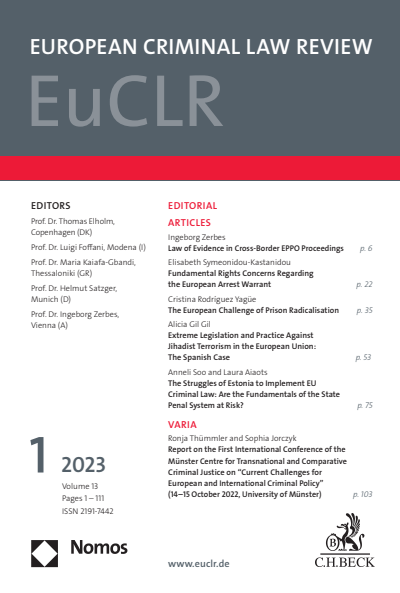
Twenty-five years after the idea of establishing a European Public Prosecutor's Office (EPPO) was mooted, the office became operational in June 2021. It was intended to provide for a paradigm shift in the prosecution of serious fraud against the EU...
The European Arrest Warrant, adopted twenty years ago, has proved to be a useful instrument for strengthening transnational cooperation between EU Member States in the field of criminal law. Still, its implementation has revealed serious problems...
Prisons have become a key element in the prevention of international terrorism. To keep them from becoming a breeding ground for violent extremism, generating or fostering radicalisation, both the Council of Europe and the EU have developed prison...
Spanish criminal and penitentiary legislation and practice relating to the crime of terrorism have undergone a further notable expansion with the emergence of jihadist terrorism. This article demonstrates how legislation and practice in this area...
Today, countries are no longer as free in shaping their penal systems as they used to be. By becoming members of a supranational organisation such as the European Union (EU), states have agreed to pursue a common criminal policy for common goals. To...