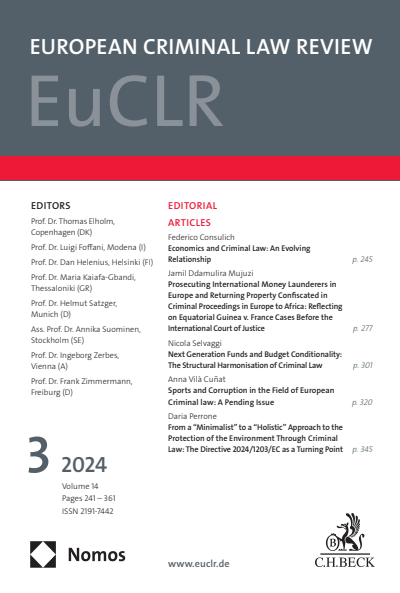
The European Criminal Law Review (EuCLR) is a journal dedicated to the development of European Criminal Law and the cooperation in criminal matters within the European Union. In these areas the Lisbon Treaty has supposedly brought about the most important changes and also the greatest challenges for the future. It is the journal’s ambition to provide a primary forum for comprehensive discussion and critical analysis of all questions arising in relation to European Criminal Law. It will include articles and relevant material on topics such as - the harmonisation of national criminal law in consideration of European legal instruments, - the implementation of the principle of mutual recognition in the area of cooperation in criminal matters and the development towards the creation of a European Public Prosecutor, - the emergence of a balanced European Criminal Policy based on fundamental rights, freedom and democracy with particular reference to the Charter of Fundamental Rights of the European Union and the European Convention on Human Rights.
The proportionality principle is a fundamental aspect of European legal orders and central to European law, despite varying interpretations of what a ‘proportionality test’ entails in different contexts. This was evident when the Court of...
The principle of legality appears to have recently gained less prominence in the European criminal field. The significant array of leading judgments to draw the rationale of this overarching principle has been slow-paced, with negative impacts on...
The subsidiarity principle under Art. 5 para. 3 TEU involves two conditions for the EU to act in shared areas of competence: material and procedural subsidiarity. The first requires demonstrating why the Union’s objective(s) cannot be sufficiently...
The article examines the role of “precedent” in the European Court of Human Rights’ case-law on procedural fairness under Article 6 of the ECHR. Although not formally bound by prior decisions, the Court systematically relies on them to ensure...
This article examines the nature, legal framework and implications of remote participation in criminal proceedings within the European Union. It explores the balance between technological advancement – which enhances efficiency and streamlines...