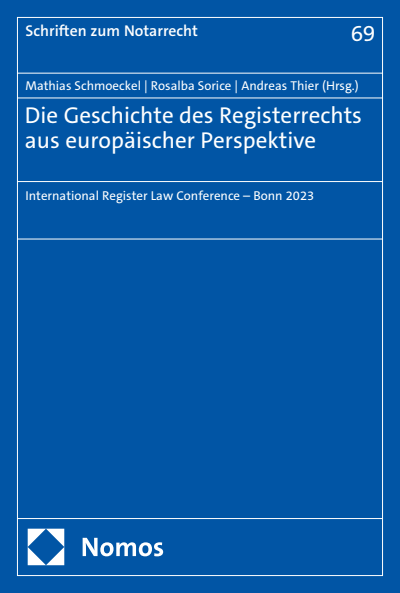
Die Geschichte des Registerrechts aus europäischer Perspektive
International Register Law Conference – Bonn 2023- Editors:
- | |
- Series:
- Schriften zum Notarrecht, Volume 69
- Publisher:
- 2025
Summary
Lately, it has become clear to which degree individuals have to provide state officials with private information in order to solve all sorts of new problems: The COVID pandemic made it necessary that the state acquired vaccine doses for the population, while individuals had to demonstrate their need. Electronic storage and sending of knowledge made it easier to exchange information between individuals and public authorities. With regard to the question of informational self-determination, registration has become a central issue of the new legal order. In 2023, we held an international conference on register law. The different perspectives are shown in this book and can be a start to understanding this issue and to developing new ideas.With contributions byProf. Dr. María Aránzazu Calzadilla Medina | Prof. Dr. John Finlay | Prof. Dr. Arndt Kiehnle | Prof. Dr. Arzu Oğuz | Prof. Dr. Laurent Pfister | Triinu Rennu | Prof. Dr. Thomas Rüfner | Prof. Dr. Mathias Schmoeckel | Prof. Dr. Rosalba Sorice | Prof. Dr. Martin Sunnqvist | Prof. Dr. Andreas Thier, M.A.
Keywords
Search publication
Bibliographic data
- Edition
- 1/2025
- Copyright Year
- 2025
- ISBN-Print
- 978-3-7560-2384-4
- ISBN-Online
- 978-3-7489-5225-1
- Publisher
- Nomos, Baden-Baden
- Series
- Schriften zum Notarrecht
- Volume
- 69
- Language
- German
- Pages
- 234
- Product Type
- Edited Book
Table of contents
- Titelei/Inhaltsverzeichnis No access Pages 1 - 6
- Autorenverzeichnis No access Pages 7 - 8
- Introduction No access Pages 9 - 12Authors:
- Authors:
- I. What is a register? No access
- 1. Taxes and the Census No access
- 2. The provincial census in Iudaea No access
- 3. Tax data No access
- III. Roman cadastres No access
- IV. The bibliothéke enktéseon (Register of Acquisitions) in Roman Egypt No access
- V. Conclusion No access
- Authors:
- I. Introduction No access
- II. Late Antique Foundations and Medieval Developments of Ecclesiastical Register No access
- III. Ecclesiastical Registers in the Early Modern Period No access
- IV. Canon Registers and the Rise of Secular Registers No access
- V. Conclusion No access
- Authors:
- I. Introduction: No access
- 1. Archiving No access
- 2. History of the General Directorate of Land Registry and Cadastre No access
- a) Tahrir books No access
- b) Mufassal Books No access
- c) İcmal Notebooks No access
- d) Ruznamçe Books No access
- e) Cebe Notebooks No access
- f) Kal'a and Mustahfazat Notebooks No access
- g) Derdest Notebooks No access
- h) Anatolia and Rumelia Attendance Books No access
- i) Evkaf Books No access
- j) Vakıf (Foundation) Cedid Books and Documents No access
- k) Mülkname No access
- 4. Books and Documents that constitute the basis of ownership No access
- 1. In General No access
- 2. Ottoman Period Tahrir Tradition and Population Records No access
- 3. Population Registration Scheme No access
- 4. Administrative Organisation in Population Services No access
- IV. Conclusion: No access
- Authors:
- I. What is a register? What is a public register? No access
- II. Proliferation, dematerialization, personal data and privacy: current public registers No access
- III. “Documentary revolution”, emergence and proliferation: history of public registers in France No access
- aa) Civil status registers, between “public memory” and “property” of citizens No access
- bb) The late establishment of a “civil status register” of merchants and companies No access
- b) The introduction of public registers of private deeds confronted by the secrecy of estate No access
- aa) Between publicity and secrecy: variety and variations in the rules of communication of registered documents under the Ancien Régime No access
- bb) “Everything is public”: contemporary law on the communication of registered documents No access
- cc) Legal certainty and security of third parties, justifications for making registers public No access
- aa) Restrictions on the publication of notaries’ registers and tax registration No access
- bb) The “secrecy of filiation”: restrictions on the communication of civil status records No access
- cc) A new balance between public registers and the protection of privacy and personal data? No access
- Authors:
- II. The natural person and the Civil Registry No access
- III. The Land Registry and the significance of registry information No access
- IV. Approach to the Spanish cadastral information system: real estate cadaster No access
- V. The Commercial Registry as an instrument for economic development No access
- VI. The Public Insolvency Registry as a public, free, and permanent registry No access
- VII. Guiding principles and purpose of the Registry of Movable Property No access
- VIII. The Water Registry: Guaranteeing Legal Security in the Framework of Water Use and Exploitation No access
- IX. The Central Registry of Ultimate Beneficial Ownership: Pursuing Transparency No access
- X. The Right of Association before the National Register of Associations No access
- XI. The Role of the National Register of Foundations in Achieving General Interest Purposes No access
- XII. Final Recapitulation No access
- Creation of fiscal Registers in Modern Italy: tax function or control tool? No access Pages 159 - 168Authors:
- Authors:
- I. Introduction and background No access
- II. Land and population registers for taxation purposes: “jordeböcker” and “mantalslängder” No access
- III. Church records according to the 1686 Church Act No access
- IV. Estate inventories according to the 1734 Law Code of the Realm No access
- V. A new real estate register in 1875 No access
- VI. Trade register introduced in 1888 No access
- VII. Concluding comments No access
- Authors:
- I. Introduction No access
- II. Structure of the Land Register No access
- III. The Land Cadastre No access
- IV. Problems that arose during the implementation of land consolidation No access
- V. Land consolidation as a practical aid in solving issues No access
- VI. Summary No access
- Authors:
- I. The creation of registers No access
- 1. Provision of formal evidence No access
- 2. Notice of facts No access
- 3. Preservation No access
- 4. Execution No access
- 5. Creation of rights No access
- 6. Data creation No access
- III. Scottish records in the British context No access
- IV. Maintaining the security of the records No access
- V. Oversight of the registers No access
- VI. Management of registers No access
- VII. The quality of writing No access
- VIII. National versus local registers No access
- IX. The mechanics of local registers No access
- X. Registration of births, deaths and marriages No access
- XI. Conclusion No access
- XII. Acknowledgements No access
- Authors:
- I. Definition of the term ‘register under private law’ No access
- II. The development of public registers – a consequence of the emergence of the modern state? No access
- III. Older registers of rulers' chanceries No access
- IV. Medieval registers of German cities (municipal registers) No access
- 1. Instrumenta publica … fidem faciunt No access
- 2. Public deeds issued by governmental authorities? No access
- VI. Two aspects of ‘publicus’ and ‘öffentlich’ in the modern era: official, governmental, referring to the state or freely accessible to all, open, not secret No access
- VII. Notarial deeds in modern ages: public faith based on official power No access
- VIII. Medieval Cologne shrine books (Schreinsbücher) and other municipal registers: Verschweigung No access
- IX. Formal act-theory in the 19th century: Adolf Exner (1841–1894) No access
- X. Section 892 German Civil Code No access
- XI. Immediate indefeasibility and deferred indefeasibility No access
- 1. Nikolaus Thaddäus v. Gönner (1764–1827): Formal and material publicity No access
- 2. Gönner: The responsibility of the right holder who omits the protestation against an incorrect entry No access
- XIII. Results (partly repressed or forgotten since the 20th century) No access
- XIV. Recent developments No access