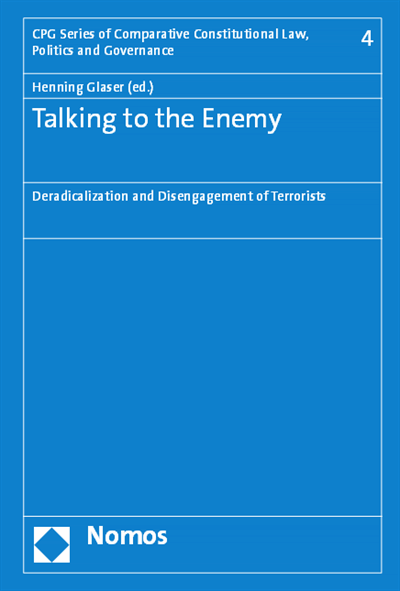
Talking to the Enemy
Deradicalization and Disengagement of Terrorists- Editors:
- Series:
- CPG Series of Comparative Constitutional Law, Politics and Governance, Volume 4
- Publisher:
- 2017
Summary
As a collected volume, ‘Talking to the Enemy’ focuses on various aspects of the communicative dimension of counter-terrorism and its marginal conditions. In its first part, the book features eight articles providing a variety of perspectives on Western as well as Asian efforts in countering potentially violent extremism. Besides more theoretical approaches, they offer practical insights from the coal face of counter-terrorism, especially in the field of disengagement, deradicalization and rehabilitation. The second part is made up of a longer essay breaking down the effects of the fundamental post-9/11 trends in counter-terrorism on single strategies of how to engage with the adversary in form of de-radicalization, counter-terrorism and counter-insurgency. A third part rounds off the volume with additional material including an interview on the Islamic State and its impact on geopolitics with a former chief intelligence advisor to the Indian government. The book addresses those generally interested in countering radicalization, terrorism, counter-insurgency, conflict and IR/security studies as well as particular communicative techniques and the politics of counter-terrorism from different regional angles.
Search publication
Bibliographic data
- Edition
- 1/2017
- Copyright Year
- 2017
- ISBN-Print
- 978-3-8487-0433-0
- ISBN-Online
- 978-3-8452-4739-7
- Publisher
- Nomos, Baden-Baden
- Series
- CPG Series of Comparative Constitutional Law, Politics and Governance
- Volume
- 4
- Language
- English
- Pages
- 374
- Product Type
- Edited Book
Table of contents
- Titelei/Inhaltsverzeichnis No access Pages 1 - 8
- Authors:
- A. Introduction No accessAuthors:
- B. (De-)radicalization, Disengagement and Rehabilitation: Processes, Programs and Marginal Conditions No accessAuthors:
- Bibliography No accessAuthors:
- Authors:
- A. Introduction No accessAuthors:
- B. Knowing the Enemy No accessAuthors:
- C. The Right War? No accessAuthors:
- D. The Just War? No accessAuthors:
- E. Preemption No accessAuthors:
- F. Reciprocity No accessAuthors:
- G. Limits of Coercive Power No accessAuthors:
- H. Countering Radical Ideology No accessAuthors:
- I. De-radicalization/Disengagement No accessAuthors:
- J. Rehabilitation No accessAuthors:
- K. Education Reform No accessAuthors:
- L. Communication Management No accessAuthors:
- M. A Platform for the Moderate Voice No accessAuthors:
- Bibliography No accessAuthors:
- Authors:
- A. Introduction No accessAuthors:
- B. The Context No accessAuthors:
- Authors:
- I. Global Programs No accessAuthors:
- II. Challenges and Opportunities No accessAuthors:
- Authors:
- I. The Origins of Rehabilitation No accessAuthors:
- II. The Contemporary Wave of Rehabilitation No accessAuthors:
- E. Conclusion No accessAuthors:
- Bibliography No accessAuthors:
- Authors:
- A. Introduction No accessAuthors:
- B. The Contested Concept of De-radicalization No accessAuthors:
- C. Exemplary Practices of De-radicalization in Southeast Asia as a Means for Counter-Terrorism No accessAuthors:
- D. De-radicalization Efforts in the Philippines: The Case of Muslim Detainees Accused of Various Crimes Associated Witch Terrorism No accessAuthors:
- E. Challenges in Implementing De-radicalization Programs as Counter-Terrorism Measures No accessAuthors:
- Authors:
- I. Visitation No accessAuthors:
- II. Counseling No accessAuthors:
- III. Legal Assistance No accessAuthors:
- IV. Social and Economic Assistance No accessAuthors:
- V. After Care No accessAuthors:
- G. Conclusion No accessAuthors:
- Bibliography No accessAuthors:
- Authors: |
- A. Introduction No accessAuthors: |
- B. Terrorist Action as Rational Action No accessAuthors: |
- C. Terrorist Action as Radical Action No accessAuthors: |
- D. The Normalcy of the Extreme No accessAuthors: |
- Authors: |
- I. De-Radicalization Programs: Possible Effects on Extremism, Radicalism, and Terrorist Motives No accessAuthors: |
- II. De-radicalization and Distributions of Extremism No accessAuthors: |
- F. Conclusion No accessAuthors: |
- Bibliography No accessAuthors: |
- Authors:
- A. Introduction No accessAuthors:
- Authors:
- I. The Danger Signs No accessAuthors:
- II. The Root of the Problem No accessAuthors:
- Authors:
- I. The Premise of the Terrorist No accessAuthors:
- II. The Narrative of the Terrorist and its Inconsistencies No accessAuthors:
- Authors:
- 1. The Audience No accessAuthors:
- Authors:
- a) Knowing the Audience No accessAuthors:
- b) Knowing the Subject No accessAuthors:
- Authors:
- 1. Start Listening No accessAuthors:
- 2. Understand and Counter the Message of the Enemy No accessAuthors:
- 3. Learning from Models of Youth Radicalization to Develop Modules of Counter-Radicalization No accessAuthors:
- 4. Developing Tools to Measure Effectiveness of the Counter-Narrative Mechanisms No accessAuthors:
- Authors:
- I. Hear Things you do not like to Hear No accessAuthors:
- II. Make Mistakes Fast and Rectifications Faster No accessAuthors:
- III. Be Humble, Seek Help and Form Alliances No accessAuthors:
- IV. Focus on What Can Be Done No accessAuthors:
- V. Building Programs Around an Institution or Alliance and not as an Individual No accessAuthors:
- VI. Treating the Youth as Part of the Solution and not Part of the Problem No accessAuthors:
- E. Conclusion No accessAuthors:
- Bibliography No accessAuthors:
- Authors:
- Authors:
- I. Starting with “Roots” No accessAuthors:
- II. Thesis: Radicalization of Human Beings Done by Human Beings No accessAuthors:
- B. Defining Phenomena and Measures No accessAuthors:
- Authors:
- I. The National Democratic Party of Germany: Old Wine in new Bottles No accessAuthors:
- II. The Religious Fanaticism: Islamism, Salafism, Wahhabism No accessAuthors:
- III. Effects of Radicalization No accessAuthors:
- Authors:
- I. The German drop-out Program EXIT No accessAuthors:
- II. HATIF No accessAuthors:
- III. Radicalization Awareness Network (RAN) No accessAuthors:
- IV. European Network of Deradicalization (ENoD) No accessAuthors:
- Authors:
- I. Vengeance and Group Pressure No accessAuthors:
- II. Embedding of Racist or Fanatic Thoughts (stage “early”) No accessAuthors:
- III. Interim Findings: Opt-out Programs are not Enough No accessAuthors:
- Authors:
- I. Banning Extremist Groups and Associations (stage “repressive”) No accessAuthors:
- II. Legal Sanctions against Extremists (stage “repressive”) No accessAuthors:
- III. Counter-Terrorism Legislation in Germany No accessAuthors:
- IV. Joint Terrorism Defense Centre of Germany (GTAZ) No accessAuthors:
- V. Counter-Terrorism Legislation in Europe No accessAuthors:
- VI. Sense of Punishment No accessAuthors:
- VII. Special Law for the Enemies of our Values? No accessAuthors:
- Authors:
- I. Knowing the “Enemy” (1st step) No accessAuthors:
- II. Finding the “Enemy” (2nd step) No accessAuthors:
- III. Fighting the “Enemy” No accessAuthors:
- G. Conclusion No accessAuthors:
- Bibliography No accessAuthors:
- Authors: |
- A. Introduction No accessAuthors: |
- B. Points of Intersection and Divergence No accessAuthors: |
- C. Types of Linkages No accessAuthors: |
- D. Incentives and Disincentives No accessAuthors: |
- E. Drivers and Enablers No accessAuthors: |
- Authors: |
- I. Cutting off the Money Supply No accessAuthors: |
- II. Improving Governance and Reducing Areas of Ungoverned Space No accessAuthors: |
- G. Concluding Remarks No accessAuthors: |
- Bibliography No accessAuthors: |
- Authors:
- Authors:
- I. A new Terrorism? No accessAuthors:
- II. A new Counter-Terrorism? No accessAuthors:
- Authors:
- I. Communication and Counter-Terrorism No accessAuthors:
- II. Core Values and Counter-Terrorism No accessAuthors:
- III. Deriving a Dichotomous Model View on Counter-Terrorism No accessAuthors:
- Authors:
- I. Filling the Gap: The Global War on Terror and the Cold War No accessAuthors:
- II. Paradigm Shift No accessAuthors:
- Authors:
- 1. Foundation No accessAuthors:
- 2. Continuation No accessAuthors:
- D. Conclusion and Outlook: Counterterrorism and Communication in Times of the GWOT No accessAuthors:
- Bibliography No accessAuthors:
- Interview with Major General Ashok Hukku (ret.) on the Islamic State No access Pages 355 - 364Authors:
- Authors:
- A. Sri Lankan Context No accessAuthors:
- B. Rehabilitation of Ex-LTTE Combatants No accessAuthors:
- C. Engagement of Individuals with Extremist Ideology No accessAuthors:
- D. Conclusion No accessAuthors:
- List of Contributors No access Pages 371 - 372
- Index No access Pages 373 - 374