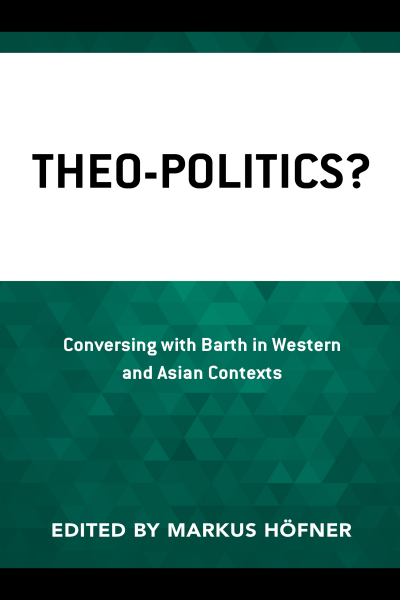
Theo-Politics?
Conversing with Barth in Western and Asian Contexts- Editors:
- Publisher:
- 2021
Summary
Using the theological work of Karl Barth as a resource for present-day inquiry, the contributors in this volume discuss the complex interconnections between the religious and the political designated by the term theo-politics. Speaking from various political and cultural contexts (Germany, the United Kingdom, the United States, Hong Kong, Taiwan, and the People’s Republic of China) and different disciplinary perspectives (Protestant Theology, Political Sciences, and Sociology), the contributors address contemporary challenges in relating the religious and the political in Western and Asian societies. Topics analyzed include the impact of diverse cultural backgrounds on given theo-political arrangements, theological assessments of political power, the political significance of individual and communal Christian existence and the place of Christian communities in civil societies. In their nuanced discussions of these topics, the contributors neither advocate for a privatized, apolitical understanding of the Christian faith nor for a religious politics seeking to overcome modern processes of differentiation and secularization. Critically engaging Barth’s theology, they examine the Christian responsibility in and for the political sphere and reflect on the practice of such responsibility in Western and Asian contexts.
Keywords
Search publication
Bibliographic data
- Edition
- 1/2021
- Copyright Year
- 2021
- ISBN-Print
- 978-1-9787-1005-4
- ISBN-Online
- 978-1-9787-1006-1
- Publisher
- Lexington, Lanham
- Language
- English
- Pages
- 500
- Product Type
- Edited Book
Table of contents
- Contents No access
- Figures No access
- Tables No access
- Acknowledgments No access
- Theo-Politics? No access
- Conversing with Barth in Western and Asian Contexts No access
- Secular Politics or the Political in Theological Frame? Beyond an Apparent Opposition No access
- Theo-Politics—Today and Tomorrow No access
- Notes No access
- The Kingdom of God No access
- The Kingdom in the World, or: Church and State No access
- Church, Community, and the Sino-Christian Theologians: A Footnote No access
- Afterword No access
- Notes No access
- Karl Barth—A Theological Trickster No access
- Mission Revisited No access
- Contextual Theology—Intercultural Theology No access
- Contextuality and Dialogical Imperative as Forms of Theological Existence No access
- Notes No access
- Recent Controversies over Male Circumcision No access
- Karl Barth on Baptism No access
- Drawing upon Christian Theology to Inform Current Debates on Circumcision No access
- Conclusion No access
- Notes No access
- Methodical Reflection 1: Karl Barth’s Barmen II, and the Lutheran “Estates”: New Alliances No access
- Methodical Reflection 2: An Ethics of the Estates as an Ethics of the Middle Range for—among Other Things—Questions of Health Care No access
- The “Clash of the Spirit of the Age with Nature”—Reasons for the Rapid Increase in the Rate of Cesarean Sections No access
- Aspects of a Theology of Birth No access
- Luther’s Doctrine of the Three Estates in His Exegesis of the Psalms (1533) No access
- Hanna Strack’s Phenomenology of the Holiness of Birth, and Women as Co-operators of God’s Creative Action No access
- Making Connections and Brief Look at Ethical Concretization No access
- Notes No access
- Introduction No access
- Pre-Cold War Period (1840s to 1946) No access
- Cold War Period 1 (1946 to 1966) No access
- Cold War Period 2 (1966–1990) No access
- Post-Cold War (or Continuation of the New Cold War): 1991 to 2013 No access
- Conclusion No access
- Notes No access
- Introduction No access
- The Nation and the Fatherland as Medium of the Divine, Where Immanence and Transcendence Meet: Otto Dibelius in 1918 No access
- The Theological and Cultural Dynamics in Fichte’s Deification of the National State: A Theory of Life No access
- The “Timeless” Religio-Poietic Dynamic—An Intermediate Reflection No access
- Strategy 1: A Theological Decoupling of the Shortcut—Karl Barth’s Tambach Lecture of 1919 No access
- Strategy 2: Radical Desacralization and Demythologization—Karl Barth’s Treatment of Nation in 1951 No access
- Paradoxes and Temptations—Concluding Remarks No access
- Notes No access
- Introduction No access
- Sovereignty and the Rule of Law No access
- The Political Use of the Law No access
- Justification and Justice No access
- Legality and Legitimation No access
- Barth on Legality and Legitimacy No access
- Conclusion No access
- Notes No access
- Against the Liberal Order No access
- Decision and Autonomy No access
- Exceptional Revelation No access
- Transcendence and Competitive Sovereignties No access
- Conclusion No access
- Notes No access
- Introduction No access
- “Welcome to Surveillance Society!” Politics of Visibility, Markets of Visibility, and the Visible Self No access
- “Lordless Powers”: Knowledge Gone Wild No access
- “Cave, cave, Dominus videt!” Panoptic Inspection and the “Eye of God” No access
- “Dataism” and the End of Theory: Surveillance as Religion No access
- “Whither Shall I Flee?” Living under Drones No access
- Reclaiming the “Panoptic Psalm” No access
- Demonology Wanted: New Perspectives in Political Ethics? No access
- Notes No access
- Sino-Theology and Chinese Thought No access
- The “Substance” of Chinese Culture and the Theology of Karl Barth No access
- Zhang Xu: Karl Barth’s Political Theology in a Chinese Context No access
- Sino-Theology as Public Theology No access
- Notes No access
- Barth on God’s Distributive Justice No access
- The Political Payoff of Barth’s Reconfiguration No access
- God’s Righteousness: Problems and Perspectives No access
- Notes No access
- Introduction No access
- The Challenge of Global Democracy No access
- Religion and Democracy in the Era of Globalization No access
- The Theories of Carl Schmitt and Karl Barth—A Framework for Contemporary International Political Theory? No access
- Conclusion No access
- Notes No access
- Introduction No access
- Barth’s Political Theology According to John Howard Yoder: Sectarian Protestantism? No access
- Barth’s Shift from Gathering to Sending: The Nonsectarian Particularity of the Church No access
- Barth, Political Ecclesiology, and Christian Responsibility for Society and State No access
- Conclusion No access
- Notes No access
- Liberal Democracy in Critique No access
- An Alternative Vision of Democracy No access
- Barth’s Conception of the State No access
- Democracy: Preferable, but Relativized No access
- The Church’s Relationship with the State No access
- Yoder’s Appraisal of Democracy No access
- Yoder’s Democratic Ecclesiology No access
- Continuities No access
- Distinctions No access
- Learning from Democracy No access
- Conclusions No access
- Notes No access
- Introduction No access
- Sacred Rhetoric No access
- Karl Barth and the “Great Positive Possibility” No access
- Open Evenings No access
- An Ethos of Openness No access
- Beyond the Legacy of Malformation No access
- Training for the Serious Game No access
- Conclusion No access
- Notes No access
- Preliminary Remarks and Outline No access
- Everything Perishable IS only a “Gleichnis” No access
- Everything Perishable is ONLY a “Gleichnis” No access
- Everything Perishable is only a “Gleichnis” [OF THE IMPERISHABLE] No access
- Some Philosophical-Theological Dimensions of the Concept of “Gleichnis” No access
- “Christian Community and Civil Community” (1946)28 No access
- A Preliminary Analysis of the Situation in Mainland China in a Postcolonial and Globalizing Context No access
- “The Three-Self Patriotic Movement of the Protestant Church” No access
- The Politically Engaged Christians No access
- The Apolitical Mainstream No access
- Basic Critiques and Preliminary Proposals from the Viewpoint of Barth’s Political Theology No access
- Notes No access
- Introduction: Religion from a Sociological Perspective No access
- Religious Developments in Germany—Theoretical Remarks No access
- Secularization at the Social Level: The Relation between Religion and Society No access
- Individual Secularization No access
- What is Going on in the Protestant Church? No access
- The Theoretical Explanation of the Empirical Findings No access
- Consequences: Secularization and More Discussions about Religion and Politics No access
- Notes No access
- Covenantal Relationship as a Framework for Political Theology No access
- Barth’s “Realism” No access
- “Revolt”: The Heart of Christian Political Action No access
- Conclusion No access
- Notes No access
- Introduction No access
- Religious Diversity and Democracy in Hong Kong No access
- Public Theology in the Chinese-Speaking World No access
- Patriotism and “Movement against Nationalistic Education” No access
- Pacifism, Civil Disobedience, and “Occupy Central” No access
- Theological Integrity and Public Theology No access
- Concluding Remarks No access
- Notes No access
- God’s Trinitarian Sovereignty: Perichoresis and Appropriation No access
- God’s Election and Antidemocratic Hegemony No access
- Democratic Freedom and God the Creator No access
- Democratic Participation and God the Reconciler No access
- Democratic Promise and God the Redeemer No access
- Notes No access
- Introduction No access
- 1950–1980 No access
- 1980–1997 No access
- Post-1997 No access
- Dialogue between Barth and the Hong Kong Experience No access
- Notes No access
- Introduction No access
- Two “Death” Alerts No access
- A City without Politics No access
- One Country, Two Systems: An Unprecedented Experiment? No access
- Struggles for Citizenship No access
- Church at the Crossroad No access
- Freedom to Serve in the midst of Political Change No access
- The Paradoxical Nature of the Church’s Political Responsibility No access
- Primacy of Humanity No access
- The Dynamic Notion of Near and Distant Neighbors No access
- In Place of a Conclusion No access
- Notes No access
- Religious Deprivatization and Democratization: Global Phenomena No access
- Democratization to Democracy: Not a Linear Trajectory No access
- Religion, Democratization, and Democracy No access
- Religion and Political Society No access
- Religion and Civil Society No access
- Religion and the State No access
- Poland No access
- South Korea No access
- Conclusion No access
- Notes No access
- Introduction No access
- What Is the Social Gospel? No access
- Inequality No access
- Criminal Justice No access
- Conclusion: Generosity, Mercy, and the Liberal State No access
- Why Is Renewing the Social Gospel So Difficult? No access
- Conclusion: The Role of Theology and the Churches in This Pluralistic Conversation No access
- Notes No access
- What Is Civil Society? No access
- Civil Society and Religion in Germany at the Beginning of the Third Millennium as a Concrete Model and Example No access
- Law and Spirit: Biblical Value Systems and Civil Society No access
- Notes No access
- Index No access Pages 487 - 492
- About the Editor No access Pages 493 - 494
- About the Contributors No access Pages 495 - 500