, to see if you have full access to this publication.
Monograph No access
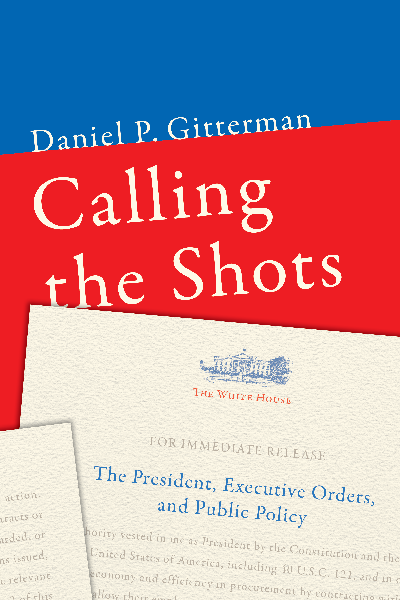
Calling the Shots
The President, Executive Orders, and Public Policy
Authors:
Publisher:
2017
Summary
Modern presidents are CEOs with broad powers over the federal government.
The United States Constitution lays out three hypothetically equal branches of governmentthe executive, the legislative, and the judicialbut over the years, the president, as head of the executive branch, has emerged as the usually dominant political and administrative force at the federal level. In fact, Daniel Gitterman tells us, the president is, effectively, the CEO of an enormous federal bureaucracy.
Using the unique legal authority delegated by thousands of laws, the ability to issue executive orders, and the capacity to shape how federal agencies write and enforce rules, the president calls the shots as to how the government is run on a daily basis. Modern presidents have, for example, used the power of the purchaser to require federal contractors to pay a minimum wage and to prohibit contracting with companies and contractors that knowingly employ unauthorized alien workers.
Presidents and their staffs use specific tools, including executive orders and memoranda to agency heads, as instruments of control and influence over the government and the private sector. For more than a century, they have used these tools without violating the separation of powers. Calling the Shots demonstrates how each of these executive powers is a powerful weapon of coercion and redistribution in the president's political and policymaking arsenal.
Search publication
Bibliographic data
Edition
1/2017
Copyright Year
2017
ISBN-Print
978-0-8157-2902-0
ISBN-Online
978-0-8157-2903-7
Publisher
Rowman & Littlefield, Lanham
Language
English
Pages
1
Product Type
Monograph
Table of contents
ChapterPages
Table of Contents No access
Acknowledgments No access
The President, Executive Orders and Memos, and Public Policy No access Pages 1 - 22
The President and the Power of the Purchaser No access Pages 23 - 38
Barack Obama and the Power of the Purchaser No access Pages 39 - 52
The President and the Power of the Employer No access Pages 53 - 72
The President and the Power of the Equal Opportunity Employer No access Pages 73 - 92
Barack Obama and the Power of the Employer-in-Chief No access Pages 93 - 104
The President and the Power of the Ethical Employer No access Pages 105 - 118
The President and the Power of the Payer No access Pages 119 - 134
Impact of the President's Executive Powers on Politics and Policy No access Pages 135 - 146
Appendix 1: The Power of the Purchaser and Key Policy Outcomes No access Pages 147 - 152
Appendix 2: Obama, the Power of the Purchaser, and New Policy Areas No access Pages 153 - 154
Appendix 3: The Power of Employer-in-Chief and Policy Outcomes No access Pages 155 - 157
Appendix 4: Power and the Equal Opportunity Employer and Policy Outcomes No access Pages 158 - 161
Appendix 5: The Power of the Ethical Employer-in-Chief and Policy Outcomes No access Pages 162 - 163
Appendix 6: The Power of the Payer-in-Chief and Policy Outcomes No access Pages 164 - 168