, to see if you have full access to this publication.
Monograph No access
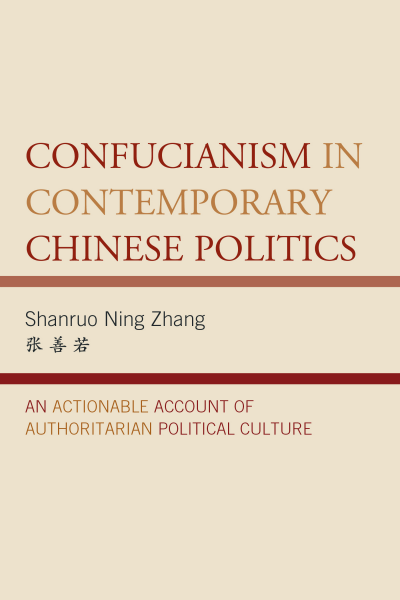
Confucianism in Contemporary Chinese Politics
An Actionable Account of Authoritarian Political Culture
Authors:
Publisher:
2016
Summary
This book examines the ways in which Confucian political culture operates in contemporary Chinese politics and influences its development. The author argues that the authoritarian political culture performs functions similar to the democratic political culture, drawing on a wide range of data—surveys, interviews, archives, Public Hearing Meeting records, and the Party Congress Reports of the Chinese Communist Party—to substantiate and illustrate these arguments. In an authoritarian political system, the “legitimating values” of the authoritarian political culture persuade the public of their government’s legitimacy and the “engaging values” equip individuals with a set of cultural dispositions, resources, and skills to acquire political resources and services from the state. In the context of Chinese politics, personal connections infused with affection and trust—the Social Capital in the Confucian culture—facilitate political engagement. Despite the country’s continuous advocacy for the “rule of law,” state and public perceptions of legal professionals and legal practices, such as mediation and lawyer-judge relations, are fundamentally moralized. A new “people ideology,” which originated in the Confucian political culture, has been re-appropriated to legitimate the Party’s hegemonic governing position and policies.
Keywords
Search publication
Bibliographic data
Edition
1/2016
Copyright Year
2016
ISBN-Print
978-0-7391-8239-0
ISBN-Online
978-0-7391-8240-6
Publisher
Lexington, Lanham
Language
English
Pages
248
Product Type
Monograph
Table of contents
ChapterPages
Contents No access
Acknowledgments No access
Chapter One. Confucian Political Culture in China No access Pages 1 - 16
Chapter Two. An Actionable Account of Authoritarian Political Culture No access Pages 17 - 52
Chapter Three. Morality and Law in Confucianism No access Pages 53 - 78
Chapter Four. Guanxi, Informal Politics, and Everyday Forms of Political Engagement No access Pages 79 - 96
Chapter Five. Moralizing the Rule of Law No access Pages 97 - 132
Chapter Six. The Gateways of Political Communication in China No access Pages 133 - 160
Chapter Seven. The Silent Revolution in the Official Rhetoric of the CCP No access Pages 161 - 200
Chapter Eight. Conclusion No access Pages 201 - 210
Appendix 1. Interviewees and Interviews No access Pages 211 - 214
Appendix 2. Information on Profiles of People’s Mediators No access Pages 215 - 216