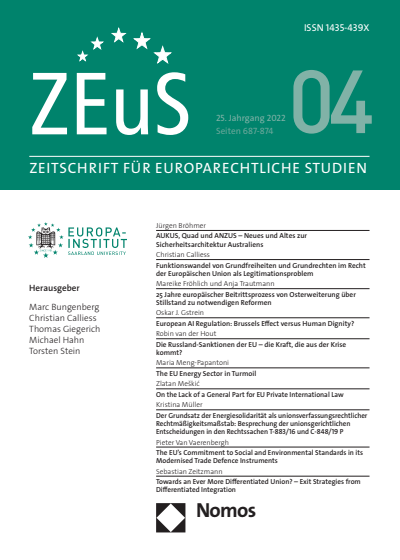
The Zeitschrift für Europarechtliche Studien (ZEuS) is published by the Europa-Institut, law department, of Saarland University since 1998. The concept of ZEuS is a wide one: the journal addresses current aspects and fundamental problems connected with European Integration, European law and International law. Consisting of articles especially in German and English which commentate on current developments in the law, ZEuS offers an ideal forum for contributors of both academic and professional backgrounds. Moreover, ZEuS makes a conscious effort to provide young academics and students with the opportunity to have their work published. Finally, all speeches held at the Europa-Institut are published in ZEuS. Website: www.zeus.nomos.de
This paper attempts to give an overview of core elements of the Australian Security Architecture. The focus lies on new developments in the collaboration with the United States and the United Kingdom around the procurement of nuclear propulsion...
The status of the Union citizenship is defined by individual rights. Since the groundbreaking van Gend & Loos ruling of the European Court of Justice, the European fundamental freedoms have protected the economic freedom of the “market...
The European Union has multiplied the number of its members since its founding. Although it faces numerous challenges, accession seems to continue to offer great incentives. Here, for example, the participation in the internal market, regional...
The European Commission proposal for a legal framework to comprehensively regulate Artificial Intelligence (AI) came after years of public consultation and deliberation. Most prominently the AI High Level Expert Group (AI HLEG) prepared ethical...
The Russian aggression against Ukraine has shifted the European security order. For the European Union (EU) and many other (western) states, sanctions against Russia and Belarus are the means of choice to assert themselves as relevant players. In...
Climate change poses an existential threat to our planet, our health, and our well-being. This has been identified by the European Union (EU), which seeks to change its regulatory framework to adjust to a more sustainable paradigm. This paper seeks...
The question of a general part for EU Private International Law has attracted research and debate among PIL scholars long before the EU started to codify this legal field after the Amsterdam Treaty. However, the EU has made no attempt to make use of...
In the cases T-883/16 und C-848/19 P, the EU Courts have for the first time explicitly classified the solidarity between Member States enshrined in Article 194 (1) TFEU as a justiciable primary law standard of legality in the area of EU energy...
Since the modernisation of the Basic Regulations in 2017 and 2018, the EU explicitly exerts social and environmental goals through the application of its trade defence instruments. Whereas the Commission portrayed the new rules as a guarantee that...
In the past 25 years, differentiated policies and mechanisms of differentiated decision-making have rapidly gained prominence and relevance on EU level. It is not only well-known EU policies such as the euro currency or the Schengen area of...