, to see if you have full access to this publication.
Monograph No access
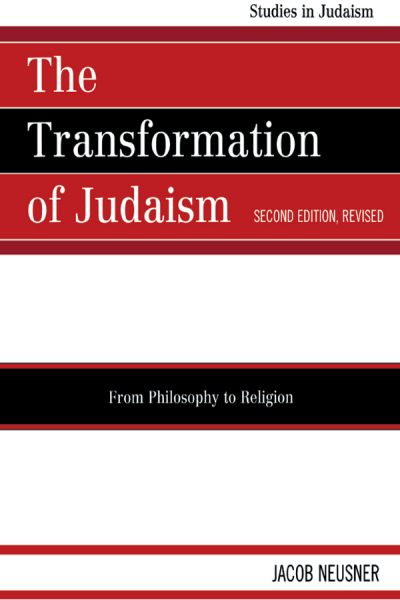
The Transformation of Judaism
From Philosophy to Religion
Authors:
Publisher:
2011
Summary
Jacob Neusner describes, analyzes, and interprets the transformation of one system of the Israelite social order by a connected but autonomous successor-system. He characterizes the successive systems classifying the one as philosophical and the other as religious. He explains the categorical account of each and sets forth the outcome of a number of topical studies on the category-formations of Rabbinic Judaism with special attention to the social order: politics, philosophy, and economics. These systems emerged as [1] autonomous when viewed synchronically, [2] connected when seen diachronically, and [3] as a continuous construction when seen at the end of their formative age. In their successive stages of categorical autonomy, connection, and finally continuity, the three distinct systems may be classified, respectively, as philosophical, religious, and theological, each one taking over and revising the definitive categories of the former and framing its own fresh, generative categories as well. The formative history of Judaism is the story of the presentations and re-presentations of categorical structures. In method, it is the exegesis of taxonomy and taxic systems. Now, after more than two decades, Neusner has decided to review the initial statement. Since the book summarizes ten years of work, from 1980 to 1990, on the Rabbinic category formations of social science politics, philosophy, and economics in the setting of the law and theology of Rabbinic Judaism from the Mishnah through the Bavli, 200-600 C.E., it seemed well worth the effort to recapitulate the original work. The revised introduction explains the omission of theology in his category-formation philosophy-religion-theology; Neusner's account of the Bavli produced the decade after this title was completed did not make possible the continuous description of the unfolding of the Rabbinic system. The pattern that appealed to Neusner from philosophy to religion to theology has not yet come to a satisfactory account. In the twenty years of work on the third layer of the canon up to the Bavli, a series of monographs clarified the theological system that sustained Rabbinic Judaism.
Search publication
Bibliographic data
Edition
1/2011
Copyright Year
2011
ISBN-Print
978-0-7618-5439-5
ISBN-Online
978-0-7618-5440-1
Publisher
Hamilton Books, Lanham
Language
English
Pages
293
Product Type
Monograph
Table of contents
ChapterPages
Table of Contents No access
Preface to the First Edition No access
Preface to the Second Edition, Revised No access
Introduction No access
Prologue to Part One: Philosophical Categories No access
Chapter 1: Modes of Thought: From Philosophy to Religion No access
Chapter 2: Scarce Resources: Philosophical Economics Reproduced No access
Chapter 3: Legitimate Violence: From Hierarchized Foci to Unitary Focus of Power No access
Prologue to Part Two: Counterpart Categories. Categorical Reformation and the New Structure No access
Chapter 4: Learning and the Category, "Torah" No access
Chapter 5: The Transvaluation of Value No access
Chapter 6: Empowerment and the Category, "The People Israel" No access
Prologue to Part Three: Comparison and Classification of Systems No access
Chapter 7: The New Learning: The Gnostic Torah No access
Chapter 8: The New Order: The Political Economy of Zekhut No access
Chapter 9: Enchanted Judaism and The City of God No access
Bibliography No access Pages 259 - 293
Similar publications
from the topics "Religion und Theologie allgemein"