Book Titles Open Access Full access

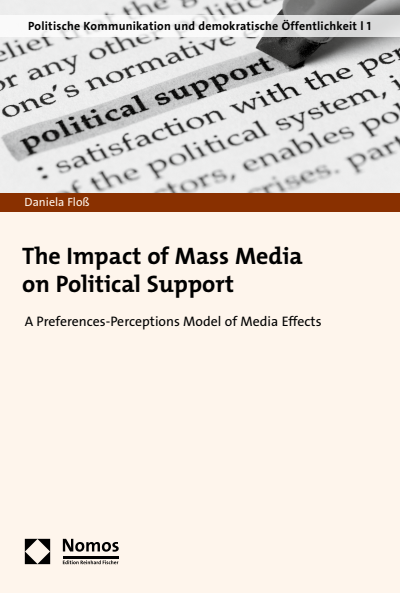
The Impact of Mass Media on Political Support

A Preferences-Perceptions Model of Media Effects
Authors:
Publisher:
 2010

Summary

Warum sinkt das Vertrauen der Bürger in die Politik? Aktuelle Forschungsergebnisse zeigen, dass die Art und Weise wie Medien über politische Ereignisse und Themen berichten zur politischen Malaise beiträgt. Die vorliegende Arbeit liefert wichtige Befunde zum Einfluss der Medienberichterstattung über politische Entscheidungsprozesse auf politisches Vertrauen. Im Mittelpunkt steht dabei die Rolle individueller Erwartungen und Ansprüche der Bürger an politische Prozesse.

Empirisch wurden Online-Befragungen, eine experimentelle Studie sowie eine Inhaltsanalyse der Berichterstattung durchgeführt. Die Ergebnisse belegen, dass Medien die Wahrnehmung politischer Prozesses prägen und dadurch das politische Vertrauen der Bürger schwächen können. Dabei zeigte sich: Vor allem dann, wenn die Medienberichterstattung den Eindruck erweckt, dass die tatsächlichen Entscheidungsprozesse nicht den eigenen Vorstellungen entsprechen, sinkt das politische Vertrauen.

Die Ergebnisse der Arbeit leisten einen Beitrag zur Spezifizierung der Bedingungen, unter denen Medienberichterstattung das Vertrauen der Bürger in die Institutionen und Akteure einer Demokratie schwächen kann.

Keywords


Bibliographic data

Copyright year
2010
ISBN-Print
978-3-8329-5387-4
ISBN-Online
978-3-8452-2530-2
Publisher
Nomos, Baden-Baden
Series
Politische Kommunikation und demokratische Öffentlichkeit
Volume
1
Language
English
Pages
218
Product type
Book Titles

Table of contents

ChapterPages
  1. Titelei/InhaltsverzeichnisPages 2 - 16 Download chapter (PDF)
  2. Political Support and Mass Media: Relevance and Objectives of this StudyPages 17 - 22 Download chapter (PDF)
      1. The Impact of Routine Use of Political Media InformationPages 23 - 27 Download chapter (PDF)
      2. The Impact of Certain Aspects of News CoveragePages 27 - 30 Download chapter (PDF)
      3. The Impact of Media Strategy FramesPages 30 - 32 Download chapter (PDF)
      4. Summary and ConclusionPages 32 - 34 Download chapter (PDF)
      1. Trough Effects on Social Reality PerceptionsPages 34 - 36 Download chapter (PDF)
      2. Trough Effects on Issue Accessibility or Perceived Issue ImportancePages 36 - 37 Download chapter (PDF)
      3. Trough Effects on EmotionsPages 37 - 37 Download chapter (PDF)
      4. Trough Effects on Political KnowledgePages 37 - 38 Download chapter (PDF)
      5. Summary and ConclusionPages 38 - 39 Download chapter (PDF)
      1. The Role of Media Trust and Media CredibilityPages 39 - 40 Download chapter (PDF)
      2. The Role of Political SophisticationPages 40 - 42 Download chapter (PDF)
      3. The Role of Intensity of General Media UsePages 42 - 43 Download chapter (PDF)
      4. The Role of Information Processing StrategiesPages 43 - 43 Download chapter (PDF)
      5. The Role of Individual PredispositionsPages 43 - 45 Download chapter (PDF)
      6. Summary and ConclusionPages 45 - 47 Download chapter (PDF)
    1. Summary and Suggestions for the Present StudyPages 47 - 49 Download chapter (PDF)
    1. The Preferences-Perceptions Relationship as Predictor of Political SupportPages 50 - 56 Download chapter (PDF)
      1. The Media’s Impact on the Perception of Political ProcessesPages 56 - 60 Download chapter (PDF)
      2. The Media’s Impact on Preferences Regarding Political ProcessesPages 60 - 61 Download chapter (PDF)
      3. The Media’s Presentations of Political ProcessesPages 61 - 63 Download chapter (PDF)
    2. Outline of the Preferences-Perceptions Model of Media EffectsPages 63 - 71 Download chapter (PDF)
    3. This Study’s Empirical Program to Test the ModelPages 71 - 73 Download chapter (PDF)
    1. Research QuestionPages 74 - 75 Download chapter (PDF)
      1. Content Analysis SamplePages 75 - 77 Download chapter (PDF)
      2. Codebook and ReliabilityPages 77 - 79 Download chapter (PDF)
      3. ProcedurePages 79 - 80 Download chapter (PDF)
      1. Characteristics of the Media’s Presentations of Political ProcessesPages 80 - 85 Download chapter (PDF)
      2. Identifying Presentation PatternsPages 85 - 86 Download chapter (PDF)
    2. Summary and DiscussionPages 86 - 87 Download chapter (PDF)
    1. HypothesesPages 88 - 90 Download chapter (PDF)
      1. Variables and OperationalizationPages 90 - 93 Download chapter (PDF)
      2. Participants and ProceduresPages 93 - 95 Download chapter (PDF)
      3. Data AnalysisPages 95 - 95 Download chapter (PDF)
      1. Process Preferences: Model Development and ValidationPages 95 - 101 Download chapter (PDF)
      2. Measuring Process PerceptionsPages 101 - 104 Download chapter (PDF)
      3. Discriminant Validity of Preferences and Perceptions ScalesPages 104 - 105 Download chapter (PDF)
      4. Test of Cultural Invariance of Process Preferences ScalePages 105 - 107 Download chapter (PDF)
      5. Process Preferences: Test of Invariance Regarding Objects of AssessmentPages 107 - 112 Download chapter (PDF)
      6. Construct Validity of the ScalesPages 112 - 118 Download chapter (PDF)
    2. Summary and DiscussionPages 118 - 120 Download chapter (PDF)
    1. Research Questions and HypothesesPages 121 - 123 Download chapter (PDF)
      1. Experimental Design and ParticipantsPages 123 - 124 Download chapter (PDF)
      2. ProceduresPages 124 - 131 Download chapter (PDF)
      3. Stimulus MaterialPages 131 - 134 Download chapter (PDF)
      4. Variables and OperationalizationPages 134 - 136 Download chapter (PDF)
      5. Data AnalysisPages 136 - 136 Download chapter (PDF)
      1. Treatment and Manipulation ChecksPages 136 - 138 Download chapter (PDF)
      2. Impact of Stimulus Articles on Process PerceptionsPages 138 - 143 Download chapter (PDF)
      3. Effect of Stimulus Articles on Political Support via Effects on AccessibilityPages 143 - 144 Download chapter (PDF)
    2. Summary and DiscussionPages 144 - 147 Download chapter (PDF)
    1. Research Questions and HypothesesPages 148 - 151 Download chapter (PDF)
      1. Variables and OperationalizationPages 151 - 154 Download chapter (PDF)
      2. Participants and ProcedurePages 154 - 156 Download chapter (PDF)
      3. Data AnalysisPages 156 - 159 Download chapter (PDF)
      1. The Impact of Television Use on Process Perceptions and Political SupportPages 159 - 163 Download chapter (PDF)
      2. The Impact of Television Use on Process Preferences and Political SupportPages 163 - 167 Download chapter (PDF)
      3. The Role of Process Preferences as Moderator of Effects on Political SupportPages 167 - 171 Download chapter (PDF)
      4. Chronical Accessibility as ModeratorPages 171 - 172 Download chapter (PDF)
      5. The Joint Impact of Media Use and Situational ExposurePages 172 - 174 Download chapter (PDF)
    2. Summary and DiscussionPages 174 - 177 Download chapter (PDF)
  3. ConclusionsPages 178 - 186 Download chapter (PDF)
  4. ReferencesPages 187 - 202 Download chapter (PDF)
    1. Overview of Items Included in the Literature ReviewPages 203 - 212 Download chapter (PDF)
    2. Overview of Items Used in the StudyPages 212 - 216 Download chapter (PDF)
    3. Measurement Models of Latent Factors Used in the AnalysesPages 216 - 218 Download chapter (PDF)

Similar publications

from the topics "Media Policy & Media Ethics"
Cover of book: Law & Critique | Recht & Kritik
Edited Book Full access
Greta Olson, Christian Schmidt, Benno Zabel, Jochen Bung, Franziska Martinsen, Hanna Meißner
Law & Critique | Recht & Kritik
Cover of book: Israel in deutschen Medien
Book Titles No access
Jonas Hessenauer, Lukas Uwira
Israel in deutschen Medien
Cover of book: Deepfakes und das Persönlichkeitsrecht
Book Titles No access
Antonia Dicke
Deepfakes und das Persönlichkeitsrecht
Cover of book: Trennen – Verbinden – Takten
Book Titles No access
Patrick Wöhrle, Stephan Hein, Stefan Meißner
Trennen – Verbinden – Takten
Cover of Volume: Communicatio Socialis (ComSoc) Volume 58 (2025), Edition 4
Volume Partial access
Zeitschrift für Ethik der Medien und der digitalen Gesellschaft
Volume 58 (2025), Edition 4