, to see if you have full access to this publication.
Edited Book No access
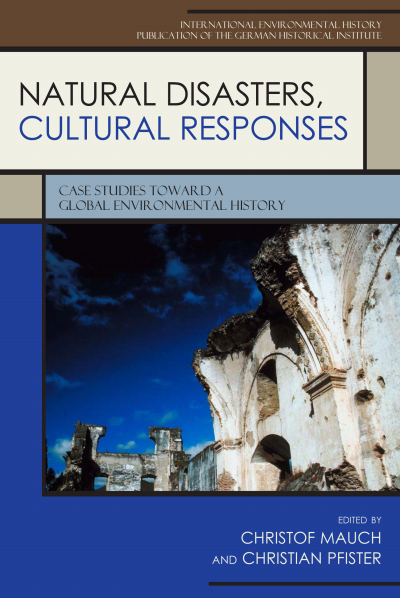
Natural Disasters, Cultural Responses
Case Studies Toward a Global Environmental History
Editors:
|
Publisher:
2009
Summary
Catastrophes, it seems, are becoming more frequent in the twenty-first century. According to UN statistics, every year approximately two hundred million people are directly affected by natural disasters_seven times the number of people who are affected by war. Discussions about global warming and fatal disasters such as Katrina and the Tsunami of 2004 have heightened our awareness of natural disasters and of their impact on both local and global communities. Hollywood has also produced numerous disaster movies in recent years, some of which have become blockbusters. This volume demonstrates that natural catastrophes_earthquakes, hurricanes, floods, etc._have exercised a vast impact on humans throughout history and in almost every part of the world. It argues that human attitudes toward catastrophes have changed over time. Surprisingly, this has not necessarily led to a reduction of exposure or risk. The organization of the book resembles a journey around the globe_from Europe to North Africa, the Middle East, and Asia, and from the Pacific through South America and Mexico to the United States. While natural disasters appear everywhere on the globe, different cultures, societies, and nations have adopted specific styles for coping with disaster. Indeed, how humans deal with catastrophes depends largely on social and cultural patterns, values, religious belief systems, political institutions, and economic structures. The roles that catastrophes play in society and the meanings they are given vary from one region to the next; they differ_and this is one of the principal arguments of this book_from one cultural, political, and geographic space to the next. The essays collected here help us to understand not only how people in different times throughout history have learned to cope with disaster but also how humans in different parts of the world have developed specific cultural, social, and technological strategies for doing so.
Search publication
Bibliographic data
Edition
1/2009
Copyright Year
2009
ISBN-Print
978-0-7391-2416-1
ISBN-Online
978-0-7391-3461-0
Publisher
Lexington, Lanham
Language
English
Pages
382
Product Type
Edited Book
Table of contents
ChapterPages
Acknowledgments No access
Introduction No access Pages 1 - 16
Chapter 1: Learning from Nature-Induced Disasters No access Pages 17 - 40
Chapter 2: Disaster and Political Culture in Germany since 1500 No access Pages 41 - 76
Chapter 3: Summer Frost No access Pages 77 - 102
Chapter 4: Society and Natural Risks in France, 1500-2000 No access Pages 103 - 136
Chapter 5: Humanitarianism and Colonialism No access Pages 137 - 164
Chapter 6: The Floods of Baghdad No access Pages 165 - 182
Chapter 7: Interpreting Earthquakes in Medieval Islamic Texts No access Pages 183 - 196
Chapter 8: Famine in Bengal No access Pages 197 - 232
Chapter 9: “Heaven-Sent Disasters” in Late Imperial China No access Pages 233 - 264
Chapter 10: Cultures of Disaster, Cultures of Coping No access Pages 265 - 284
Chapter 11: The Paraná River Floods during the Spanish Colonial Period No access Pages 285 - 304
Chapter 12: Documenting Disaster No access Pages 305 - 326
Chapter 13: American Disasters during the Twentieth Century No access Pages 327 - 354
Afterword No access Pages 355 - 360
Index No access Pages 361 - 378
About the Contributors No access Pages 379 - 382
Similar publications
from the topics "Kultursoziologie & Wissenssoziologie"