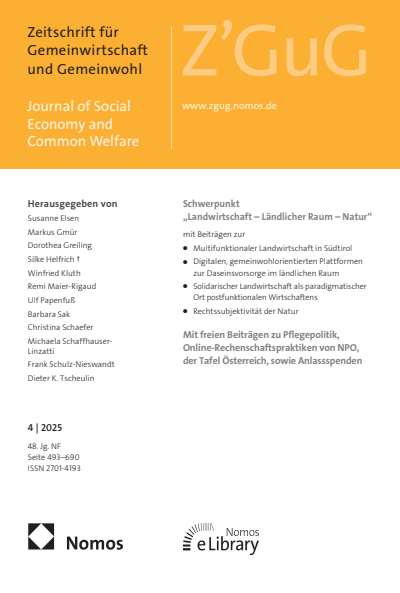
The Zeitschrift für Gemeinwirtschaft und Gemeinwohl (Z'GuG) is an interdisciplinary academic journal with relevance for professional practice (business, politics, civil society). The journal is published as a new series of the Zeitschrift für öffentliche und gemeinwirtschaftliche Unternehmen (ZögU) - Journal for Public and Nonprofit Services. The thematic focus is on public economics in its diversity of sponsors, administrative theory, the social economy, the third sector, cooperatives, as well as topics of importance to civil society such as communalization, neighborhood and district concepts, network development, and social space building. The Z'GuG is open to fundamental theoretical and methodological discussions and takes up topics that require a cultural-scientific, but also philosophical opening, including the social (medical, nursing, educational, etc.) care debates, gender and other diversity controversies, commons theory, and gift and reciprocity research. From these openings, Z'GuG is dedicated to the meta-theme of the common good.
The paper aims to present research conducted on the sidelines of the Award in memory of Agitu Gudeta, a sociologist and shepherdess of Ethiopian origin who inhabited and transformed the Mocheni Valley in Trentino. Over the course of three editions...
Digital platforms are generally of paramount importance for the changing provision of public services. However, research has so far paid little attention to differentiation based on spatial structural characteristics. This article examines the role...
This article interprets community-supported agriculture as a paradigmatic example of post-functional economic activity. The concept of agrosophia encapsulates a practice in which agriculture is seen not merely as a form of production, but as an...
This article examines the legal personhood of nature as a lever for an ecologically embedded property and economic culture. It asks whether such recognition transforms capitalism or signals its end. Drawing on the embeddedness debate, it shows how...
In 1995, social long-term care insurance was introduced in Germany as the fifth pillar of the social insurance system, thus recognizing the need for long-term care as a general life risk. The concept of German long-term care insurance is based on...
The internet provides a fast, inexpensive way for nonprofit organizations to present accountability efforts. This article explores how nonprofit organizations in Austria disclose financial and operational information on their websites. Through...
The study examines the role of cooperating food banks for social non-profit organisations (NPOs), using the example of “Die Tafel Österreich”. This is analysed in the context of the fulfilment of the social functions of NPOs in the welfare...
Given the often intense competition for resources and the advancing digitalization, event-driven fundraising is becoming increasingly important for many nonprofit organizations (NPO). This source of income is characterized by its connection to...