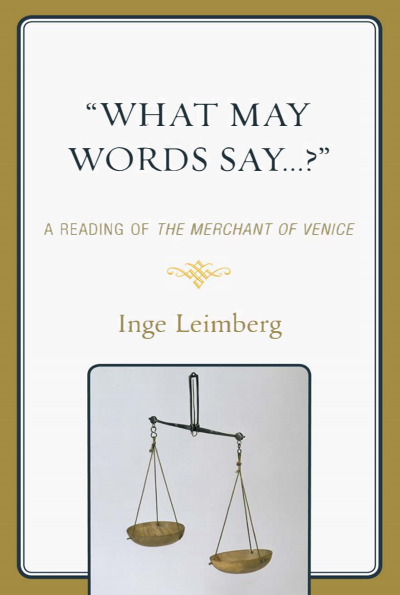
'What May Words Say ... ?'
A Reading of the The Merchant of Venice- Authors:
- Publisher:
- 2011
Summary
What may words say_?' A Reading of The Merchant of Venice contains, in a form resembling a running commentary, a comprehensive and in many respects unconventional interpretation of The Merchant of Venice. The play's development of ideas is unfolded in a literary analysis that focuses on the poet's words in their philological, historical, and philosophical contexts. What the words say is that the play is dominated by the three Delphic maxims, Know thyself, Nothing too much, and Give surety and harm is at hand. Within the intellectual and ethical compass of these tenets the two-stranded action of the play is developed, and the question why Shakespeare added the story of the caskets to the story of the bond is answered by the words law and choice, which are as closely connected semantically as the two stories are interrelated in the dramatic structure. The self-knowledge achieved in the musical cadence of the play is everyone's seeing God's image in the other person, and the law finally chosen is forgiveness.
Search publication
Bibliographic data
- Edition
- 1/2011
- Copyright Year
- 2011
- ISBN-Print
- 978-1-61147-000-0
- ISBN-Online
- 978-1-61147-001-7
- Publisher
- Lexington, Lanham
- Language
- English
- Pages
- 293
- Product Type
- Monograph
Table of contents
- Contents No access
- Preface No access
- 1. "What do you call the play?" No access
- 2. "Good sentences . . ." No access
- 1–7 Know thyself No access
- 8–68 "I know Antonio / Is sad . . ." No access
- 69–112 "A stage, where every man must play a part . . ." No access
- 113–160 "Then do but say to me what I should do . . ." No access
- 161–185 "To have it of my trust . . ." No access
- 1–9 Nothing too much No access
- "to be seated in the mean" No access
- "what were good to do" No access
- "O me the word 'choose'!" No access
- 32–98 Interlude: "these princely suitors" No access
- "How to choose right . . ." No access
- "my father's will" No access
- a. The number three No access
- b. The number 3000 No access
- c. Ducat, the coin and the word No access
- 1–9 "Antonio shall become bound, well" No access
- 11–34 "he is sufficient" No access
- 35–47 "possessed with murd'rous hate" No access
- 47–65 "I do never use it" No access
- 66–97 "I make it breed as fast" No access
- 59 "the breach of custom is breach of all" No access
- 98–138 The Golden Rule No access
- 138–175 "How feel you yourself my friend? . . ." No access
- 176–177 "And forgive us our debts . . ." No access
- Scene 1. "what braggardism is this?" No access
- 1–30 "An enemy may chance to give good counsel" No access
- 31–35 "this is my true-begotten father" No access
- 36–95 "it is a wise father that knows his own child" No access
- 95–148 "I have brought him a present" No access
- 149–160 "Such beginning, such end" No access
- 161–197 Epilogue: "Something too liberal" No access
- Scene 3. "Farewell good Launcelot" No access
- Scene 3. (continued). "We paint the devil foul . . ." No access
- Scene 4. "Will you prepare you for this masque to-night?" No access
- Scene 5. "Lock up my doors . . ." No access
- 1–21 "Haste makes waste" No access
- 22–25 "Here dwells my father Jew" No access
- 26–32 "Who are you?" No access
- 33–50 "catch this casket" No access
- 51–59 "wise, fair, and true" No access
- 60–68 "the wind is come about" No access
- Scene 7. "I stand for sacrifice" No access
- Scene 8. "by some nuntius to recount the things" No access
- 1–84 "I will use them according to their desert" No access
- 85–101 "he bringeth sensible regreets" No access
- 1–66 "The villainy you teach me I will execute" No access
- 67–120 "thou torturest me Tubal" No access
- 1–24 "I pray you tarry" No access
- 24–38 "Promise me life . . ." No access
- 39–41 "Suit the action to the word" No access
- 42–53 "Let music sound . . ." No access
- 53–62 "while he doth make his choice" No access
- 63–72 "Tell me where is fancy bred?" No access
- 73 "So may the outward shows be least themselves" No access
- 74 "The world is still deceiv'd with ornament―" No access
- 75–107 The "hidden man of the heart" No access
- 108–114 "Por. [Aside.]" No access
- 114–171 "Turn you where your lady is" No access
- 149–174 "O that you were yourself!" No access
- 171–185 "With this ring I thee wed . . ." No access
- 186–218 "good joy,―good joy . . . / . . . But who comes here?" No access
- 219–265 "So now I have confessed . . ." No access
- 266–325 "if I might but see you . . ." No access
- 1–20 "but he would not heare" No access
- 21–36 "pray God Bassanio come . . ." No access
- 1–9 "you would be prouder of the work" No access
- "an egall yoke of love . . ." No access
- "a like proportion . . ." No access
- "purchasing the semblance of my soul, / From out the state of hellish cruelty!―" No access
- 24–44 "I have toward heaven breathed a secret vow, / To live in prayer and contemplation" No access
- 45–84 "Come on Nerissa, I have work in hand" No access
- 1–64 "O dear discretion, how his words are suited" No access
- 64–84 "―first let us go to dinner" No access
- 1–13 "I do oppose / My patience to his fury" No access
- 14–34 "To love is human; to be indulgent is human, too" No access
- 35–42 "I'll not answer that!" No access
- 43–62 "But say it is my humour . . ." No access
- 43–62 (once more) "I am not well" No access
- 58 "None is offended but by himself" No access
- 63–83 "use no farther means" No access
- 84–103 "What judgment shall I dread doing no wrong?" No access
- 104–142 Interlude: "As fox to lamb . . ." No access
- 143–169 "Bellario's letter" No access
- 170–179 "Which is the merchant here? And which the Jew?" No access
- 180–198 "My doctrine shall drop as the rain . . ." No access
- 198–203 "I crave the law" No access
- 204–224 "Take thrice thy money, bid me tear the bond" No access
- 224–258 "swear not . . ." No access
- 259–277 "Give me your hand, Bassanio, fare you well" No access
- 278–294 "stuff'd with protestations" No access
- 294–301 "Tarry a little, there is something else―" No access
- 302–308 "one jot or one tittle" No access
- 308–318 "Pay the bond thrice . . ." No access
- 319–342 "on peril of a curse" No access
- 342–369 "Tarry Jew" No access
- 370–453 "Better give than take" No access
- 383 "He presently become a Christian" No access
- 391–396 "Exit [Shylock]" No access
- 397–453 "For giving it to me" No access
- Scene 2. "This ring I do accept most thankfully" No access
- 1–24 "The moon shines bright . . ." No access
- 25–53 "bring your music forth into the air" No access
- 54–57 "Wise silence is best musicke unto bliss" No access
- 58–65 "my soul's imaginary sight" No access
- 66–68 "pierce your mistress' ear" No access
- 69–70 "Obey, and be attentive" No access
- 70 (continued) "The nimble spirits in the arteries" No access
- 71–79 "Beasts and all cattle . . ." No access
- 79–88 "Tune thy Musicke to thy hart" No access
- 89–113 "Whan every foul cometh there to chese his mate" No access
- 113–141 "welcome home!" No access
- 142–208 "Thou canst not hit it, hit it, hit it" No access
- 192–208 "We will have rings and things . . ." No access
- 209–266 "Liebstes Blondchen! ach verzeihe!" No access
- 267–307 "Finisque ab origine pendet" No access
- The Somonynge of Eueryman No access
- "By fygure a morall playe" No access
- God No access
- Death No access
- Fellowship No access
- Kindred and Cousin No access
- Goods No access
- Knowledge and Good Deeds No access
- Confession No access
- "a sure rekenynge" No access
- "grete ioy and melody" No access
- Bibliography No access Pages 254 - 274
- Index No access Pages 275 - 293