, to see if you have full access to this publication.
Monograph No access
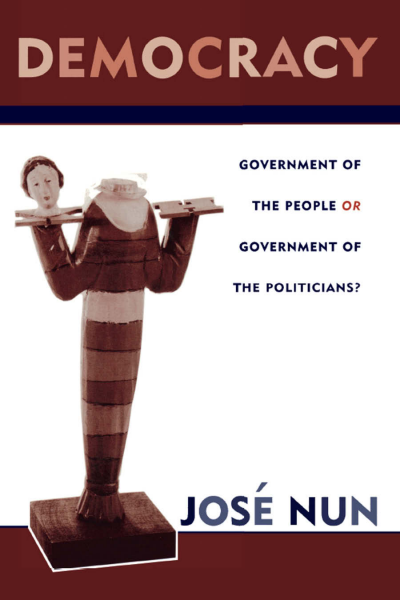
Democracy
Government of the People or Government of the Politicians?
Authors:
Publisher:
2003
Summary
One hundred and fifty years ago, Abraham Lincoln stressed the pressing need for a new definition of 'freedom.' Today, with 85 of some 190 countries claiming to be representative democracies, JosZ Nun makes an equally compelling case for 'democracy.' In emerging democracies throughout much of the developing world, the need is especially urgent, as nascent debates about democracy are modified by such descriptions as delegative, transitional, incomplete, low-intensity, relative, uncertain, or even authoritarian. In accessible and engaging style, Nun provides a comprehensive analysis of the theory and practice of democracy from ancient Greece to contemporary Latin America. The author's authoritative historical and comparative discussion of democracy is combined with his own evaluation of the conditions and possibilities for the development of genuinely democratic societies in our time, in Latin America and throughout the world. The author identifies the preconditions of a democratic regime, the links between citizenship construction and social rights, the centrality of work for the promotion of equality and freedom, and the current democratic deficits both in core and peripheral countries. All readers will benefit from Nun's insightful distinction between two visions of democracy—government of the people or government of the politicians—and its profound consequences.
Search publication
Bibliographic data
Edition
1/2003
Copyright Year
2003
ISBN-Print
978-0-7425-2040-0
ISBN-Online
978-0-585-47977-4
Publisher
Rowman & Littlefield, Lanham
Language
English
Pages
151
Product Type
Monograph
Table of contents
ChapterPages
Table of Contents No access
Preface No access
Chapter 1. Introduction No access Pages 1 - 4
Chapter 2. Family Resemblances No access Pages 5 - 8
Chapter 3. Athens and Sparta No access Pages 9 - 12
Chapter 4. Schumpeter and the Politicians No access Pages 13 - 24
Chapter 5. The Pluralist Theories No access Pages 25 - 28
Chapter 6. The Declaration of 1948 No access Pages 29 - 32
Chapter 7. Capitalism and Democracy: A First Approach No access Pages 33 - 36
Chapter 8. The Keynesian Alchemy No access Pages 37 - 40
Chapter 9. Marshall and the Citizens No access Pages 41 - 50
Chapter 10. From Schumpeter to Marshall No access Pages 51 - 54
Chapter 11. The Experience in the Developed Capitalist Countries No access Pages 55 - 58
Chapter 12. European Transitions to Democracy No access Pages 59 - 64
Chapter 13. Capitalism and Democracy: A Second Approach No access Pages 65 - 70
Chapter 14. Legitimacy, Moral Autonomy, and Preferences No access Pages 71 - 80
Chapter 15. From the Thirty Glorious Years to the Great Recession No access Pages 81 - 84
Chapter 16. Welfare States in Transition No access Pages 85 - 88
Chapter 17. The Problematic of Social Exclusion No access Pages 89 - 94
Chapter 18. The Latin American Case No access Pages 95 - 104
Chapter 19. An Unhappy Balance No access Pages 105 - 110
Chapter 20. An Idea and Its Concrete Manifestations No access Pages 111 - 116
Chapter 21. Conditional Democracy No access Pages 117 - 122
Chapter 22. Deceiving Resemblances No access Pages 123 - 128