, to see if you have full access to this publication.
Monograph No access
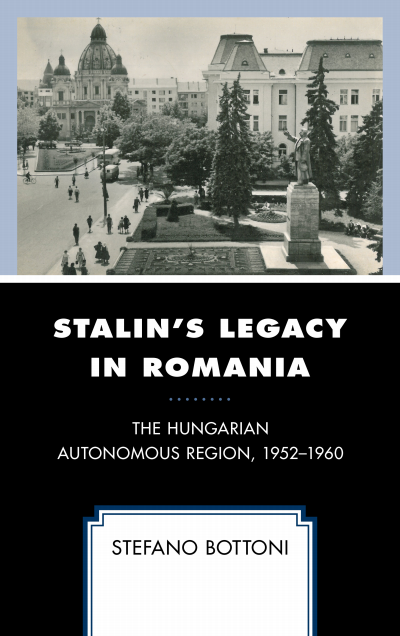
Stalin's Legacy in Romania
The Hungarian Autonomous Region, 1952–1960
Authors:
Publisher:
2018
Summary
This study explores the little-known history of the Hungarian Autonomous Region (HAR), a Soviet-style territorial autonomy that was granted in Romania on Stalin’s personal advice to the Hungarian Székely community in the summer of 1952. Since 1945, a complex mechanism of ethnic balance and power-sharing helped the Romanian Communist Party (RCP) to strengthen—with Soviet assistance—its political legitimacy among different national and social groups. The communist national policy followed an integrative approach toward most minority communities, with the relevant exception of Germans, who were declared collectively responsible for the German occupation and were denied political and even civil rights until 1948. The Hungarians of Transylvania were provided with full civil, political, cultural, and linguistic rights to encourage political integration. The ideological premises of the Hungarian Autonomous Region followed the Bolshevik pattern of territorial autonomy elaborated by Lenin and Stalin in the early 1920s. The Hungarians of Székely Land would become a “titular nationality” provided with extensive cultural rights. Yet, on the other hand, the Romanian central power used the region as an instrument of political and social integration for the Hungarian minority into the communist state. The management of ethnic conflicts increased the ability of the PCR to control the territory and, at the same time, provided the ruling party with a useful precedent for the far larger “nationalization” of the Romanian communist regime which, starting from the late 1950s, resulted in “ethnicized” communism, an aim achieved without making use of pre-war nationalist discourse. After the Hungarian revolution of 1956, repression affected a great number of Hungarian individuals accused of nationalism and irredentism. In 1960 the HAR also suffered territorial reshaping, its Hungarian-born political leadership being replaced by ethnic Romanian cadres. The decisive shift from a class dictatorship toward an ethnicized totalitarian regime was the product of the Gheorghiu-Dej era and, as such, it represented the logical outcome of a long-standing ideological fouling of Romanian communism and more traditional state-building ideologies.
Keywords
Search publication
Bibliographic data
Edition
1/2018
Copyright Year
2018
ISBN-Print
978-1-4985-5121-2
ISBN-Online
978-1-4985-5122-9
Publisher
Lexington, Lanham
Language
English
Pages
398
Product Type
Monograph
Table of contents
ChapterPages
Contents No access
Acknowledgments No access
Introduction No access
Ch01. Managing Ethnic Diversity No access Pages 1 - 50
Ch02. Stalin’s Gift No access Pages 51 - 94
Ch03. Romanian Drivers in the Hungarian Car No access Pages 95 - 142
Ch04. The Stalinist Greenhouse No access Pages 143 - 214
Ch05. The Impact of the 1956 Hungarian Revolution in Romania No access Pages 215 - 282