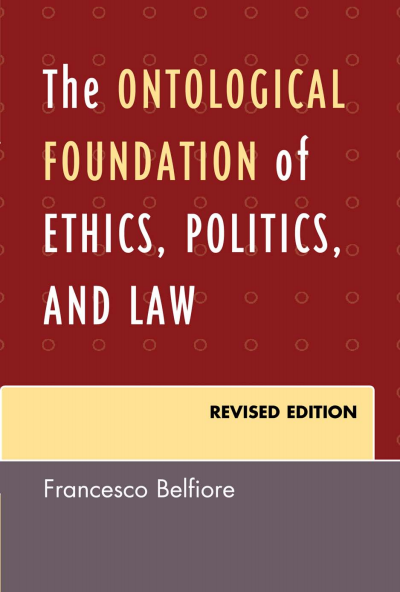
The Ontological Foundation of Ethics, Politics, and Law
- Authors:
- Publisher:
- 2013
Summary
The revised edition of The Ontological Foundation of Ethics, Politics, and Law adds new concepts and discusses the views of additional thinkers. The author refers to his basic ontological conception of the human “mind” or “spirit” as an evolving, conscious, triadic entity composed of intellect, sensitivity, and power, each exerting a bidirectional (selfish and moral) activity. Through this approach, the notions of good, morality, society, and law are derived from the structure and functioning of the mind. It follows that the solutions presented are the results of a discovery and not the consequence of a choice. Otherwise stated, ethics, politics, and law are given an ontological foundation. For each topic considered, Belfiore shows how his thought can reinterpret the views of other philosophers. This new edition, enriched in concepts and quotations, appears as an innovative and highly stimulating contribution to the philosophical branches of ethics, politics, and law, and will be of interest to both graduate students and philosophy scholars.
Keywords
Search publication
Bibliographic data
- Edition
- 1/2013
- Copyright Year
- 2013
- ISBN-Print
- 978-0-7618-6070-9
- ISBN-Online
- 978-0-7618-6071-6
- Publisher
- Hamilton Books, Lanham
- Language
- English
- Pages
- 510
- Product Type
- Monograph
Table of contents
- Contents No access
- Figures No access
- Tables No access
- Preface No access
- Preface to the Revised Edition No access
- 1.1.1.1―Critical Analysis of the "Cogito Ergo Sum" No access
- 1.1.1.2.1―The Outward Mind Activity (or Selfishness). 1―The Intellect and Its Products: Ideas, Projects, and Fantasies No access
- 1.1.1.2.2―The Outward Mind Activity (or Selfishness). 2―The Sensitiveness and Its Products: Sentiments No access
- 1.1.1.2.3―The Outward Mind Activity (or Selfishness). 3―The Power and Its Products: Actions No access
- 1.1.1.2.4―The Inward Mind Activity (or Consciousness) and Its Products: Moral Thoughts, Moral Feelings, and Moral Acts No access
- 1.1.2―The New Ontological Conception in Four Propositions No access
- 1.1.3.1―Judgment by "Specific Criteria" No access
- 1.1.3.2.1―Judgment of Ideas and Projects by the Value Criterion No access
- 1.1.3.2.2―Judgment of Sentiments by the Value Criterion No access
- 1.1.3.2.3―Judgment of Actions by the Value Criterion No access
- 1.1.3.2.4―Judgment of Moral Thoughts, Moral feelings, and Moral Acts by the Value Criterion No access
- 1.1.3.2.5―The Judgment by the Value Criterion (Particular versus Universal) and the Concept of Mind Evolution No access
- 1.2―Synopsis of the Mind Components, Their Products, and Their Judgment Criteria No access
- 2.1.1.1―Moral Thoughts and Moral Projects/Decisions No access
- 2.1.1.2―Moral Feelings No access
- 2.1.1.3―Moral Acts No access
- 2.1.2―Defining Moral Events: Consciousness versus Selfishness No access
- 2.1.3.1.1―Moral Thoughts (and Moral Conception) versus Personal (or Selfish) Ideas (and Scientific Theories) No access
- 2.1.3.1.2―Moral Projects and Decisions versus Personal (or Selfish) Projects and Decisions No access
- 2.1.3.2―Moral Feelings versus Personal (or Selfish) Sentiments No access
- 2.1.3.3.1―Features of Personal (or Selfish) Actions No access
- 2.1.3.3.2―Features of Moral Acts No access
- 2.1.3.3.3―Relationship Between Moral Acts and Personal Actions No access
- 2.1.4.1―Defining Moral Principles (Moral Thoughts), Moral Values (Moral Feelings), and Moral Norms (Moral Projects) No access
- 2.1.4.2―Hierarchical Arrangement of the Various "Moral Goods" No access
- 2.1.5.1―The Ground Moral Norm: An "Open" (non-Dogmatic) Norm No access
- 2.1.5.2.1―Moral Responsibility Toward Others No access
- 2.1.5.2.2―Moral Responsibility Toward Oneself as the Origin of the Rights No access
- 2.1.5.3―The Limit of Moral Responsibility: The "Evolution-Allowing, Involution-Avoiding Condition" No access
- 2.1.6―The Imprecision in Defining Moral Goods and the Uncertainty in Moral Choices No access
- 2.1.7―An Overview on Moral Choices: "Moral" versus "Procedural" Choices No access
- 2.2.1.1.1―The Supposed "Is-Ought Gap" and the "Evolution Toward Better States" as an Intrinsic Property of the Mind No access
- 2.2.1.1.2―Filling the "Is-Ought Gap" (or Connecting Reason to Morals) No access
- 2.2.1.1.3―The Universalizability Principle No access
- 2.2.1.1.4―A New Version of the Universalizability Principle No access
- 2.2.1.1.5―Treating Men as Ends No access
- 2.2.1.1.6―Other Views About the Reason-Morals Relationship No access
- 2.2.1.2.1―Arguments Against the Role of Moral Feelings in Moral Judgments No access
- 2.2.1.2.2―The Notion of "Moral Feeling" in Classical Philosophical Works No access
- 2.2.1.2.3―The Notion of "Moral Feeling" in Modern Philosophy No access
- 2.2.1.3.1―Neither Utilitarianism nor Kantianism: Categorical Desires No access
- 2.2.1.3.2―Self-Interest Theories No access
- 2.2.1.3.3―Rawls' Constructivism: The Higher-Order Interests of Free and Equal Persons No access
- 2.2.1.3.4―Other Theories No access
- 2.2.1.4.1―Nietzsche's Thought No access
- 2.2.1.4.2―Moral Skepticism No access
- 2.2.1.5.1―General Considerations No access
- 2.2.1.5.2―Abortion: A Typical Hard Moral Case No access
- 2.2.1.5.3―Other Examples of Hard Moral Cases No access
- 2.2.1.6.1―Good versus Bad Moral Acts No access
- 2.2.1.6.2―Promoting the Evolution of Sensitiveness versus Promoting Happiness No access
- 2.2.1.6.3―Pursuing Mind Evolution as the Source of Human Rights No access
- 2.2.1.7.1―The General Class of Good Moral Acts No access
- 2.2.1.7.2―The Sub-Classes of Good Moral Acts No access
- 2.2.1.8―The Selfishness/Consciousness Balance (or Outward versus Inward Mind activity) No access
- 2.2.1.9―An Overview of the Main Metaethical Theories No access
- 2.2.2―Judgment of Moral Events (Moral Thoughts, Feelings, and Acts) by the Value Criterion No access
- 2.3.1―Supererogation No access
- 2.3.2―Moral Formalism No access
- 2.3.3―Fanaticism No access
- 2.4.1.1―Personal Decisions and Actions, as Determined by the Prevailing Sentiment No access
- 2.4.1.2―Moral Decisions and Moral Acts as Determined by the Prevailing Moral Feelings No access
- 2.4.1.3―The Fundamental Moral Choice: Moral Projects versus Personal Projects (The Claimed "Free Will") No access
- 2.4.2―Moral Responsibility in the Absence of Internal Freedom No access
- 2.5.1―Ethics and the Other Products of the Mind Components No access
- 2.5.2―Ethics and Religion No access
- 3.1.1.1.1―The Origin of Human Society No access
- 3.1.1.1.2―Relationships Between Communities of Different Degrees of Universality No access
- 3.1.1.2―Public Selfish Actions versus Public Moral Acts as the Binomial Motor of Human Society No access
- 3.1.2.1.1―Advantages of the "Principle of the Best Approach to Universality of Public Actions" No access
- 3.1.2.1.2―The "Best Approach to Universality" and the Proposal of a "Gradational Democracy" No access
- 3.1.2.2.1―Making the "Voting Act" Free and Responsible No access
- 3.1.2.2.2―The Meaning of the "Voting Act" No access
- 3.1.2.3.1―The Rating of Actions and of Laws No access
- 3.1.2.3.2―Publicly Justified Power No access
- 3.1.2.3.3―Informal Mini-Communities No access
- 3.1.2.4―"Arrogance", "Violence", and Publicly Unjustified Power No access
- 3.1.2.5.1―The Ethical Aspects of Politics: The "Evolution-Allowing Condition" as the Public Moral End No access
- 3.1.2.5.2―Duties as the Source of Rights No access
- 3.1.2.5.3―The Imprecision in Defining Public Moral Ends and Norms as Source of Discussion and Diverse Opinions No access
- 3.2.1―General Concepts: 1. The Centrality of the Idea of Class to Understand Men and Society No access
- 3.2.2.1.1―Equality of Human Beings: Their Common Properties and Universal Rights No access
- 3.2.2.1.2―Diversity of Human Beings: Their Individual Properties and Rights No access
- 3.2.2.1.3―Equality versus Diversity of Human Beings No access
- 3.2.2.2.1―Overview No access
- 3.2.2.2.2―The Analysis of the Concept of Equality No access
- 3.2.2.2.3―Equality as Related to Meritocracy, Fraternity, and Friendship No access
- 3.2.2.2.4―The Confutation of the Concept of Equality No access
- 3.2.3.1―Private Property: Main Theories on Its Origin No access
- 3.2.3.2―A Justificatory Theory of Private Property No access
- 3.2.3.3―The Communal Property No access
- 3.2.3.4―Property, Liberty, and Virtues No access
- 3.2.4.1―Hobbes No access
- 3.2.4.2―Hume No access
- 3.2.4.3―Nietzsche No access
- 3.2.5.1―Happiness, Utility, and Welfare as Moral Ends No access
- 3.2.5.2―"Rule Utilitarianism" and "Government House Utilitarianism" No access
- 3.2.6.1.1―Rawls' First Principle (Equal Right to Liberty) No access
- 3.2.6.1.2―Rawls' Second Principle (or Difference Principle) No access
- 3.2.6.1.3―Rawls' Rule of the Priority of Liberty (First Priority Rule) No access
- 3.2.6.1.4―Rawls' Rule of the Priority of Justice (Second Priority Rule) No access
- 3.2.6.2―Dworkin's Theory No access
- 3.2.6.3―Other Views on the Compensation for Inequalities No access
- 3.2.7―Libertarianism No access
- 3.2.8.1.1―Socialization of the Means of Production No access
- 3.2.8.1.2―The Alleged Abundance of Resources and the Need for Justice No access
- 3.2.8.2.1―On the Existence and Nature of the "Surplus Value" No access
- 3.2.8.2.2―Transfer of the "Surplus Value" No access
- 3.2.8.3―Alienation No access
- 3.2.8.4―Analytical Marxism and Non-Marxist Theories of Socialism No access
- 3.2.9―Communitarianism No access
- 3.2.10.1―Political Liberalism No access
- 3.2.10.2―Liberal Nationalism No access
- 3.2.11.1―Citizenship Theory and Civic Virtues No access
- 3.2.11.2―Civic Republicanism No access
- 3.2.11.3―Teaching and Learning Civic Virtues No access
- 3.2.12―Multiculturalism No access
- 3.2.13―Feminism No access
- 3.2.14.1―Environmental Policy No access
- 3.2.14.2―Rebellion No access
- 3.3.1―General Considerations No access
- 3.3.2.1―Dirty-Hands Cases in Non-Democratic Non-Constitutional (Old and Modern) States No access
- 3.3.2.2.1―Dirty Hands and Democracy No access
- 3.3.2.2.2―The Alleged Justification of Dirty Hands No access
- 3.3.2.2.3―Against Dirty Hands No access
- 3.3.2.2.4―Comments on the Corruption in Political Life No access
- 3.4.1.1―General Concepts No access
- 3.4.1.2.1―Ethics in the International Society No access
- 3.4.1.2.2―Remarks on War No access
- 3.4.2.1―Legal Positivism No access
- 3.4.2.2―Natural Law No access
- 3.4.2.3―Kantianism No access
- 3.4.2.4―Contractarian Thought No access
- 3.4.2.5―The Cosmopolitan Conception (Cosmopolitanism) No access
- 4.1.1.1―Defining Laws No access
- 4.1.1.2.1―The Value Criterion No access
- 4.1.1.2.2―The Specific Judgment Criteria No access
- 4.1.1.3.1―The Two-Fold Nature of Laws No access
- 4.1.1.3.2―Validity, Efficaciousness, and Binding Force of Laws No access
- 4.1.1.4―Re-Definition of Laws No access
- 4.1.2.1―More on Laws in a Democratic Constitutional State No access
- 4.1.2.2―Duties as the Source of Rights in a Democratic Constitutional State No access
- 4.1.2.3―Norms, Laws, Rules, and Commands No access
- 4.2.1.1―Classical Views on Natural Law No access
- 4.2.1.2.1―The Ethical Basis of Law No access
- 4.2.1.2.2―Political Obligation (Reasons to Obey the Law) No access
- 4.2.1.2.3―Interpretation of "Prior Law" No access
- 4.2.2.1―Laws as Orders Backed by Threats No access
- 4.2.2.2―The Internal View of Laws No access
- 4.2.2.3.1―The Distinction of Primary from Secondary Rules No access
- 4.2.2.3.2―The Nature of Secondary Rules (Rules of Recognition) No access
- 4.2.2.4.1―The "Minimum Content of Natural Law" Theory No access
- 4.2.2.4.2―Other Views on the Law-to-Morality Relationship No access
- 4.2.2.5―Dworkin's Rules, Principles, and Policies No access
- 4.2.3.1.1―The Thesis of Legal Formalism No access
- 4.2.3.1.2―Legal Formalism and the Individuality of Judges No access
- 4.2.3.2.1―The Thesis of Legal Realism: Judges as Lawmakers No access
- 4.2.3.2.2―Legal Realism and the Binding Character of "Rules" No access
- 4.2.3.2.3―Legal Realism and the Internal View of Laws No access
- 4.2.3.2.4―Legal Realism and the "Final" Decisions No access
- 4.2.3.2.5―The Ultimate Criteria of Legal Validity No access
- 4.2.4.2―Critical Legal Studies No access
- 4.2.4.3―The Rule of Law No access
- 4.2.5―Law and Economics No access
- 4.2.6.1―Moral Philosophy and Constitutional Law No access
- 4.2.6.2.1―The Constitution and the Hierarchy of "Powers" No access
- 4.2.6.2.2―The Constitution and the Hierarchy of Laws No access
- 4.2.6.3―The Ontological Basis of the Separation of "Powers" No access
- 4.2.6.4―Different Constitutions No access
- 4.3.1.1―Adjudication by Trial and Appellate Courts No access
- 4.3.1.2.1―The Constitutional Constraint No access
- 4.3.1.2.2―The Judicial Review and the "Power" of Judges No access
- 4.3.2―Sanctions and Punishment No access
- 4.3.3―Intemational and Supra-National Laws No access
- Chapter 5―Concluding Remarks No access Pages 453 - 456
- References No access Pages 457 - 482
- Index No access Pages 483 - 510