, to see if you have full access to this publication.
Edited Book No access
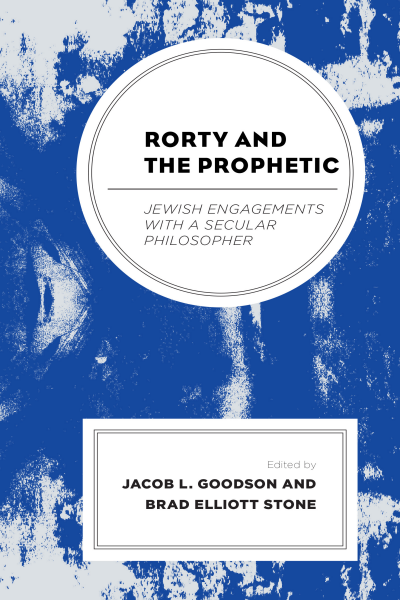
Rorty and the Prophetic
Jewish Engagements with a Secular Philosopher
Editors:
|
Publisher:
2021
Summary
The American neo-pragmatist philosopher Richard Rorty dismisses the public applicability of Jewish moral reasoning, because it is based on “the will of God” through divine revelation. As a self-described secular philosopher, it comes as no surprise that Rorty does not find public applicability within a divinely-ordered Jewish ethic. Rorty also rejects the French Jewish philosopher Emmanuel Levinas’s ethics, which is based upon the notion of infinite responsibility to the Face of the Other. In Rorty’s judgment, Levinas’s ethics is “gawky, awkward, and unenlightening.” From a Rortyan perspective, it seems that Jewish ethics simply can’t win: either it is either too dependent on the will of God or over-emphasizes the human Other. This book responds to Rorty’s criticisms of Jewish ethics in three different ways: first, demonstrating agreements between Rorty and Jewish thinkers; second, offering reflective responses to Rorty’s critiques of Judaism on the questions of Messianism, prophecy, and the relationship between politics and theology; third, taking on Rorty’s seemingly unfair judgment that Levinas’s ethics is “gawky, awkward, and unenlightening.” While Rorty does not engage the prophetic tradition of Jewish thought in his essay, “Glorious Hopes, Failed Prophecies,” he dismisses the possibility for prophetic reasoning because of its other-worldliness and its emphasis on predicting the future. Rorty fails to attend to and recognize the complexity of prophetic reasoning, and this book presents the complexity of the prophetic within Judaism. Toward these ends and more, Brad Elliott Stone and Jacob L. Goodson offer this book to scholars who contribute to the Jewish academy, those within American Philosophy, and those who think Richard Rorty’s voice ought to remain in “conversations” about religion and “conversations” among the religious.
Keywords
Search publication
Bibliographic data
Edition
1/2021
Copyright Year
2021
ISBN-Print
978-1-4985-2300-4
ISBN-Online
978-1-4985-2301-1
Publisher
Lexington, Lanham
Language
English
Pages
240
Product Type
Edited Book
Table of contents
ChapterPages
Contents No access
Chapter Previews No access
Notes No access
Bibliography No access
Chapter 1 Rorty, My Atheist Rabbi? No access
Chapter 2 Prudence in the Twenty-First Century No access
Chapter 3 Charlottesville Pragmatism No access
Chapter 4 The Grounds of Prophecy No access
Chapter 5 Messianism as a Conversation-Stopper? No access
Chapter 6 How to Read Rorty as a Political Theologian No access
Chapter 7 All in the Details No access
Chapter 8 Two Faces of Heteronomy No access
Chapter 9 “A Faith without Triumph” No access
Chapter 10 Rabbinic Reasoning and a Rortyan Ethic No access
Conclusion Heidegger’s Nazism and Anti-Semitism, and Their Effect on Heidegger Scholarship No access
Index No access Pages 233 - 238
About the Contributors No access Pages 239 - 240
Similar publications
from the topics "Religion und Theologie allgemein"
Edited Book No access
Jan Hermelink, Alexander Deeg, Michael Domsgen, Kristin Merle, Marcell Saß