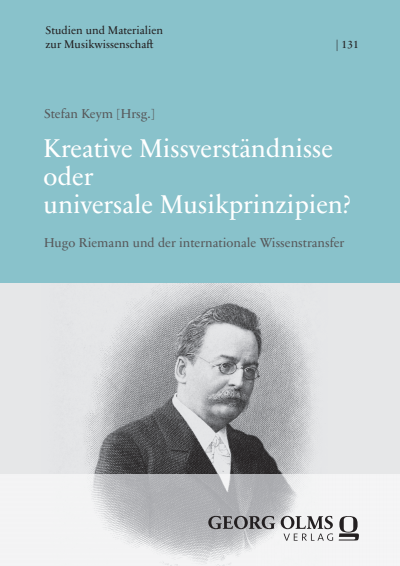
Kreative Missverständnisse oder universale Musikprinzipien?
Hugo Riemann und der internationale Wissenstransfer- Editors:
- Series:
- Studien und Materialien zur Musikwissenschaft, Volume 131
- Publisher:
- 2024
Summary
No other music scholar has had such an international resonance during and after his lifetime as Hugo Riemann. His numerous writings have been translated into many languages and his ideas continue to have an impact right up to the current "Neo-Riemannian Theory".The articles in this book examine how Riemann himself further developed the ideas of authors such as Rameau or Fétis; they also offer a panorama of Riemann's reception in Europe, Russia, China and the USA. In both cases, it becomes clear that international transfers of knowledge are always determined by the specific contexts and needs in the receiving country and therefore inevitably lead to modifications of the appropriated concepts and to creative misunderstandings.With contributions byMario Carrozzo | Thomas Christensen | Damien Ehrhardt | Hans-Joachim Hinrichsen | Christoph Hust | Stefan Keym | Thomas Husted Kirkegaard | Elena Lagutina | Iwona Lindstedt | Nathan Martin | Fabian Moss | Markus Neuwirth | Robert Rabenalt | Alexander Rehding | Ullrich Scheideler | Gesine Schröder | Benedict Tylor | Christian Utz
Keywords
Search publication
Bibliographic data
- Copyright Year
- 2024
- ISBN-Print
- 978-3-487-16680-3
- ISBN-Online
- 978-3-487-42443-9
- Publisher
- Georg Olms Verlag, Baden-Baden
- Series
- Studien und Materialien zur Musikwissenschaft
- Volume
- 131
- Language
- German
- Pages
- 377
- Product Type
- Edited Book
Table of contents
- Titelei/Inhaltsverzeichnis No access Pages 1 - 6
- Einführung No access Pages 7 - 14Authors:
- Authors:
- I No access
- II No access
- III No access
- IV No access
- V No access
- Authors:
- 1. Kontroversen im Spannungsfeld „exotischer Musik“ um 1900 No access
- 2. Capellens musiktheoretischer Entwurf: Traditionskritik und Anti-Moderne No access
- 3. Riemanns und Capellens Modelle für die Integration „exotischer“ Melodik und Harmonik No access
- 4. Diskussion und Fazit No access
- Authors:
- 1. Rameau According to Riemann No access
- 2. Rameau According to Rameau No access
- 3. Riemann on Rameau, Take 2 No access
- History in the Shadows of Theory: Riemann and Fétis as Historians of Music Theory No access Pages 97 - 112Authors:
- Authors:
- 1. Riemann als Leser Kochs No access
- 2. Musikalische Praxis: Theorie und Vortragslehre No access
- Authors:
- 1. Genese des Beethoven-Bildes No access
- 2. Grundzüge des Beethoven-Bildes No access
- 3. Entwicklung des Beethoven-Bildes No access
- 4. Schluss No access
- Authors:
- 1. Umfang und Grundsätze der editorischen Tätigkeit Riemanns No access
- 2. Wolfgang Amadeus Mozart: Sonate C-Dur („Sonata facile“) KV 545, Beginn des 1. Satzes No access
- 3. Ludwig van Beethoven, Sonate C-Dur op. 53 („Waldstein“), Beginn des 1. Satzes No access
- 4.1. Johann Sebastian Bach, Invention Nr. 15 h-Moll No access
- 4.2. Johann Sebastian Bach, Fuge C-Dur aus dem Wohltemperierten Klavier, Bd. 1 No access
- Authors:
- 1. Riemann im Vereinsgeflecht der IMG No access
- 2. Riemanns Präsenz als Autor in den beiden Zeitschriften der IMG No access
- Authors:
- 1. Spuren und Netzwerke No access
- 2. Gefilterte Theoriegeschichte No access
- 3. Wenn das System funktioniert No access
- Der unübersichtliche Weg musikalischer Ästhetik No access
- Authors:
- 1. Denmark No access
- 2. Sweden No access
- 3. Norway No access
- Authors:
- 1. The Growth of Riemann’s Reputation in Britain No access
- 2. Two Influential Advocates: Prout and Niecks No access
- 3. Adversaries: British Responses to Riemann’s Theories of Harmony and Metre No access
- Authors:
- 1.1. Die Phrasenlehre No access
- 1.2. Die Harmonielehre No access
- 2. Riemann und der französischsprachige Kulturraum seiner Zeit: ein Kairos der Rezeptionsgeschichte No access
- 3. Neuere Entwicklungen der Riemann-Rezeption in Frankreich: von Serge Guts vereinfachter Harmonielehre zur „théorie postriemannienne“ No access
- Authors:
- 1. Italian Musicography at the Time of the First Contacts with Riemann’s Work No access
- 2. “Once a German historian has made a blunder, he is unstoppable”: Riemann and Italian Music Historiography at the Turn from the 19th to the 20th Century No access
- 3. “An arbitrary and fallacious basis”: Riemann and the Italian Theory of Harmony at the Turn from the 19th to the 20th century No access
- 4. “A poor amateur […] should be able at once to ‘sing’ like a Liszt”: Riemann’s Theory of Rhythm, Metre and Morphology in Italy No access
- The Reception of Riemann-Erpf’s Function Theory in Józef M. Chomiński’s Writings No access Pages 313 - 324Authors:
- Die Rezeption der Ideen Hugo Riemanns in Russland und der Sowjetunion No access Pages 325 - 338Authors:
- Authors:
- Ad 2. No access
- Ad 1. No access
- Ad 3. No access
- Ad 4. No access
- Addendum ad 1. No access
- Ad 5. No access
- Transatlantic Transformations: On Neo-Riemannian Theories No access Pages 367 - 377Authors: