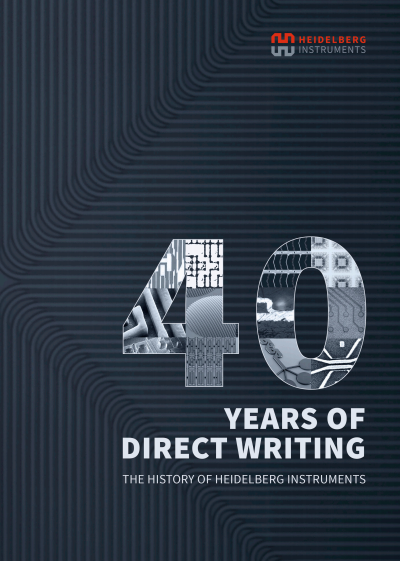
40 Years of Direct Writing
The History of Heidelberg Instruments- Authors/Editors:
- |
- Publisher:
- 2025
Summary
In 1984, five scientists from the university and research institutes in Heidelberg, Germany, founded the company Heidelberg Instruments GmbH. They aspired to commercialize and bring to market products based on the laser scanning Technology developed in their labs. In 2024, the company Heidelberg Instruments Mikrotechnik GmbH celebrated their 40th anniversary – a world-renowned manufacturer of laser lithography systems, one of the global market leaders in the field. The path to get there, however, had not Always been smooth. There had been twists and turns and upheavals and very difficult times, but there had also been perseverance, masterful engineering feats, and economical success. The “History of Heidelberg Instruments” recounts this complex development and Highlights technological and business aspects of the company’s first 40 years.
Keywords
Search publication
Bibliographic data
- Edition
- 1/2025
- Copyright Year
- 2025
- ISBN-Print
- 978-3-95505-524-0
- ISBN-Online
- 978-3-7489-6721-7
- Publisher
- Verlag Regionalkultur, Ubstadt-Weiher
- Language
- English
- Pages
- 114
- Product Type
- Edited Book
Table of contents
- Foreword No access
- CONTENT No access
- 1.1. Heidelberg in the Early Eighties No access
- 1.2. The Founders No access
- 1.3. Funding No access
- 1.4. The Mission No access
- 1.5. First Premises No access
- 2.1. Confocal Imaging No access
- 2.2. AWIS – the Automatic Wafer Inspection System No access
- 2.3. LPM – the Line Profile Measurement System (1987) No access
- 2.4. LSM or CLSM – the Confocal Laser Scanning Microscope No access
- 2.5. LTS – the Laser Tomographic Scanner (1987) No access
- 2.6.1. The LLS (Laser Lithography System) No access
- 2.6.2. The LPS (Laser Patterning System) No access
- 2.7. The Company Logo No access
- 3.1. The Money Runs Out No access
- 3.2.1. Laser Microscopy – Leica Lasertechnik No access
- 3.2.2. Ophthalmology – Heidelberg Engineering No access
- 3.2.3. Laser Lithography – Heidelberg Instruments Mikrotechnik GmbH No access
- 4.1. Heidelberg Instruments Mikrotechnik GmbH in 1990 No access
- 4.3. Lasarray Acquires HIMT – Lasarray GmbH is Founded No access
- 4.2. Lasarray AG No access
- 4.6. Roel Wijnaendts Becomes Owner of Heidelberg Instruments No access
- 5.1. New Headquarters No access
- 5.2. Working Life in the Early Nineties No access
- 5.3. The DWL2.32x24 Large-Area Mask Writer No access
- 5.4. Hard Times (1994-1995) No access
- 6.1. Lithography: Direct Writing and Photomasks No access
- 6.2.1. Applications No access
- 6.2.2. Types No access
- 6.2.3. Material No access
- 6.3.1. Emulsion Type Photomasks No access
- 6.3.2. Masks for Display Manufacturing No access
- 6.4. The Photomask Market No access
- 7.1. Gerber Systems Corporation No access
- 7.2. The Large-Area Mask Writer: the MaskWrite 1550 No access
- 7.3. Other Systems in the Portfolio (1996-1998) No access
- 8.1. Taiwan No access
- 8.2. China, Japan, US, and Korea No access
- 9.1. An Affordable DWL No access
- 9.2. The Start of Grayscale Lithography No access
- 10.1. The “Old Halle 2” No access
- 10.2. Extension of “Halle 1”, the Headquarters No access
- 10.3. “Halle 3” – a Brand-New Production Building No access
- 10.4. The “New Halle 2” No access
- 11.1. The First Tabletop System μPG101 (2006) No access
- 11.2. The Captain Leaves the Bridge (2005) No access
- 11.3. The Detours – Exploring Related Technology and Markets No access
- 12.1. The Laser Drilling System – ViaMagic (1998-2003) No access
- 12.2. The Large-Scale Aligner LSA (2001-2005) No access
- 12.3. The Laser Direct Imaging System LDI (2005-2007) No access
- 12.4. Inkjet (2003-4) No access
- 13.1. The Laser Ablation Machine – LAM66 (1998) No access
- 13.2. Process Systems LVIP and LHIP (1999-2002) No access
- 13.3. Speedmask – a High-Speed Flat Bed Laser Plotter (1999-2006) No access
- 13.4. SMiLE (2008-2011) No access
- 13.5. Digital Lith (2012-2015) No access
- 14.1. The Display Market, Take One (MW1100) (2001-2002) No access
- 14.2. The Display Market, Take Two (MW 2400) (2003-2005) No access
- 14.3. Long Substrates – MW3200 (2004) No access
- 14.4.1. The Tilting-Stage System No access
- 14.4.2. The Freeform 3D No access
- 14.5. A Very Special Stage System (Stage8G) (2011-12) No access
- 15.1. Introduction of the Technical Board (2012-13) No access
- 15.2. Introduction of the Process and Application Lab (2012) No access
- 16.1. The End of the MaskWrite (2008) No access
- 16.2. The Volume Pattern Generators (2008) No access
- 16.3. Small-Area VPG Systems No access
- 16.4. A New Logo (2007) No access
- 17.1. The First System with a DMD™ – the μPG 501 (2012) No access
- 17.2. The MLA, a Success Story (2015) No access
- 18.1. The DWL 2000 (2009) No access
- 18.2. DWL 66 FS (2006) No access
- 18.3. DWL 66+ (2013) No access
- 19.1. The RAG-Stiftung Investment Company No access
- 19.2. The RSBG Acquires Heidelberg Instruments No access
- 20.1.1. The VPG HR (2017) No access
- 20.1.2. The VPG+ – a New VPG Release (2017) No access
- 20.1.3. The ULTRA (2018) No access
- 20.2. MLA 300, the Industrial MLA (2019) No access
- 21.1. SwissLitho AG No access
- 21.2. Acquisition No access
- 21.3. The Power of Direct Writing (2019) No access
- 21.4.1. Konrad and Steff en are AppointedManaging Directors (2017) No access
- 21.4.2. Martin Leaves Heidelberg Instruments(2020) No access
- 21.4.3. A New Era No access
- 21.5. A Thousand Splendid Systems (2020) No access
- 22.1. The Situation Before the Move No access
- 22.2. Wieblingen No access
- 23.1. True 3D with TPP (2021) No access
- 23.2. The ISO 9001:2015 Certification (2021) No access
- 23.3. The LAB14 Group (2022) No access
- 23.4. Heidelberg Instruments in 2024 No access
- 23.5. The 40-Year Celebration No access
- EPILOGUE: HEIDELBERG INSTRUMENTS – WHO WE ARE No access Pages 104 - 104
- ACKNOWLEDGEMENTS No access Pages 105 - 105
- REFERENCES No access Pages 106 - 106
- LIST OF FIGURES AND CHAPTER VISUALS WITH PICTURE CREDITS No access Pages 107 - 112
- GLOSSARY – SYSTEMS No access Pages 113 - 114