, to see if you have full access to this publication.
Edited Book No access
Mr. Science and Chairman Mao's Cultural Revolution
Science and Technology in Modern China
Editors:
|
Publisher:
2012
Summary
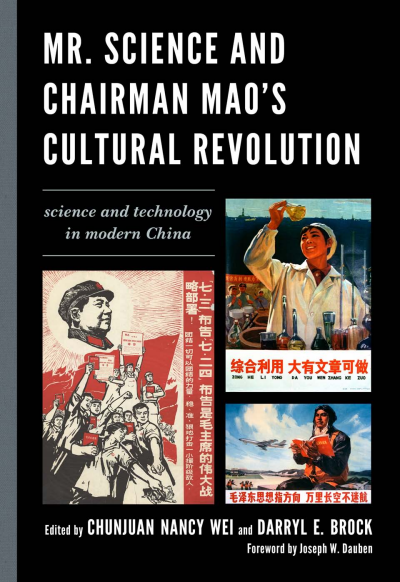
China is emerging as a new superpower in science and technology, reflected in the success of its spacecraft and high-velocity Maglev trains. While many seek to understand the rise of China as a technologically-based power, the Cultural Revolution of the 1960s may seem an unlikely era to explore for these insights. Despite the widespread verdict of the Great Proletarian Cultural Revolution as an unmitigated disaster for China, a number of recent scholars have called for re-examining Maoist science—both in China and in the West. At one time Western observers found much to admire in Chairman Mao's mass science, his egalitarian effort to take science out of the ivory tower and place it in the hands of the disenfranchised peasant, the loyal worker, and the patriot soldier. Chunjuan Nancy Wei and Darryl E. Brock have assembled a rich mix of talents and topics related to the fortunes and misfortunes of science, technology, and medicine in modern China, while tracing its roots to China's other great student revolution—the May Fourth Movement. Historians of science, political scientists, mathematicians, and others analyze how Maoist science served modern China in nationalism, socialism, and nation-building—and also where it failed the nation and the Chinese people. If the Cultural Revolution contributed to China's emerging space program and catalyzed modern malaria treatments based on Traditional Chinese Medicine, it also provided the origins of a science talent gap and the milieu from which a one-child policy would arise. Given the fundamental importance of China today, and of East Asia generally, it is imperative to have a better understanding of its most recent scientific history, but especially that history in a period of crisis and how that crisis was resolved. What is at issue here is not only the specific domain of the history of science, but the social and scientific policies of China generally as they developed and were applied prior to, during, and after the Cultural Revolution.
Keywords
Search publication
Bibliographic data
Edition
1/2012
Copyright Year
2012
ISBN-Print
978-0-7391-4974-4
ISBN-Online
978-0-7391-4975-1
Publisher
Lexington, Lanham
Language
English
Pages
391
Product Type
Edited Book
Table of contents
ChapterPages
Contents No access
Foreword No access
Acknowledgements No access
Chapter 1 Introduction: Reassessing the Great Proletarian Cultural Revolution No access
Chapter 2 The People’s Landscape: Mr. Science and the Mass Line No access
Chapter 3 Science Imperiled: Intellectuals and the Cultural Revolution No access
Chapter 4 Screening the Maoist Mr. Science:Breaking with Old Ideas and Constructing the Post-Capitalist University No access
Chapter 5 Dialectics of Numbers:Marxism, Maoism, and the Calculus of Infinitesimals No access
Chapter 6 Ideology and Cosmology: Maoist Discussion on Physics and the Cultural Revolution No access
Chapter 7 Space for the People: China’s Aerospace Industry and the Cultural Revolution No access
Chapter 8 Barefoot Doctors: The Legacy of Chairman Mao’s Healthcare No access
Chapter 9 Rural Agriculture: Scientific and Technological Development during the Cultural Revolution No access
Chapter 10 Missile Science, Population Science: The Origins of China’s One-Child Policy No access
Chapter 11 Worker Innovation: Did Maoist Promotion Contribute to China’s Present Technological and Economic Success? No access
Chapter 12 On the Appropriate Use of Rose-Colored Glasses: Reflections on Science in Socialist China No access