, to see if you have full access to this publication.
Volume Partial access

Volume 66 (2015), Edition 2

SozW Soziale Welt
Authors:
Journal:
SozW Soziale Welt
Publisher:
 2015


Bibliographic data

ISSN-Print
0038-6073
ISSN-Online
2942-3414
Publisher
Nomos, Baden-Baden
Language
German
Product type
Volume

Articles

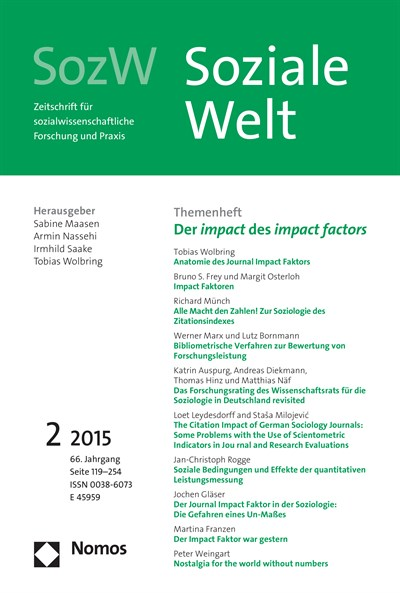
Cover of Volume: SozW Soziale Welt Volume 66 (2015), Edition 2
Article
Partial access
Page 119 - 120
Nomos Verlagsgesellschaft mbH & Co. KG, Baden-Baden 2015

Cover of Volume: SozW Soziale Welt Volume 66 (2015), Edition 2
Article
Full access

Page 121 - 140
Nomos Verlagsgesellschaft mbH & Co. KG, Baden-Baden 2015
Authors:

Cover of Volume: SozW Soziale Welt Volume 66 (2015), Edition 2
Article
Full access

Page 141 - 148
Nomos Verlagsgesellschaft mbH & Co. KG, Baden-Baden 2015
Authors:

Cover of Volume: SozW Soziale Welt Volume 66 (2015), Edition 2
Article
Full access

Page 149 - 160
Nomos Verlagsgesellschaft mbH & Co. KG, Baden-Baden 2015
Authors:

Cover of Volume: SozW Soziale Welt Volume 66 (2015), Edition 2
Article
Full access

Page 161 - 176
Nomos Verlagsgesellschaft mbH & Co. KG, Baden-Baden 2015
Authors:

Cover of Volume: SozW Soziale Welt Volume 66 (2015), Edition 2
Article
Full access

Page 177 - 192
Nomos Verlagsgesellschaft mbH & Co. KG, Baden-Baden 2015
Authors:

Cover of Volume: SozW Soziale Welt Volume 66 (2015), Edition 2
Article
Full access

Page 193 - 204
We analyze the citation impacts (‚cited‘) and citation practices (‚citing‘) of sociological journals which publish mainly in German, and discuss major drawbacks of using the journal impact factor (IF) to assess the quality of these journals....
Nomos Verlagsgesellschaft mbH & Co. KG, Baden-Baden 2015
Authors:

Cover of Volume: SozW Soziale Welt Volume 66 (2015), Edition 2
Article
Full access

Page 205 - 214
Nomos Verlagsgesellschaft mbH & Co. KG, Baden-Baden 2015
Authors:

Cover of Volume: SozW Soziale Welt Volume 66 (2015), Edition 2
Article
Full access

Page 215 - 224
Nomos Verlagsgesellschaft mbH & Co. KG, Baden-Baden 2015
Authors:

Cover of Volume: SozW Soziale Welt Volume 66 (2015), Edition 2
Article
Full access

Page 225 - 242
Nomos Verlagsgesellschaft mbH & Co. KG, Baden-Baden 2015
Authors:

Cover of Volume: SozW Soziale Welt Volume 66 (2015), Edition 2
Article
Full access

Page 243 - 250
The argument between propagators and opponents of quantitative performance measures in research and higher education is at a stalemate. On the one hand are those who promote enthusiastically quantitative performance measures, not giving much thought...
Nomos Verlagsgesellschaft mbH & Co. KG, Baden-Baden 2015
Authors:

Cover of Volume: SozW Soziale Welt Volume 66 (2015), Edition 2
Article
Partial access
Page 251 - 256
Nomos Verlagsgesellschaft mbH & Co. KG, Baden-Baden 2015

Bibliography (363 entries)

  1. American Society for Cell Biology et al. (2012): San Francisco Declaration on Research Assessment, online abrufbar unter: http://am.ascb.org/dora/, letztes Abrufdatum: 20.10.2014. Open Google Scholar doi.org/10.5771/0038-6073-2015-2-121
  2. Amin, Mayur / Michael Mabe (2000): Impact Factors: Use and Abuse, in: Perspectives in Publishing 1, S.1-6. Open Google Scholar doi.org/10.5771/0038-6073-2015-2-121
  3. Bishop, Dorothy (2012): How to Bury your Academic Writing, online abrufbar unter: http://deevybee.blogspot.ch/2012/08/how-to-bury-your-academic-writing.html, letztes Abrufdatum: 20.10.2014. Open Google Scholar doi.org/10.5771/0038-6073-2015-2-121
  4. Bornmann, Lutz / Hans-Dieter Daniel (2008): What Do Citation Counts Measure? A Review of Studies on Citing Be-havior, in: Journal of Documentation 64, S.45-80. Open Google Scholar doi.org/10.5771/0038-6073-2015-2-121
  5. Braun, Norman / Armin Nassehi / Julian Müller / Irmhild Saake / Tobias Wolbring (Hrsg.) (2014): Begriffe – Positionen – Debatten. Eine Relektüre von 65 Jahren. Soziale Welt, 21. Sonderband der Sozialen Welt, Baden-Baden. Open Google Scholar doi.org/10.5771/0038-6073-2015-2-121
  6. Brischoux, François / Timothée R. Cook (2009): Junior Seek an End to the Impact Factor Race, in: BioScience 59, S.638-639. Open Google Scholar doi.org/10.5771/0038-6073-2015-2-121
  7. Dimitrov, Jordan D. / Srini V. Kaveri / Jagadeesh Bayry (2010): Metrics: Journal's Impact Factor Skewed by a Single Paper, in: Nature 466, S.179. Open Google Scholar doi.org/10.5771/0038-6073-2015-2-121
  8. Falagas, Matthew E. / Vangelis G. Alexiou (2008): The Top-ten in Journal Impact Factor Manipulation, in: Archivum Immunologiae et Therapiae Experimentalis 56, S.223-226. Open Google Scholar doi.org/10.5771/0038-6073-2015-2-121
  9. Feyerabend, Paul (1975): Against Method: Outline of an Anarchistic Theory of Knowledge, London. Open Google Scholar doi.org/10.5771/0038-6073-2015-2-121
  10. Fleck, Christian (2013): The Impact Factor Fetishism, in: European Journal of Sociology 54, S.327-356. Open Google Scholar doi.org/10.5771/0038-6073-2015-2-121
  11. Fleck, Christian / Barbara Hönig (2014): European Sociology. Its Size, Shape, and ‚Excellence‘, in: Sokratis Koniordos / Alexandros-Andreas Kyrtsis (Hrsg.), The Handbook of European Sociology, London – New York, S.40-66. Open Google Scholar doi.org/10.5771/0038-6073-2015-2-121
  12. Garfield, Eugene (2006): The History and Meaning of the Journal Impact Factor, in: Journal of the American Medical Association 295, S.90-93. Open Google Scholar doi.org/10.5771/0038-6073-2015-2-121
  13. Gigerenzer, Gerd et al. (1999): Internationalisierung der psychologischen Forschung in Deutschland, Österreich und der Schweiz: Sieben Empfehlungen, in: Psychologische Rundschau 50, S.101-113. Open Google Scholar doi.org/10.5771/0038-6073-2015-2-121
  14. Guerrero-Bote, Vicente P. / Félix Moya-Anegón (2014): Relationship between Downloads and Citations at Journal and Paper Levels, and the Influence of Language, in: Scientometrics 101, S.1043-1065. Open Google Scholar doi.org/10.5771/0038-6073-2015-2-121
  15. Harzing, Anne-Wil (2013): A Preliminary Test of Google Scholar as a Source for Citation Data: A Longitudinal Study of Nobel Prize Winners, in: Scientometrics 93, S.1057-1075. Open Google Scholar doi.org/10.5771/0038-6073-2015-2-121
  16. Harzing, Anne-Wil (2014): A Longitudinal Study of Google Scholar Coverage between 2012 and 2013, in: Scientomet-rics 98, S.565-575. Open Google Scholar doi.org/10.5771/0038-6073-2015-2-121
  17. Hicks, Diana (2004): The Four Literatures of Social Science, in: Henk F. Moed / Wolfgang Glänzel / Ulrich Schmoch (Hrsg.), Handbook of Quantitative Science and Technology Research, New York u.a., S.473-496. Open Google Scholar doi.org/10.5771/0038-6073-2015-2-121
  18. Hinz, Thomas (2013): Editorial, in: Zeitschrift für Soziologie 42, S.2-6. Open Google Scholar doi.org/10.5771/0038-6073-2015-2-121
  19. Hitchcock, Steve (Hrsg.) (2013): The Effect of Open Access and Downloads (‚Hits‘) on Citation Impact: A Bibliog-raphy of Studies, Southampton, online abrufbar unter: http://eprints.soton.ac.uk/354006/, letztes Abrufdatum: 20.10.2014. Open Google Scholar doi.org/10.5771/0038-6073-2015-2-121
  20. Hornbostel, Stefan (2006): Forschungsrankings: Artefakte oder Sichtbarkeit der Forschungsarbeit?, in: Maximilian Stempfhuber (Hrsg.), In die Zukunft publizieren: Herausforderungen an das Publizieren und die Informationsversor-gung in den Wissenschaften, Bonn, S.263-277. Open Google Scholar doi.org/10.5771/0038-6073-2015-2-121
  21. Hornbostel, Stefan / Bernd Klingsporn / Markus von Ins (2009): Messung von Forschungsleistungen – eine Vermessen-heit?, in: Alexander von Humboldt-Stiftung (Hrsg.), Publikationsverhalten in unterschiedlichen wissenschaftlichen Disziplinen. Beiträge zur Beurteilung von Forschungsleistungen, 2. erweiterte Aufl., Bonn, S.14-35. Open Google Scholar doi.org/10.5771/0038-6073-2015-2-121
  22. Krampen, Günter / Juliane Lessing / Gabriel Schui (2012): Zitation deutsch- versus englischsprachiger Publikations-Dubletten deutscher Autoren. Eine empirische Miniatur, in: Psychologische Rundschau 63, S.160-166. Open Google Scholar doi.org/10.5771/0038-6073-2015-2-121
  23. Krampen, Günter / Leo Montada / Markus M. Müller / Gabriel Schui (2005): Internationalität und Internationalisierung der deutschsprachigen Psychologie, Göttingen. Open Google Scholar doi.org/10.5771/0038-6073-2015-2-121
  24. Kromrey, Helmut (2002): Empirische Sozialforschung, 10. Aufl., Opladen. Open Google Scholar doi.org/10.5771/0038-6073-2015-2-121
  25. Kuhn, Thomas (1970): The Structure of Scientific Revolutions, 2. erweiterte Aufl., Chicago / IL. Open Google Scholar doi.org/10.5771/0038-6073-2015-2-121
  26. Kurtz, Michael J. / Johan Bollen (2010): Usage Bibliometrics, in: Annual Review of Information Science and Technol-ogy 44, S.3-64. Open Google Scholar doi.org/10.5771/0038-6073-2015-2-121
  27. Leydesdorff, Loet (1998): Theories of Citation?, in: Scientometrics 43, S.5-25. Open Google Scholar doi.org/10.5771/0038-6073-2015-2-121
  28. Leydesdorff, Loet / Lutz Bornmann (i.E.): The Operationalization of „Fields“ as WoS Subject Categories (WCs) in Evaluative Bibliometrics: The Cases of „Library and Information Science“ and „Science & Technology Studies“, in: Journal of the Association for Information Science and Technology. Open Google Scholar doi.org/10.5771/0038-6073-2015-2-121
  29. Lutter, Mark / Martin Schröder (2014): Who Becomes a Tenured Professor, and Why? Panel Data Evidence from Ger-man Sociology, 1980-2013, MPIfG Discussion Paper 14 / 19. Open Google Scholar doi.org/10.5771/0038-6073-2015-2-121
  30. Marder, Eve / Helmut Kettenmann / Sten Grillner (2010): Impacting Our Young, in: Proceedings of National Acadamy of Sciences 107, S.21233. Open Google Scholar doi.org/10.5771/0038-6073-2015-2-121
  31. Marx, Werner (2009): Forschungsbewertung auf der Basis von Zitierungen – Aussagekraft und Grenzen der Methode, in: Alexander von Humboldt-Stiftung (Hrsg.), Publikationsverhalten in unterschiedlichen wissenschaftlichen Diszipli-nen. Beiträge zur Beurteilung von Forschungsleistungen, 2. erweiterte Aufl., Bonn, S.132-155. Open Google Scholar doi.org/10.5771/0038-6073-2015-2-121
  32. Merton, Robert K. (1968): The Matthew Effect in Science, in: Science 159, S.56-63. Open Google Scholar doi.org/10.5771/0038-6073-2015-2-121
  33. Merton, Robert K. (1988): The Matthew Effect in Science II: Cumulative Advantage and the Symbolism of Intellectual Property, in: ISIS 79, S.606-623. Open Google Scholar doi.org/10.5771/0038-6073-2015-2-121
  34. Münch, Richard (2009): Publikationsverhalten in der Soziologie, in: Alexander von Humboldt-Stiftung (Hrsg.), Publi-kationsverhalten in unterschiedlichen wissenschaftlichen Disziplinen, Beiträge zur Beurteilung von Forschungsleistun-gen, 2. erweiterte Aufl., Bonn, S.69-77. Open Google Scholar doi.org/10.5771/0038-6073-2015-2-121
  35. Mutz, Rüdiger / Hans-Dieter Daniel (2012a): Skewed Citation Distributions and Bias Factors: Solutions to Two Core Problems with the Journal Impact Factor, in: Journal of Informetrics 6, S.169-176. Open Google Scholar doi.org/10.5771/0038-6073-2015-2-121
  36. Mutz, Rüdiger / Hans-Dieter Daniel (2012b): The Generalized Propensity Score Methodology for Estimating Unbiased Journal Impact Factors, in: Scientometrics 92, S.377-390. Open Google Scholar doi.org/10.5771/0038-6073-2015-2-121
  37. Nature Publishing Group (2014): Author Insights 2014. Figshare, online abrufbar unter: http://dx.doi.org/10.6084/m9.figshare.1204999, letztes Abrufdatum: 20.10.2014. Open Google Scholar doi.org/10.5771/0038-6073-2015-2-121
  38. Ochsner, Michael / Sven E. Hug / Hans-Dieter Daniel (2012). Indicators for Research Quality in the Humanities: Op-portunities and Limitations, in: Bibliometrie – Praxis und Forschung 4, S.1-17. Open Google Scholar doi.org/10.5771/0038-6073-2015-2-121
  39. Ogden, Trevor L. / David L. Bartley (2008): The Ups and Downs of Journal Impact Factors, in: The Annals of Occupa-tional Hygiene 52, S.73-82. Open Google Scholar doi.org/10.5771/0038-6073-2015-2-121
  40. Orduña-Malea, Enrique / Juan Manuel Ayllón / Alberto Martín-Martín / Emilio Delgado López-Cózar (2014): About the size of Google Scholar: Playing the Numbers, in: Granada: EC3 Working Papers 18, online abrufbar unter: http://arxiv.org/abs/1407.6239, letztes Abrufdatum: 26.10.2014. Open Google Scholar doi.org/10.5771/0038-6073-2015-2-121
  41. Osterloh, Margit / Bruno S. Frey (2013): Heißt „gut“ publiziert auch „gute“ Publikation? Über die Rolle des Impact Factors in der Wissenschaft, in: Forschung & Lehre 7 / 13, S.546-547. Open Google Scholar doi.org/10.5771/0038-6073-2015-2-121
  42. PLoS Medicine Editors (2006): The Impact Factor Game. It is Time to Find a Better Way to Assess the Scientific Liter-ature, in: PLoS Medicine 3, S.0707-0708. Open Google Scholar doi.org/10.5771/0038-6073-2015-2-121
  43. Plumpe, Werner (2009): Qualitätsmessung: W. Plumpe: Stellungnahme zum Rating des Wissenschaftsrates aus Sicht des Historikerverbandes, online abrufbar unter: http://hsozkult.geschichte.hu-berlin.de/forum/id=1101&type=diskussionen, letztes Abrufdatum: 30.10.2014. Open Google Scholar doi.org/10.5771/0038-6073-2015-2-121
  44. Podolny, Joel (2005). Status Signals. A Sociological Study of Market Competition, Princeton. Open Google Scholar doi.org/10.5771/0038-6073-2015-2-121
  45. Popper, Karl R. (1934): Logik der Forschung, Tübingen. Open Google Scholar doi.org/10.5771/0038-6073-2015-2-121
  46. Seglen, Per O. (1997): Why the Impact Factor of Journals Should not be Used for Evaluating Research, in: British Med-ical Journal 314, S.498-502. Open Google Scholar doi.org/10.5771/0038-6073-2015-2-121
  47. Smith, Richard (2006): Commentary: The Power of the Unrelenting Impact Factor – Is it a Force for Good or Harm?, in: International Journal of Epidemiology 35, S.1129-1130. Open Google Scholar doi.org/10.5771/0038-6073-2015-2-121
  48. Thomson Reuters (1994): The Thomson Reuters Impact Factor, online abrufbar unter: http://wokinfo.com/essays/impact-factor/, letztes Abrufdatum: 4.10.2014. Open Google Scholar doi.org/10.5771/0038-6073-2015-2-121
  49. Van Leeuwen, Thed (2012): Discussing Some Basic Critique on Journal Impact Factors: Revision of Earlier Comments, in: Scientometrics 82, S.443-455. Open Google Scholar doi.org/10.5771/0038-6073-2015-2-121
  50. Waltman, Ludo / Nees Jan van Eck (2013): Source Normalized Indicators of Citation Impact: An Overview of Different Approaches and an Empirical Comparison, in: Scientometrics 96, S.699-716. Open Google Scholar doi.org/10.5771/0038-6073-2015-2-121
  51. Wilhite, Allen W. / Eric A. Fong (2012): Coercive Citation in Academic Publishing, in: Science 335, S.542-543. Open Google Scholar doi.org/10.5771/0038-6073-2015-2-121
  52. Wissenschaftsrat (2008): Forschungsleistungen deutscher Universitäten und außeruniversitärer Einrichtungen der So-ziologie, Köln. Open Google Scholar doi.org/10.5771/0038-6073-2015-2-121
  53. Archambault, É. / V. Larivière (2009): History of the journal impact factor: contingencies and consequences, in: Scien-tometrics, 79 / 3, S.639-653. Open Google Scholar doi.org/10.5771/0038-6073-2015-2-141
  54. Baum, J. A.C. (2010): Free-Riding on Power Laws: questioning the validity of the Impact Factor as a measure of re-search quality in organization studies, in: Organization, 18 / 4, S.449-466. Open Google Scholar doi.org/10.5771/0038-6073-2015-2-141
  55. Buchstein, H. (2009): Demokratie und Lotterie, Frankfurt / Main. Open Google Scholar doi.org/10.5771/0038-6073-2015-2-141
  56. Cicchetti, D.V. (1991): The reliability of peer review for manuscript and grant submissions: a crossdisciplinary investi-gation, in: Behavioral and Brain Sciences 14 / 01, S.119-135. Open Google Scholar doi.org/10.5771/0038-6073-2015-2-141
  57. DORA (San Francisco Declaration on Research Assessment) (2012), online abrufbar unter: Open Google Scholar doi.org/10.5771/0038-6073-2015-2-141
  58. http://www.ascb.org/dora-old/files/SFDeclarationFINAL.pdf, letztes Abrufdatum: 16.12.2014. Open Google Scholar doi.org/10.5771/0038-6073-2015-2-141
  59. Duxbury, N. (2008): Random Justice, Oxford. Open Google Scholar doi.org/10.5771/0038-6073-2015-2-141
  60. Espeland, W.N. / M. Sauder (2007): Rankings and Reactivity: How Public measures Recreate Social Worlds. American Journal of Sociology 113 / 1, S.1-40. Open Google Scholar doi.org/10.5771/0038-6073-2015-2-141
  61. Frey, B.S. (2003): Publishing as prostitution? – Choosing between one’s own ideas and academic success, in: Public Choice 116, S.205-223. Open Google Scholar doi.org/10.5771/0038-6073-2015-2-141
  62. Frey, B.S. / F. Homberg / M. Osterloh (2013): Organizational Control Systems and Pay-for-Performance in the Public Service, in: Organization Studies 34 / 7, S.949-972. Open Google Scholar doi.org/10.5771/0038-6073-2015-2-141
  63. Frey, B.S. / M. Osterloh (2012): Rankings: Unbeabsichtigte Nebenwirkungen und Alternativen, in: Ökonomenstimme vom 17.2.2012, online abrufbar unter: http://www.oekonomenstimme.org/artikel/2012/02/rankings-unbeabsichtigte-nebenwirkungen-und-alternativen/, letztes Abrufdatum: 1.5.2015. Open Google Scholar doi.org/10.5771/0038-6073-2015-2-141
  64. Frey, B.S. / M. Osterloh (2013): Gut publizieren = gute Publikation?, in: Ökonomenstimme vom 16.5.2013, online abrufbar unter: http://www.oekonomenstimme.org/artikel/2013/05/gut-publizieren--gute-publikation/, letztes Abrufda-tum: 1.5.2015. Open Google Scholar doi.org/10.5771/0038-6073-2015-2-141
  65. Frey, B. S. / M. Osterloh (2014): Schlechte Behandlung des wissenschaftlichen Nachwuchses und wie man das än-dern könnte, in: Ökonomenstimme vom 28.10.2014, online abrufbar unter: http://www.oekonomenstimme.org/artikel/2014/10/schlechte-behandlung-des-wissenschaftlichen-nachwuchses-und-wie-man-das-aendern-koennte/, letztes Abrufdatum: 1.5.2015. Open Google Scholar doi.org/10.5771/0038-6073-2015-2-141
  66. Goodall, A.H. (2009): Highly cited leaders and the performance of research universities, Research Policy 38, S.1070-1092. Open Google Scholar doi.org/10.5771/0038-6073-2015-2-141
  67. Haustein, S. / V. Larivière (2015): The Use of Bibliometrics for Assessing Research: Possibilities, Limitations and Adverse Effects, in: I. Welpe / J. Wollersheim / S. Ringelhan / M. Osterloh (Hrsg.), Incentives and Performance – Gov-ernance of Research Organization, Heidelberg, S.121-139. Open Google Scholar doi.org/10.5771/0038-6073-2015-2-141
  68. Heintz, B. (2008): Governance by Numbers. Zum Zusammenhang von Quantifizierung und Globalisierung am Beispiel der Hochschulpolitik, in: G.F. Schuppert / A. Voßkuhl (Hrsg.), Governance von und durch Wissen, Nomos, S.110-304. Open Google Scholar doi.org/10.5771/0038-6073-2015-2-141
  69. Helbing, D. / S. Balietti (2011): How to create an innovation accelerator, in: EPJ Special Topics 195, S.101-136. Open Google Scholar doi.org/10.5771/0038-6073-2015-2-141
  70. Hornbostel, S. / B. Klingsporn / M. von Ins (2009): Messung von Forschungsleistungen – eine Vermessenheit?, in: Alexander von Humboldt Stiftung (Hrsg.), Publikationsverhalten in unterschiedlichen Disziplinen. Beiträge zur Beurtei-lung von Forschungsleistungen, 2. erweiterte Auflage, Berlin, S.14-35. Open Google Scholar doi.org/10.5771/0038-6073-2015-2-141
  71. International Mathematical Union (IMU) (2008): Citation Statistics. A report, Corrected version, 16.12.08. Open Google Scholar doi.org/10.5771/0038-6073-2015-2-141
  72. Jarwal, S.D. / A.M. Brion / M.L. King (2009): Measuring research quality using the journal impact factor, citations and ‚Ranked Journals‘: blunt instruments or inspired metrics?, in: Journal of Higher Education Policy and Management 31 / 4, S.289-300. Open Google Scholar doi.org/10.5771/0038-6073-2015-2-141
  73. Kieser, A. (2012): JOURQUAL – der Gebrauch, nicht der Missbrauch, ist das Problem. Oder: Warum Wirtschaftsin-formatik die beste deutschsprachige betriebswirtschaftliche Zeitschrift ist, in: Die Betriebswirtschaft 72, S.93-110. Open Google Scholar doi.org/10.5771/0038-6073-2015-2-141
  74. Kriegeskorte, N. (2012): Open evaluation: a vision for entirely transparent post-publication peer review and rating for science, in: Frontiers in Computational Neuroscience 6, S.1-18. Open Google Scholar doi.org/10.5771/0038-6073-2015-2-141
  75. Laband, D.N. / R.D. Tollison (2003): Dry holes in economic research, in: Kyklos 56, S.161-174. Open Google Scholar doi.org/10.5771/0038-6073-2015-2-141
  76. Meho, L.I. (2006): The Rise and Fall of Citation Analysis, Preprint physics, online abrufbar unter: http://arxiv.org/pdf/physics/0701012, letztes Abrufdatum: 1.5.2015. Open Google Scholar doi.org/10.5771/0038-6073-2015-2-141
  77. Merton, R.K. (1973): The sociology of science: Theoretical and empirical investigation, Chicago / IL. Open Google Scholar doi.org/10.5771/0038-6073-2015-2-141
  78. Moed, H.F. (2002): The impact-factors debate: the ISI's uses and limits, in: Nature 415 / 6873, S.731-732. Open Google Scholar doi.org/10.5771/0038-6073-2015-2-141
  79. Moed, H.F. (2007): The future of research evaluation rests with an intelligent combination of advanced metrics and transparent peer review, in: Science and Public Policy 34, S.575-583. Open Google Scholar doi.org/10.5771/0038-6073-2015-2-141
  80. Monastersky, R. (2005): The number that's devouring science, in: Chronicle of Higher Education 14.10.2005, online abrufbar unter: http://www3.nd.edu/~pkamat/citations/chronicle.pdf, letztes Abrufdatum: 1.5.2015. Open Google Scholar doi.org/10.5771/0038-6073-2015-2-141
  81. Nicolai, A.T. / S. Schmal / C. Schuster (2015): Interrater Reliability of the Peer Review Process in Management Jour-nals, in: I. Welpe / J. Wollersheim / S. Ringelhan / M. Osterloh (Hrsg.), Incentives and Performance – Governance of Research Organization, Heidelberg, S.107-120. Open Google Scholar doi.org/10.5771/0038-6073-2015-2-141
  82. Osterloh, M. (2010): Governance by Numbers. Does it Really Work in research?, Analyse & Kritik 32, S.267-283. Open Google Scholar doi.org/10.5771/0038-6073-2015-2-141
  83. Osterloh, M. / B.S. Frey (2014): Ranking Games, in: Evaluation Review 23.3.2014, online abrufbar unter: http://erx.sagepub.com/content/39/1/102, letztes Abrufdatum: 1.5.2015. Open Google Scholar doi.org/10.5771/0038-6073-2015-2-141
  84. Osterloh, M. / B.S. Frey (2015): Rankings und der Preis der Wissenschaft, in: Zeitschrift für Kulturwissenschaft (er-scheint demnächst). Open Google Scholar doi.org/10.5771/0038-6073-2015-2-141
  85. Osterloh, M. / A. Kieser (2015): Double-Blind Peer Review: How to Slaughter a Sacred Cow, in: I. Welpe / J. Wol-lersheim / S. Ringelhan / M. Osterloh (Hrsg.), Incentives and Performance – Governance of Research Organization, Heidelberg, S.307-324. Open Google Scholar doi.org/10.5771/0038-6073-2015-2-141
  86. Oswald, A.J. (2007): An examination of the reliability of prestigious scholarly journals: Evidence and implications for decision-makers, in: Economica 74, S.21-31. Open Google Scholar doi.org/10.5771/0038-6073-2015-2-141
  87. Polanyi, M. ([1962]2002): The republic of science: Its political and economic theory, in: Minerva 1, S.54-73, wieder abgedruckt in: P Mirowski / E.M. Sent (2002), Science Bought and Sold. Essays in the Economics of Science, Chicago / IL, S.465–485. Open Google Scholar doi.org/10.5771/0038-6073-2015-2-141
  88. Reinhart, M. (2012): Soziologie und Epistemologie des Peer Reviews, Baden-Baden. Open Google Scholar doi.org/10.5771/0038-6073-2015-2-141
  89. Rost, K. / B.S. Frey (2011): Quantitative and qualitative rankings of scholars, in: Schmalenbach Business Review 63, S.63-91. Open Google Scholar doi.org/10.5771/0038-6073-2015-2-141
  90. Rothwell, P.M. / C.N. Martyn (2000): Reproducibility of peer review in clinical neuroscience. Is agreement between reviewers any greater than would be expected by chance alone?, Brain 123, S.1964-1969. Open Google Scholar doi.org/10.5771/0038-6073-2015-2-141
  91. Rousseeuw, P.J. (1991): A diagnostic plot for regression outliers and leverage points, in: Computational Statistics & Data Analysis 11 / 1, S.127-129. Open Google Scholar doi.org/10.5771/0038-6073-2015-2-141
  92. Schmoch, U. (2015): The Informative Value of International University Rankings: Some Methodological Remarks, in: I. Welpe / J. Wollersheim / S. Ringelhan / M. Osterloh (Hrsg.), Incentives and Performance – Governance of Research Organization, Heidelberg, S.141-154. Open Google Scholar doi.org/10.5771/0038-6073-2015-2-141
  93. Starbuck, W.H. (2005): How much better are the most prestigious journals? The statistics of academic publication, in: Organization Science 16, S.180-200. Open Google Scholar doi.org/10.5771/0038-6073-2015-2-141
  94. The Economist (2013): How Science goes Wrong, 19.10.2013, abrufbar unter: http://www.economist.com/news/leaders/21588069-scientific-research-has-changed-world-now-it-needs-change-itself-how-science-goes-wrong, letztes Abrufdatum: 1.5.2015. Open Google Scholar doi.org/10.5771/0038-6073-2015-2-141
  95. Weller, K. (2015): Social Media and Altmetrics: An Overview of Current Alternative. Approaches to Measuring Schol-arly Impact, in: I. Welpe / J. Wollersheim / S. Ringelhan / M. Osterloh (Hrsg.), Incentives and Performance – Govern-ance of Research Organization, Heidelberg, S.261-277. Open Google Scholar doi.org/10.5771/0038-6073-2015-2-141
  96. Zeitoun, H. / M. Osterloh / B.S. Frey (2014): Learning from Ancient Athens: Demarchy and Corporate Governance, in: Academy of Management Perspectives 28, S.1-14. Open Google Scholar doi.org/10.5771/0038-6073-2015-2-141
  97. Adler, Robert / John Ewing / Peter Taylor (2009): Citation Statistics. A Report from the International Mathematical Union (IMU) in Cooperation with the International council of Industrial and Applied Mathematics (ICIAM) and the Institute of Mathematical Statistics, in: Statistical Science 24 / 1, S.1-14. Open Google Scholar doi.org/10.5771/0038-6073-2015-2-149
  98. Alber, Jens / Florian Fliegner / Torben Nerlich (2009): Charakteristika prämierter Forschung in der deutschsprachigen Sozialwissenschaft. Eine Analyse der mit dem Preis der Fritz-Thyssen Stiftung ausgezeichneten sozialwissenschaftli-chen Aufsätze 1981-2006, WZB Discussion Paper No. SPI 2009-201. Open Google Scholar doi.org/10.5771/0038-6073-2015-2-149
  99. Bornmann, Lutz / Hans Dieter Daniel (2005): Does the h Index for Ranking of Scientists Really Work?, in: Scientomet-rics 65 / 3, S.391-392. Open Google Scholar doi.org/10.5771/0038-6073-2015-2-149
  100. Bornmann, Lutz / Hans Dieter Daniel (2008): What do citation counts measure? A review of studies on citing behavior, in: Journal of Documentation 64 / 1, S.45-80. Open Google Scholar doi.org/10.5771/0038-6073-2015-2-149
  101. Bornmann, Lutz / Rüdiger Mutz / Hans-Dieter Daniel (2008): Are there Better Indices for Evaluation Purposes than the h Index? A Comparison of Nine Different Variants of the h Index Using Data from Biomedicine, in: Journal of the American Society for Information Science and Technology 59 / 5, S.830-837. Open Google Scholar doi.org/10.5771/0038-6073-2015-2-149
  102. Bourdieu, Pierre (1992): Homo academicus, Frankfurt / Main. Open Google Scholar doi.org/10.5771/0038-6073-2015-2-149
  103. Burawoy, Michael (2006): For Public Sociology, in: American Sociological Review 70 / 1, S.4-28. Open Google Scholar doi.org/10.5771/0038-6073-2015-2-149
  104. Campbell, Donald T. (1957): Factors Relevant to the Validity of Experiments in Social Settings, in: Psychological Bul-letin 54, S.297-312. Open Google Scholar doi.org/10.5771/0038-6073-2015-2-149
  105. Campbell, Donald T. (1976): Assessing the Impact of Planned Social Change. Occasional Papers Series No. 8, Western Michigan University Kalamazoo, Evaluation Centers, online abrufbar unter: www.erk.ed.gov/PDFS/Ed303512, letztes Abrufdatum: 17.7.2012. Open Google Scholar doi.org/10.5771/0038-6073-2015-2-149
  106. Desrosières, Alain (2008a): Pour une sociologie historique de la quantification. L’argument statistique I, Paris. Open Google Scholar doi.org/10.5771/0038-6073-2015-2-149
  107. Desrosièrs, Alain (2008b): Pour une sociologie historique de la quantification. L’argument statistique II, Paris. Open Google Scholar doi.org/10.5771/0038-6073-2015-2-149
  108. DFG (2010): ‚Quality not Quantity‘ – DFG Adapts Rules to Counter the Flood of Publications in Research, online abrufbar unter: www.dfg.de/en/service/press/press_release/2010/pressemitteilung_nr07/index.html, letztes Abrufdatum: 2.1.2015. Open Google Scholar doi.org/10.5771/0038-6073-2015-2-149
  109. DORA (2012): San Francisco Declaration on Research Assessment, online abrufbar unter: am.asb.org/dora/, letztes Abrufdatum: 31.12.2014. Open Google Scholar doi.org/10.5771/0038-6073-2015-2-149
  110. Egghe, Leo (2006): Theory and Practice of the g-index, in: Scientometrics 69 / 1, S.131-152. Open Google Scholar doi.org/10.5771/0038-6073-2015-2-149
  111. Espeland, Wendy N. / Michael Sauder (2007): Rankings and Reactivity. How Public Measures Recreate Social Worlds, in: American Journal of Sociology 113 / 1, S.1-40. Open Google Scholar doi.org/10.5771/0038-6073-2015-2-149
  112. Espeland, Wendy N. / Michael Sauder (2009): Rankings and Diversity, in: Southern California Review of Law and Social Justice 18 / 3, S.587-608. Open Google Scholar doi.org/10.5771/0038-6073-2015-2-149
  113. Fleck, Christian (2013): The Impact Factor Fetishism, in: European Journal of Sociology 54 / 2, S.327-356. Open Google Scholar doi.org/10.5771/0038-6073-2015-2-149
  114. Foucault, Michel (1991): Die Ordnung des Diskurses, München. Open Google Scholar doi.org/10.5771/0038-6073-2015-2-149
  115. Hamann, Julian (2014): Stratifikation und Standardisierung. Effekte externer Leistungsbewertung in der Wissenschaft, unveröffentlichtes Manuskript, Warwick / UK. Open Google Scholar doi.org/10.5771/0038-6073-2015-2-149
  116. Hirsch, Jorge E. (2005): An Index to Quantify an Individual's Scientific Research Output, in: Proceedings of the Na-tional Academy of Sciences of the United States of America 102 / 46, S.16569-16572. Open Google Scholar doi.org/10.5771/0038-6073-2015-2-149
  117. Hornbostel, Stefan (1997): Wissenschaftsindikatoren. Bewertungen in der Wissenschaft, Opladen. Open Google Scholar doi.org/10.5771/0038-6073-2015-2-149
  118. ICSU (International Council for Science) (2008): Publication Practices and Indices and the Role of Peer Review in Research Assessment, online abrufbar unter: www.icsu.org/publications/cFrs-statements/, letztes Abrufdatum: 2.1.2015. Open Google Scholar doi.org/10.5771/0038-6073-2015-2-149
  119. Merton, Robert K. (1968): The Matthew Effect in Science, in: Science 159 / 3810, S.56-63. Open Google Scholar doi.org/10.5771/0038-6073-2015-2-149
  120. Münch, Richard / Christian Baier (2009): Die Konstruktion der soziologischen Realität durch Forschungsrating, in: Berliner Journal für Soziologie 19 / 2, S.295-319. Open Google Scholar doi.org/10.5771/0038-6073-2015-2-149
  121. Münch, Richard (2011): Akademischer Kapitalismus. Über die Politische Ökonomie der Hochschulreform, Berlin. Open Google Scholar doi.org/10.5771/0038-6073-2015-2-149
  122. Münch, Richard (2014): Academic Capitalism. Universities in the Global Struggle for Excellence. London – New York / NY. Open Google Scholar doi.org/10.5771/0038-6073-2015-2-149
  123. Porter, Theodore (1995): Trust in Numbers. The Pursuit of Objectivity in Science and Public Life. Princeton / NJ. Open Google Scholar doi.org/10.5771/0038-6073-2015-2-149
  124. Priem, Jason / Dario Taraborelli / Paul Groth / Cameron Neylon (2010): altmetrics: a manifesto, online abrufbar unter: altmetrics.org/manifesto/, letztes Abrufdatum: 2.1.2015. Open Google Scholar doi.org/10.5771/0038-6073-2015-2-149
  125. Quack, Martin (2015): Myths, Challenges, Risks and Opportunities in Evaluating and Supporting Scientific Research, in: Isabelle M. Welpe / Jutta Wollersheim / Stefanie Ringelhan / Margit Osterloh (Hrsg.), Incentives and Performance. Governance of Research Organizations, Heidelberg, S.223-239. Open Google Scholar doi.org/10.5771/0038-6073-2015-2-149
  126. Thomas, William I. / Dorothy Thomas (1928): The Child in America: Behavior Problems and Programs, New York / NY. Open Google Scholar doi.org/10.5771/0038-6073-2015-2-149
  127. Welpe, Isabelle M. / Jutta Wollersheim / Stefanie Ringelhan / Margit Osterloh (Hrsg.) (2015): Incentives and Perfor-mance. Governance of Research Organizations, Heidelberg. Open Google Scholar doi.org/10.5771/0038-6073-2015-2-149
  128. Abbott, A. / D. Cyranoski / N. Jones / B. Maher / O. Schiermeier / P. Van Noorden (2010): Do metrics matter?, in: Nature 465 / 7300, S.860-862. Open Google Scholar doi.org/10.5771/0038-6073-2015-2-161
  129. Adler, R. / J. Ewing / P. Taylor / P.G. Hall (2009): A report from the International Mathematical Union (IMU) in coop-eration with the International Council of Industrial and Applied Mathematics (ICIAM) and the Institute of Mathematical Statistics (IMS), in: Statistical Science 24 / 1, S.1-28. Open Google Scholar doi.org/10.5771/0038-6073-2015-2-161
  130. Archambault, É. / É.V. Gagné (2004): Science-Metrix: the use of bibliometrics in the Social Sciences and Humanities, Montreal (Canada): Social Sciences and Humanities Research Council of Canada (SSHRCC). Open Google Scholar doi.org/10.5771/0038-6073-2015-2-161
  131. Archambault, E. / E. Vignola-Gagne / G. Cote / V. Lariviere / Y. Gingrasb (2006): Benchmarking scientific output in the social sciences and humanities: The limits of existing databases, in: Scientometrics 68 / 3, S.329-342. Open Google Scholar doi.org/10.5771/0038-6073-2015-2-161
  132. Bornmann, L. / H.D. Daniel (2008): What do citation counts measure? A review of studies on citing behavior, in: Jour-nal of Documentation 64 / 1, S.45-80. Open Google Scholar doi.org/10.5771/0038-6073-2015-2-161
  133. Bornmann, L. / H.D. Daniel (2009): Der h-Index – Messung von Forschungsleistungen, in: BIOspektrum 15, S.336-337. Open Google Scholar doi.org/10.5771/0038-6073-2015-2-161
  134. Bornmann, L. / W. Marx (2011): The h index as a research performance indicator, in: European Science Editing 37 / 3, S.77-80, online abrufbar unter: http://www.lutz-bornmann.de/icons/viewpoints.pdf, letztes Abrufdatum: 1.5.2015. Open Google Scholar doi.org/10.5771/0038-6073-2015-2-161
  135. Bornmann, L. / W. Marx / A.Y. Gasparyan / G.D. Kitas (2012a): Diversity, value and limitations of the journal impact factor and alternative metrics, in: Rheumatology International 32, S.1861-1867. Open Google Scholar doi.org/10.5771/0038-6073-2015-2-161
  136. Bornmann, L. / W. Marx (2013a): Evaluating individual researchers’ performance, in: European Science Editing 39 / 2, S.39-40. Open Google Scholar doi.org/10.5771/0038-6073-2015-2-161
  137. Bornmann, L. / W. Marx (2013b): Vorschläge für Standards zur Anwendung der Szientometrie bei der Evaluation von einzelnen Wissenschaftler(inne)n im Bereich der Naturwissenschaften, in: Zeitschrift für Evaluation 12 / 1, S.103-127. Open Google Scholar doi.org/10.5771/0038-6073-2015-2-161
  138. Bornmann, L. / W. Marx (2014a): The wisdom of citing scientists, in: Journal of the Association for Information Sci-ence and Technology 65 / 6, S.1288-1292. Open Google Scholar doi.org/10.5771/0038-6073-2015-2-161
  139. Bornmann, L. / W. Marx (2014b): Distributions instead of single numbers: Percentiles and beam plots for the assess-ment of single researchers, in: Journal of the Association for Information Science and Technology 65 / 1, S.206-208. Open Google Scholar doi.org/10.5771/0038-6073-2015-2-161
  140. Bornmann, L. / W. Marx (2014c): How to evaluate individual researchers working in the natural and life sciences meaningfully? A proposal of methods based on percentiles of citations, in: Scientometrics 98 / 1, S.487-509. Open Google Scholar doi.org/10.5771/0038-6073-2015-2-161
  141. Bornmann, L. / H. Schier / W. Marx / H.D. Daniel (2012b): What factors determine citation counts of publications in chemistry besides their quality?, in: Journal of Informetrics 6 / 1, S.11-18. Open Google Scholar doi.org/10.5771/0038-6073-2015-2-161
  142. Diekmann, A. / M. Näf / M. Schubiger (2012): Die Rezeption (Thyssen-)preisgekrönter Artikel in der „Scientific Community“, in: Kölner Zeitschrift für Soziologie und Sozialpsychologie 64, S.563-581. Open Google Scholar doi.org/10.5771/0038-6073-2015-2-161
  143. Dimitrov, J.D. / S.V. Kaveri / J. Bayry (2010): Metrics: journal’s impact factor skewed by a single paper, in: Nature 466 / 7303, S.179. Open Google Scholar doi.org/10.5771/0038-6073-2015-2-161
  144. Garfield, E. (1979): Citation Indexing – Its Theory and Application in Science, Technology, and Humanities, New York / NY. Open Google Scholar doi.org/10.5771/0038-6073-2015-2-161
  145. Garfield, E. (2006): The history and meaning of the Journal Impact Factor. Journal of the American Medical Associa-tion 295 / 1, S.90-93. Open Google Scholar doi.org/10.5771/0038-6073-2015-2-161
  146. Hirsch J.E. (2005): An index to quantify an individual’s scientific research output, in: Proceedings of the National Academy of Sciences of the United States of America 102 / 46, S.6569-16572. Open Google Scholar doi.org/10.5771/0038-6073-2015-2-161
  147. Jansky, K. (1933): Radio waves from outside the solar system, in: Nature 132, S.66-66. Open Google Scholar doi.org/10.5771/0038-6073-2015-2-161
  148. Marx, W. (2011): Bibliometrie in der Forschungsbewertung, in: Forschung & Lehre 18 / 11, S.858-860, online abrufbar unter: http://www.forschung-und-lehre.de/wordpress/?p=9147, letztes Abrufdatum: 1.5.2015. Open Google Scholar doi.org/10.5771/0038-6073-2015-2-161
  149. Marx, W. / L. Bornmann (2012). Der Journal Impact Factor: Aussagekraft, Grenzen und Alternativen in der For-schungsevaluation, in: Beiträge zur Hochschulforschung 34 / 2, S.50-66, online abrufbar unter: http://www.ihf.bayern.de/, letztes Abrufdatum: 1.5.2015. Open Google Scholar doi.org/10.5771/0038-6073-2015-2-161
  150. Marx, W. / L. Bornmann (2013a): Journal Impact Factor: ‚the poor man’s citation analysis‘ and alternative approaches, in: European Science Editing 39 / 2, S.62-63. Open Google Scholar doi.org/10.5771/0038-6073-2015-2-161
  151. Marx, W. / L. Bornmann (2013b): Wie gut ist Forschung wirklich? Perzentile zur Messung von Publikationsleistungen, in: BIOspektrum 19 / 3, S.332-334. Open Google Scholar doi.org/10.5771/0038-6073-2015-2-161
  152. Marx, W. / L. Bornmann (2013c): How good is research really? Measuring the citation impact of publications with percentiles to ensure correct assessments and fair comparisons, in: EMBO Reports 14 / 3, S.226-230. Open Google Scholar doi.org/10.5771/0038-6073-2015-2-161
  153. Marx, W. / L. Bornmann (2014): On the problems of dealing with bibliometric data, in: Journal of the Association for Information Science and Technology 65 / 4, S.866-867. Open Google Scholar doi.org/10.5771/0038-6073-2015-2-161
  154. Moed, H.F. (2005): Citation analysis in research evaluation, Dordrecht. Open Google Scholar doi.org/10.5771/0038-6073-2015-2-161
  155. Neuhaus, C. / W. Marx / H.D. Daniel (2009): The publication and citation impact profiles of Angewandte Chemie and the Journal of the American Chemical Society based on the sections of Chemical Abstracts: A case study on the limita-tions of the Journal Impact Factor, in: Journal of the American Society for Information Science and Technology 60 / 1, S.176-183. Open Google Scholar doi.org/10.5771/0038-6073-2015-2-161
  156. Seglen, P.O. (1992): The skewness of science, in: Journal of the American Society for Information Science 43 / 9, S.628-638. Open Google Scholar doi.org/10.5771/0038-6073-2015-2-161
  157. Seglen, P.O. (1997): Why the impact factor of journals should not be used for evaluating research, in: British Medical Journal 314 / 7079, S.498-502. Open Google Scholar doi.org/10.5771/0038-6073-2015-2-161
  158. Vanclay, J.K. (2012): Impact Factor: outdated artefact or stepping-stone to journal certification?, in: Scientometrics 92 / 2, S.211-238. Open Google Scholar doi.org/10.5771/0038-6073-2015-2-161
  159. Van Raan, A.F.J. (2000): The Pandora’s box of citation analysis: Measuring scientific excellence – The last evil? The Web of Knowledge – A Festschrift in honour of Eugene Garfield, Medford / NJ, S.301-319. Open Google Scholar doi.org/10.5771/0038-6073-2015-2-161
  160. Waltman, L. et al. (2012): The Leiden Ranking 2011 / 2012: data collection, indicators, and interpretation, in: Journal of the American Society for Information Science and Technology 63 / 12, S.2419-2432. Open Google Scholar doi.org/10.5771/0038-6073-2015-2-161
  161. Weingart, P. (2005): Das Ritual der Evaluierung und die Verführung der Zahlen, in: Ders., Die Wissenschaft der Öf-fentlichkeit: Essays zum Verhältnis von Wissenschaft, Medien und Öffentlichkeit, Weilerswist, S.102-122. Open Google Scholar doi.org/10.5771/0038-6073-2015-2-161
  162. Allison P.D. / J.S. Long / T.K. Krauze (1982): Cumulative Advantage and Inequality in Science, in: American Socio-logical Review 47, S.615-625. Open Google Scholar doi.org/10.5771/0038-6073-2015-2-177
  163. Baier, C. (2011): Wissenschaft regieren. Eine diskursanalytische Studie zum Forschungsrating des Wissenschaftsrates, in: Soziale Welt 62, S.371-390. Open Google Scholar doi.org/10.5771/0038-6073-2015-2-177
  164. Bornmann, L. / H.P. Daniel (2003): Begutachtung durch Fachkollegen in der Wissenschaft. Stand der Forschung zu Reliabilität, Fairness und Validität des Peer-Review-Verfahrens, in: S. Schwarz / U. Teichler (Hrsg.), Universität auf dem Prüfstand. Konzepte und Befunde der Hochschulforschung, Frankfurt / Main, S.207-225. Open Google Scholar doi.org/10.5771/0038-6073-2015-2-177
  165. Bornmann, L. / R. Mutz / C. Neuhaus / H.D. Daniel (2008): Citation counts for research evaluation: standards of good practice for analyzing bibliometric data and presenting and interpreting results, in: Ethics in Science and Environmental Politics 8, S.93-102. Open Google Scholar doi.org/10.5771/0038-6073-2015-2-177
  166. Diekmann, A. (2007): Vorschlag für die Vereinfachung und Verbesserung der Evaluation – Lehren aus dem Pilotpro-jekt, Rundschreiben an die Mitglieder der Bewertungsgruppe, ETH-Zürich. Open Google Scholar doi.org/10.5771/0038-6073-2015-2-177
  167. Diekmann, A. / M. Näf / M. Schubiger (2012): Die Rezeption (Thyssen-)preisgekrönter Artikel in der „Scientific Community“, in: Kölner Zeitschrift für Soziologie und Sozialpsychologie 64, S.563-581. Open Google Scholar doi.org/10.5771/0038-6073-2015-2-177
  168. Hinz, T. (2015): Weitgehend überraschungsfrei, folgenlos und (so) nicht wiederholbar: Das Forschungsrating der So-ziologie in Deutschland, in: Die Evaluation der Soziologie – Kritik und Perspektiven, Bulletin der Schweizerischen Gesellschaft für Soziologie 147/148, S. 16-21. Open Google Scholar doi.org/10.5771/0038-6073-2015-2-177
  169. Hirschauer, S. (2004): Peer Review Verfahren auf dem Prüfstand. Zum Soziologiedefizit der Wissenschaftsevaluation, in: Zeitschrift für Soziologie 33, S.62-83. Open Google Scholar doi.org/10.5771/0038-6073-2015-2-177
  170. Long, J.S. / P.D. Allison / R. McGinnis (1993): Rank Advancement in Academic Careers: Sex Differences and the Effects of Productivity, in: American Sociological Review 58, S.703-722. Open Google Scholar doi.org/10.5771/0038-6073-2015-2-177
  171. Merton, R.K. (1968): The Matthew Effect in Science, in: Science 159, S. 56-63. Open Google Scholar doi.org/10.5771/0038-6073-2015-2-177
  172. Merton, R.K. (1988): The Matthew Effect in Science, II: Cumulative Advantage and the Symbolism of Intellectual Property, in: ISIS 79, S.606-623. Open Google Scholar doi.org/10.5771/0038-6073-2015-2-177
  173. Münch, R. (2007): Die akademische Elite. Zur sozialen Konstruktion wissenschaftlicher Exzellenz, Frankfurt / Main. Open Google Scholar doi.org/10.5771/0038-6073-2015-2-177
  174. Münch, R. (2009): Die Konstruktion soziologischer Exzellenz durch Forschungsrating, in: Soziale Welt 60, S.63-89. Open Google Scholar doi.org/10.5771/0038-6073-2015-2-177
  175. Münch, R. / C. Baier (2009): Die Konstruktion der soziologischen Realität durch Forschungsrating, in: Berliner Journal für Soziologie 19, S.295-319. Open Google Scholar doi.org/10.5771/0038-6073-2015-2-177
  176. Neidhardt, F. (2006): Forschungsrating der deutschen Soziologie durch den Wissenschaftsrat, in: Soziologie 35, S.303-308. Open Google Scholar doi.org/10.5771/0038-6073-2015-2-177
  177. Neidhardt, F. (2008): Das Forschungsrating des Wissenschaftsrates. Einige Erfahrungen und Befunde, in: Soziologie 37, S.421-432. Open Google Scholar doi.org/10.5771/0038-6073-2015-2-177
  178. Neidhardt, F. (2009): Stärken und Schwächen der Soziologie in Deutschland, in: Soziologie 38, S.40-48. Open Google Scholar doi.org/10.5771/0038-6073-2015-2-177
  179. Riordan, P. / C. Ganser / T. Wolbring (2011): Zur Messung von Forschungsqualität. Eine kritische Analyse des For-schungsratings des Wissenschaftsrats, in: Kölner Zeitschrift für Soziologie und Sozialpsychologie 63, S.147-172. Open Google Scholar doi.org/10.5771/0038-6073-2015-2-177
  180. Rogers, W.H. (1993): Regression Standard Errors in Clustered Samples, in: Stata Technical Bulletin 3, S.19-23. Open Google Scholar doi.org/10.5771/0038-6073-2015-2-177
  181. Steuerungsgruppe (2008): Forschungsleistungen deutscher Universitäten und außeruniversitärer Einrichtungen in der Soziologie. Steuerungsgruppe der Pilotstudie Forschungsrating im Auftrag des Wissenschaftsrates, online abrufbar unter: http://www.wissenschaftsrat.de/download/Forschungsrating/ Dokumen-te/Pilotstude_Forschungsrating_Soziologie/pilot_ergeb_sozio.pdf, letztes Abrufdatum: 20.6.2015. Open Google Scholar doi.org/10.5771/0038-6073-2015-2-177
  182. Wissenschaftsrat (2006): Bewertungsmatrix Soziologie, 14.10.2006, online abrufbar unter: http://www.wissen-schafts-rat.de/download/Forschungsrating/Dokumente/Pilotstude_Forschungsrating_Soziologie/Bewertungsmatrix_Soz.pdf, letztes Abrufdatum: 20.6.2015. Open Google Scholar doi.org/10.5771/0038-6073-2015-2-177
  183. Wissenschaftsrat (2010): Empfehlungen zur vergleichenden Forschungsbewertung in den Geisteswissenschaften, Drs 10039-10, online abrufbar unter: http://www.wissenschaftsrat.de/download/archiv/10039-10.pdf, letztes Abrufdatum: 20.6.2015. Open Google Scholar doi.org/10.5771/0038-6073-2015-2-177
  184. Wissenschaftsrat (2013): Empfehlungen zur Zukunft des Forschungsratings, Drs 3409-13, online abrufbar unter: http://www.wissenschaftsrat.de/download/archiv/3409-13.pdf, letztes Abrufdatum: 20.6.2015. Open Google Scholar doi.org/10.5771/0038-6073-2015-2-177
  185. Alberts, B. (2013): Impact factor distortions, in: Science 340 / 6134, pp.787-787. Open Google Scholar doi.org/10.5771/0038-6073-2015-2-193
  186. Archambault, É. / É. Vignola-Gagné / G. Côté / V. Larivière / Y. Gingras (2006): Benchmarking scientific output in the social sciences and humanities: The limits of existing databases, in: Scientometrics 68 /3, pp.329-342. Open Google Scholar doi.org/10.5771/0038-6073-2015-2-193
  187. Auspurg, K., / T. Hinz (2011): Group Comparisons for Regression Models with Binary Dependent Variables-Problems and Pitfalls Illustrated by Differences in Educational Opportunities between Cohorts, in: Zeitschrift für Soziologie 40 / 1, pp.62-73. Open Google Scholar doi.org/10.5771/0038-6073-2015-2-193
  188. Azrout, R. / J. van Spanje / C. de Vreese (2013): A threat called Turkey: Perceived religious threat and support for EU entry of Croatia, Switzerland and Turkey, in: Acta Politica 48 / 1, pp.2-21. Open Google Scholar doi.org/10.5771/0038-6073-2015-2-193
  189. Barabási, A.L. / R. Albert (1999): Emergence of Scaling in Random Networks, in: Science 286 / 5439, pp.509-512. Open Google Scholar doi.org/10.5771/0038-6073-2015-2-193
  190. Baumgartner, S. / L. Leydesdorff (2014): Group-Based Trajectory Modeling (GBTM) of Citations in Scholarly Litera-ture: Dynamic Qualities of ‚Transient‘ and ‚Sticky Knowledge Claims‘, in: Journal of the American Society for Infor-mation Science and Technology 65 / 4, pp.797-811. Open Google Scholar doi.org/10.5771/0038-6073-2015-2-193
  191. Bensman, S.J. (2007): Garfield and the impact factor, in: Annual Review of Information Science and Technology 41 / 1, pp.93-155. Open Google Scholar doi.org/10.5771/0038-6073-2015-2-193
  192. Blondel, V.D. / J.L. Guillaume / R. Lambiotte / E. Lefebvre (2008): Fast unfolding of communities in large networks, in: Journal of Statistical Mechanics: Theory and Experiment 8 / 10, pp.10008. Open Google Scholar doi.org/10.5771/0038-6073-2015-2-193
  193. Bornmann, L. / L. Leydesdorff (2013): Macro-Indicators of Citation Impacts of Six Prolific Countries: InCites Data and the Statistical Significance of Trends, in: PLoS ONE 8 / 2, pp.e56768. Open Google Scholar doi.org/10.5771/0038-6073-2015-2-193
  194. Bornmann, L. / L. Leydesdorff / J. Wang (2013): How to improve the prediction based on citation impact percentiles for years shortly after the publication date?, in: Journal of Informetrics 8 / 1, pp.175-180. Open Google Scholar doi.org/10.5771/0038-6073-2015-2-193
  195. Cole, J.R. / S. Cole (1973): Social Stratification in Science, Chicago / IL – London. Open Google Scholar doi.org/10.5771/0038-6073-2015-2-193
  196. Cozzens, S.E. (1989): What do citations count? The rhetoric-first model, in: Scientometrics 15 / 5, pp.437-447. Open Google Scholar doi.org/10.5771/0038-6073-2015-2-193
  197. Garfield, E. (1972): Citation Analysis as a Tool in Journal Evaluation, in: Science 178 / Number 4060, pp.471-479. Open Google Scholar doi.org/10.5771/0038-6073-2015-2-193
  198. Garfield, E. (1975): The ‚obliteration phenomenon‘ in science – and the advantage of being obliterated, in: Current Contents December 22, No. 51 / 52, pp.396-398. Open Google Scholar doi.org/10.5771/0038-6073-2015-2-193
  199. Garfield, E. (1982): Arts and humanities journals differ from natural and social sciences journals-but their similarities are surprising, in: Current Contents 47, pp.5-11. Open Google Scholar doi.org/10.5771/0038-6073-2015-2-193
  200. Garfield, E., / I.H. Sher (1963): New factors in the evaluation of scientific literature through citation indexing, in: American Documentation 14 / 3, pp.195-201. Open Google Scholar doi.org/10.5771/0038-6073-2015-2-193
  201. Hammarfelt, B. (2011): Interdisciplinarity and the intellectual base of literature studies: Citation analysis of highly cited monographs, in: Scientometrics 86 / 3, pp.705-725. Open Google Scholar doi.org/10.5771/0038-6073-2015-2-193
  202. Kreft, G.G., / E. de Leeuw (1988): The see-saw effect: A multilevel problem?, in: Quality and Quantity 22 / 2, pp.127-137. Open Google Scholar doi.org/10.5771/0038-6073-2015-2-193
  203. Leydesdorff, L. (2006): Can Scientific Journals be Classified in Terms of Aggregated Journal-Journal Citation Relations using the Journal Citation Reports?, in: Journal of the American Society for Information Science & Technology 57 / 5, pp.601-613. Open Google Scholar doi.org/10.5771/0038-6073-2015-2-193
  204. Leydesdorff, L. / L. Bornmann (2011): Integrated Impact Indicators (I3) compared with Impact Factors (IFs): An alternative design with policy implications, in: Journal of the American Society for Information Science and Technology 62 / 11, pp.133-2146. Open Google Scholar doi.org/10.5771/0038-6073-2015-2-193
  205. Leydesdorff, L. / L. Bornmann (2015): The Operationalization of ‚Fields‘ as WoS Subject Categories (WCs) in Evalua-tive Bibliometrics: The cases of ‚Library and Information Science‘ and ‚Science & Technology Studies‘, in: Journal of the Association for Information Science and Technology, early view, doi: 10.1002/asi.23408. Open Google Scholar doi.org/10.5771/0038-6073-2015-2-193
  206. Leydesdorff, L. / R.L. Goldstone (2014): Interdisciplinarity at the Journal and Specialty Level: The changing knowledge bases of the journal Cognitive Science, in: Journal of the Association for Information Science and Technol-ogy 65 / 1, pp.164-177. Open Google Scholar doi.org/10.5771/0038-6073-2015-2-193
  207. Leydesdorff, L. / L. Bornmann / R. Mutz / T. Opthof (2011): Turning the tables in citation analysis one more time: Principles for comparing sets of documents, in: Journal of the American Society for Information Science and Technology 62 / 7, pp.1370-1381. Open Google Scholar doi.org/10.5771/0038-6073-2015-2-193
  208. Luhmann, N. (1990): Die Wissenschaft der Gesellschaft, Frankfurt / Main. Open Google Scholar doi.org/10.5771/0038-6073-2015-2-193
  209. Merton, R.K. (1965): On the Shoulders of Giants: A Shandean Postscript, New York / NY. Open Google Scholar doi.org/10.5771/0038-6073-2015-2-193
  210. Merton, R.K. (1968): The Matthew Effect in Science, in: Science 159 / 3810, pp.56-63. Open Google Scholar doi.org/10.5771/0038-6073-2015-2-193
  211. Milojević, S. (2012): How are academic age, productivity and collaboration related to citing behavior of researchers?, in: PLoS ONE 7 / 11, pp.e49176. Open Google Scholar doi.org/10.5771/0038-6073-2015-2-193
  212. Milojević, S. / L. Leydesdorff (2013): Information Metrics (iMetrics): A Research Specialty with a Socio-Cognitive Identity?, in: Scientometrics 95 / 1, pp.141-157. Open Google Scholar doi.org/10.5771/0038-6073-2015-2-193
  213. Mingers, J. (2014): Problems with SNIP, in: Journal of Informetrics 8 / 4, pp.890-894. Open Google Scholar doi.org/10.5771/0038-6073-2015-2-193
  214. Moed, H.F. (2010): Measuring contextual citation impact of scientific journals, in: Journal of Informetrics 4 / 3, pp.265-277. Open Google Scholar doi.org/10.5771/0038-6073-2015-2-193
  215. Nederhof, A.J. (2006): Bibliometric monitoring of research performance in the social sciences and the humanities: A review, in: Scientometrics 66 / 1, pp.81-100. Open Google Scholar doi.org/10.5771/0038-6073-2015-2-193
  216. Oswald, A.J. (2007): An Examination of the Reliability of Prestigious Scholarly Journals: Evidence and Implications for Decision-Makers, in: Economica 74 / 293, pp.21-31. Open Google Scholar doi.org/10.5771/0038-6073-2015-2-193
  217. Price, D.J. de Solla (1970): Citation Measures of Hard Science, Soft Science, Technology, and Nonscience, pp.3-22, in: C.E. Nelson / D.K. Pollock (Hrsg.), Communication among Scientists and Engineers, Lexington / MA. Open Google Scholar doi.org/10.5771/0038-6073-2015-2-193
  218. Price, D.J. de Solla (1976): A general theory of bibliometric and other cumulative advantage processes, in: Journal of the American Society for Information Science 27 / 5, pp.292-306. Open Google Scholar doi.org/10.5771/0038-6073-2015-2-193
  219. Rafols, I. / L. Leydesdorff (2009): Content-based and Algorithmic Classifications of Journals: Perspectives on the Dy-namics of Scientific Communication and Indexer Effects, in: Journal of the American Society for Information Science and Technology 60 / 9, pp.1823-1835. Open Google Scholar doi.org/10.5771/0038-6073-2015-2-193
  220. Rafols, I. / L. Leydesdorff / A. O’Hare / P. Nightingale / A. Stirling (2012): How journal rankings can suppress inter-disciplinary research: A comparison between innovation studies and business & management, in: Research Policy 41 / 7, pp.1262-1282. Open Google Scholar doi.org/10.5771/0038-6073-2015-2-193
  221. Rehn, C. / C. Gornitzki / A. Larsson / D. Wadskog (2014): Bibliometric Handbook for Karolinska Institutet, Stockholm. Open Google Scholar doi.org/10.5771/0038-6073-2015-2-193
  222. Robinson, W.D. (1950): Ecological correlations and the behavior of individuals, in: American Sociological Review 15, pp.351-357. Open Google Scholar doi.org/10.5771/0038-6073-2015-2-193
  223. Ruiz-Castillo, J. / L. Waltman (in preparation): Field-normalized citation impact indicators using algorithmically con-structed classification systems of science. Open Google Scholar doi.org/10.5771/0038-6073-2015-2-193
  224. Seglen, P.O. (1997): Why the impact factor of journals should not be used for evaluating research, in: British Medical Journal 314, pp.498-502. Open Google Scholar doi.org/10.5771/0038-6073-2015-2-193
  225. Sivertsen, G. (2003): Bibliografiske datakilder til dokumentasjon av vitenskapelige publikasjoner, pp. 89, Oslo: NIFU skriftserie nr. 22/2003, online available at http://www.nifustep.no/norsk/publikasjoner/bibliografiske_datakilder_til_dokumentasjon_av_vitenskapelige_publikasjoner, last access: May 1st 2015. Open Google Scholar doi.org/10.5771/0038-6073-2015-2-193
  226. Thomson Reuters (s.d.): Incites, Indicators Handbook, online available at: researchanalyt-ics.thomsonreuters.com/m/pdfs/indicators-handbook.pdf, last access: May 1st 2015. Open Google Scholar doi.org/10.5771/0038-6073-2015-2-193
  227. Verstak, A. / A. Acharya / H. Suzuki / S. Henderson / M. Iakhiaev / C.C.Y. Lin / N. Shetty (2014): On the Shoulders of Giants: The Growing Impact of Older Articles, arXiv preprint arXiv:1411.0275. Open Google Scholar doi.org/10.5771/0038-6073-2015-2-193
  228. Waltman, L. / N.J. van Eck / T.N. van Leeuwen / M.S. Visser (2013): Some modifications to the SNIP journal impact indicator, in: Journal of Informetrics 7 / 2, pp.272-285. Open Google Scholar doi.org/10.5771/0038-6073-2015-2-193
  229. Wang, J. (2013): Citation time window choice for research impact evaluation, in: Scientometrics 94 / 3, pp.851-872. Open Google Scholar doi.org/10.5771/0038-6073-2015-2-193
  230. Wouters, P. (1998): The signs of science, in: Scientometrics 41 / 1, pp.225-241. Open Google Scholar doi.org/10.5771/0038-6073-2015-2-193
  231. Yitzhaki, M. (1998): The ‚language preference‘ in sociology: Measures of ‚language self-citation‘, ‚relative own-language preference indicator‘, and ‚mutual use of language‘, in: Scientometircs 41 / 1-2, pp.243-254. Open Google Scholar doi.org/10.5771/0038-6073-2015-2-193
  232. Aksnes, Dag W. / Arie Rip (2009): Researchers’ perceptions of citations, in: Research Policy 38, S.895-905. Open Google Scholar doi.org/10.5771/0038-6073-2015-2-205
  233. Alberts, Bruce (2013): Impact factor distortions, in: Science 340, S.787. Open Google Scholar doi.org/10.5771/0038-6073-2015-2-205
  234. Balaban, Alexandru T. (2012): Positive and negative aspects of citation indices and journal impact factors, in: Scientometrics 92, S.241-247. Open Google Scholar doi.org/10.5771/0038-6073-2015-2-205
  235. Bartneck, Christoph / Servaas Kokkelmans (2011): Detecting h-index manipulation through self-citation analysis, in: Scientometrics 87, S.85-98. Open Google Scholar doi.org/10.5771/0038-6073-2015-2-205
  236. Baum, Joel A.C. (2011): Free-Riding on Power Laws: questioning the validity of the Impact Factor as a measure of research quality in organization studies, in: Organization 18, S.449-466. Open Google Scholar doi.org/10.5771/0038-6073-2015-2-205
  237. Bourdieu, Pierre (1992): Homo academicus, Frankfurt / Main. Open Google Scholar doi.org/10.5771/0038-6073-2015-2-205
  238. Brandt, Tasso / Marija Breitfuss / Stephanie Daimer / Michael Dinges / Brigitte Ecker / Jürgen Egeln / Tim Flink / An-dreas Niederl / Christian Rammer / Sybille Reidl / Jan-Christoph Rogge / Simon Roßmann / Paula Schiessler / Torben Schubert / Dagmar Simon (2012): Forschung an deutschen Hochschulen – Veränderungen durch neue Governance-Modelle und den Exzellenzdiskurs. Zur Situation der Forschung an Deutschlands Hochschulen – Aktuelle empirische Befunde, Berlin, S.3-206. Open Google Scholar doi.org/10.5771/0038-6073-2015-2-205
  239. Bröckling, Ulrich (2007): Das unternehmerische Selbst. Soziologie einer Subjektivierungsform, Frankfurt / Main. Open Google Scholar doi.org/10.5771/0038-6073-2015-2-205
  240. Buela-Casal, Gualberto / Izabela Zych (2012): What do the scientists think about the impact factor?, in: Scientometrics 92, S.281-292. Open Google Scholar doi.org/10.5771/0038-6073-2015-2-205
  241. Casadevall, Arturo / Ferric C. Fang (2014): Causes for the persistence of impact factor mania, in: mBio 5, S.1-5. Open Google Scholar doi.org/10.5771/0038-6073-2015-2-205
  242. Ceci, Stephen J. / Wendy M. Williams (2011): Understanding current causes of women’s underrepresentation in science, in: Proceedings of the National Academy of Sciences 108, S.3157-3162. Open Google Scholar doi.org/10.5771/0038-6073-2015-2-205
  243. Delgado López-Cózar, Emilio / Nicolás Robinson-García / Daniel Torres-Salinas (2014): The Google scholar experi-ment: How to index false papers and manipulate bibliometric indicators, in: Journal of the Association for Information Science and Technology 65, S.446-454. Open Google Scholar doi.org/10.5771/0038-6073-2015-2-205
  244. Fernández-Ríos, Luis / Javier Rodríguez-Díaz (2014): The „impact factor style of thinking“: A new theoretical frame-work, in: International Journal of Clinical and Health Psychology 14, S.154-160. Open Google Scholar doi.org/10.5771/0038-6073-2015-2-205
  245. Fleck, Christian (2013): Der Impact-Faktor-Fetischismus, in: Leviathan 41, S.611-646. Open Google Scholar doi.org/10.5771/0038-6073-2015-2-205
  246. Flink, Tim / Dagmar Simon (2014): Erfolg in der Wissenschaft: Von der Ambivalenz klassischer Anerkennung und neuer Leistungsmessung. in: Denis Hänzi / Hildegard Matthies / Dagmar Simon (Hrsg.), Erfolg. Konstellationen und Paradoxien einer gesellschaftlichen Leitorientierung, Baden-Baden, S.123-144. Open Google Scholar doi.org/10.5771/0038-6073-2015-2-205
  247. Funken, Christiane / Jan-Christoph Rogge / Sinje Hörlin (2015): Vertrackte Karrieren. Zum Wandel der Arbeitswelten in Wirtschaft und Wissenschaft, Frankfurt / Main. Open Google Scholar doi.org/10.5771/0038-6073-2015-2-205
  248. Jungbauer-Gans, Monika / Christiane Gross (2013): Determinants of Success in University Careers: Findings from the German Academic Labor Market, in: Zeitschrift für Soziologie 42, S.74-92. Open Google Scholar doi.org/10.5771/0038-6073-2015-2-205
  249. Kreckel, Reinhard / Karin Zimmermann (2014): Hasard oder Laufbahn. Akademische Karrierestrukturen im internatio-nalen Vergleich, Leipzig. Open Google Scholar doi.org/10.5771/0038-6073-2015-2-205
  250. Luhmann, Niklas (1970): Soziologische Aufklärung. Aufsätze zur Theorie sozialer Systeme, Köln – Opladen. Open Google Scholar doi.org/10.5771/0038-6073-2015-2-205
  251. Lutter, Mark / Martin Schröder (2014): Who becomes a tenured professor, and why? Panel data evidence from German sociology, 1980-2013, Köln. Open Google Scholar doi.org/10.5771/0038-6073-2015-2-205
  252. Maasen, Sabine / Mario Kaiser / Martin Reinhart / Barbara Sutter (Hrsg.) (2012): Handbuch Wissenschaftssoziologie, Wiesbaden. Open Google Scholar doi.org/10.5771/0038-6073-2015-2-205
  253. Martinson, Brian C. / Melissa S. Anderson / A. Lauren Crain / Raymond de Vries (2006): Scientists’ perceptions of organizational justice and self-reported misbehaviors, in: Journal of empirical research on human research ethics 1, S.51-66. Open Google Scholar doi.org/10.5771/0038-6073-2015-2-205
  254. Martinson, Brian C. / Melissa S. Anderson / Raymond de Vries (2005): Scientists behaving badly, in: Nature 435, S.737-738. Open Google Scholar doi.org/10.5771/0038-6073-2015-2-205
  255. Marx, Werner / Lutz Bornmann (2012): Der Journal Impact Factor: Aussagekraft, Grenzen und Alternativen in der Forschungsevaluation, in: Beiträge zur Hochschulforschung 34, S.50-66. Open Google Scholar doi.org/10.5771/0038-6073-2015-2-205
  256. Merton, Robert K. (1938): Social Structure and Anomie, in: American Sociological Review 3, S.672-682. Open Google Scholar doi.org/10.5771/0038-6073-2015-2-205
  257. Osterloh, Margit / Bruno S. Frey (2013): Heißt „gut“ publiziert auch „gute“ Publikation? Über die Rolle des Impact Factors in der Wissenschaft, in: Forschung & Lehre 20, S.546-547. Open Google Scholar doi.org/10.5771/0038-6073-2015-2-205
  258. Schiller, Friedrich (2006[1789]): Was heißt und zu welchem Ende studiert man Universalgeschichte? Eine akademische Antrittsrede, Stuttgart. Open Google Scholar doi.org/10.5771/0038-6073-2015-2-205
  259. Teodorescu, Daniel / Tudorel Andrei (2014): An examination of „citation circles“ for social sciences journals in Eastern European countries, in: Scientometrics 99, S.209-231. Open Google Scholar doi.org/10.5771/0038-6073-2015-2-205
  260. The PLoS Medicine Editors (2006): The Impact Factor Game. It is time to find a better way to assess the scientific literature, in: PLoS medicine 3, S.e291. Open Google Scholar doi.org/10.5771/0038-6073-2015-2-205
  261. Vanclay, Jerome K. (2012): Impact factor: outdated artefact or stepping-stone to journal certification?, in: Scientometrics 92, S.211-238. Open Google Scholar doi.org/10.5771/0038-6073-2015-2-205
  262. Vries, Raymond de / Melissa S. Anderson / Brian C. Martinson (2006): Normal Misbehavior: Scientists Talk about the Ethics of Research, in: Journal of empirical research on human research ethics 1, S.43-50. Open Google Scholar doi.org/10.5771/0038-6073-2015-2-205
  263. Amin, Mayur / Michael Mabe (2000): Impact Factors: Use and Abuse, in: Perspectives in Publishing 1, S.1-6. Open Google Scholar doi.org/10.5771/0038-6073-2015-2-215
  264. Bewertungsgruppe Soziologie (2008): Pilotstudie Forschungsrating Soziologie. Abschlussbericht der Bewertungsgruppe, Drs. 8422-08, Köln: Wissenschaftsrat, online abrufbar unter: http://www.wissenschaftsrat.de/download/Forschungsrating/Dokumente/Grundlegende%20Dokumente%20zum%20Forschungsrating/8422-08.pdf, letztes Abrufdatum: 2.2.2015.Bookstein, Abraham (1990a): Informetric Distributions, Part I: Unified Overview, in: Journal of the American Society for Information Science 41 / 5, S.368-375. Open Google Scholar doi.org/10.5771/0038-6073-2015-2-215
  265. Bookstein, Abraham (1990b): Informetric Distributions, Part II: Resilience to Ambiguity, in: Journal of the American Society for Information Science 41 / 5, S.376-386. Open Google Scholar doi.org/10.5771/0038-6073-2015-2-215
  266. DFG (Deutsche Forschungsgemeinschaft) (2004): Empfehlungen zu einer ‚Leistungsorientierten Mittelvergabe‘ (LOM) an den Medizinischen Fakultäten – Stellungnahme der Senatskommission für Klinische Forschung der Deutschen For-schungsgemeinschaft, Bonn: DFG, online abrufbar unter: http://www.dfg.de/download/pdf/dfg_im_profil/reden_stellungnahmen/2004/stellungnahme_klinische_forschung_04.pdf, letztes Abrufdatum: 2.2.2015. Open Google Scholar doi.org/10.5771/0038-6073-2015-2-215
  267. DORA (2013): San Francisco Declaration on Research Assessment, online abrufbar unter: http://www.ascb.org/dora-old/files/SFDeclarationFINAL.pdf, letztes Abrufdatum: 2.2.2015. Open Google Scholar doi.org/10.5771/0038-6073-2015-2-215
  268. Franzen, Martina (2011): Breaking News: Wissenschaftliche Zeitschriften im Kampf um Aufmerksamkeit. Baden-Baden. Open Google Scholar doi.org/10.5771/0038-6073-2015-2-215
  269. Glänzel, Wolfgang / Henk F. Moed (2002): Journal impact measures in bibliometric research, in: Scientometrics 53 / 2, S.171-193. Open Google Scholar doi.org/10.5771/0038-6073-2015-2-215
  270. Gläser, Jochen / Stefan Lange / Grit Laudel / Uwe Schimank (2010a): Informed Authority? The Limited Use of Re-search Evaluation Systems for Managerial Control in Universities, in: Richard Whitley / Jochen Glaser / Lars Engwall (Hrsg.), Reconfiguring Knowledge Production: Changing Authority Relationships in the Sciences and Their Conse-quences for Intellectual Innovation, Oxford, S.149-183. Open Google Scholar doi.org/10.5771/0038-6073-2015-2-215
  271. Gläser, Jochen / Stefan Lange / Grit Laudel / Uwe Schimank (2010b): The Limits of Universality: How field-specific epistemic conditions affect Authority Relations and their Consequences, in: Richard Whitley / Jochen Gläser / Lars Engwall (Hrsg.), Reconfiguring Knowledge Production: Changing authority relationships in the sciences and their con-sequences for intellectual innovation, Oxford, S.291-324. Open Google Scholar doi.org/10.5771/0038-6073-2015-2-215
  272. Gläser, Jochen / Grit Laudel (2007): The social construction of bibliometric evaluations, in: Richard Whitley / Jochen Gläser (Hrsg.), The Changing Governance of the Sciences: The Advent of Research Evaluation Systems, Dordrecht, S.101-123. Open Google Scholar doi.org/10.5771/0038-6073-2015-2-215
  273. Moed, H.F. (Hrsg.) (2005): Citation Analysis in Research Evalution, Dordrecht. Open Google Scholar doi.org/10.5771/0038-6073-2015-2-215
  274. Moed, H.F. / T.N. vanLeeuwen / J. Reedijk (1996): A critical analysis of the journal impact factors of Angewandte Chemie and the Journal of the American Chemical Society – Inaccuracies in published impact factors based on overall citations only, in: Scientometrics 37 / 1, S.105-116. Open Google Scholar doi.org/10.5771/0038-6073-2015-2-215
  275. Oltersdorf, Jenny (2013): Publikationen: Funktion und Repräsentation – Präsenz von Kommunikationskanälen der deutschen Kunstgeschichte in bibliographischen Nachweisinstrumenten. Dissertation, Humboldt-University of Berlin, online abrufbar unter: http://edoc.hu-berlin.de/dissertationen/oltersdorf-jenny-2013-07-09/PDF/oltersdorf.pdf, letztes Abrufdatum: 2.2.2015. Open Google Scholar doi.org/10.5771/0038-6073-2015-2-215
  276. Rafols, Ismael / Loet Leydesdorff / Alice O’Hare / Paul Nightingale / Andy Stirling (2012): How journal rankings can suppress interdisciplinary research: A comparison between Innovation Studies and Business & Management, in: Re-search Policy 41 / 7, S.1262-1282. Open Google Scholar doi.org/10.5771/0038-6073-2015-2-215
  277. REF (2012): Panel criteria and working methods, online abrufbar unter: http://www.ref.ac.uk/media/ref/content/pub/panelcriteriaandworkingmethods/01_12.pdf, letztes Abrufdatum: 2.2.2015. Open Google Scholar doi.org/10.5771/0038-6073-2015-2-215
  278. Thomson Reuters (2014): Journal Impact Factor – Snapshot of a 3 Year Window, online abrufbar unter: http://wokinfo.com/media/pdf/JCR_Elements2013data-2014.pdf, letztes Abrufdatum: 2.2.2015. Open Google Scholar doi.org/10.5771/0038-6073-2015-2-215
  279. Van Raan, Anthony F.J. (1996): Advanced bibliometric methods as quantitative core of peer review based evaluation and foresight exercises, in: Scientometrics 36 / 3, S.397-420. Open Google Scholar doi.org/10.5771/0038-6073-2015-2-215
  280. Waltman, Ludo / Nees Jan van Eck (2012): The inconsistency of the h-index, in: Journal of the American Society for Information Science and Technology 63 / 2, S.406-415. Open Google Scholar doi.org/10.5771/0038-6073-2015-2-215
  281. Wilhite, Allen W. / Eric A. Fong (2012): Coercive Citation in Academic Publishing, in: Science 335 / 6068, S.542-543. Open Google Scholar doi.org/10.5771/0038-6073-2015-2-215
  282. Zuckerman, Harriet / Robert K. Merton ([1972]1973): Age, Aging, and Age Structure in Science, in: Robert K. Merton (Hrsg.), The Sociology of Science, Chicago / IL, S.497-559. Open Google Scholar doi.org/10.5771/0038-6073-2015-2-215
  283. Adam, Michaele (2014): Bibliometrie 2.0 – Altmetrics in der Medizin, in: GMS Medizin – Bibliothek – Information 14, S.1-8. Open Google Scholar doi.org/10.5771/0038-6073-2015-2-225
  284. Adler, Robert / John Ewing / Peter Taylor (2008): Citation statistics. A report from the joint committee on quantitative assessment of research, online abrufbar unter: http://www.mathunion.org/fileadmin/IMU/Report/CitationStatistics.pdf, letztes Abrufdatum 2.2.2015. Open Google Scholar doi.org/10.5771/0038-6073-2015-2-225
  285. Anderson, Chris (2008): The End of Theory: The Data Deluge Makes the Scientific Method Obsolete. The Wire vom 23. Juni 2008, online abrufbar unter: http://archive.wired.com/science/discoveries/magazine/16-07/pb_theory, letztes Abrufdatum 2.2.2015. Open Google Scholar doi.org/10.5771/0038-6073-2015-2-225
  286. Angermüller, Johannes (2010): Wissenschaft zählen. Regieren im digitalen Panoptikum, in: Leon Hempel / Susanne Krasmann / Ulrich Bröckling (Hrsg.), Leviathan. Berliner Zeitschrift für Sozialwissenschaft. Sonderheft 25: Sichtbar-keitsregime. Überwachung, Sicherheit und Privatheit im 21. Jahrhundert, S.174-190. Open Google Scholar doi.org/10.5771/0038-6073-2015-2-225
  287. Badenschier, Franziska / Holger Wormer (2012): Issue Selection in Science Journalism: Towards a Special Theory of News Values for Science News?, in: Simone Rödder / Martina Franzen / Peter Weingart (Hrsg.): The Sciences’ Media Connection – Public Communication and its Repercussions, Sociology of the Sciences Yearbook 28, Dordrecht u.a., S.59-85. Open Google Scholar doi.org/10.5771/0038-6073-2015-2-225
  288. Baecker, Dirk (2007): Studien zur nächsten Gesellschaft, Frankfurt / Main. Open Google Scholar doi.org/10.5771/0038-6073-2015-2-225
  289. Bik, Holly M. / Miriam C. Goldstein (2013): An introduction to social media for scientists, in: PLoS biology 11 / 4, S.e1001535. Open Google Scholar doi.org/10.5771/0038-6073-2015-2-225
  290. Borck, Cornelius (2009): Editorial: Berichte zur Wissenschaftsgeschichte 2 / 2009, in: Berichte zur Wissenschaftsge-schichte 32, S.131-134. Open Google Scholar doi.org/10.5771/0038-6073-2015-2-225
  291. Bornmann, Lutz (2012): Measuring the societal impact of research: research is less and less assessed on scientific im-pact alone – we should aim to quantify the increasingly important contributions of science to society, in: EMBO reports 13, S.673-676. Open Google Scholar doi.org/10.5771/0038-6073-2015-2-225
  292. Bornmann, Lutz (2014): Do altmetrics point to the broader impact of research? An overview of benefits and disad-vantages of altmetrics, in: Journal of Informetrics 8, S.895-903. Open Google Scholar doi.org/10.5771/0038-6073-2015-2-225
  293. Cheung, Man K. (2013): Altmetrics. Too soon for use in assessment, in: Nature 494, S.176. Open Google Scholar doi.org/10.5771/0038-6073-2015-2-225
  294. Chew, Mabel / Elmer V. Villanueva / Martin Van Der Weyden (2007): Life and times of the impact factor: retrospec-tive analysis of trends for seven medical journals (1994-2005) and their Editors’ views, in: Journal of the Royal Society of Medicine 100, S.142-150. Open Google Scholar doi.org/10.5771/0038-6073-2015-2-225
  295. Costas, Rodrigo / Zohreh Zahedi / Paul Wouters (2014): Do ‚altmetrics‘ correlate with citations? Extensive comparison of altmetric indicators with citations from a multidisciplinary perspective, in: arXiv:1401.4321v1. Open Google Scholar doi.org/10.5771/0038-6073-2015-2-225
  296. DORA (2013): American Society for Cell Biology: San Francisco declaration on research assessment, online abrufbar unter: http://am.ascb.org/dora /, letztes Abrufdatum: 2.2.2015. Open Google Scholar doi.org/10.5771/0038-6073-2015-2-225
  297. Drösser, Christoph (2003): Werdet Teil der Revolution! Ein Gespräch mit dem Nobelpreisträger Harold Varmus, in: DIE ZEIT Nr. 26, online abrufbar unter: http://www.zeit.de/2003/26/N-Interview-Varmus?mobile=false, letztes Abruf-datum 1.5.2015. Open Google Scholar doi.org/10.5771/0038-6073-2015-2-225
  298. Eysenbach, Gunther (2011): Can tweets predict citations? Metrics of social impact based on Twitter and correlation with traditional metrics of scientific impact, in: Journal of medical Internet research 13, S.e123. Open Google Scholar doi.org/10.5771/0038-6073-2015-2-225
  299. Fenner, Martin (2013): What can article-level metrics do for you?, in: PLoS biology 11, S.e1001687. Open Google Scholar doi.org/10.5771/0038-6073-2015-2-225
  300. Fleck, Christian (2013): Der Impact Faktor-Fetischismus, in: Leviathan 41, S.611-646. Open Google Scholar doi.org/10.5771/0038-6073-2015-2-225
  301. Franck, Georg (1998): Ökonomie der Aufmerksamkeit. Ein Entwurf, München. Open Google Scholar doi.org/10.5771/0038-6073-2015-2-225
  302. Franzen, Martina (2011): Breaking News. Wissenschaftliche Zeitschriften im Kampf um Aufmerksamkeit, Baden-Baden. Open Google Scholar doi.org/10.5771/0038-6073-2015-2-225
  303. Franzen, Martina (i.E., 2015): Science between Trust and Control: Non-Reproducibility in Scholarly Publishing, in: Harald Atmanspacher / Sabine Maasen (Hrsg.), Handbook: Reproducibility: Principles, Problems, Practices and Pro-spects, New York, S. 468-485. Open Google Scholar doi.org/10.5771/0038-6073-2015-2-225
  304. Fröhlich, Gerhard (2008): Wissenschaftskommunikation und ihre Dysfunktionen: Wissenschaftsjournale, Peer Review, Impact Faktoren, in: Hettwer, Holger et al. (Hg.): WissensWelten. Gütersloh, 64-80. Open Google Scholar doi.org/10.5771/0038-6073-2015-2-225
  305. Funtowicz, Silvio O. / Jerome R. Ravetz (1993): Science for the post-normal age, in: Futures 25, S.739-755. Open Google Scholar doi.org/10.5771/0038-6073-2015-2-225
  306. Garfield, Eugene (1955): Citation Indexes for Science. A New Dimension in Documentation through Association of Ideas, in: Science 128, S.108-111. Open Google Scholar doi.org/10.5771/0038-6073-2015-2-225
  307. Garfield, Eugene (1998): Letters to the Editor: The impact factor and using it correctly, in: Der Unfallchirurg 48, S.413. Open Google Scholar doi.org/10.5771/0038-6073-2015-2-225
  308. Gibbons, Michael / Camilla Limoges / Helga Nowotny et al. (Hrsg.) (1994): The New Production of Knowledge. The Dynamics of Science and Technology in Contemporary Societies, London. Open Google Scholar doi.org/10.5771/0038-6073-2015-2-225
  309. Gross, Liza (2012): Practitioner’s Perspective: Science as a Public Resource: Rules of Engagement, in: Simone Rödder / Martina Franzen / Peter Weingart (Hrsg.), The Sciences’ Media Connection – Public Communication and its Reper-cussions, Sociology of the Sciences Yearbook 28, Dordrecht u.a., S.353-362. Open Google Scholar doi.org/10.5771/0038-6073-2015-2-225
  310. Herb, Ulrich (2013): AltMetrics / Social Media Impact. Tagung “Auf dem Weg zur Exzellenz? Die evaluierte Wissen-schaft. Salzburg 13./14.12.2013. online abrufbar unter: http://de.slideshare.net/uherb/2913-1213salzburg-fertig-29281928, letztes Abrufdatum: 2.2.2015. Open Google Scholar doi.org/10.5771/0038-6073-2015-2-225
  311. Hirsch, Jorge E. (2005): An index to quantify an individual's scientific research output, in: PNAS 102, S.16569-16572. Open Google Scholar doi.org/10.5771/0038-6073-2015-2-225
  312. Hung, Jochen (2011): Großbritannien: Aufregung im Elfenbeinturm, in: duz – Deutsche Universitätszeitung 09 / 11, online abrufbar unter: http://www.duz.de/duz-magazin/2011/09/aufregung-im-elfenbeinturm/13, letztes Abrufdatum: 1.5.2015. Open Google Scholar doi.org/10.5771/0038-6073-2015-2-225
  313. Impact StoryTeam (2012): Ten reasons you should put altmetrics on your CV right now. In: ImpactStory blog vom 12. Juni 2014, online abrufbar unter: http://blog.impactstory.org/altmetrics-on-a-cv/, letztes Abrufdatum: 2.2.2015. Open Google Scholar doi.org/10.5771/0038-6073-2015-2-225
  314. Kurtz, Michael J. / Johan Bollen (2010): Usage Bibliometrics, in: Annual Review of Information Science and Technol-ogy 44, S.3-64. Open Google Scholar doi.org/10.5771/0038-6073-2015-2-225
  315. Kwok, Roberta (2013): Altmetrics make their mark. Alternative measures can yield useful data on achievement – but must be used cautiously, in: Nature 500, S.491-493. Open Google Scholar doi.org/10.5771/0038-6073-2015-2-225
  316. Li, Xuemei / Mike Thelwall / Dean Giustini (2011): Validating online reference managers for scholarly impact meas-urement, in: Scientometrics 91, S.461-471. Open Google Scholar doi.org/10.5771/0038-6073-2015-2-225
  317. Lin, Jennifer / Martin Fenner (2013): Altmetrics in Evolution: Defining and Redefining the Ontology of Article-Level Metrics, in: ISQ 25, S.20-26. Open Google Scholar doi.org/10.5771/0038-6073-2015-2-225
  318. Luhmann, Niklas (1997): Die Gesellschaft der Gesellschaft, 2 Bände, Frankfurt / Main. Open Google Scholar doi.org/10.5771/0038-6073-2015-2-225
  319. Luhmann, Niklas (2005): Selbststeuerung der Wissenschaft, in: Ders. (Hrsg.), Soziologische Aufklärung 1, Wiesbaden, 7. Aufl., S.291-316. Open Google Scholar doi.org/10.5771/0038-6073-2015-2-225
  320. Marcinkowski, Frank / Matthias Kohring (2014): The changing rationale of science communication: a challenge to scientific autonomy, in: Journal of Science Communication 13, C04. Open Google Scholar doi.org/10.5771/0038-6073-2015-2-225
  321. Marcinkowski, Frank / Matthias Kohring / Andres Friedrichsmeier / Silke Fürst (2013): Neue Governance und die Öf-fentlichkeit der Hochschulen, in: Edgar Grande et al. (Hrsg.): Neue Governance der Wissenschaft. Reorganisation – externe Anforderungen –Medialisierung, Bielefeld, S.257-288. Open Google Scholar doi.org/10.5771/0038-6073-2015-2-225
  322. Meyer, Marshall W. / Vipin Gupta (1994): The performance paradox, in: Research in Organizational Behavior 16, S.309-369. Open Google Scholar doi.org/10.5771/0038-6073-2015-2-225
  323. Michalek, Andrea / Mike Buschman / Marianne Parkhill (2014): Altmetrics: A Modern Way to Assess Research and Journals, in: Editorial Office News of the International Society of Managing and Technical Editors, S.6-8. Open Google Scholar doi.org/10.5771/0038-6073-2015-2-225
  324. Mohammadi, E. / Mike Thelwall (2014): Mendeley readership altmetrics for the socialsciences and humanities: Re-search evaluation and knowledge flows, in: Journal of the Association for Information Science and Technology 65, S.1627-1638. Open Google Scholar doi.org/10.5771/0038-6073-2015-2-225
  325. Mohammadi, E. / Mike Thelwall / Kayvan Kousha (2015): Can Mendeley bookmarks reflect readership? A survey of user motivations, in: Journal of the Association for Information Science and Technology. DOI: 10.1002/asi.23477. Open Google Scholar doi.org/10.5771/0038-6073-2015-2-225
  326. Münch, Richard (2011): Akademischer Kapitalismus. Über die politische Ökonomie der Hochschulreform, Berlin. Open Google Scholar doi.org/10.5771/0038-6073-2015-2-225
  327. National Information Standards Organization (NISO) (2014): Alternative Metrics Initiative Phase 1 White Paper, online abrufbar unter: http://www.niso.org/apps/group_public/download.php/13809/Altmetrics_project_phase1_white_paper.pdf, letztes Abrufdatum: 2.2.2015. Open Google Scholar doi.org/10.5771/0038-6073-2015-2-225
  328. Osterloh, Margrit (2010): Governance by numbers: Does it really work in research?, in: Analyse und Kritik 32, S.267-283. Open Google Scholar doi.org/10.5771/0038-6073-2015-2-225
  329. Parthasarathy, Hemai (2005): Measures of Impact, in: PloS Biology 3, S.e296. Open Google Scholar doi.org/10.5771/0038-6073-2015-2-225
  330. Peters, Hans Peter (2012): Scientific sources and the mass media: Forms and consequences of medialization, in: Simone Rödder / Martina Franzen / Peter Weingart (Hrsg.), The Sciences’ Media Connection – Public Communication and its Repercussions, Sociology of the Sciences Yearbook 28, Dordrecht u.a., S.217-240. Open Google Scholar doi.org/10.5771/0038-6073-2015-2-225
  331. Phillips, David P. / Elliot J. Kanter / Bridget Bednarczyk et al. (1991): Importance of the lay press in the transmission of medical knowledge to the scientific community, in: New England Journal of Medicine 325, S.1180-1183. Open Google Scholar doi.org/10.5771/0038-6073-2015-2-225
  332. Piwowar, Heather (2013): Value all research products, in: Nature 493, S.159. Open Google Scholar doi.org/10.5771/0038-6073-2015-2-225
  333. Piwowar, Heather / Jason Priem (2013): The Power of Altmetrics on a CV, in: ASIS&T Bulletin April / Mai 2013, online abrufbar unter: https://www.asis.org/Bulletin/Apr-13/AprMay13_Piwowar_Priem.html, letztes Abrufdatum: 1.5.2015. Open Google Scholar doi.org/10.5771/0038-6073-2015-2-225
  334. Priem, Jason / Dario Taraborelli / Paul Groth / Cameron Neylon (2010): Alt-metrics: A manifesto, online abrufbar un-ter: http://altmetrics.org/manifesto, letztes Abrufdatum: 15.1.2015. Open Google Scholar doi.org/10.5771/0038-6073-2015-2-225
  335. Priem, Jason (2013): Beyond the paper, in: Nature 495, S.437-440. Open Google Scholar doi.org/10.5771/0038-6073-2015-2-225
  336. Priem, Jason (2014): Altmetrics, in: Basil Cronin / Cassidy R. Sugimoto (Hrsg.): Beyond Bibliometrics. Harnessing Multidimensional Indicators of Scholarly Impact. Cambridge, Massachusetts, S.263-287. Open Google Scholar doi.org/10.5771/0038-6073-2015-2-225
  337. Schimank, Uwe (2010): Reputation statt Wahrheit: Verdrängt der Nebencode den Code?. Soziale Systeme 16, S.233-242. Open Google Scholar doi.org/10.5771/0038-6073-2015-2-225
  338. Seglen, Per (1991): Die Evaluierung von Wissenschaftlern anhand des „journal impact“, in: Peter Weingart et al. (Hrsg.), Indikatoren der Wissenschaft und Technik, Frankfurt / Main – New York / NY, S.72-90. Open Google Scholar doi.org/10.5771/0038-6073-2015-2-225
  339. Slaughter, Sheila / Gary Rhoades (2004): Academic capitalism and the new economy. Markets, state, and higher education, Baltimore / MD. Open Google Scholar doi.org/10.5771/0038-6073-2015-2-225
  340. Stichweh, Rudolf (2010): Theorie und Methode in der Systemtheorie, in: René John / Anna Henkel / Jana Rückert-John (Hrsg.), Die Methodologien des Systems. Wie kommt man zum Fall und wie dahinter?, Wiesbaden, S.15-28. Open Google Scholar doi.org/10.5771/0038-6073-2015-2-225
  341. Sugimoto, Cassidy R. (2014): Keynote presentation: The Failure of Altmetrics, LIDA 2014: University of Zadar, Zadar, Kroatien, Juni 2014, online abrufbar unter: http://ella.slis.indiana.edu/~sugimoto/preprints/SugimotoZadar2014.pdf, letztes Abrufdatum: 2.2.2015. Open Google Scholar doi.org/10.5771/0038-6073-2015-2-225
  342. Tananbaum, Greg (2013): Article-Level-Metrics. A SPARC Primer, online abrufbar unter: http://www.sparc.arl.org/sites/default/files/sparc-alm-primer.pdf, letztes Abrufdatum: 2.2.2015. Open Google Scholar doi.org/10.5771/0038-6073-2015-2-225
  343. Taylor, Mike (2013): Exploring the boundaries. How altmetrics can expand our vision of scholarly communication and social impact, in: Information Standards Quarterly 25, S.27-32. Open Google Scholar doi.org/10.5771/0038-6073-2015-2-225
  344. The PLoS Medicine Editors (2006): The Impact Factor Game, in: PLoS Med 3, S.e291. Open Google Scholar doi.org/10.5771/0038-6073-2015-2-225
  345. Viney, Ian (2013): Altmetrics: Research council responds, in: Nature 494, S.176. Open Google Scholar doi.org/10.5771/0038-6073-2015-2-225
  346. Weingart, Peter (2012): The Lure of the Mass Media and Its Repercussions on Science, in: Simone Rödder / Martina Franzen / Peter Weingart (Hrsg.), The Sciences’ Media Connection – Public Communication and its Repercussions, Sociology of the Sciences Yearbook 28, Dordrecht u.a., S.17-32. Open Google Scholar doi.org/10.5771/0038-6073-2015-2-225
  347. Wouters, Paul / Rodrigo Costas (2012): Users, narcissism and control – tracking the impact of scholarly publications in the 21st century, Utrecht. Open Google Scholar doi.org/10.5771/0038-6073-2015-2-225
  348. Burrows, R. (2012): Living with the h-index? Metric assemblages in the contemporary academy, in: The Sociological Review 60 / 2, S.355-372. Open Google Scholar doi.org/10.5771/0038-6073-2015-2-243
  349. Butler, L. (2008): Using a balanced approach to bibliometrics: quantitative performance measures in the Australian Research Quality Framework, in: Ethics in Science and Environmental Politics 8, S.1-10. Open Google Scholar doi.org/10.5771/0038-6073-2015-2-243
  350. Butler, L. (2010): Impacts of performance-based research funding systems: A review of the concerns and the evidence, in: OECD (Hrsg.), Performance-based Funding for Public Research in Tertiary Education Institutions: Workshop Pro-ceedings, OECD Publishing, S.127-168. Open Google Scholar doi.org/10.5771/0038-6073-2015-2-243
  351. DORA, The San Francisco Declaration on Research Assessment, online abrufbar unter: http://am.ascb.org/dora/, letztes Abrufdatum: 2.5.2015. Open Google Scholar doi.org/10.5771/0038-6073-2015-2-243
  352. Enserink, M. (2009): Are You Ready to Become a Number?, in: Science 323, S.1626-1664. Open Google Scholar doi.org/10.5771/0038-6073-2015-2-243
  353. International Mathematical Union (IMU)(2008): Citation Statistics, online abrufbar unter: http://www.mathunion.org/fileadmin/IMU/Report/CitationStatistics.pdf, letztes Abrufdatum 22.3.2015. Open Google Scholar doi.org/10.5771/0038-6073-2015-2-243
  354. Martin, B. / R. Whitley (2010): The UK Research Assessment Exercise: a Case of Regulatory Capture?, in: R. Whitley / J. Gläser/ L. Engwall (Hrsg.), Reconfiguring Knowledge Production: Changing authority Oxford relationships in the sciences and their consequences for intellectual innovation, Oxford, S.51-80. Open Google Scholar doi.org/10.5771/0038-6073-2015-2-243
  355. Osuna, C. / L. Cruz Castro / L. Sanz Menéndez (2011): Overturning some assumptions about the effects of evaluation systems on publication performance, in: Scientometrics 86 / 3, S.575-592. Open Google Scholar doi.org/10.5771/0038-6073-2015-2-243
  356. Peters, H.P. et al. (2007): Culture and technological innovation: Impact of institutional trust and appreciation of nature on attitudes towards food biotechnology in the USA and Germany, in: International Journal of Public Opinion Research 19 / 2, S.191-220. Open Google Scholar doi.org/10.5771/0038-6073-2015-2-243
  357. Power, M. (1997): The Audit Society: Rituals of Verification, Oxford. Open Google Scholar doi.org/10.5771/0038-6073-2015-2-243
  358. Rhoten, D. / W.W. Powell (2007): Property: Expanded Protection versus New Models of Open Science, in: Annu. Rev. Law Soc. Sci. 3, S.345-373. Open Google Scholar doi.org/10.5771/0038-6073-2015-2-243
  359. Sarewitz, D. (2007): Does Science Policy Matter?, in: Issues in Science and Technology 2, S.31-38. Open Google Scholar doi.org/10.5771/0038-6073-2015-2-243
  360. Weingart, P. (2013): The loss of trust and how to regain it: performance measures and entrepreneurial universities, in: L. Engwall / P. Scott (Hrsg.), Trust in Universities, London, S.83-95. Open Google Scholar doi.org/10.5771/0038-6073-2015-2-243
  361. Weingart, P. (2005): Impact of bibliometrics upon the science system: Inadvertent consequences?, in: Scientometrics 62 / 1, S.117.131. Open Google Scholar doi.org/10.5771/0038-6073-2015-2-243
  362. Wilsdon, J., et al. (2015). The Metric Tide: Report of the Independent Review of the Role of Metrics in Research As-sessment and Management. DOI: 10.13140/RG.2.1.4929.1363, © HEFCE 2015. Open Google Scholar doi.org/10.5771/0038-6073-2015-2-243
  363. Wilsdon, J. (2015): We need a measured approach to metrics, Nature, 9. Juli, VOL 523, 129 Open Google Scholar doi.org/10.5771/0038-6073-2015-2-243

Latest issues

SozW Soziale Welt
See all issues
Cover der Ausgabe: SozW Soziale Welt Jahrgang 76 (2025), Heft 4
Ausgabe Partial access
Zeitschrift für sozialwissenschaftliche Forschung. The German Sociological Review
Jahrgang 76 (2025), Heft 4
Cover der Ausgabe: SozW Soziale Welt Jahrgang 76 (2025), Heft 3
Ausgabe Partial access
Zeitschrift für sozialwissenschaftliche Forschung. The German Sociological Review
Jahrgang 76 (2025), Heft 3
Cover der Ausgabe: SozW Soziale Welt Jahrgang 76 (2025), Heft 1-2
Ausgabe Partial access
Zeitschrift für sozialwissenschaftliche Forschung. The German Sociological Review
Jahrgang 76 (2025), Heft 1-2
Cover der Ausgabe: SozW Soziale Welt Jahrgang 75 (2024), Heft 4
Ausgabe Partial access
Zeitschrift für sozialwissenschaftliche Forschung. The German Sociological Review
Jahrgang 75 (2024), Heft 4
Cover der Ausgabe: SozW Soziale Welt Jahrgang 75 (2024), Heft 3
Ausgabe No access
Zeitschrift für sozialwissenschaftliche Forschung. The German Sociological Review
Jahrgang 75 (2024), Heft 3