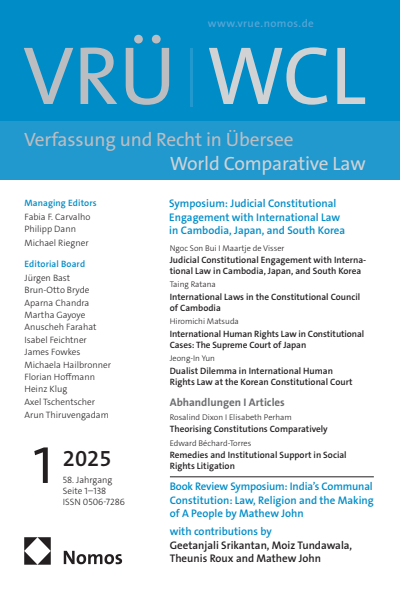
"Law and Politics in Africa, Asia and Latin America" analyses legal and constitutional developments in all states or regions outside of Europe as well as their regional and international integration. Founded in 1968 and inspired by decolonization and the idea of a cooperative new beginning, the Journal also promotes a special interest in contributions on 'Law and development'. The journal aims to provide a forum for a variety of perspectives on these fields of interest, be they focused on one country or comparative, theoretical or methodological in nature. Next to extensive articles, the journal publishes shorter reports about current events or conferences as well as book reviews. As a special service, each issue of "Law and Politics in Africa, Asia and Latin America" contains an international bibliography of relevant publications from around the world. This is compiled in cooperation with the Leibniz-Institute for Global and Regional Studies in Hamburg (GIGA). "Law and Politics" addresses authors and readers on all continents and aims to serve as a forum of mutual exchange. The journal is open for contributions from legal and social sciences as well as for analyses from practitioners. The journal is published quarterly and welcomes contributions in German, English, Spanish and French. Website: www.vrue.nomos.de
In India’s federal constitution, the urban housing agenda is allotted to the state governments. However, the overzealousness of the union government has meant that little of this power has been exercised by the state governments, with policies...
In India’s booming urban sprawl, Muslim communities are being boxed into corners geographically, socially, and economically. This paper explores the socio-spatial segregation of Muslim communities in Indian megacities, focusing on how systemic...
This article interrogates the role of the Public Trust Doctrine in adjudicating urban land disputes, particularly in the context of informal settlements. Through a comparative analysis of Indian and South African jurisprudence, it argues that Indian...
The persistence of military coups in the Global South raises new questions in terms of how constitution-makers use constitutions to prevent, deter or resist a coup and to what effect. In this article, we examine how constitution-makers respond to...
While the establishment of Indonesia’s Constitutional Court is traditionally viewed as an altruistic milestone for institutionalizing democracy and constitutionalism, this narrative remains unsatisfactory when scrutinized through a political...
Madagascar experiences, once more, political unrest and military intervention in its political life. President Rajoelina, a major political figure especially since 2009, lost his power in October 2025, and it is presently still not clear towards...