, to see if you have full access to this publication.
Monograph No access
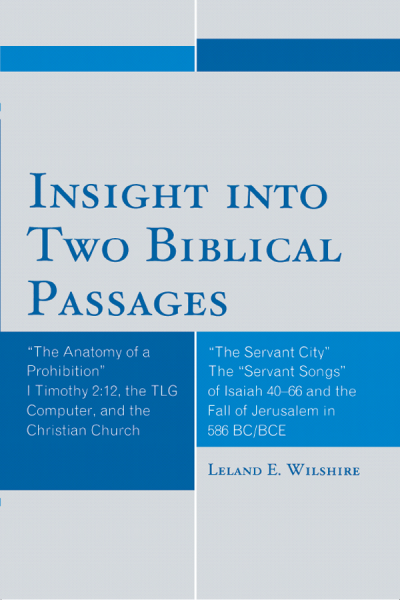
Insight into Two Biblical Passages
Anatomy of a Prohibition I Timothy 2:12, the TLG Computer, and the Christian Church
Authors:
Publisher:
2010
Summary
This work comprises new insights into two Biblical passages. The first study, titled 'The Anatomy of a Prohibition,' uses the TLG computer database to offer a new interpretation of I Timothy 2:12. The author provides insight that the TLG computer, with its data selections from 200 BC/BCE to 200 AD/CE, supports the interpretation of one of the key words 'authentein' as 'committing violent action,' not 'having authority.' It then explores the effect of this interpretation on exegesis, gender pronouncements, hermeneutics, tradition, theology, and relevance. As a supplement, it offers a history of traditional translations, mistranslations, and interpretations. The second insight study discusses seeing the 'suffering servant' of Isaiah 40-55 as the city of Jerusalem. This 'Servant City' study is based upon a comparison with the material outside the songs and with other ANE city descriptions that are also in the first millennium.
Search publication
Bibliographic data
Edition
1/2010
Copyright Year
2010
ISBN-Print
978-0-7618-5207-0
ISBN-Online
978-0-7618-5208-7
Publisher
Hamilton Books, Lanham
Language
English
Pages
147
Product Type
Monograph
Table of contents
ChapterPages
Table of Contents No access
The Anatomy of a Prohibition: I Timothy 2.12, the TLG Computer, and the Christian Church No access Pages 1 - 2
Foreword No access Pages 3 - 5
Preface No access Pages 6 - 8
Chapter 2. Philology, Lexicons, and the Computer Databank: A New Opening in Understanding the I Tim. 2:12 Prohibition No access
Chapter 3. A 1984 Attempt by GeorgeW. Knight III, by the use of Lexicons, to deal with the word authentein No access
Chapter 4. The Use of the Computer Data and Other Citations in a Background Study of the Word AUTHENTEO in I Tim. 2:12 No access
Chapter 5. A New Interpretation of the I Tim. 2.12 Prohibition in Light of the New Computer Databank Understanding No access
Chapter 6. Three Sample Alternative Approaches; that of Paul W. Barnett, Catherine C. Kroeger and the Editors of Women in the Church No access
Chapter 1. Exegesis No access
Chapter 2. Gender No access
Chapter 3. Hermeneutics No access
Chapter 4. Tradition No access
Chapter 5. Theology No access
Chapter 6. Authority No access
Chapter 7. Ecclesiology No access
Chapter 8. Relevance No access
Chapter 2. The Use of the Prohibition in the Traditional Translations and Interpretations of the Latin Early Church No access
Chapter 3. Traditional Translations and Interpretations of the Prohibition during the Middle Ages No access
Chapter 4. Reformulations of the Prohibition during the Era of the Renaissance and Reformation No access
Chapter 5. Differing English Translations of the I Tim. 2.12 Prohibition in Modern History and their Use in the Current Understandings of Women in Ecclesiastical Leadership No access
Notes No access Pages 90 - 100
Working Bibliography No access Pages 101 - 109
The Servant City: The "Servant Songs" of Isaiah 40-66 and the Fall of Jerusalem in 586 BC/BCE No access Pages 110 - 110
Foreword No access Pages 111 - 112
Preface No access Pages 113 - 114
Chapter 1. Background: Three Interpretations of the Fall of Jerusalem 586 BC/BCE No access Pages 115 - 120
Chapter 2. The "Suffering Servant" Metaphor in the "Servant Songs" of Isaiah 40-66 Relating to the Destruction of the City of Jerusalem No access Pages 121 - 129
Chapter 3. The Voice of the Isaianic "Servant Songs" within the Ancient Near Eastern Literary Tradition of Destroyed Cultic Centers No access Pages 130 - 136
Chapter 4. The Meaning and Future of the "Suffering Servant" Metaphor in "Isaiah" (Isaiah 40-66) Concerning the Destruction of Jerusalem No access Pages 137 - 139
Notes No access Pages 140 - 143
Working Bibliography No access Pages 144 - 146
Afterword No access Pages 147 - 147
Similar publications
from the topics "Religion und Theologie allgemein"