, to see if you have full access to this publication.
Monograph No access
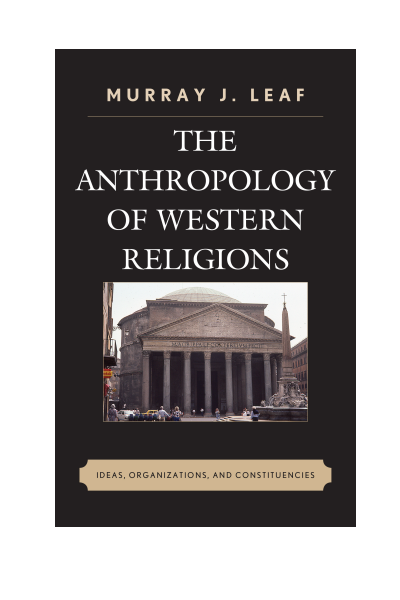
The Anthropology of Western Religions
Ideas, Organizations, and Constituencies
Authors:
Publisher:
2014
Summary
The world’s “great” religions depend on traditions of serious scholarship, dedicated to preserving their key texts but also to understanding them and, therefore, to debating what understanding itself is and how best to do it. They also have important public missions of many kinds, and their ideas and organizations influence many other important institutions, including government, law, education, and kinship. The Anthropology of Western Religions: Ideas, Organizations, and Constituencies is a comparative survey of the world’s major religious traditions as professional enterprises and, often, as social movements. Documenting the principle ideas behind Western religious traditions from an anthropological perspective, Murray J. Leaf demonstrates how these ideas have been used in building internal organizations that mobilize or fail to mobilize external support.
Keywords
Search publication
Bibliographic data
Edition
1/2014
Copyright Year
2014
ISBN-Print
978-0-7391-9238-2
ISBN-Online
978-0-7391-9239-9
Publisher
Lexington, Lanham
Language
English
Pages
263
Product Type
Monograph
Table of contents
ChapterPages
Contents No access
List of Illustrations No access
Preface No access
Acknowledgments No access
Other Approaches No access
“Higher” Traditions in General No access
Further Reading No access
Websites No access
Geopolitics No access
City Gods and Law No access
Gilgamesh Epic No access
Gods and Oaths No access
Family and Clan Gods No access
Mystery Cults No access
Zoroastrianism No access
Greek and Roman Philosophy No access
Conclusion No access
Further Reading No access
Notes No access
Central Ideas No access
Biblical History No access
Legal Content in the Tanakh No access
Subsequent Developments No access
Ceremonies No access
Recent Organizational Developments No access
Conclusion No access
Further Reading No access
Notes No access
Core Ideas No access
The Life of Christ No access
The Gospels in the Context of Judaism No access
Christianity beyond the Jewish Context No access
Formation of the Canon No access
Christianity’s Two Idea Systems No access
Conclusion: The End of Early Christianity No access
Further Reading No access
Notes No access
Foundation No access
The Division Between Sunni and Shia No access
Elements of Doctrine No access
Organizations No access
Constituency No access
Baha’i No access
Ahmadiyya movement No access
The Arab Spring No access
Conclusion No access
Further Reading No access
Notes No access
Roman Catholicism: Centralization No access
The Crusades and Inquisition No access
Pre-Reformation Heretical Movements No access
The Renaissance and the Reformation No access
The Counter-Reformation No access
The Radical Reformation No access
The Great Awakenings No access
United Church of Canada No access
“Marginal” Christians No access
Critical Scholarship and Public Theology No access
Conclusion No access
Further Reading No access
Notes No access
Religion and Social Development No access
Religion and Ethics No access
Final Thought No access
Bibliography No access Pages 253 - 256
Index No access Pages 257 - 262
About the Author No access Pages 263 - 263
Similar publications
from the topics "Religion und Theologie allgemein"