, to see if you have full access to this publication.
Monograph No access
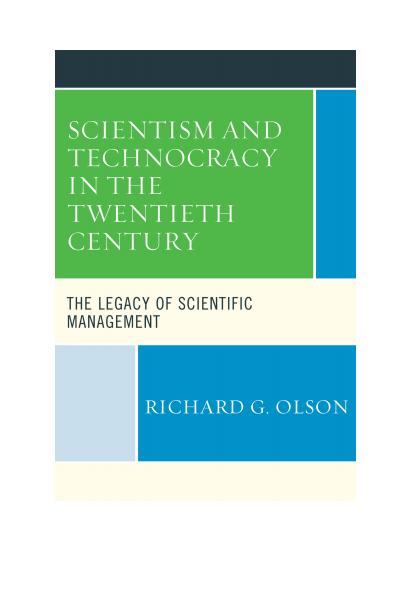
Scientism and Technocracy in the Twentieth Century
The Legacy of Scientific Management
Authors:
Publisher:
2015
Summary
Scientism, or the application of methods, attitudes, and concepts drawn from the natural sciences to human activities and social policy formation, is a pervasive feature of modern life, and it is one which has immense impact upon virtually all aspects of our private and public lives. This work explores the impact of Scientific Management, a movement initiated at the beginning of the twentieth century by the mechanical engineer, Frederick Winslow Taylor, in spreading scientistic attitudes through its appropriation by technical experts (technocrats) who have played a central and growing role in formulating public policies, not just in the United States, but throughout the world. It explores the movement of Scientific Management out of its initial American industrial context into progressive politics in the United States, into the policies of the Third Reich, those of the Soviet Union under Lenin and Stalin, into Cold War policy formation in both the U.S. and the U.S.S.R , and into those of contemporary China and the European Union, with short but important excursions into France, Sweden, Japan, and the developing world. Moreover it also explores some of the aesthetic dimensions of scientism and technocracy, especially as they have been reflected in modernist architecture and literature, and it examines current trends in education and the structure of advisory organizations such as RAND Corporation which are shaping the character and impact of scientistic and technocratic attitudes. Overall the approach is ambivalent toward scientism, acknowledging some of its great strengths in promoting economic growth and providing advice on security related issues, but offering criticisms of its narrow emphasis on efficiency, its insensitivity to qualitative considerations and the experience of those with specialized local knowledge, and its long term tendency to ignore distributive justice and promote income concentration.
Keywords
Search publication
Bibliographic data
Edition
1/2015
Copyright Year
2015
ISBN-Print
978-1-4985-2570-1
ISBN-Online
978-1-4985-2571-8
Publisher
Lexington, Lanham
Language
English
Pages
209
Product Type
Monograph
Table of contents
ChapterPages
Contents No access
Preface No access
Acknowledgments No access
1 Scientism among the Engineers No access Pages 1 - 16
2 Scientific Management Enters the Public Domain No access Pages 17 - 50
3 Taylorism Goes Global No access Pages 51 - 82
4 Technocracy during the Cold War, 1945–1990 No access Pages 83 - 106
5 Technocracy/Scientism in the Developing World, 1900–2000 No access Pages 107 - 134
6 Mitigated Scientism and Technocracy No access Pages 135 - 152
7 Continuing Concerns about the Role of Technical Expertise in a Democracy No access Pages 153 - 174