, to see if you have full access to this publication.
Edited Book No access
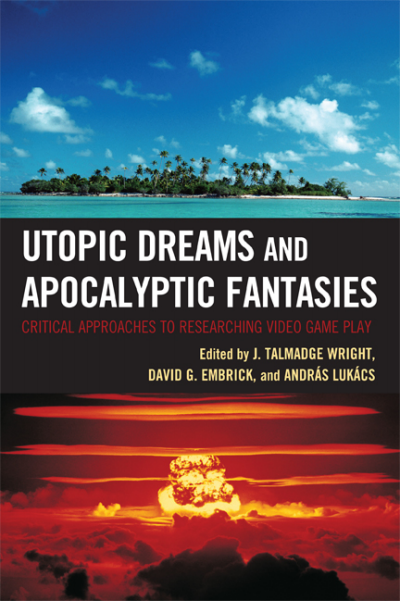
Utopic Dreams and Apocalyptic Fantasies
Critical Approaches to Researching Video Game Play
Editors:
| |
Publisher:
2010
Summary
Few books have attempted to contextualize the importance of video game play with a critical social, cultural and political perspective that raises the question of the significance of work, pleasure, fantasy and play in the modern world. The study of why video game play is 'fun' has often been relegated to psychology, or the disciplines of cultural anthropology, literary and media studies, communications and other assorted humanistic and social science disciplines. In Utopic Dreams and Apocalyptic Fantasies, Talmadge Wright, David Embrick and Andras Lukacs invites us to move further and consider questions on appropriate methods of researching games, understanding the carnival quality of modern life, the role of marketing in altering game narratives, and the role of fantasy and desire in modern video game play. Embracing an approach that combines a cultural and/or critical studies approach with a sociological understanding of this new media moves the debate beyond simple media effects, moral panics, and industry boosterism to one of asking critical questions, what does modern video game play 'mean,' what questions should we be asking, and what can sociological research contribute to answering these questions. This collection includes works which use textual analysis, audience based research, symbolic interactionism, as well as political economic and psychoanalytic perspectives to illuminate areas of inquiry that preserves the pleasure of modern play while asking tough questions about what such pleasure means in a world divided by political, economic, cultural and social inequalities.
Search publication
Bibliographic data
Edition
1/2010
Copyright Year
2010
ISBN-Print
978-0-7391-4700-9
ISBN-Online
978-0-7391-4702-3
Publisher
Lexington, Lanham
Language
English
Pages
274
Product Type
Edited Book
Table of contents
ChapterPages
Contents No access
List of Tables No access
Acknowledgments No access
Chapter 1. Introduction No access Pages 1 - 12
Chapter 2. Play and Cultural Transformation—Or, What Would Huizinga Think of Video Games? No access
Chapter 3. “Is He ’Avin a Laugh?”: The Importance of Fun to Virtual Play Studies No access
Chapter 4. Capitalism, Contradiction, and the Carnivalesque: Alienated Labor vs. Ludic Play No access
Chapter 5. Sneaking Mission: Late Imperial America and Metal Gear Solid No access
Chapter 6. I Blog, Therefore I Am: Virtual Embodiment and the Self No access
Chapter 7. Marketing Computer Games: Reinforcing or Changing Stereotypes? No access
Chapter 8. Censoring Violence in Virtual Dystopia: Issues in the Rating of Video Games in Japan and of Japanese Video Games Outside Japan No access
Chapter 9. Coding Culture: Video Game Localization and the Practice of Mediating Cultural Difference No access
Chapter 10. Beyond “Sheeping the Moon”—Methodological Considerations for Critical Studies of Virtual Realms No access
Chapter 11. The Chorus of the Dead: Roles, Identity Formation, and Ritual Processes Inside an FPS Multiplayer Online Game No access
Chapter 12. The Quantitative-Qualitative Antinomy in Virtual World Studies No access
Chapter 13. Virtual Today, Reality Tomorrow: Taking Our Sociological Understanding of Virtual Gameplay to the Next Level No access