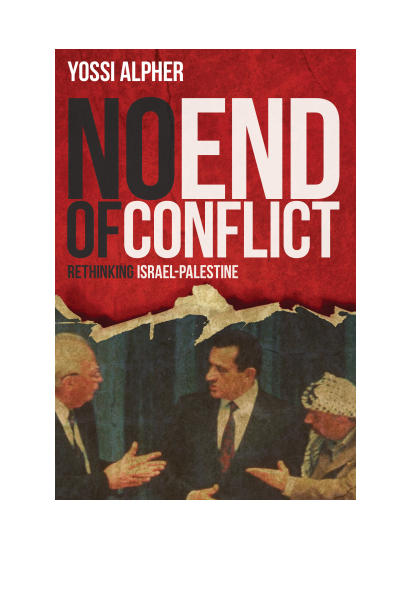
No End of Conflict
Rethinking Israel-Palestine- Authors:
- Publisher:
- 2016
Summary
Yossi Alpher, a veteran of peace process research and dialogue, explains how Israel got into its current situation of growing international isolation, political stalemate, and gathering messianic political influence. He investigates the inability of Israelis and Palestinians to make peace and end their conflict before suggesting not “solutions” (as there is no current prospect for a realistic comprehensive solution), but ways to moderate and soften the worst aspects of the situation and “muddle through” as Israel looks to a somber bi-national future.
Alpher argues that a sober reassessment is long overdue in the way the West looks at the Israeli-Palestinian relationship. He submits that we have to stop talking about “the peace process” as if it still seriously exists, that 20 years of the Oslo process have failed for very substantial reasons that the professional peacemakers ignore at their risk, and that Israel is more likely to sink into a single-state reality than to remain truly “Jewish and democratic.” Yet, his is a non-ideological, no nonsense book. Israel will not disappear, will not become impoverished, and will still find strategic partners.
The book opens with a true story of two sisters whose lives were separated in 1947, as a parable for what is still happening in Israel’s relations with the Arab world in general and the Palestinians in particular. It then offers brief analyses of how Israel looks today in the world, from a rejection of deceptive nostalgia for imaginary “good old days” to a discussion of Israel’s increasingly problematic internal cohesion and the paralysis this generates in decision making regarding territories-for-peace issues. A discussion of Diaspora Jewish influence focuses on the Diaspora’s anachronistic approach to the peace process. It is followed by a look at the highly negative effect regional developments are having on Israeli attitudes toward Arabs in general and peace in particular, using the summer 2014 war with Gaza-based Hamas as a case in point. Next comes a discussion of the history of the Israeli-Palestinian conflict and peace process, looking at the principal processes and dynamics that have thwarted peace and coexistence since the 1930s. Alpher argues that peace process practitioners on all sides—Israel, Palestinians, other Arabs, the US, the UN—have consistently ignored these dynamics or refused to take them seriously, producing today’s stalemate. The book concludes with a look at the scaled-down alternatives available today for avoiding, or at least delaying, total paralysis and a one-state reality. These include a UN approach and another unilateral withdrawal. It concludes with an examination of the increasingly influential Israeli proponents of a one-state solution and the spectacular damage their policies are bringing about.
Keywords
Search publication
Bibliographic data
- Copyright Year
- 2016
- ISBN-Print
- 978-1-4422-5858-7
- ISBN-Online
- 978-1-4422-5859-4
- Publisher
- Rowman & Littlefield, Lanham
- Language
- English
- Pages
- 161
- Product Type
- Monograph
Table of contents
- Contents No access
- Maps No access
- Preface No access
- Acknowledgments No access
- Introduction No access Pages 1 - 2
- Chapter One: Rachel, or the Arab-Jewish Divide No access Pages 3 - 10
- Chapter Two: After Nearly Fifty Years of Occupation No access
- Chapter Three: The Emerging Social-Political-Demographic Challenge to Israeli Internal Cohesion No access
- Chapter Four: The Global Jewish Factor No access
- Chapter Five: The Region No access
- Chapter Six: Resolving the Palestinian Issue, 1936–2009 No access
- Chapter Seven: Lessons from Kerry’s Failure and the American Role No access
- Chapter Eight: Are There Alternative Ways to Muddle Through? No access
- Chapter Nine: On the Slippery Slope toward a Binational Israel No access
- Chapter Ten: Summarizing the Strategic Ramifications of the Quasi-Apartheid Schemes No access
- Chapter Eleven: Are There Radical Alternative Realities? No access
- Index No access Pages 151 - 160
- About the Author No access Pages 161 - 161