, to see if you have full access to this publication.
Monograph No access
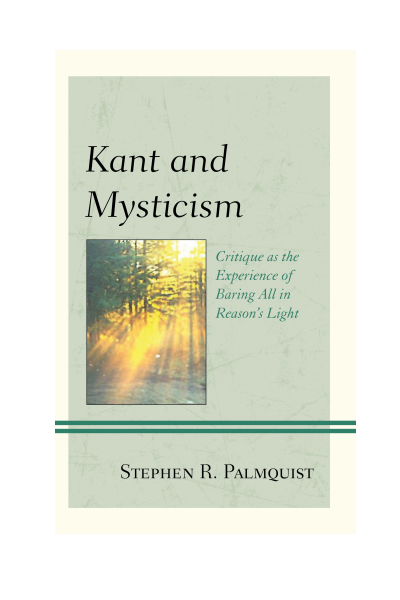
Kant and Mysticism
Critique as the Experience of Baring All in Reason's Light
Authors:
Publisher:
2019
Summary
What is happening when someone has a mystical experience, such as “feeling at one with the universe” or “hearing God’s voice?” Does philosophy provide tools for assessing such claims? Which claims can be dismissed as delusions and which ones convey genuine truths that might be universally meaningful? Valuable insights into such pressing questions can be found in the writings of Immanuel Kant, though few philosophical commentators have appreciated the implications beyond his famous “Copernican hypothesis.” In Kant and Mysticism, Stephen R. Palmquist corrects this skewed view of Kant once and for all.
Beginning with a detailed analysis of Kant’s 1766 work Dreams of a Spirit-Seer, Palmquist demonstrates that in Dreams Kant first discovers and explains his plan to write a new, “critical” philosophy that will revolutionize metaphysics by laying bare the limits of human reason. Palmquist shows how the same metaphorical relationship—between reason’s dreams (metaphysics) and sensibility’s dreams (mysticism)—permeates Kant’s mature writings. Clarifying how Kant’s final (unfinished) book, Opus Postumum, completes this dual project, Palmquist explains how the “critical mysticism” entailed by Kant’s position has profound implications for contemporary understandings of religious and mystical experience, both by religious individuals and by philosophers seeking to understand such experiences.
Search publication
Bibliographic data
Edition
1/2019
Copyright Year
2019
ISBN-Print
978-1-7936-0464-4
ISBN-Online
978-1-7936-0465-1
Publisher
Lexington, Lanham
Language
English
Pages
167
Product Type
Monograph
Table of contents
ChapterPages
Table of Contents No access
List of Figures No access
Preface No access
Introduction No access Pages 1 - 8
1 The Copernican Hypothesisas the Key to Kant’s Awakeningfrom Dogmatic Slumber No access
2 The Impact of Swedenborg’s Mysticism on Kant’s Metaphysical Dreams No access
3 Kant’s Awakening No access
4 Kant’s Metaphysical Dream No access
5 Does Mystical Experience Always Prompt Delirium? No access
6 Kant’s Critique of Delirious Mysticism No access
7 Immediate Experience of the Moral No access
8 Key Metaphors GuidingKant’s Critical Mysticism No access
9 Can the Original (Threefold) Synthesis Be Consciously Experienced? No access
10 The Categorical Imperativeas the Voice of God No access
11 Matter’s Living Force as Immediate Experience of the World No access
12 The Highest Purpose of Philosophyas Exhibiting the God–Man No access