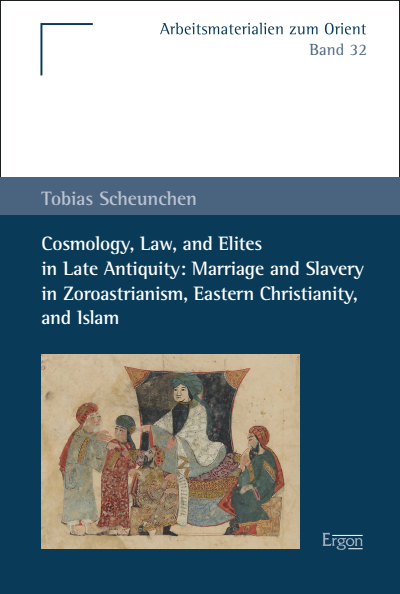
Cosmology, Law, and Elites in Late Antiquity: Marriage and Slavery in Zoroastrianism, Eastern Christianity, and Islam
- Authors:
- Series:
- Transkulturelle Orientstudien / Transcultural Oriental Studies (TOS), Volume 32
- Publisher:
- 26.03.2019
Summary
Can elites use cosmological imagery to sanction marital and slavery practices for their political aspirations? Can interactions between Late Antique legal systems be thought beyond “borrowings?” This work studies legal writings from the Zoroastrian, East Syrian, and Islamic traditions arguing that Late Antique matrimonial and slavery practices were significantly informed by cosmological imagery and repeatedly brought in line with the elites’ political aspirations. It suggests that these legal traditions should be thought in a shared epistemic framework to account for the changes and meaningfulness of legal concepts and institutions and cannot simply be reduced to a narrative of borrowings. Instead, this book shows that interactions between Late Antique legal systems were more complex and characterized by patterns of negotiation and competition mirroring the various entanglements of the Late Antique citizen’s life.
Keywords
Search publication
Bibliographic data
- Publication year
- 2019
- Publication date
- 26.03.2019
- ISBN-Print
- 978-3-95650-467-9
- ISBN-Online
- 978-3-95650-468-6
- Publisher
- Ergon, Baden-Baden
- Series
- Transkulturelle Orientstudien / Transcultural Oriental Studies (TOS)
- Volume
- 32
- Language
- English
- Pages
- 144
- Product type
- Book Titles
Table of contents
- Titelei/Inhaltsverzeichnis No access Pages I - XVI
- Chapter I: Introduction No access Pages 1 - 6
- A. Zoroastrianism and the Sasanians No access
- B. Christianity and the Church of the East No access
- C. Islam and the Arabs No access
- Chapter III: Literature review No access Pages 17 - 28
- Chapter IV: Methodology No access Pages 29 - 32
- A. Jurisprudence, legal practice, and the modality of lawmaking No access
- B. Legal sources: a survey No access
- 1. Cosmogony and eschatology: the origins and benefits of marriage No access
- a. Full marriage (pādiḫšāy) No access
- b. Auxiliary marriage (čagar) No access
- c. Consensus marriage (ḫwasrāyēn) No access
- d. Temporary marriage (nē az ān ī hamēīg) No access
- 3. Intermediary (ayōkēn) and substitute-successors (stūr) No access
- 4. The practice of next-of-kin marriage (ḫwēdōdah) No access
- 5. Sustaining elite households No access
- 1. On the nature of Christian marriage: marrying strangers (masbā d-nukrāyātā) and monogamy No access
- 2. Filing for divorce (purshānā)—the impossible? No access
- 3. The Sasanians accommodating their interests?—the Synods of 486 and 497 No access
- 4. (Re)negotiating matrimony: the prohibitions of Mar Aba No access
- 5. Reclaiming legal space? No access
- 1. The conditions of marriage (shurūṭ al-zawāj) No access
- 2. Women forbidden to marry (muḥarramāt al-nisāʾ) No access
- a. Unprotected (exchange) marriage (nikāḥ al-shighār) No access
- b. Marriage of the daughter without her consent (bi-ghayr riḍāhā) No access
- c. Marrying without a legal guardian (bi-ghayr walī) No access
- d. Fixed-term marriage (al-nikāḥ ilā ajal) No access
- 4. Stipulating the bridal dower (ṣadāq/mahr) No access
- 5. Situating the Islamic law on matrimony No access
- D. Preliminary conclusion No access
- a. Substance (bun) and fruit/increase (bar) No access
- b. Ownership (ḫwēšīh) and possession (dārišn) No access
- a. Selling and pledging slaves No access
- b. Selling children into slavery No access
- a. Full and partial manumission No access
- b. Reclaiming former slaves into slavery No access
- 4. Locating the slave in Ērānšahr No access
- 1. Slavery—a corollary of the original sin? No access
- a. Root (ʿeqārā) and fruit (pirā) No access
- b. The peculium of the slave No access
- 3. Manumitting slaves No access
- 4. Eternal slavery? No access
- 1. Islamic justifications for slavery No access
- 2. The legal (in)capacity of the slave to property No access
- 3. Manumitting slaves No access
- 4. From slaves to clients (mawālī) No access
- D. Preliminary conclusion No access
- Towards a shared framework of Late Antique legal epistemes? No access
- A. Sasanian law No access
- B. East Syrian law No access
- C. Early Islamic law No access
- Index No access Pages 137 - 144