, um zu prüfen, ob Sie einen Vollzugriff auf diese Publikation haben.
Monographie Kein Zugriff

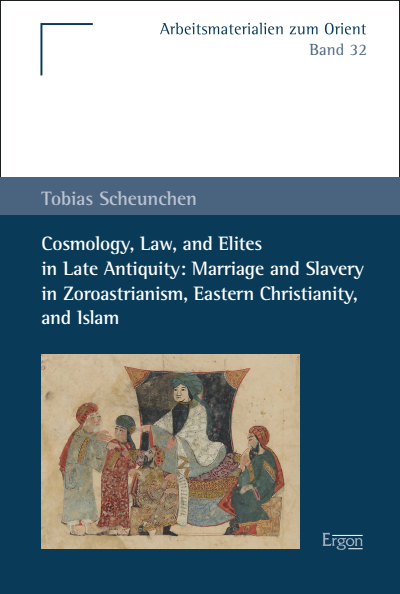
Cosmology, Law, and Elites in Late Antiquity: Marriage and Slavery in Zoroastrianism, Eastern Christianity, and Islam

Autor:innen:
Verlag:
 2019

Schlagworte


Publikation durchsuchen


Bibliographische Angaben

Copyrightjahr
2019
ISBN-Print
978-3-95650-467-9
ISBN-Online
978-3-95650-468-6
Verlag
Ergon, Baden-Baden
Reihe
Transkulturelle Orientstudien / Transcultural Oriental Studies (TOS)
Band
32
Sprache
Englisch
Seiten
144
Produkttyp
Monographie

Inhaltsverzeichnis

KapitelSeiten
  1. Titelei/Inhaltsverzeichnis Kein Zugriff Seiten I - XVI
  2. Chapter I: Introduction Kein Zugriff Seiten 1 - 6
    1. A. Zoroastrianism and the Sasanians Kein Zugriff
    2. B. Christianity and the Church of the East Kein Zugriff
    3. C. Islam and the Arabs Kein Zugriff
  3. Chapter III: Literature review Kein Zugriff Seiten 17 - 28
  4. Chapter IV: Methodology Kein Zugriff Seiten 29 - 32
    1. A. Jurisprudence, legal practice, and the modality of lawmaking Kein Zugriff
    2. B. Legal sources: a survey Kein Zugriff
      1. 1. Cosmogony and eschatology: the origins and benefits of marriage Kein Zugriff
        1. a. Full marriage (pādiḫšāy) Kein Zugriff
        2. b. Auxiliary marriage (čagar) Kein Zugriff
        3. c. Consensus marriage (ḫwasrāyēn) Kein Zugriff
        4. d. Temporary marriage (nē az ān ī hamēīg) Kein Zugriff
      2. 3. Intermediary (ayōkēn) and substitute-successors (stūr) Kein Zugriff
      3. 4. The practice of next-of-kin marriage (ḫwēdōdah) Kein Zugriff
      4. 5. Sustaining elite households Kein Zugriff
      1. 1. On the nature of Christian marriage: marrying strangers (masbā d-nukrāyātā) and monogamy Kein Zugriff
      2. 2. Filing for divorce (purshānā)—the impossible? Kein Zugriff
      3. 3. The Sasanians accommodating their interests?—the Synods of 486 and 497 Kein Zugriff
      4. 4. (Re)negotiating matrimony: the prohibitions of Mar Aba Kein Zugriff
      5. 5. Reclaiming legal space? Kein Zugriff
      1. 1. The conditions of marriage (shurūṭ al-zawāj) Kein Zugriff
      2. 2. Women forbidden to marry (muḥarramāt al-nisāʾ) Kein Zugriff
        1. a. Unprotected (exchange) marriage (nikāḥ al-shighār) Kein Zugriff
        2. b. Marriage of the daughter without her consent (bi-ghayr riḍāhā) Kein Zugriff
        3. c. Marrying without a legal guardian (bi-ghayr walī) Kein Zugriff
        4. d. Fixed-term marriage (al-nikāḥ ilā ajal) Kein Zugriff
      3. 4. Stipulating the bridal dower (ṣadāq/mahr) Kein Zugriff
      4. 5. Situating the Islamic law on matrimony Kein Zugriff
    1. D. Preliminary conclusion Kein Zugriff
        1. a. Substance (bun) and fruit/increase (bar) Kein Zugriff
        2. b. Ownership (ḫwēšīh) and possession (dārišn) Kein Zugriff
        1. a. Selling and pledging slaves Kein Zugriff
        2. b. Selling children into slavery Kein Zugriff
        1. a. Full and partial manumission Kein Zugriff
        2. b. Reclaiming former slaves into slavery Kein Zugriff
      1. 4. Locating the slave in Ērānšahr Kein Zugriff
      1. 1. Slavery—a corollary of the original sin? Kein Zugriff
        1. a. Root (ʿeqārā) and fruit (pirā) Kein Zugriff
        2. b. The peculium of the slave Kein Zugriff
      2. 3. Manumitting slaves Kein Zugriff
      3. 4. Eternal slavery? Kein Zugriff
      1. 1. Islamic justifications for slavery Kein Zugriff
      2. 2. The legal (in)capacity of the slave to property Kein Zugriff
      3. 3. Manumitting slaves Kein Zugriff
      4. 4. From slaves to clients (mawālī) Kein Zugriff
    1. D. Preliminary conclusion Kein Zugriff
    1. Towards a shared framework of Late Antique legal epistemes? Kein Zugriff
    1. A. Sasanian law Kein Zugriff
    2. B. East Syrian law Kein Zugriff
    3. C. Early Islamic law Kein Zugriff
  5. Index Kein Zugriff Seiten 137 - 144

Ähnliche Veröffentlichungen

aus dem Schwerpunkt "Europarecht & Internationales Recht & Rechtsvergleichung"
Cover des Buchs: Der Volkseinwand
Monographie Kein Zugriff
Florian Feigl
Der Volkseinwand
Cover des Buchs: Wie fördert die EU Menschenrechte in Drittstaaten?
Monographie Kein Zugriff
Dennis Traudt
Wie fördert die EU Menschenrechte in Drittstaaten?
Cover des Buchs: Future-Proofing in Public Law
Sammelband Kein Zugriff
Nicole Koblenz LL.M., Nicholas Otto, Gernot Sydow
Future-Proofing in Public Law