, to see if you have full access to this publication.
Edited Book No access
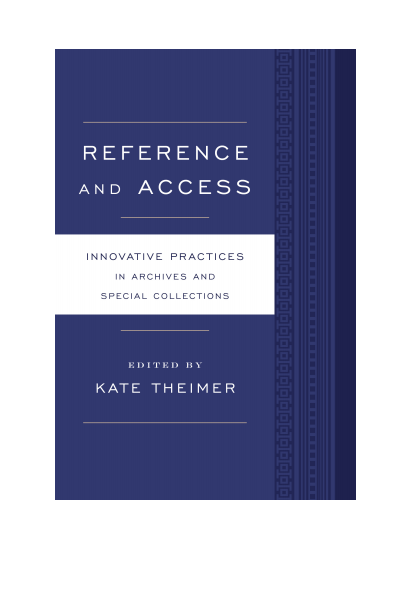
Reference and Access
Innovative Practices for Archives and Special Collections
Editors:
Publisher:
2014
Summary
Reference and Access: Innovative Practices for Archives and Special Collections explores how archives of different sizes and types are increasing their effectiveness in serving the public and meeting internal needs. The book features twelve case studies that demonstrate new ways to interact with users to answer their questions, provide access to materials, support patrons in the research room, and manage reference and access processes. The featured case studies are Building Bridges: Closing the Divide between Minimally Processed Collections and Researchers Managing Risk with a Virtual Reading Room: Two Born-Digital Projects Improvements on a Shoestring: Changing Reference Systems and Processes Twenty-First Century Security in a Twentieth-Century Space: Reviewing, Revising and Implementing New Security Practices in the Reading Room Talking in the Night: Exploring Webchats to Serve New Audiences A Small Shop Meets a Big Challenge: Finding Creative Ways to Assist the Researchers of the Breath of Life Archival Institute for Indigenous Languages The Right Tool at the Right Time: Implementing Responsive Reproduction Policies and Procedures Going Mobile: Using iPads to Improve the Reading Room Experience Beyond “Trial by Fire”: Towards A More Active Approach to Training New Reference Staff Access for All: Making Your Archives Website Accessible for People with Disabilities No Ship of Fools: A Digital Humanities Collaboration to Enhance Access to Special Collections Websites as a Digital Extension of Reference: Creating a Reference and IT Partnership for Web Usability Studies Each of these case studies deconstructs reference and access services into their essential elements: interacting with people who have questions, providing access to materials that meet researcher needs, assisting researchers as they use materials, and managing the processes needed to support reference and access. The volume will be useful to those working in archives and special collections as well as other cultural heritage organizations, and provides ideas ranging from the aspirational to the immediately implementable. It also provides students and educators in archives, library, and public history graduate programs a resource for understanding the issues driving change in the field today and the kinds of strategies archivists are using to meet these new challenges.
Search publication
Bibliographic data
Edition
1/2014
Copyright Year
2014
ISBN-Print
978-0-8108-9091-6
ISBN-Online
978-0-8108-9092-3
Publisher
Rowman & Littlefield, Lanham
Language
English
Pages
191
Product Type
Edited Book
Table of contents
ChapterPages
Contents No access
Introduction No access
Chapter One: Building Bridges No access Pages 1 - 16
Chapter Two: Managing Risk with a Virtual Reading Room No access Pages 17 - 36
Chapter Three: Improvements on a Shoestring No access Pages 37 - 50
Chapter Four: Twenty-First-Century Security in a Twentieth-Century Space No access Pages 51 - 66
Chapter Five: Talking in the Night No access Pages 67 - 80
Chapter Six: A Small Shop Meets a Big Challenge No access Pages 81 - 94
Chapter Seven: The Right Tool at the Right Time No access Pages 95 - 108
Chapter Eight: Going Mobile No access Pages 109 - 122
Chapter Nine: Beyond “Trial by Fire” No access Pages 123 - 136
Chapter Ten: Access for All No access Pages 137 - 154
Chapter Eleven: No Ship of Fools No access Pages 155 - 170
Chapter Twelve: Websites as a Digital Extension of Reference No access Pages 171 - 184