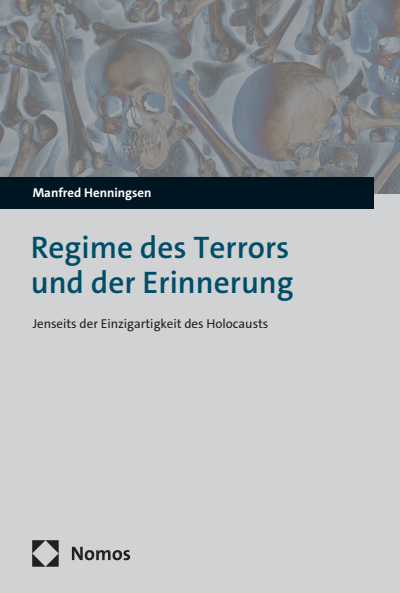
Regime des Terrors und der Erinnerung
Jenseits der Einzigartigkeit des Holocausts- Authors:
- Publisher:
- 2025
Summary
Manfred Henningsen illustrates how convenient it has become not recognizing other regimes of terror in recent history as holocausts. Manfred Henningsen compares the memory of Nazi Germany’s macro criminal record with the remembrances of Stalin’s Russia and Mao’s China, the Japanese Empire, Pol Pot’s Cambodia, Sukarno’s Indonesia. He discusses the cultural reasons for these memory distortions in the West and in the societies that have experienced this genocidal violence. Henningsen has embedded his search in an autobiographical context that begins with his birth, upbringing and education in Germany from 1938 to 1969, continues after his move to Hawaii in 1970 in the American political culture and becomes more realized through traveling in Europe, Asia, and Africa. Manfred Henningsen was a professor at the University of Hawaii at Manoa in Honolulu where he taught until his retirement in 2020 for fifty years.
Keywords
Search publication
Bibliographic data
- Edition
- 1/2025
- Copyright Year
- 2025
- ISBN-Print
- 978-3-7560-0900-8
- ISBN-Online
- 978-3-7489-1646-8
- Publisher
- Nomos, Baden-Baden
- Language
- German
- Pages
- 269
- Product Type
- Monograph
Table of contents
- Titelei/Inhaltsverzeichnis No access Pages 1 - 8
- Michael J. Shapiro – Geschichte und Gegengeschichte des Holocausts No access Pages 9 - 12
- a) Putins Erfindung der russischen Geschichte No access
- b) Die deutsche und die amerikanische Geschichtsdebatte No access
- a) Regime des Terrors und der Erinnerung No access
- b) Die deutsche Suche No access
- c) Die Hinterfragung des amerikanischen Mythos No access
- aa) Das Regime der Roten Khmer No access
- bb) Das kaiserliche Japan und die Invasion in China No access
- cc) Amerikanische Erinnerungen ausländischer Kriege No access
- a) Demozidaler Terror im 20. Jahrhundert No access
- b) Koloniale Terrorregime No access
- Kapitel 2: Terror und Erinnerung: Jenseits der Einzigartigkeit des Holocausts No access Pages 111 - 134
- Kapitel 3: Von der Verleugnung zur Anerkennung und Versöhnung: Deutschlands Kampf mit der Erinnerung an das Böse No access Pages 135 - 158
- Kapitel 4: Die umstrittenen Erinnerungen an Buchenwald No access Pages 159 - 170
- Kapitel 5: Die Politik des Vergessens und Erinnerns: Wie Japan und Deutschland ihre Erinnerung an Massenmord und Terror verarbeiten No access Pages 171 - 190
- a) Weißes Amerika No access
- b) Die Geschichte von Thomas Jefferson No access
- c) Schwarzes amerikanisches Gedächtnis No access
- a) Die Definition des Holocausts als einzigartig böse No access
- b) Ist der Holocaust einzigartig böse? No access
- Fazit No access Pages 245 - 256
- Danksagung No access Pages 257 - 258
- Bibliographie No access Pages 259 - 268
- Über den Autor No access Pages 269 - 269
Bibliography (185 entries)
No match found. Try another term.
- Agamben, Giorgio. Was von Auschwitz bleibt: Das Archiv und der Zeuge. Homo sacer III. Frankfurt am Main: edition suhrkamp, 2003. Open Google Scholar DOI: 10.5771/9783748916468
- Allen, James, Hilton Als, John Lewis, Leon F. Litwack. Without Sanctuary: Lynching Photography in America. Santa Fe, NM: Twin Palms Publishers, 1999. Open Google Scholar DOI: 10.5771/9783748916468
- Appiah, Kwame A. Lines of Descent: W. E. B. Du Bois and the Emergence of Identity (W. E. B. Du Bois Lectures), Cambridge, MA: Harvard University Press, 2014. Open Google Scholar DOI: 10.5771/9783748916468
- Arendt, Hannah. „The Aftermath of Nazi-Rule – Report from Germany.” Commentary (Oktober 1950). Open Google Scholar DOI: 10.5771/9783748916468
- Arendt, Hannah. Eichmann in Jerusalem: Ein Bericht von der Banalität des Bösen. München: Piper, 1964. Open Google Scholar DOI: 10.5771/9783748916468
- Arendt, Hannah. Elemente und Ursprünge totaler Herrschaft. Frankfurt am Main: Europäische Verlagsanstalt., 1955. Open Google Scholar DOI: 10.5771/9783748916468
- Arendt, Hannah. The Origins of Totalitarianism. London: Penguin Modern Classics, 2017. Open Google Scholar DOI: 10.5771/9783748916468
- Aretin, Karl Otmar Freiherr von. „Deutsche Historiker als professionelle Verdränger? Zum Vorwurf von Manfred Henningsen.“ Merkur (November 1985). Open Google Scholar DOI: 10.5771/9783748916468
- Aschheim, Steven. Zwischen Kultur und Katastrophe, Konfrontation, Krise und Kreativität als deutsch-jüdische Erfahrung. Frankfurt am Main: Europäische Verlagsanstalt, 2024. Open Google Scholar DOI: 10.5771/9783748916468
- Augustinus. St. Augustine’s Confessions. Volume I, Cambridge, MA: Harvard University Press, 1968. Open Google Scholar DOI: 10.5771/9783748916468
- Barnouw, Dagmar. The War in the Empty Air: Victims, Perpetrators, and Postwar Germans. Bloomington: Indiana University Press, 2008. Open Google Scholar DOI: 10.5771/9783748916468
- Bauer, Yehuda. Rethinking the Holocaust. New Haven, CT: Yale University Press, 2000. Open Google Scholar DOI: 10.5771/9783748916468
- Beuys, Barbara. Sophie Scholl: Biografie. München: Hanser, 2010. Open Google Scholar DOI: 10.5771/9783748916468
- Bix, Herbert. „Hirohito: String Puller, Not Puppet.” The New York Times (19. September 2014). Open Google Scholar DOI: 10.5771/9783748916468
- Blackmon, Douglas A. Slavery by Another Name: The Re-Enslavement of Black Americans in America from The Civil War to World War II. New York: Doubleday, 2009. Open Google Scholar DOI: 10.5771/9783748916468
- Blight, David W. Race and Reunion: The Civil War in American Memory. Cambridge, MA.: The Belknap Press, 2002. Open Google Scholar DOI: 10.5771/9783748916468
- Brodie, Fawn. Thomas Jefferson: An Intimate History. New York: Bantam Books, 1974. Open Google Scholar DOI: 10.5771/9783748916468
- Buckley, Chris. “On Hong Kong Shelves”. New York Times (18. Mai 2013). Open Google Scholar DOI: 10.5771/9783748916468
- Callahan, Allen Dwight. The Talking Book: African Americans and the Bible. New Haven, CT/London: Yale University Press, 2006. Open Google Scholar DOI: 10.5771/9783748916468
- Chang, Iris. Die Vergewaltigung von Nanking. Das Massaker in der chinesischen Hauptstadt am Vorabend des Zweiten Weltkriegs. Leipzig: Pendo, 1999. Open Google Scholar DOI: 10.5771/9783748916468
- Cochrane, Joe. “‘Act of Killing’ Film Fails to Stir Indonesia.” The New York Times (1. März 2014). Open Google Scholar DOI: 10.5771/9783748916468
- Collins, Gail. “Discovering the Limitations of Statues”, The New York Times (19. August, 2017). Open Google Scholar DOI: 10.5771/9783748916468
- Confino, Alon. A World Without Jews: The Nazi Imagination from Persecution to Genocide. New Haven, CT/London: Yale University Press, 2014. Open Google Scholar DOI: 10.5771/9783748916468
- Conrad, Joseph. Herz der Finsternis. Philipp Reclam Verlag, 2021. Open Google Scholar DOI: 10.5771/9783748916468
- Conze, Eckart, Norbert Frei, Peter Hayes, Moshe Zimmermann (Hrsg.). Das Amt und die Vergangenheit: Deutsche Diplomaten im Dritten Reich und in der Bundesrepublik. München: Karl Blessing Verlag, 2010. Open Google Scholar DOI: 10.5771/9783748916468
- Cooper, Barry/Jodi Bruhn. Voegelin Recollected: Conversations on a Life. Columbia, MO: University of Missouri Press, 2007. Open Google Scholar DOI: 10.5771/9783748916468
- Cortés, Hernán. Letters from Mexiko. Übersetzt und herausgegeben von Anthony Pagden. New Haven, CT/London: Yale University Press, 1986. Open Google Scholar DOI: 10.5771/9783748916468
- Courtois, Stéphane u.a. Le livre noir du Communisme: Crimes, terreur, répression. Paris: Robert Laffont, 1997. Open Google Scholar DOI: 10.5771/9783748916468
- Diestelkamp, A., R. Laun, P. Rassow, H. Rothfels, Th. Schieder (Hrsg.). Dokumentation der Vertreibung der Deutschen aus Ost-Mitteleuropa. 1954, 8 Bände. Open Google Scholar DOI: 10.5771/9783748916468
- Dikötter, Frank. Mao‘s Great Famine: The History of China’s Most Devastating Catastrophe,1958–1962. New York: Walker & Co., 2010. Open Google Scholar DOI: 10.5771/9783748916468
- Dikötter, Frank. The Triumph of Liberation, A History of the Chinese Revolution,1945–1957. New York: Bloomsbury, 2013. Open Google Scholar DOI: 10.5771/9783748916468
- Dikötter, Frank. The Cultural Revolution: A People's History, 1962–1976. New York: Bloomsbury, 2016. Open Google Scholar DOI: 10.5771/9783748916468
- Dirk, Moses A. (Hrsg.). Genocide and Settler Societies. New York/Oxford: Berghahn Books, 2004. Open Google Scholar DOI: 10.5771/9783748916468
- Douglass, Frederick. Autobiographies: My Bondage and My Freedom (1855). New York: Library of America, The College Edition, 1996. Open Google Scholar DOI: 10.5771/9783748916468
- Drobisch, Klaus, Günther Wieland. System der NS-Konzentrationslager 1933–1939. Berlin: Akademie Verlag, 1993. Open Google Scholar DOI: 10.5771/9783748916468
- Du Bois, W. E. B. Black Reconstruction in America, 1860–1880. Free Press, 1999 New York: Atheneum, 1992. Open Google Scholar DOI: 10.5771/9783748916468
- Earl, Hilary. The Nuremberg SS-Einsatzgruppen Trial, 1945–1958: Atrocity, Law, and History. New York: Cambridge University Press, 2009. Open Google Scholar DOI: 10.5771/9783748916468
- Eder, Jacob S. Holocaust-Angst: Die Bundesrepublik, die USA und die Erinnerung an den Judenmord seit den siebziger Jahren. Göttingen: Wallstein Verlag, 2020. Open Google Scholar DOI: 10.5771/9783748916468
- Elkins, Stanley. Slavery: A Problem in American Institutional and Intellectual Life. Chicago/London: University of Chicago Press, 1969. Open Google Scholar DOI: 10.5771/9783748916468
- Ellis, Joseph J. American Sphinx: The Character of Thomas Jefferson. New York: Alfred Knopf Inc, 1997. Open Google Scholar DOI: 10.5771/9783748916468
- Ellison, Ralph. Der unsichtbare Mann. Berlin: Aufbau Verlag, 2019. Open Google Scholar DOI: 10.5771/9783748916468
- Faust, Drew Gilpin. The Republic of Suffering: Death and the American Civil War. New York: Knopf, 2008. Open Google Scholar DOI: 10.5771/9783748916468
- Feldman, Deborah. Exodus. New York: Plume – Penguin Group 2015. Open Google Scholar DOI: 10.5771/9783748916468
- Feldman, Deborah. Unorthodox. The Scandalous Rejection of my Hasidic Roots. New York: Simon & Schuster, 2012. Open Google Scholar DOI: 10.5771/9783748916468
- Feldman, Deborah. Überbitten. Zürich: Secession Verlag für Literatur, 2017. Open Google Scholar DOI: 10.5771/9783748916468
- Felman, Shoshana. The Juridical Unconscious: Trials and Traumas in the Twentieth Century. Cambridge, MA: Harvard University Press, 2002. Open Google Scholar DOI: 10.5771/9783748916468
- Fong, Mei. One Child: The Story of Chinas Most Radical Experiment. Boston/New York: Houghton Mifflin Harcourt, 2016. Open Google Scholar DOI: 10.5771/9783748916468
- Friedman, Lawrence J. The White Savage: Racial Fantasies in the Postbellum South. Englewood Cliffs, NJ: Prentice-Hall, 1970. Open Google Scholar DOI: 10.5771/9783748916468
- Friedrich, Jörg. Der Brand: Deutschland im Bombenkrieg. 1940‒1945. München: Propyläen, 2002. Open Google Scholar DOI: 10.5771/9783748916468
- Gaus, Günter. Gespräch mit Hannah Arendt. München: Piper, 1965. Open Google Scholar DOI: 10.5771/9783748916468
- Gay, Peter. My German Question: Growing up in Nazi Berlin. New Haven, CT/ London: Yale University Press, 1998. Open Google Scholar DOI: 10.5771/9783748916468
- Gerlach, Christian. Extremely Violent Societies: Mass Violence in the Twentieth-Century World. Cambridge/New York: Cambridge University Press, 2010. Open Google Scholar DOI: 10.5771/9783748916468
- Giddens, Anthony. Turbulenter und mächtiger Kontinent: Welche Zukunft für Europa? Cambridge: Polity, 2013. Open Google Scholar DOI: 10.5771/9783748916468
- Goldhagen, Daniel Jonah. Hitlers willige Vollstrecker: Ganz gewöhnliche Deutsche und der Holocaust. München: Pantheon Verlag, 2012. Open Google Scholar DOI: 10.5771/9783748916468
- Goltermann, Svenja. Die Gesellschaft der Überlebenden: Deutsche Kriegsheimkehrer und ihre Gewalterfahrungen im Zweiten Weltkrieg. München: DVA, 2009. Open Google Scholar DOI: 10.5771/9783748916468
- Gordon-Reed, Annette, Peter S. Onuf. Most Blessed of the Patriarchs: Thomas Jefferson and the Empire of the Imagination. Liveright Publishing Corporation, 2016. Open Google Scholar DOI: 10.5771/9783748916468
- Gordon-Reed, Annette. ֦”Message to the World.” The Times Literary Supplement (26. Juli 2020). Open Google Scholar DOI: 10.5771/9783748916468
- Greenberg, Amy S. A Wicked War: Polk, Clay, Lincoln, and the 1846 U.S. Invasion of Mexico. New York: Knopf, 2013. Open Google Scholar DOI: 10.5771/9783748916468
- Guez, Olivier. Heimkehr der Unerwünschten: Eine Geschichte der Juden in Deutschland nach 1945. Mit einem Vorwort von Jorge Semprun. München: Piper, 2011. Open Google Scholar DOI: 10.5771/9783748916468
- Gutiérrez, Gustavo. Las Casas: In Search of the Poor of Jesus Christ. New York: Orbis Books, 1993. Open Google Scholar DOI: 10.5771/9783748916468
- Halberman, Clyde. “Nearly 40 Years, Kissinger’s Words Stir Fresh Outrage among Jews.” The New York Times (17. Dezember 2010). Open Google Scholar DOI: 10.5771/9783748916468
- Harding, Thomas. Hanns und Rudolf: Der deutsche Jude und die Jagd nach dem Kommandanten von Auschwitz. München: dtv, 2015. Open Google Scholar DOI: 10.5771/9783748916468
- Henningsen, Franziska. Psychoanalysen mit traumatisierten Patienten. Trennung, Krankheit, Gewalt. Stuttgart: Klett-Cotta 2012. Open Google Scholar DOI: 10.5771/9783748916468
- Henningsen, Manfred. „‘Eichmann war kein Ungeheuer.‘ Die Kontroverse um Hannah Arendts 'Bericht von der Banalität des Bösen.“ Münchner Abendzeitung. (26./27. September 1964). Open Google Scholar DOI: 10.5771/9783748916468
- Henningsen, Manfred. „Das göttliche Recht der Könige: Jacob I. und Robert Filmer“. In: Eric Voegelin, Zwischen Revolution und Restauration. Politisches Denken in England im 17. Jahrhundert. München: List, 1968. Open Google Scholar DOI: 10.5771/9783748916468
- Henningsen, Manfred. „Gesellschaft der Intelligenzquotienten“. Die Zeit (7. September 1973). Open Google Scholar DOI: 10.5771/9783748916468
- Henningsen, Manfred. Der Fall Amerika. Zur Sozial- und Bewusstseinsgeschichte einer Verdrängung. München: List, 1974. Open Google Scholar DOI: 10.5771/9783748916468
- Henningsen, Manfred. „Die Ideologie des Bicentennial“. Merkur (Juni 1976), S. 501‒14. Open Google Scholar DOI: 10.5771/9783748916468
- Henningsen, Manfred. „Das amerikanische Selbstverständnis und die Erfahrung des Großen Krieges.“ In: Klaus Vondung (Hrsg.). Kriegserlebnis. Der Erste Weltkrieg in der literarischen Gestaltung und symbolischen Deutung der Nationen. Göttingen: Vandenhoeck & Ruprecht, 1980, S. 368‒86. Open Google Scholar DOI: 10.5771/9783748916468
- Henningsen, Manfred. „Die Welt der nordamerikanischen Sklaven“. L'80 (Juni 1984): S. 90‒112. Open Google Scholar DOI: 10.5771/9783748916468
- Henningsen, Manfred. „Zur Symbolik des Zweiten Weltkriegs heute.“ Merkur (Mai 1985): S. 444‒51. Open Google Scholar DOI: 10.5771/9783748916468
- Henningsen, Manfred “The Politics of Memory: Holocaust and Legitimacy in Open Google Scholar DOI: 10.5771/9783748916468
- Post-Nazi Germany,”. Holocaust and Genocide Studies. Bd. 4 (1989): S. 15‒26. Open Google Scholar DOI: 10.5771/9783748916468
- Henningsen, Manfred. „Der heilige Mauritius und der Streit um die multikulturelle Identität des Westens.“ Merkur (September 1992): S. 834‒45. Open Google Scholar DOI: 10.5771/9783748916468
- Henningsen, Manfred. „Die Regime des Terrors“. Merkur (Februar 1997): S. 105‒16. Open Google Scholar DOI: 10.5771/9783748916468
- Henningsen, Manfred. „Die Unwahrscheinlichkeit eines Clash of Civilizations“. Bochumer Jahrbuch für Ostasienforschung (1999): S. 107‒17. Open Google Scholar DOI: 10.5771/9783748916468
- Henningsen, Manfred. „Demozid und Politik: Über die Funktion des Rassismus in modernen Regimen des Terrors.“ In: Christian Rödel, Marília dos Santos Lopes, and Thomas Beck (Hrsg..). Die Geschichte der europäischen Expansion. Barrieren und Zugänge. Festschrift E. Schmitt. Wiesbaden: Harrassowitz, 2004, S. 209‒25. Open Google Scholar DOI: 10.5771/9783748916468
- Henningsen, Manfred. „Die europäische Schrumpfung der Menschheit. Die Aufklärung und die Entstehung des transatlantischen Rassismus.“ In: Aram Mattioli, Markus Ries, and Enno Rudolph (Hrsg.). Intoleranz im Zeitalter der Aufklärung. Europa 1770‒1848. Zürich: Orell Fuessli, 2004. Open Google Scholar DOI: 10.5771/9783748916468
- Henningsen, Manfred. Der Mythos Amerika. Frankfurt am Main: Eichborn, 2009. Open Google Scholar DOI: 10.5771/9783748916468
- Henningsen, Manfred. „Terror und Erinnerung“. Merkur (Dezember 2013): S.1116‒1124. Open Google Scholar DOI: 10.5771/9783748916468
- Henningsen, Manfred. „Eric Voegelins Dekonstruktion der Rasse im Jahr 1933“. Hochschulabschluss Zeitschrift der Fakultät für Philosophie Bd. 35 (2014): S. 207‒221. Open Google Scholar DOI: 10.5771/9783748916468
- Hilberg, Raul. Die Vernichtung der europäischen Juden. Die Zeit des Nationalsozialismus, 3 Bände. Frankfurt am Main: S. Fischer Verlag, 2023. Open Google Scholar DOI: 10.5771/9783748916468
- Hinton, Alexander Laban. Why Did They Kill? Cambodia in the Shadow of Genocide. Berkeley/California: University of California Press, 2004. Open Google Scholar DOI: 10.5771/9783748916468
- Hoehn, Maria, und Martin Klimke. A Breath of Freedom. The Civil Rights Struggle, African GIs and Germany. New York: Palgrave Macmillan 2010. Open Google Scholar DOI: 10.5771/9783748916468
- Holowchak, M. Andrew. Framing a Legend: Exposing the Distorted History of Thomas Jefferson and Sally Hemings. Amherst: Prometheus Books, 2013. Open Google Scholar DOI: 10.5771/9783748916468
- Horkheimer, Max. Kritische Theorie. Eine Dokumentation. Bd. I, Hrsg. von Alfred Schmidt. Frankfurt am Main: S. Fischer Verlag, 1968. Open Google Scholar DOI: 10.5771/9783748916468
- Horkheimer, Max, Theodor Adorno. Dialektik der Aufklärung: Philosophische Fragmente. Frankfurt am Main: Fischer Taschenbuch, 1988. Open Google Scholar DOI: 10.5771/9783748916468
- Jaspers, Karl. Wohin treibt die Bundesrepublik? München: Piper 1966. Open Google Scholar DOI: 10.5771/9783748916468
- Jaspin, Elliot. Buried in the Bitter Waters. The Hidden History of Racial Cleansing in America. New York: Basic Books, 2008. Open Google Scholar DOI: 10.5771/9783748916468
- Jefferson, Thomas. Notes on the State of Virginia. Ed. with an introduction and notes by William Peden. Chapel Hill: University of North Carolina Press, 1982. Open Google Scholar DOI: 10.5771/9783748916468
- Jensen, A. R. Genetics & Education. London: Methuen 1972. Open Google Scholar DOI: 10.5771/9783748916468
- Jisheng, Yang. Tombstone: The Great Chinese Famine, 1958–1962. New York: Farrar, Strauss and Giroux 2008. Open Google Scholar DOI: 10.5771/9783748916468
- Ju-ao, Mei. The Tokyo Trial and War Crimes in Asia. Singapore: Palgrave Macmillan, 2018. Open Google Scholar DOI: 10.5771/9783748916468
- Kant, Immanuel. Der Streit der Fakultäten, in: Schriften zur Anthropologie, Geschichtsphilosophie, Politik und Pädagogik. Werke in Zehn Bänden, Hrsg. W. Weischedel. Darmstadt: Wissenschaftliche Buchgesellschaft 1968. Open Google Scholar DOI: 10.5771/9783748916468
- Kant, Immanuel. Die Religion innerhalb der Grenzen der bloßen Vernunft. Reclam, 1986. Open Google Scholar DOI: 10.5771/9783748916468
- Kant, Immanuel. Political Writings. Hrsg. von H. S. Reiss, Cambridge Texts in the History of Political Thought, 1991. Open Google Scholar DOI: 10.5771/9783748916468
- Katsuichi, Honda. The Nanjing Massacre: A Japanese Journalist Confronts Japan's National Shame. Hrsg. von Frank Gibney. Armouk, New York. M.E. Sharpe, 1999. Open Google Scholar DOI: 10.5771/9783748916468
- Keyserlingk-Rehbein, Linda von. Nur eine »ganz kleine Clique«? Die NS-Ermittlungen über das Netzwerk vom 20. Juli 1944. Berlin: Lukas Verlag, 2018. Open Google Scholar DOI: 10.5771/9783748916468
- Kiernan, Ben. The Pol Pot Regime: Race, Power, and Genocide in Cambodia under the Khmer Rouge, 1975‒79. New Haven, CT: Yale University Press, 1996. Open Google Scholar DOI: 10.5771/9783748916468
- Kiernan, Ben. Blood, and Soil: A World History of Genocide and Extermination from Sparta to Darfur. New Haven, CT/London: Yale University Press, 2007. Open Google Scholar DOI: 10.5771/9783748916468
- Kiernan, Ben. The Pol Pot Regime. New Haven, CT: Yale University Press, 2008. Open Google Scholar DOI: 10.5771/9783748916468
- Klemt, Adalbert G. Die Säkularisierung der universalhistorischen Auffassung. Zum Wandel des Geschichtsdenkens im 16. und 17. Jahrhundert. Göttingen/Berlin/Frankfurt am Main: Musterschmidt Verlag, 1960. Open Google Scholar DOI: 10.5771/9783748916468
- Knigge, Volkhard (Hrsg.). Buchenwald: Ausgrenzung und Gewalt 1937 bis 1945. Führer zur Dauerausstellung in der Gedenkstätte Buchenwald. Göttingen: Wallstein Verlag 2017. Open Google Scholar DOI: 10.5771/9783748916468
- Kohl, Christiane. The Witness House: Nazis and Holocaust Survivors Sharing a Villa During the Nuremberg Trials. New York: Other Press, 2010. Open Google Scholar DOI: 10.5771/9783748916468
- Kojève, Alexandre. Introduction to the Reading of Hegel: Lectures on the Phenomenology of the Spirit. Assembled by Raymond Queneau. Ed. by Allan Bloom. New York/London: Basic Books, 1969. Open Google Scholar DOI: 10.5771/9783748916468
- Kogon, Eugen. „Gericht und Gewissen.“ Frankfurter Hefte (1946): 29. Open Google Scholar DOI: 10.5771/9783748916468
- Kogon, Eugen. Der SS-Staat: Das System der deutschen Konzentrationslager. Frankfurt am Main: Europäische Verlagsanstalt, 1959. Open Google Scholar DOI: 10.5771/9783748916468
- Kohler, Lotte, Hans Saner (Hrsg.). Hannah Arendt-Karl Jaspers Korrespondenz 1926‒1969. New York: Harcourt Brace Jovanovich, 1992. Open Google Scholar DOI: 10.5771/9783748916468
- Kushner, Tony. The Holocaust and the Liberal Imagination: A Social and Cultural History. Oxford/Cambridge, MA: Blackwell, 1994. Open Google Scholar DOI: 10.5771/9783748916468
- Laak, Dirk van. Gespräche in der Sicherheit des Schweigens: Carl Schmitt in der politischen Geistesgeschichte der frühen Bundesrepublik. Berlin: Akademie Verlag, 1993. Open Google Scholar DOI: 10.5771/9783748916468
- Landrieu, Mitch. In the Shadow of Statues: A White Southerner Confronts History. New York: Viking, 2018. Open Google Scholar DOI: 10.5771/9783748916468
- Lanzmann, Claude. Der Letzte der Ungerechten. DVD. 2013. Open Google Scholar DOI: 10.5771/9783748916468
- Las Casas, Bartolomé de. The Devastation of the Indies: A Brief Account. Baltimore, MD/London: Johns Hopkins University Press, 1992. Open Google Scholar DOI: 10.5771/9783748916468
- Lawson, Tom. The Last Man: A British Genocide in Tasmania. New York/London: Taurus, 2014. Open Google Scholar DOI: 10.5771/9783748916468
- Le Vine, Peg. Love and Dead in Cambodia: Weddings, Births, and Ritual Harm under the Khmer Rouge. Singapur: National University Press, 2010. Open Google Scholar DOI: 10.5771/9783748916468
- Lewis, D. L. W.E. Du Bois: The Fight for Equality and the American Century 1919–1963. New York: Henry Holt Co., 2004. Open Google Scholar DOI: 10.5771/9783748916468
- Lim, Louise. The People Republic of Amnesia: Tiananmen Revisited. New York: Oxford University Press, 2014. Open Google Scholar DOI: 10.5771/9783748916468
- Lind, Jennifer. Sorry States: Apologies in International Politics. Ithaca, NY/London: Cornell University Press, 2008. Open Google Scholar DOI: 10.5771/9783748916468
- Madley, Benjamin. An American Genocide: The United States and the California Indian Catastrophe New Haven, CT/London: Yale University Press, 2016. Open Google Scholar DOI: 10.5771/9783748916468
- Marrus, Michael R. The Nuremberg War Crimes Trial 1945–46: A Documentary History. Boston/New York: St. Martin's Press, 1997. Open Google Scholar DOI: 10.5771/9783748916468
- McPherson, Edward (Hrsg.). The political history of the United States of America during the period of reconstruction, (from April 15, 1865, to July 15, 1870,). Washington, D.C.: Philp & Solomons, 1871. Open Google Scholar DOI: 10.5771/9783748916468
- Minnow, Martha. Between Vengeance and Forgiveness: Facing History after Genocide and Mass Violence. Boston: Beacon Press, 1999. Open Google Scholar DOI: 10.5771/9783748916468
- Mitter, Rana. Forgotten Ally: China's World War II, 1937–1945. Boston/New York Houghton Mifflin Harcourt, 2013. Open Google Scholar DOI: 10.5771/9783748916468
- Möllers, Christoph. Der vermisste Leviathan: Staatstheorien in der Bundesrepublik. Frankfurt am Main: Suhrkamp, 2008 Open Google Scholar DOI: 10.5771/9783748916468
- Morrison, Toni. Playing in the Dark: Whiteness and the Literary Imagination. New York: Vintage Books, 1993. Open Google Scholar DOI: 10.5771/9783748916468
- Moses, Dirk A. (Hrsg.). Genocide and Settler Society: Frontier Violence and Stolen Indigenous Children in Australian History. New York/Oxford: Berghahn Books, 2004. Open Google Scholar DOI: 10.5771/9783748916468
- Mosse, George. German Jews Beyond Judaism. Bloomington: Indiana University Press, 1985. Open Google Scholar DOI: 10.5771/9783748916468
- Nakazato, Nariaki. Neonationalist Mythology in Postwar Japan: Pal's Dissenting Judgment at the Tokyo War Crimes Tribunal. Lexington Books, 2016. Open Google Scholar DOI: 10.5771/9783748916468
- Naimark, Norman M. The Russians in Germany: A History of the Soviet Zone of Occupation, 1945–1949. Cambridge/London: Harvard University Press, 1995. Open Google Scholar DOI: 10.5771/9783748916468
- Naimark, Norman M. Stalin’s Genocides. Princeton University Press, 2010. Open Google Scholar DOI: 10.5771/9783748916468
- Naumann, Bernd. Auschwitz: A Report on the Proceedings against Robert Carl Mulka and Others Before the Court in Frankfurt. With an introduction by Hannah Arendt. New York: Friedrich Praeger, 1966. Open Google Scholar DOI: 10.5771/9783748916468
- Neiman, Susan. Von den Deutschen lernen: Wie Gesellschaften mit dem Bösen in ihrer Geschichte umgehen können. Berlin: Hanser, 2020. Open Google Scholar DOI: 10.5771/9783748916468
- Niethammer, Lutz (Hrsg.). Der gesäuberte Antifaschismus. Die SED und die roten Kapos von Buchenwald. Berlin: Akademie Verlag, 1994. Open Google Scholar DOI: 10.5771/9783748916468
- Pappe, Ilan. The Ethnic Cleansing of Palestine. Oxford: One World Publication, 2007. Open Google Scholar DOI: 10.5771/9783748916468
- Pincus, Steven. 1688: The First Modern Revolution. New Haven, CT: Yale University Press, 2009. Open Google Scholar DOI: 10.5771/9783748916468
- Pinker, Steven. Enlightenment Now: The Case for Reason, Science, Humanism, and Progress. New York: Penguin, 2018. Open Google Scholar DOI: 10.5771/9783748916468
- Record in Pictures oft Yasukuni Jinja. Yushukan. Tokyo: Mori Publishing, 2017. Open Google Scholar DOI: 10.5771/9783748916468
- Report of the National Advisory Commission on Civil Disorders. New York: Bantam Books, 1968. Open Google Scholar DOI: 10.5771/9783748916468
- Rieff, David. In Praise of Forgetting. Yale University Press, 2016. Open Google Scholar DOI: 10.5771/9783748916468
- Robinson, Geoffrey R. The Killing Season: A History of the Indonesian Massacres, 1965–66 (Human Rights and Crimes Against Humanity). Princeton, NJ: Princeton University Press, 2018. Open Google Scholar DOI: 10.5771/9783748916468
- Rosenberg, Alan, Gerald E. Myers (Hrsg.). Echoes from the Holocaust: Philosophical Reflections on a Dark Time. Philadelphia: Temple University Press, 1988. Open Google Scholar DOI: 10.5771/9783748916468
- Rudoren, Jodi. “In Exodus from Israel to Germany, a Young Nation's Fissures Show”. The New York Times (16. Oktober 2014). Open Google Scholar DOI: 10.5771/9783748916468
- Rummel, Rudolph. Lethal Politics: Soviet Genocide and Mass Murder. New Brunswick, NJ: Transaction Books, 1990. Open Google Scholar DOI: 10.5771/9783748916468
- Rummel, Rudolph. The Blue Book of Freedom: Ending Famine, Poverty, Democide and War. Nashville, TN: Cumberland House Publishing, 2007 Open Google Scholar DOI: 10.5771/9783748916468
- Rummel, Rudolph. China's Bloody Century: Genocide and Mass Murder Since 1900. Rutgers, New Jersey, Transaction Publishers, 1991. Open Google Scholar DOI: 10.5771/9783748916468
- Rummel, Rudolph. Democide: Nazi Genocide and Mass Murder. Rutgers, New Jersey, Transaction Publishers, 1992. Open Google Scholar DOI: 10.5771/9783748916468
- Rummel, Rudolph. Death by Government: Genocide and Mass Murder in the Twentieth Century. New Jersey, Transaction Publishers, 1994. Open Google Scholar DOI: 10.5771/9783748916468
- Rummel, Rudolph. Statistics of Democide. Genocide and Mass Murder since 1900. Münster, Deutschland: LIT Verlag, 1998. Open Google Scholar DOI: 10.5771/9783748916468
- Ophir, Adi. The Order of Evils: Toward an Ontology of Morals. New York: Zone Books, 2005. Open Google Scholar DOI: 10.5771/9783748916468
- Overy, Richard. The Bombing War: Europe 1939‒1945. London: Allen Lane, 2013. Open Google Scholar DOI: 10.5771/9783748916468
- Salzborn, Samuel. Kollektive Unschuld. Die Abwehr der Shoah im deutschen Erinnern. Berlin/Leipzig: Hentrich Verlag, 2020. Open Google Scholar DOI: 10.5771/9783748916468
- Sands, Philip. East West Street: On the Origins of "Genocide" and "Crimes Against Humanity". New York: Knopf, 2016. Open Google Scholar DOI: 10.5771/9783748916468
- Schelling, Friedrich W. J. Philosophical Investigations into the Essence of Human Freedom. Albany, NY: Suny Press, 2006. Open Google Scholar DOI: 10.5771/9783748916468
- Schildt, Alex. Medien-Intellektuelle in der Bundesrepublik. Hrsg. von Detlef Siegfried, Gabriele Kandzora. Göttingen: Wallstein-Verlag, 2020. Open Google Scholar DOI: 10.5771/9783748916468
- Scholem, Gershom. „Against the Myth of the German-Jewish Dialogue”. In: On Jews and Judaism in Crisis: Selected Essays. Ed. by Werner J. Dannhauser. New York: Schocken, 1976. Open Google Scholar DOI: 10.5771/9783748916468
- Sebald, W. G. On the Natural History of Destruction. New York: Random House, 2003. Open Google Scholar DOI: 10.5771/9783748916468
- Semprun, Jorge. Die große Reise: Was für ein schöner Sonntag!, 2 Bde., Frankfurt am Main: Suhrkamp Verlag, 1994. Open Google Scholar DOI: 10.5771/9783748916468
- Semprun, Jorge, Schreiben oder Leben. Frankfurt am Main: Suhrkamp Verlag, 1995. Open Google Scholar DOI: 10.5771/9783748916468
- Shenkman, Yan. „Gulag Survivors Tell Their Stories.” New York Times (17. September, 2014). Open Google Scholar DOI: 10.5771/9783748916468
- Skya, Walter. Japan’s Holy War: The Ideology of Radical Shinto Ultranationalism. New York: Oxford University Press, 2009. Open Google Scholar DOI: 10.5771/9783748916468
- Sowjetische Speziallager in Deutschland 1945 bis 1950. Bd. I: Studien und Berichte. Hrsg. von Alexander von Plato, Bd. II: Sowjetische Dokumente zur Lagerpolitik. Hrsg. von Ralf Possekel. Berlin: Akademie Verlag, 1998. Open Google Scholar DOI: 10.5771/9783748916468
- Soyinka, Wole. The Burden of Memory ‒ The Muse of Forgiveness. New York: Oxford University Press, 1999. Open Google Scholar DOI: 10.5771/9783748916468
- Snyder, Timothy. Black Earth. The Holocaust as History and Warning. New York: Tim Duggan Books, 2015. Open Google Scholar DOI: 10.5771/9783748916468
- Snyder, Timothy. Bloodlands: Europa zwischen Hitler und Stalin. München, C.H. Beck, 2015. Open Google Scholar DOI: 10.5771/9783748916468
- Stangneth, Barbara. Eichmann vor Jerusalem: Das unbehelligte Leben eines Massenmörders. Zürich: Arche, 2011. Open Google Scholar DOI: 10.5771/9783748916468
- Stannard, David, E. American Holocaust: Columbus and the Conquest of the New World, New York/Oxford: Oxford University Press, 1992. Open Google Scholar DOI: 10.5771/9783748916468
- Stannard, David E. Before the Horror: The Population of the Hawai’i on the Eve of Western Contact. Honolulu, Social Science Institute,1989. Open Google Scholar DOI: 10.5771/9783748916468
- Steinberg, Jonathan. Bismarck: A Life. New York: Oxford University Press, 2011. Open Google Scholar DOI: 10.5771/9783748916468
- Stoltzfus, Nathan. Resistance of the Heart: Intermarriage and the Rosenstrasse Protest in Nazi-Germany, New York/London: Norton, 1996. Open Google Scholar DOI: 10.5771/9783748916468
- Svendsen, Lars., H. A Philosophy of Evil. Campaign, IL/London: Dalkey Archive Press, 2010. Open Google Scholar DOI: 10.5771/9783748916468
- Tuchel, Johannes. 20. Juli: „‘Feiglinge‘ und ‚Verräter‘.“ Die Zeit (8. Januar 2009). Open Google Scholar DOI: 10.5771/9783748916468
- Turner, Robert F. (Hrsg.). The Jefferson-Hemings Controversy: Report of the Scholars Commission. Durham, NC: North Carolina: Carolina Academic Press, 2011. Open Google Scholar DOI: 10.5771/9783748916468
- Vesper, Bernward, Schröder, Jörg (Hrsg.). Die Reise: Romanessay. Reinbek bei Hamburg: Rowohlt Taschenbuch, 1983. Open Google Scholar DOI: 10.5771/9783748916468
- Voegelin, Eric. „Die Ursprünge des Totalitarismus“ und Arendts “Eine Antwort“. The Review of Politics, Bd. 15 (1953), S. 73. Open Google Scholar DOI: 10.5771/9783748916468
- Voegelin, Eric. „Die deutsche Universität und die Ordnung der deutschen Gesellschaft: A Reconsideration of the Nazi Era“. In: The Collected Works of Eric Voegelin, Vol. 12: Published Essays, 1966‒1985. Hrsg. von Ellis Sandoz. Baton Rouge, LA/London: Louisiana State University Press, 1990, 36f. Open Google Scholar DOI: 10.5771/9783748916468
- Voegelin, Eric. The Collected Works of Eric Voegelin, Bd. 31: Hitler and the Germans. Hrsg. von Detlev Clemens, Brendan Purcell. Columbia, MO/London: University of Missouri Press, 1999. Open Google Scholar DOI: 10.5771/9783748916468
- Voegelin, Eric. „Die politischen Religionen“. In: The Collected Works of Eric Voegelin, Bd. 5: Modernity without Restraint. Hrsg. von by Manfred Henningsen. Columbia, MO/ London: University of Missouri Press, 2000. Open Google Scholar DOI: 10.5771/9783748916468
- Voegelin, Eric, Henningsen, Manfred (Hrsg.) Modernity Without Restraint: The Political Religions, the New Science of Politics, and Science, Politics, and Gnosticism (5) (The Collected Works of Eric Voegelin, Band 5), University of Missouri Press, 1999. Open Google Scholar DOI: 10.5771/9783748916468
- Voegelin, Eric. Hitler und die Deutschen. Hrsg. von Manfred Henningsen. München: Fink Verlag, 2006. Open Google Scholar DOI: 10.5771/9783748916468
- Walker, David. „An Appeal to the Colored Citizens of the World”. In: Against Slavery: An Abolitionist Reader. Hrsg. von Mason Lowance. New York: Penguin Publishing Group, 2000. Open Google Scholar DOI: 10.5771/9783748916468
- Wenzel, Mirjam. Gericht und Gedächtnis: Der deutschsprachige Holocaust-Diskurs der sechziger Jahre. Göttingen: Wallstein-Verlag, 2009. Open Google Scholar DOI: 10.5771/9783748916468
- Witoszek, Nina, Lars Trägårdh (Hrsg.), Culture and Crisis. The Case of Germany and Sweden. New York, 2002. Open Google Scholar DOI: 10.5771/9783748916468
- Witte, Bernd. Moses und Homer: Griechen, Juden, Deutsche: Eine andere Geschichte der deutschen Kultur. Berlin: de Gruyter, 2018. Open Google Scholar DOI: 10.5771/9783748916468
- Wyman, David, S. Das unerwünschte Volk. Amerika und die Vernichtung der europäischen Juden. Frankfurt am Main: Fischer Taschenbuch, 2000. Open Google Scholar DOI: 10.5771/9783748916468
- Zoske, Robert M. Flamme sein! Hans Scholl und die Weiße Rose: Eine Biografie. München: C. H. Beck, 2018. Open Google Scholar DOI: 10.5771/9783748916468