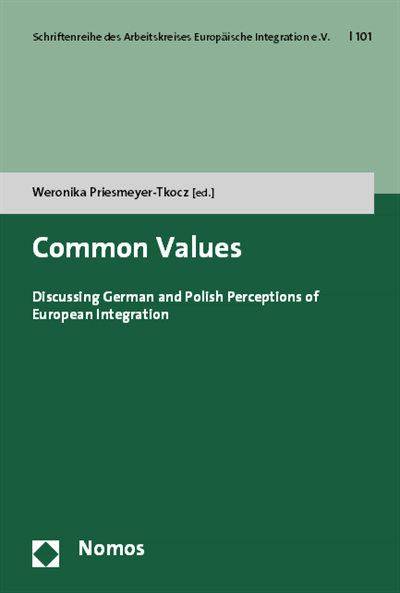
Common Values
Discussing German and Polish Perceptions of European Integration- Editors:
- Series:
- Schriftenreihe des Arbeitskreises Europäische Integration e.V., Volume 101
- Publisher:
- 2017
Summary
Das Verständnis von gemeinsamen Werten spielt vor dem Hintergrund der Diskussion um die Fortentwicklung der europäischen Integration sowie angesichts der Zunahme von rechtspopulistischen Tendenzen in Europa eine große Rolle. Dies betrifft sowohl die wissenschaftliche Debatte und öffentliche Meinung als auch die aktuelle Politik innerhalb der EU. Auch das deutsch-polnische Verhältnis wird auf die Probe gestellt.
Der Sammelband befasst sich mit Gemeinsamkeiten, Gegensätzen, Argumenten und Gegenargumenten im deutschen und polnischen Verständnis der europäischen Integration. Hierbei werden gleichermaßen verschiedene Blickpunkte auf Begriffsdeutungen der Werte und Prinzipien, auf denen die EU basiert wie auch empirische Forschung zu Politikfeldern im binationalen Kontext einer Analyse unterzogen.
(Nachwuchs-)WissenschaftlerInnen und AnalytikerInnen aus Deutschland und Polen wirkten an der Publikation mit. Der Ansatz ist multiperspektivisch, interdisziplinär und lösungsorientiert.
Mit Beiträgen von:
Kai-Olaf Lang, Magdalena Musiał-Karg, Adam Jaskulski, Adrian Chojan, Mikołaj J. Tomaszyk, Maciej Cieślukowski, Adam Kirpsza, Ida Musiałkowska, Mariusz Ruszel, Jan Muszyński, Kamila Schöll-Mazurek, Marta Kozłowska, Erik Malchow, Oliver Tettenborn, Ireneusz Paweł Karolewski, Thomas Mehlhausen, Bartosz Rydliński und Weronika Priesmeyer-Tkocz.
Search publication
Bibliographic data
- Edition
- 1/2017
- Copyright Year
- 2017
- ISBN-Print
- 978-3-8487-4208-0
- ISBN-Online
- 978-3-8452-8477-4
- Publisher
- Nomos, Baden-Baden
- Series
- Schriftenreihe des Arbeitskreises Europäische Integration e.V.
- Volume
- 101
- Language
- English
- Pages
- 336
- Product Type
- Edited Book
Table of contents
- Titelei/Inhaltsverzeichnis No access Pages 1 - 6
- Discussing different perceptions of European integration and common values – introduction No access Pages 7 - 12Authors:
- Authors:
- Introduction No accessAuthors:
- Authors:
- 1.1. Changes of democracy as a result of ‘ambitious transformation’ No accessAuthors:
- 1.2. The erosion of democracy No accessAuthors:
- Authors:
- 2 1 Formal instruments No accessAuthors:
- 2.2. Informal instruments No accessAuthors:
- Authors:
- 3.1. Counter-strategies of countries in question No accessAuthors:
- 3.2. Some thoughts about effectiveness No accessAuthors:
- Authors:
- 1. Introduction No accessAuthors:
- 2. The Brexit referendum No accessAuthors:
- 3. Referendum in Hungary No accessAuthors:
- 4. Concluding remarks No accessAuthors:
- Authors:
- 1. Introduction No accessAuthors:
- 2. A new political situation in Poland. How did we get here? No accessAuthors:
- 3. Is Poland still a liberal democracy? No accessAuthors:
- 4. Common European values versus national interests No accessAuthors:
- 5. Conclusion No accessAuthors:
- Authors: |
- 1. Introduction No accessAuthors: |
- 2. Ideological assumptions of Law and Justice’s European policy No accessAuthors: |
- 3. Foreign policy pursued by Beata Szydło’s government No accessAuthors: |
- 4. Summary No accessAuthors: |
- Authors:
- Authors:
- I. “A treasure chest of information” No accessAuthors:
- II. Standards No accessAuthors:
- Authors:
- I. The constitutional scope of telecommunication privacy No accessAuthors:
- II. Guarantees within the scope of the ECHR – an overview No accessAuthors:
- III. The case law in Poland and Germany No accessAuthors:
- Authors:
- Authors:
- 1. Repression vs. prevention No accessAuthors:
- 2. The duty to inform in German police law and in criminal trial No accessAuthors:
- Authors:
- 1. The origin of the operational and detection functions of the police No accessAuthors:
- 2. The duty to inform in the Polish police law and the codes of criminal procedure No accessAuthors:
- Authors:
- I. The Börgerl case No accessAuthors:
- II. The case of Wróblewski and others No accessAuthors:
- III. Interim conclusion No accessAuthors:
- Authors:
- I. The escape from freedom No accessAuthors:
- II. Socialist ideals No accessAuthors:
- III. Consequences (and more) No accessAuthors:
- IV. Using the duties to inform as litmus paper in the area of tension between security and freedom No accessAuthors:
- Authors:
- 1. Introduction No accessAuthors:
- 2. Definition of energy security No accessAuthors:
- 3. Energy security – Germany and Poland in comparison No accessAuthors:
- 4. The understanding of energy security in Germany and Poland No accessAuthors:
- 5. Is there room for trust in energy policy relations between Poland and Germany? No accessAuthors:
- 6. Summary No accessAuthors:
- Authors:
- 1. Introduction No accessAuthors:
- 2. The rule of financial solidarity No accessAuthors:
- 3. “I want my money back” No accessAuthors:
- 4. Germany’s financial assistance for Poland No accessAuthors:
- 5. Is Germany a real net contributor? No accessAuthors:
- 6. Summary No accessAuthors:
- Authors:
- Introduction No accessAuthors:
- 1. Polish and German delegations in the EP: a comparison No accessAuthors:
- 2. What affects voting cohesion between Polish and German MEPs? – Hypotheses No accessAuthors:
- 3. Research design No accessAuthors:
- 4. Polish-German voting cohesion in the EP: descriptive statistics No accessAuthors:
- 5. Polish-German voting cohesion in the EP: statistical analysis No accessAuthors:
- 6. Conclusions No accessAuthors:
- Authors:
- 1. Introduction No accessAuthors:
- 2. Transposition of the EU law in Poland in numbers No accessAuthors:
- 3. The enforcement performance of Poland No accessAuthors:
- 4. Incorrect transposition of directives and infringements proceedings against Poland No accessAuthors:
- 5. Tools facilitating the implementation of the EU law in Poland No accessAuthors:
- 6. Current developments and conclusions No accessAuthors:
- Authors:
- 1. Introduction No accessAuthors:
- 2. Rights of Polish economic migrants in the light of the EU directives No accessAuthors:
- 3. Facts No accessAuthors:
- Obstacles to the full realization of free movement of workers No accessAuthors:
- 4. New forms of employment and unfavourable mechanisms on the German labour market No accessAuthors:
- 5. Free movement of labour at the European level – solutions and work in progress No accessAuthors:
- 6. Solutions supporting the functionality of the free movement of workers within the EU in the framework of Polish-German relations No accessAuthors:
- 7. Reflections No accessAuthors:
- 8. Conclusions and recommendations No accessAuthors:
- Authors:
- 1. Ambiguity of political terms and the public discourse No accessAuthors:
- 2. Social world complexity and volatility as a challenge for social actors No accessAuthors:
- 3. Concepts’ proneness to changes in meaning No accessAuthors:
- 4. People’s responsiveness to political redefinitions No accessAuthors:
- 5. Summary No accessAuthors:
- Authors:
- 1. Clustering in the network No accessAuthors:
- 2. Habitus of a community No accessAuthors:
- 3. Statistics on German-Polish internet usage No accessAuthors:
- 4. German-Polish stereotypes on the internet No accessAuthors:
- 5. Sports, electronic music and homosexuality No accessAuthors:
- 6. The ‘Polish leaving’ No accessAuthors:
- 7. Migration of stereotypes No accessAuthors:
- 8. Consolidation through humour: Marek Fis versus Steffen Möller No accessAuthors:
- 9. Social function of social media No accessAuthors:
- 10. Democratization of the internet No accessAuthors:
- 11. Key benefits of stereotypes No accessAuthors:
- Authors:
- 1. Introduction and Outline: Western values, Eastern misvalues or: Getes, Polish and other suspicious citizens of ‘our’ outskirts No accessAuthors:
- 2. Can the Subaltern speak? Or: is there anybody out there? No accessAuthors:
- 3. DE as software of a universalistic (and somewhat solipsistic) culture No accessAuthors:
- 4. Communication as relationship or: othering of the East No accessAuthors:
- 5. Towards a communicative practice of talking and listening to each other No accessAuthors:
- Authors: |
- 1. Einleitung No accessAuthors: |
- Authors: |
- Bürgerplattform (PO) No accessAuthors: |
- Polnische Bauernpartei (PSL) No accessAuthors: |
- Recht und Gerechtigkeit (PiS) und Solidarisches Polen (SP) No accessAuthors: |
- Bündnis der Demokratischen Linken (SLD) No accessAuthors: |
- Deine Bewegung (TR) No accessAuthors: |
- Authors: |
- Christlich-Demokratische Union (CDU) / Christlich-Soziale Union (CSU) No accessAuthors: |
- Sozialdemokratische Partei Deutschlands (SPD) No accessAuthors: |
- Bündnis 90/Die Grünen No accessAuthors: |
- Die Linke No accessAuthors: |
- 4. Auswertung der Debatten No accessAuthors: |
- 5. Fazit No accessAuthors: |
- Authors: |
- 1. Between Giedroyc and Bahr – On the Polish and German myths of foreign policy No accessAuthors: |
- 2. What’s next for the Eastern Partnership? No accessAuthors: |
- 3. Ukraine as primus inter pares of the Eastern Partnership? No accessAuthors: |
- 4. How should the policy towards Putin’s Russia be? No accessAuthors: |
- 5. Potential allies to the Polish-German cooperation No accessAuthors: |
- 6. Why should we believe in Polish-German cooperation? No accessAuthors: |
- Contributors (in alphabetical order) No access Pages 331 - 336