, to see if you have full access to this publication.
Monograph No access
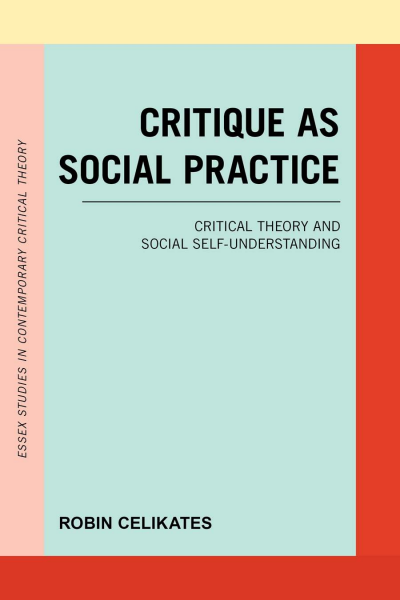
Critique as Social Practice
Critical Theory and Social Self-Understanding
Authors:
Publisher:
2018
Summary
Can critical theory diagnose ideological delusion and false consciousness from above, or does it have to follow the practices of critique ordinary agents engage in? This book argues that we have to move beyond this dichotomy, which has led to a theoretical impasse. Whilst ordinary agents engage in complex forms of everyday critique, it must remain the task of critical theory to provide analysis and critique of social conditions that obstruct the development of reflexive capacities and of their realization in corresponding practices of critique. Only an approach that is at the same time non-paternalistic, pragmatist, and dialogical as well as critical will be able to realize the emancipatory potential of the Frankfurt School tradition of critical theory in radically changing social circumstances.
The translation of this work was funded by Geisteswissenschaften International – Translation Funding for Humanities and Social Sciences from Germany, a joint initiative of the Fritz Thyssen Foundation, the German Federal Foreign Office, the collecting society VG WORT and the Börsenverein des Deutschen Buchhandels (German Publisher & Booksellers Association)
Keywords
Search publication
Bibliographic data
Edition
1/2018
Copyright Year
2018
ISBN-Print
978-1-78660-462-0
ISBN-Online
978-1-78660-464-4
Publisher
Rowman & Littlefield, Lanham
Language
English
Pages
223
Product Type
Monograph
Table of contents
ChapterPages
Contents No access
Preface No access
Acknowledgements No access
1. Judgemental Dopes, Reflexive Agents and Social Scientists No access
2. Critical Theory and the Pragmatic Turn No access
3. The Philosophy of Social Science – Philosophy and Social Science No access
4. Three Models of Critique No access
1.1 Science versus Common Sense No access
1.2 The Epistemological Break No access
2.1 The Gift Exchange and Its Consequences No access
2.2 The Economy of Practices No access
3.1 Structure + Habitus = Practice? No access
3.2 Social Science as Critique No access
4.1 The Normative Objection No access
4.2 The Political-Strategical Objection No access
4.3.1 Excursus: Participant Observation and Representation in Ethnology No access
4.4 The Empirical Objection No access
5. Summary and Preview No access
1. What Is Ethnomethodology? No access
2.1 Forms of Reflexivity No access
2.2 Pros and Laypeople No access
2.3 The Tension between Everyday Practice and Reflection No access
2.4 So What? No access
3.1 From Critical Sociology to a Sociology of Critique No access
3.2 Elements of a Sociology of Critique and Justification No access
3.3 Two Forms of Critique No access
4. Summary and Preview No access
1. Internal or External Critique? No access
2. Second-Order ‘Pathologies’ as Structural Reflexivity Deficits No access
3.1 On the Psychogenesis and Sociogenesis of Reflexive Capacities No access
3.2.1 Double-Consciousness: W. E. B. Du Bois on Life ‘behind the Veil’ No access
3.2.2 Invisibility: Ralph Waldo Ellison on the Struggle against Not Being Recognised No access
3.2.3 The Psychopathology of Labour: Christophe Dejours on the Banalisation of Social Suffering No access
3.3 Critical Theory as Meta-Critique No access
4.1 Critical Theory as Reconstructive Critique No access
4.2 Three Conceptions of Reconstruction No access
5.1 Habermas: Knowledge and Human Interests Revisited No access
5.2.1 Aims No access
5.2.2 Procedure and Method No access
5.2.3 Is the Analogy between Psychoanalysis and Critical Theory Misleading? No access
6.1 Reflective Unacceptability and Cognitive Dissonance No access
6.2 Between Symmetry and Asymmetry No access
6.3 Critical Theory and the Tension between the Logics of Competence and Obstruction No access
6.4 Critical Theory as Social Practice No access
7. ‘System Justification’ and Reconstructive Critique No access