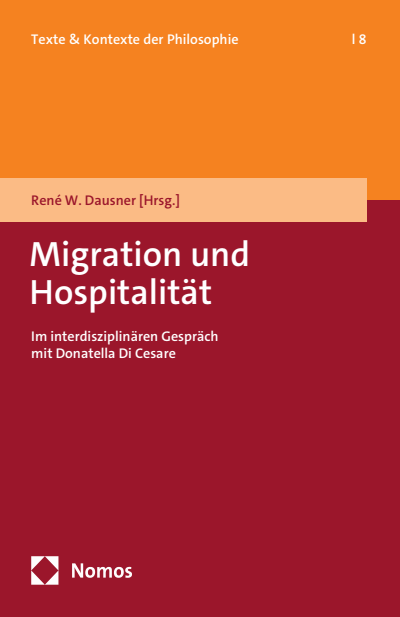
Migration und Hospitalität
Im interdisziplinären Gespräch mit Donatella Di Cesare- Editors:
- Series:
- Texte & Kontexte der Philosophie, Volume 8
- Publisher:
- 2025
Summary
In 2015, Europe became aware of the importance of migration. With her book "Philosophy of Migration" (2017), the famous philosopher Donatella Di Cesare presented the first philosophical examination of this central topic. The primary aim of this publication is to take up the innovative approach of the Italian philosopher Donatella Di Cesare and to bring it to bear in interdisciplinary contributions. In accordance with the book series, Donatella Di Cesare herself has her say, reformulating her idea and reacting retrospectively to the individual contributions at the end of the volume. "Migration and Hospitality” is a thought-provoking book about the humanity of mankind.With contributions byIsabella Bruckner | Donatella Di Cesare | René W. Dausner | Margit Eckholt | Naika Foroutan | Stefan Gassmann | Annabel Herzog | Andreas Hetzel | Judith Kohlenberger | Carsten Lotz | Amanda Malerba | Jürgen Manemann | Regina Polak | Johann Szews
Keywords
Search publication
Bibliographic data
- Edition
- 1/2025
- Copyright Year
- 2025
- ISBN-Print
- 978-3-7560-0732-5
- ISBN-Online
- 978-3-7489-1826-4
- Publisher
- Nomos, Baden-Baden
- Series
- Texte & Kontexte der Philosophie
- Volume
- 8
- Language
- German
- Pages
- 224
- Product Type
- Edited Book
Table of contents
- Titelei/Inhaltsverzeichnis No access Pages 1 - 6
- Authors:
- Politische Herausforderungen des 21. Jahrhunderts: Im Gespräch mit Donatella Di Cesare No access
- Wer sind die Migranten? Versuch einer Phänomenologie No accessAuthors:
- Authors: |
- I. Denialismus und Souveränismus No access
- II. Ethik der Alterität und postsouveränistische Politik No access
- III. Von der Migration her denken No access
- IV. Politiken des Miteinander Wohnens No access
- Authors:
- I. Philosophie heißt, Grenzen überschreiten No access
- II. Mit den Migrant*innen beginnen No access
- III. Politische Ohnmacht No access
- IV. Grenze als Berührungsfläche No access
- V. Wider die Strategien der Immunisierung No access
- VI. Anarchische Revolte No access
- VII. Habituelle Dimensionen ethischen Handelns No access
- Authors:
- I. Die generellen Argumente No access
- II. Zwei jüdische Modelle des Zuhauseseins No access
- III. Zu Hause sein: Zwischen Moral und Politik No access
- Authors:
- I. No access
- II. No access
- III. No access
- Authors:
- I. Letzte Version des zeitgenössischen Elends No access
- II. Unrechtmäßige Nacktheit No access
- III. Das Gespenst des Gastes No access
- IV. Sakralität und episches Anderswo No access
- V. Der entkleidete Fremde No access
- Authors:
- I. Donatella Di Cesares Kritik an Lévinas’ „Politik der Alterität“ No access
- II. Phänomenologie des Wohnens angesichts von Atopizität und Anarchie des Denkens bei Di Cesare No access
- III. Emmanuel Lévinas und die „Politik der Alterität“ No access
- IV. Endlichkeit der Gastfreundschaft als Aufbau einer gemeinsamen Welt No access
- Authors:
- I. Ausgangslage – Die postmigrantische Gesellschaft No access
- II. Postmigrantische Fremde No access
- III. Pluralität als Trennungsmarker No access
- IV. Ambivalenz der Hospitalität No access
- V. Politische Ambivalenz – Hospitalität als Gleichbehandlungsgrundsatz No access
- VI. Herstellung von Ordnung durch Klassifizierung No access
- VII. Fazit No access
- Wem gehört das Land? Der „ansässige Fremde“ im Spannungsverhältnis zwischen Universalität und Souveränismus No access Pages 149 - 160Authors:
- Authors:
- I. „Als Europa unterging […]“ – Denken in einer Welt in Bewegung No access
- II.1 Wohnen No access
- II.2 Gastfreundschaft No access
- III. Europa als Horizont – Zusammenwohnen in Frieden No access
- Authors:
- I. Die Semantik des Fremden No access
- II. Biblische Erzählungen des (Gottes-)Gastes No access
- III. Philosophisch-theologische Überlegungen No access
- IV. Klösterliche Gastlichkeit in benediktinischer Manier No access
- V. Conclusio No access
- Authors:
- I. Empirische Befunde zum „immunitären Gemeinsinn“ der europäischen Bevölkerung No access
- II. Die Brisanz einer „Politik der Gastfreundschaft“ für Christen in Europa No access
- III.1 Verlust der universalen Perspektive No access
- III.2 Die ambivalente Rolle des Christentums No access
- III.3 Bibeltheologische Amnesie No access
- IV. Umkehr: Aber wie? No access
- Eine Erwiderung No accessAuthors:
- Autor:innenverzeichnis No access Pages 223 - 224