, to see if you have full access to this publication.
Monograph No access
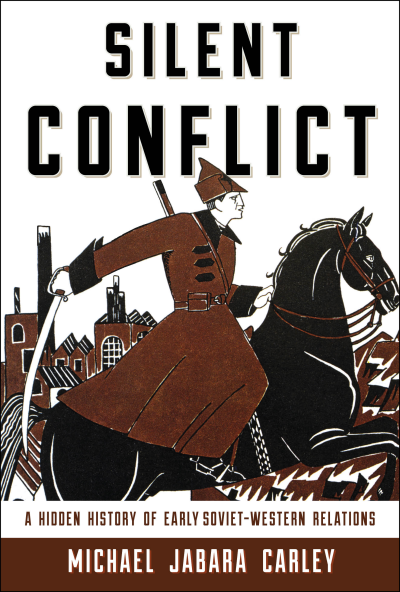
Silent Conflict
A Hidden History of Early Soviet-Western Relations
Authors:
Publisher:
2014
Summary
This deeply informed book traces the dramatic history of early Soviet-western relations after World War I. Michael Jabara Carley provides a lively exploration of the formative years of Soviet foreign policy making after the Bolshevik Revolution, especially focusing on Soviet relations with the West during the 1920s. Carley demonstrates beyond doubt that this seminal period—termed the “silent conflict” by one Soviet diplomat—launched the Cold War. He shows that Soviet-western relations, at best grudging and mistrustful, were almost always hostile. Concentrating on the major western powers—Germany, France, Great Britain, and the United States—the author also examines the ongoing political upheaval in China that began with the May Fourth Movement in 1919 as a critical influence on western-Soviet relations.
Carley draws on twenty-five years of research in recently declassified Soviet and western archives to present an authoritative history of the foreign policy of the Soviet state. From the earliest days of the Bolshevik Revolution, deeply anti-communist western powers attempted to overthrow the newly formed Soviet government. As the weaker party, Soviet Russia waged war when it had to, but it preferred negotiations and agreements with the West rather than armed confrontation. Equally embattled by internal struggles for power after the death of V. I. Lenin, the Soviet government was torn between its revolutionary ideals and the pragmatic need to come to terms with its capitalist adversaries. The West too had its ideologues and pragmatists. This illuminating window into the overt and covert struggle and ultimate standoff between the USSR and the West during the 1920s will be invaluable for all readers interested in the formative years of the Cold War.
Keywords
Search publication
Bibliographic data
Copyright Year
2014
ISBN-Print
978-0-8108-9619-2
ISBN-Online
978-1-4422-2586-2
Publisher
Rowman & Littlefield, Lanham
Language
English
Pages
446
Product Type
Monograph
Table of contents
ChapterPages
Contents No access
Figures No access
Preface No access
Acknowledgments No access
Biographical Notes No access
Abbreviations and Acronyms No access
CHAPTER ONE. How It Began: Revolution, Intervention, Civil War, 1917–1921 No access Pages 1 - 28
CHAPTER TWO. “We Must Trade and They Must Trade”: First Attempts at Peaceful Coexistence, 1921–1922 No access Pages 29 - 70
CHAPTER THREE. Which Way Soviet Policy? Confusion and Incoherence, 1922–1923 No access Pages 71 - 102
CHAPTER FOUR. “Hedged in by Reservations”: Peaceful Coexistence in London and Paris, 1923–1924 No access Pages 103 - 140
CHAPTER FIVE. “Save the Family Silver”: Fearful Coexistence in Paris and Berlin, 1924–1925 No access Pages 141 - 180
CHAPTER SIX. “Steady! Don’t Let Us Get Jumpy”: Revolution in China, 1924–1925 No access Pages 181 - 204
CHAPTER SEVEN. Principles and Reprisals: Hostile Coexistence in London and Washington, 1925–1926 No access Pages 205 - 238
CHAPTER EIGHT. “The Blind and the Lame”: Rapallo Reaffirmed, 1925–1927 No access Pages 239 - 260
CHAPTER NINE. Red Scare, War Scare: China and the Rupture of Anglo-Soviet Relations, 1925–1927 No access Pages 261 - 300
CHAPTER TEN. “Colossal Misfortune”: Hostile Coexistence in Paris, 1925–1927 No access Pages 301 - 348
CHAPTER ELEVEN. “These Are Times of Quick Suspicions”: Sullen Coexistence, 1927–1930 No access Pages 349 - 386
CHAPTER TWELVE. “Always a Trump in Our Game”: Rapallo Sustained, 1927–1930 No access Pages 387 - 408
CHAPTER THIRTEEN. Conclusion: Sorting It Out No access Pages 409 - 424