, to see if you have full access to this publication.
Edited Book No access
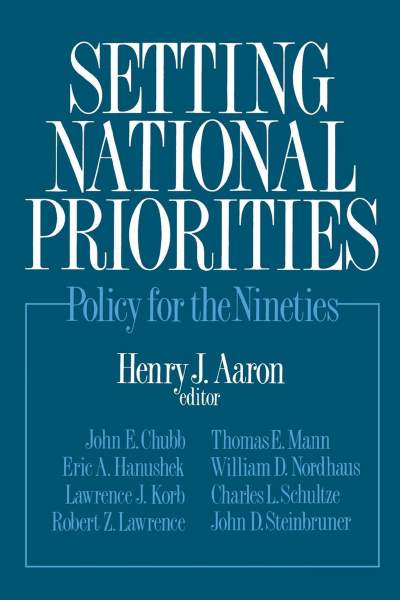
Setting National Priorities
Policy for the Nineties
Editors:
Publisher:
2010
Summary
Setting National Priorities continues the highly acclaimed and influential series of books that examine domestic and foreign policy choices confronting the United States. Members of the Brookings staff join outside experts to evaluate America's course through the next decade.
In clear and nontechnical terms the contributors explain and evaluate options for the United States in the 1990s, consider whether the federal government's current pollicies are consistent with long-term objectives, and explain what action could best achieve those goals.
Charles L. Schultze shows why it is important to solve the problem of the federal budget deficit and how it can be done: John D. Steinbruner addresses the revolution taking place in American foreign policy and explains how the United States can be more secure with lower defense spending; Lawrence J. Korb evaluates President Bush's defense budget and suggests possible improvements; Robert Z. Lawrence describes how the U.S. government and private industry should respond to the competitive challenge from foreign companies; William D. Nordhaus explains the risks form global warming and presents a policy to meet them; John E. Chubb and Eric A. Hanshek chart new directions of American elementary and secondary education; Henry J. Aaron identifies the major problems with the financing of healthcare and describes how they can be solved; and Thomas E. Mann considers how political institutions and public preferences constrain our ability to enact needed policy changes and what might be done to overcome those obstacles.
Search publication
Bibliographic data
Edition
1/2010
Copyright Year
2010
ISBN-Print
978-0-8157-0047-0
ISBN-Online
978-0-8157-1944-1
Publisher
Rowman & Littlefield, Lanham
Language
English
Pages
317
Product Type
Edited Book
Table of contents
ChapterPages
Contents No access
The Budget No access
Foreign and Defense Policy No access
The Defense Budget No access
Technology and Trade No access
Global Warming No access
Education No access
Health Care No access
Politics No access
How Large Are Budget Deficits Likely to Be? No access
Why Worry about the Budget Deficit? No access
Where Does Federal Spending Go? No access
How Can the Deficit Be Turned into a Surplus? No access
Appendix A: Do the Official Accounts Overstate the Size of the Federal Budget Deficit? No access
Appendix B: The Productivity Payoff from Public Infrastructure Investment No access
Cooperative Security No access
Economic Engagement No access
International Equity No access
The State of Adjustment No access
The Defense Debate No access
The 1991-95 Program No access
Conclusion No access
Postwar Trade and Innovation Policies No access
Innovation in One Country No access
The Foreign Challenge No access
Policy Options No access
Preferable Options No access
Conclusions No access
Scientific Theory and Evidence of Global Warming No access
Social and Economic Effects of Climatic Change No access
Possible Responses to the Threat No access
Policies to Slow Global Warming No access
A More Serious Problem Than People Think No access
Why "More" Has Not Meant "Better" No access
The Problem of Bureaucracy No access
The Need for Output Policies No access
Administrative Reforms No access
Market-Oriented Reforms No access
Alternative Market Mechanisms No access
The Role of Federal Policy No access
Conclusion No access
Health Care Expenditures No access
Health Insurance No access
The Role of Governments in Health Care No access
Strategies for Reform No access
A 1990s Agenda for Health Care Financing No access
Bush's First Year No access
Sources of Immobilism No access
Prospects for Change No access
Coping with Contemporary Political Arrangements No access