, to see if you have full access to this publication.
Monograph No access
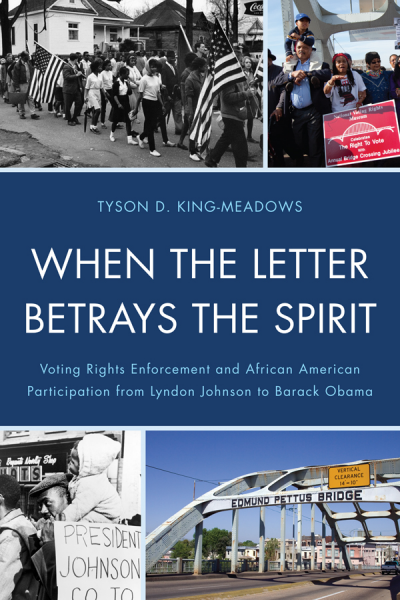
When the Letter Betrays the Spirit
Voting Rights Enforcement and African American Participation from Lyndon Johnson to Barack Obama
Authors:
Publisher:
2011
Summary
When the Letter Betrays the Spirit examines the wide latitude provided to the executive branch and to the Supreme Court by the text of the Voting Rights Act of 1965. Drawing from government enforcement data, legislative history, Supreme Court rulings, the 2006 reauthorization debate on the VRA, and from the 2007 scandal involving the firing of U.S. attorneys under the Bush Administration, the book examines when, why, and how executive and judicial discretion facilitates violation of voting rights. Connecting Johnson to Obama, the book outlines why the executive-centered model of voting rights enforcement relegates Congress to the sidelines, and outlines why a Congress-centered approach provides the best protection against the effects of the law enforcement axiom: the law is neither self-executing nor self-interpreting. The book also examines 2008 survey results about public support for a Jim Crow-era election reform policy that would require voters to read a passage of the Constitution. Describing the civic literacy dimensions of voting rights law from Shaw v. Reno (1993) to Northwest Austin Utility v. Holder (2009), the book highlights the complicated nature of the post-racial rhetoric surrounding the 2008 election cycle and surrounding the upcoming post-2010 census redistricting cycles.
Search publication
Bibliographic data
Edition
1/2011
Copyright Year
2011
ISBN-Print
978-0-7391-4912-6
ISBN-Online
978-0-7391-4914-0
Publisher
Lexington, Lanham
Language
English
Pages
346
Product Type
Monograph
Table of contents
ChapterPages
Contents No access
Tables, Figures, and Maps No access
Acknowledgments No access
Introduction: Congressional Authority andVoting Rights Enforcement No access
Chapter 1. Why Discretion Matters in Voting Rights Enforcement No access
Chapter 2. Obama’s Inheritance: The Johnson Framework, the VRA, and Faith in Federal Power No access
Chapter 3. Misdirections: Political Theatre and the 2006 Reauthorization of Section 5 No access
Chapter 4. Partisan Spoils of Office: A Post-Shaw Judicial Philosophy of Civic Literacy No access
Chapter 5. Is “Bull Connor” Dead? Contemporary Public Opinion on Voting Rights Policy No access
Chapter 6. A Battle of Principals: Congress, the DOJ, and the George W. Bush Administration No access
Chapter 7. The Macro-Political Context Shaping Enfranchisement No access
Conclusion: Regulating Discretion and the Challenge of Post-Racial Politics No access Pages 289 - 300
Appendix 1. Minority Descriptive Representation and the Voting Rights Act No access Pages 301 - 304
Appendix 2. Measuring Contemporary Public Opinion on Voting Rights Policy No access Pages 305 - 310